University of Illinois Chicago engineers have helped design a new method to make hydrogen gas from water using only solar power and agricultural waste, such as manure or husks. The method reduces the energy needed to extract hydrogen from water by 600 %, creating new opportunities for sustainable, climate-friendly chemical production.
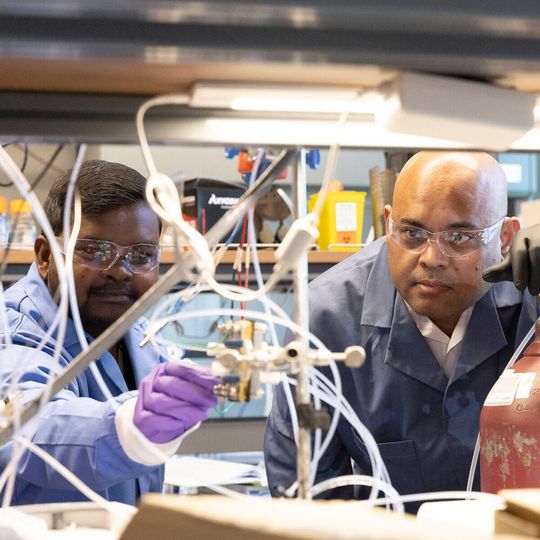
Associate Professor Meenesh Singh, right, and postdoctoral researcher Rohit Chauhan work in Singh’s laboratory at the University of Illinois Chicago.
(Source: Jenny Fontaine/ UIC)
Hydrogen-based fuels are one of the most promising sources of clean energy. But producing pure hydrogen gas is an energy-intensive process that often requires coal or natural gas and large amounts of electricity. In a paper for Cell Reports Physical Science, a multi-institutional team led by UIC engineer Meenesh Singh unveils the new process for green hydrogen production.
The method uses a carbon-rich substance called biochar to decrease the amount of electricity needed to convert water to hydrogen. By using renewable energy sources such as solar power or wind and capturing byproducts for other uses, the process can reduce greenhouse gas emissions to net zero.
“We are the first group to show that you can produce hydrogen utilizing biomass at a fraction of a volt,” said Singh, associate professor in the department of chemical engineering. “This is a transformative technology.”
Electrolysis, the process of splitting water into hydrogen and oxygen, requires an electric current. At an industrial scale, fossil fuels are typically required to generate this electricity.
Recently, scientists have decreased the voltage required for water splitting by introducing a carbon source to the reaction. But this process also uses coal or expensive chemicals and releases carbon dioxide as a byproduct.
Singh and colleagues modified this process to instead use biomass from common waste products. By mixing sulfuric acid with agricultural waste, animal waste or sewage, they create a slurry-like substance called biochar, which is rich in carbon.
The team experimented with different kinds of biochar made from sugarcane husks, hemp waste, paper waste and cow manure. When added to the electrolysis chamber, all five biochar varieties reduced the power needed to convert water to hydrogen. The best performer, cow dung, decreased the electrical requirement sixfold to roughly a fifth of a volt.
The energy requirements were low enough that the researchers could power the reaction with one standard silicon solar cell generating roughly 15 milliamps of current at 0.5 volt. That’s less than the amount of power produced by an AA battery.
“It’s very efficient, with almost 35 % conversion of the biochar and solar energy into hydrogen” said Rohit Chauhan, a co-author and postdoctoral scholar in Singh’s lab. “These are world record numbers; it’s the highest anyone has demonstrated.”
To make the process net-zero, it must capture the carbon dioxide generated by the reaction. But Singh said this too could have environmental and economic benefits, such as producing pure carbon dioxide to carbonate beverages or converting it into ethylene and other chemicals used in plastic manufacturing.
“It not only diversifies the utilization of biowaste but enables the clean production of different chemicals beyond hydrogen,” said UIC graduate Nishithan Kani, co-lead author on the paper. “This cheap way of making hydrogen could allow farmers to become self-sustainable for their energy needs or create new streams of revenue.”
Orochem Technologies Inc., who sponsored the research, has filed for patents on their processes for producing biochar and hydrogen, and the UIC team plans to test the methods on a large scale.
Original Article: Sub-volt conversion of activated biochar and water for H2 production near equilibrium via biochar-assisted water electrolysis; Cell Reports Physical Science; DOI:10.1016/j.xcrp.2024.102013
Date: 08.12.2025
Naturally, we always handle your personal data responsibly. Any personal data we receive from you is processed in accordance with applicable data protection legislation. For detailed information please see our privacy policy.
Consent to the use of data for promotional purposes
I hereby consent to Vogel Communications Group GmbH & Co. KG, Max-Planck-Str. 7-9, 97082 Würzburg including any affiliated companies according to §§ 15 et seq. AktG (hereafter: Vogel Communications Group) using my e-mail address to send editorial newsletters. A list of all affiliated companies can be found here
Newsletter content may include all products and services of any companies mentioned above, including for example specialist journals and books, events and fairs as well as event-related products and services, print and digital media offers and services such as additional (editorial) newsletters, raffles, lead campaigns, market research both online and offline, specialist webportals and e-learning offers. In case my personal telephone number has also been collected, it may be used for offers of aforementioned products, for services of the companies mentioned above, and market research purposes.
Additionally, my consent also includes the processing of my email address and telephone number for data matching for marketing purposes with select advertising partners such as LinkedIn, Google, and Meta. For this, Vogel Communications Group may transmit said data in hashed form to the advertising partners who then use said data to determine whether I am also a member of the mentioned advertising partner portals. Vogel Communications Group uses this feature for the purposes of re-targeting (up-selling, cross-selling, and customer loyalty), generating so-called look-alike audiences for acquisition of new customers, and as basis for exclusion for on-going advertising campaigns. Further information can be found in section “data matching for marketing purposes”.
In case I access protected data on Internet portals of Vogel Communications Group including any affiliated companies according to §§ 15 et seq. AktG, I need to provide further data in order to register for the access to such content. In return for this free access to editorial content, my data may be used in accordance with this consent for the purposes stated here. This does not apply to data matching for marketing purposes.
Right of revocation
I understand that I can revoke my consent at will. My revocation does not change the lawfulness of data processing that was conducted based on my consent leading up to my revocation. One option to declare my revocation is to use the contact form found at https://contact.vogel.de. In case I no longer wish to receive certain newsletters, I have subscribed to, I can also click on the unsubscribe link included at the end of a newsletter. Further information regarding my right of revocation and the implementation of it as well as the consequences of my revocation can be found in the data protection declaration, section editorial newsletter.




:quality(80)/p7i.vogel.de/wcms/55/f2/55f26cfb29878f58625b4697bacff0b9/0132894544v2.jpeg "The programme is designed to build an integrated R&D platform for sustainable specialty polymers. (Source: NUS)")
:quality(80)/p7i.vogel.de/wcms/2d/9e/2d9ea6bd89a718c2eb6a99172c3b92ad/0132813039v2.jpeg "A new nontargeted chemical analysis of 113 personal care and cleaning products in the US found that nearly all contained unlabeled chemicals. (Source: free licensed)")
:quality(80)/p7i.vogel.de/wcms/1e/cb/1ecbe8d7e82ac7dcfefef112d32415a3/0132811057v1.jpeg "A study of 426 university students highlights the combined importance of laboratory safety practices and healthy dietary habits. (Source: free licensed)")
:quality(80)/p7i.vogel.de/wcms/17/c0/17c0660deff66cc5f9b09a0e3b3286b5/0132714162v1.jpeg "Due to its unique properties, green hydrogen may be a promising tool to achieve a low-carbon economy. (Source: free licensed)")
:quality(80)/p7i.vogel.de/wcms/13/d3/13d35105f74a1c2e22b9c7a270e8e9b3/0132611155v2.jpeg "Circulating cell free DNA. (Source: Amsbio)")
:quality(80)/p7i.vogel.de/wcms/bc/ed/bced6850297a04dbea471a66cb6bb6fe/0132611405v2.jpeg "The latest addition to the range is a peristaltic tubing stop adapter that eliminates the need for fixed stoppers and allows custom cut lengths of peristaltic tubing to be installed on any pump head size. (Source: Biotech Fluidics )")
:quality(80)/p7i.vogel.de/wcms/c2/34/c234a6626d4f6360382ca7f1f440bebb/0132611196v2.jpeg "Testa Analytical's Trinity – a powerful new triple detector for Gel Permeation Chromatography / Size Exclusion Chromatography. (Source: Testa Analytical)")
:quality(80)/p7i.vogel.de/wcms/5b/3f/5b3fc0d5fb08c1f9727125bd926b1481/0132555049v1.jpeg "On 1 and 2 December 2026, the T3 – Transform The Tomorrow conference will explore strategies that help companies future-proof their operations. (Bild: © Vogel Corporate Solutions / AdobeStock 1280236166, Oksana)")
:quality(80)/p7i.vogel.de/wcms/7b/e5/7be5c735140cbe28f3af0ec3d88274b9/0133045403v2.jpeg "After being buried in the ground for two months and broken down by soil organisms, a new pair of cotton underwear (left) shows clear signs of decomposition (right). (Source: Nicolas Zonvi)")
:quality(80)/p7i.vogel.de/wcms/c7/5e/c75e9b334a94b8b5c2a758f20ba080a8/0133039712v1.jpeg "Researchers have developed a microaerobic activated sludge process that enables ammonium to be recovered from fermentation industry wastewater instead of releasing nitrogen into the atmosphere. (Source: free licensed)")
:quality(80)/p7i.vogel.de/wcms/9a/a0/9aa0a7f2d93c4f3a9c6297fb39a5c756/0133018161v2.jpeg "Volcanic activity and hydroclimatic anomalies. Eruptions produce a repeating wave pattern in high-altitude winds (left panels) that line up with widespread drying across Asia (right panels). This pattern appears regardless of background climate conditions. (Source: ©2026 Nie et al. CC-BY-ND)")
:quality(80)/p7i.vogel.de/wcms/d5/a3/d5a33f32cd6adf709c8afefc998d3f04/0132845576v1.jpeg "The study shows that the foreign media are less likely to report on certain effects of climate change, such as droughts and flooding (shown here: the 2021 Ahrtal floods). (Source: Volker Lannert/ Uni Bonn)")
:quality(80)/p7i.vogel.de/wcms/79/76/7976d17b980bedfe35acaa532d690046/0132713841v2.jpeg "Observed rice yield losses from 1°C warming are more than twice as high as model estimates due to underestimated heat stress. (Source: AdobeStock/ducvien)")
:quality(80)/p7i.vogel.de/wcms/28/b6/28b6114fc9915c5dadee94d5c89bd129/0132593216v2.jpeg "Eating foods that contain common preservative food additives may increase the risks of high blood pressure and cardiovascular disease. (Source: Unsplash)")
:quality(80)/p7i.vogel.de/wcms/01/bc/01bcb16a3381a1d46533861eedbbae71/0132371290v1.jpeg "Adding spice may help people eat less by slowing them down. (Source: free licensed)")
:quality(80)/p7i.vogel.de/wcms/b3/16/b316ac585e067d024da89a5156c950a9/0132370983v1.jpeg "Laboratory tests suggest that some low-calorie sweeteners can alter the growth of gut bacteria, with particularly strong effects observed when isosteviol was combined with the antidepressant duloxetine. (Source: free licensed)")
:quality(80)/p7i.vogel.de/wcms/35/a6/35a63dfc2bbb54e81ef1ecc93e81695d/0133045368v2.jpeg "An updated Cochrane review finds that regulated nicotine e-cigarettes help more people quit smoking than nicotine replacement therapies such as patches and gum, although vaping is not risk-free. (Source: free licensed)")
:quality(80)/p7i.vogel.de/wcms/4c/36/4c363d55d98074ca0d82e2100f65e101/0133042959v2.jpeg "A robotic hand fitted with 3D-printed sensor module developed by the research team from Washington State University. The electronic skin can detect pressure and temperature at a fine level, laying the groundwork for bionic skin that could be used on prosthetics to help amputees and others. (Source: Sravanthi Yalamanchili/ WSU)")
:quality(80)/p7i.vogel.de/wcms/d0/31/d0319db16bd12d6421f84f0e37e3b9fb/0133018100v2.jpeg "A baby wearing the Nappa sleep-tracking pants used in the study. (Source: Babacenter)")
:quality(80)/p7i.vogel.de/wcms/8e/95/8e9539127c0938a064ac8c9ad29cc455/0133014930v3.jpeg "Study first author Dr. Reesha Patel doing research in her lab at Northwestern University Feinberg School of Medicine in Chicago. (Source: Ben Schamisso / Northwestern University)")
:quality(80)/images.vogel.de/vogelonline/bdb/1710600/1710675/original.jpg "Discover how to set yourself up for success when performing balance-based density determination of solids such as jewelry and precious metals. (Mettler Toledo)")
:quality(80)/images.vogel.de/vogelonline/bdb/1682500/1682579/original.jpg "The new XPR Analytical balance redesigned to meet the needs of laboratory technicians of working fast and lean. (Mettler Toledo)")
:quality(80)/images.vogel.de/vogelonline/bdb/1677000/1677080/original.jpg "Enhance your weighing accuracy, comfort and productivity with the redesigned XPR Analytical balance. (Mettler Toledo)")
:fill(fff,0)/images.vogel.de/vogelonline/companyimg/107800/107832/65.jpg "logoDueperthal.jpg ()")
:quality(80)/p7i.vogel.de/wcms/17/c0/17c0660deff66cc5f9b09a0e3b3286b5/0132714162v1.jpeg "Due to its unique properties, green hydrogen may be a promising tool to achieve a low-carbon economy. (Source: free licensed)")
:quality(80)/p7i.vogel.de/wcms/af/4e/af4ea968647ee9cae82b39800c611819/0129865630v2.jpeg "Map of a simulated risk of water stress in 2050 where hydrogen is used in transport and industry. Baseline risk (regardless of hydrogen use) is represented by the background color in each area. Dashed areas show water use exceeding available resources due to hydrogen production. Blue dots show areas where the risk of water stress increases by more than 50 percent in the simulation. (Source: Chalmers University of Technology / Joel Löfving)")