Scientists have graphically illustrated global concentrations of a major air pollutant for the first time using Air Quality Stripes, revealing stark contrasts in air quality improvements across Europe and worsening conditions in parts of Africa and Central Asia. The visualizations highlight global disparities in air pollution.
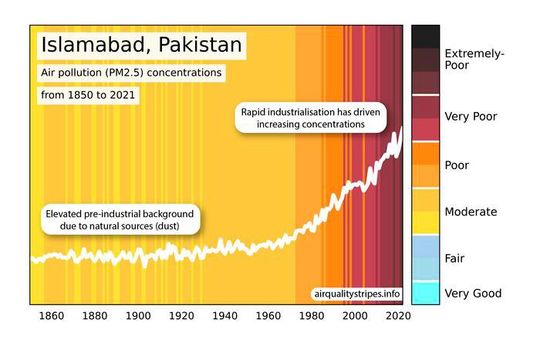
The visualisations reveal a concerning rise in particulate matter pollution in many cities in central Asia and Africa.
(Source: University of Leeds)
The global concentrations of one of the main air pollutants known to affect human health have been graphically illustrated for the first time by a team of scientists. The Air Quality Stripes which were created by the University of Leeds, the University of Edinburgh, North Carolina State University, and the UK Met Office, starkly contrast the significant improvements in air quality across much of Europe with the alarming deterioration in parts of Africa and Central Asia. The project's findings highlight both the successes and ongoing challenges in tackling air pollution worldwide.
Dr Kirsty Pringle from EPCC at the University of Edinburgh and co-director of the project, said: “Air pollution is often called the ‘invisible killer’, but these images make the invisible visible, showing the changes in particulate matter pollution over the decades.”
Dr Jim McQuaid, an Associate Professor of Atmospheric Composition in the Leeds’ School of Earth and Environment who worked on the Air Quality Stripes project with Dr Pringle, said: “The bottom line is that air pollution is one of the world's leading risk factors for death, it is thought to contribute to one in ten deaths globally. Our Air Quality Stripes show the huge range in trends and concentrations around the world. The stripes demonstrate that there is still more work to be done to reduce people’s exposure to poor air quality, and in some places a great deal more!”
Inspired by the world-famous climate warming stripes image, the researchers created their own illustration to plot the changing trends in outdoor concentrations of what is known as particulate matter air pollution, a mix of tiny liquid or solid particles such as dust, dirt, soot, or smoke, which are found throughout the atmosphere.
Dr Steven Turnock, a senior scientist from the UK Met Office who provided the data for the Air Quality Stripes project, said: “Presenting this scientific data as Air Quality stripes really brings into focus the stark contrast in air quality trends and people’s exposure to poor air quality depending on where they live.”
There are stripes for the capital city of every nation worldwide with two additional cities for China, India, and the United States. The research team also included their own cities of Leeds, Edinburgh, and Exeter.
The lightest blue stripes meet the World Health Organisation Air Quality Guidelines which were introduced in 2021, with all other colours exceeding the guideline values.
Data from computer simulations and satellite observations were combined to estimate the changing concentrations of particulate matter since the beginning of the industrial revolution, with the colour palette for the stripes devised by an artist who analysed over 200 online images of “air pollution” to identify the dominant colour palettes.
Key Findings
Europe's Air Quality Gains: The images show substantial reductions in particulate matter levels across most of Europe (predominantly Western Europe). Stricter air quality regulations and technological advancements have successfully reduced particulate matter concentrations in most European cities (e.g. London, Brussels, Berlin).
Worsening Conditions in Central Asia and parts of Africa: The visualisations reveal a concerning rise in particulate matter pollution in many cities in central Asia and Africa (e.g. Islamabad, Delhi, Nairobi). Rapid urbanisation, industrial growth, and limited regulatory frameworks are contributing to this troubling trend, which poses significant health risks to local populations.
Global Disparities: The images highlight the stark disparities in air quality progress between different regions, emphasising the need for targeted international efforts to address the growing air pollution crisis in the most affected areas.
Date: 08.12.2025
Naturally, we always handle your personal data responsibly. Any personal data we receive from you is processed in accordance with applicable data protection legislation. For detailed information please see our privacy policy.
Consent to the use of data for promotional purposes
I hereby consent to Vogel Communications Group GmbH & Co. KG, Max-Planck-Str. 7-9, 97082 Würzburg including any affiliated companies according to §§ 15 et seq. AktG (hereafter: Vogel Communications Group) using my e-mail address to send editorial newsletters. A list of all affiliated companies can be found here
Newsletter content may include all products and services of any companies mentioned above, including for example specialist journals and books, events and fairs as well as event-related products and services, print and digital media offers and services such as additional (editorial) newsletters, raffles, lead campaigns, market research both online and offline, specialist webportals and e-learning offers. In case my personal telephone number has also been collected, it may be used for offers of aforementioned products, for services of the companies mentioned above, and market research purposes.
Additionally, my consent also includes the processing of my email address and telephone number for data matching for marketing purposes with select advertising partners such as LinkedIn, Google, and Meta. For this, Vogel Communications Group may transmit said data in hashed form to the advertising partners who then use said data to determine whether I am also a member of the mentioned advertising partner portals. Vogel Communications Group uses this feature for the purposes of re-targeting (up-selling, cross-selling, and customer loyalty), generating so-called look-alike audiences for acquisition of new customers, and as basis for exclusion for on-going advertising campaigns. Further information can be found in section “data matching for marketing purposes”.
In case I access protected data on Internet portals of Vogel Communications Group including any affiliated companies according to §§ 15 et seq. AktG, I need to provide further data in order to register for the access to such content. In return for this free access to editorial content, my data may be used in accordance with this consent for the purposes stated here. This does not apply to data matching for marketing purposes.
Right of revocation
I understand that I can revoke my consent at will. My revocation does not change the lawfulness of data processing that was conducted based on my consent leading up to my revocation. One option to declare my revocation is to use the contact form found at https://contact.vogel.de. In case I no longer wish to receive certain newsletters, I have subscribed to, I can also click on the unsubscribe link included at the end of a newsletter. Further information regarding my right of revocation and the implementation of it as well as the consequences of my revocation can be found in the data protection declaration, section editorial newsletter.
The influence of natural sources was particularly notable in some locations, these sources include desert dust and wildfires, proximity to the coast was often quite noticeable with locations such as Jakarta having lower levels than might be expected.
A cocktail of pollutants
Particulate matter, or PM2.5, have a diameter less than a 30th of the width of a human hair and can penetrate deep into our lungs easily. The smallest particles cross into the bloodstream and affect our health, and some have even been detected in the blood of unborn children.
They can come from natural sources such as volcanoes and deserts but are also produced by human activities such as industry, cars, agriculture, domestic burning, and fires arising from climate change.
PM2.5 has been linked to a very wide range of health issues ranging from breathing problems like asthma, to reduced lung health, increased likelihood of developing cancer and heart disease, and an increased risk of developing many diseases including diabetes, Alzheimer’s, and Parkinson’s.
The World Health Organisation recommends that the annual average concentration of PM2.5 should not exceed a concentration of 5 micrograms per cubic meter air (5 ug/m³). This new guideline is a concentration which is generally classed as very good air quality. It is important to remember that there is NO safe level of PM2.5 recognised by medical science. At present, 99 % of the world’s population live with concentrations above this value, with the highest PM2.5 levels typically found in low- and middle-income countries.
The AQ stripes use an annual average to take account of the ups and downs due to changes in weather patterns throughout the year, and to make comparison between locations simpler. However the researchers point out that even short-term exposure to very high levels can quickly have acute health effects requiring medical treatment.
Dr McQuaid added: “We created these to try to illustrate the complex data that computer models generate, into something that is much easier to understand. Strangely, one of the major headaches for us was the colour scheme. We finally went for blue to black, representing nice clean blue skies, through to black for extremely high levels of pollution.
Dr Pringle added: “The images show that it is possible to reduce air pollution; the air in many cities in Europe is much cleaner now than it was 100 years ago, and this is improving our health. We really hope similar improvements can be achieved across the globe.”
The Air Quality Stripes follow in the footsteps of the Climate Warming Stripes which were created by Professor Ed Hawkins at the National Centre for Atmospheric Science and University of Reading in 2018 and have since become very widely used as a visual representation of the Earth’s warming climate. Professor Hawkin’s work has since inspired the creation of the Biodiversity Stripes which show biodiversity loss, and Ocean Acidification Stripes.




:quality(80)/p7i.vogel.de/wcms/62/32/62327aaae1415beeed47db6201e79661/0133375912v2.jpeg "A cotton trailer outfitted with benches and a sunshade offers farmworkers a reprieve from the sun as they take a break from picking cantaloupe melons in Firebaugh, Calif.
(Source: Joe Proudman/ Regents of the University of California)")
:quality(80)/p7i.vogel.de/wcms/e6/c8/e6c8bd554776ee1ad2f1f0723fb243a7/0133369387v1.jpeg "Roman road (Source: Queen Mary University of London)")
:quality(80)/p7i.vogel.de/wcms/51/68/51687ac4cc19f2757c138498b877de57/0133167039v2.jpeg "CMFs are foams that consist of hollow spheres – made of materials such as stainless steel, nickel, or other metals and alloys – embedded in a metallic matrix. The resulting material is both lightweight and remarkably strong at absorbing compressive forces. (Source: Jie Sun/ NC State University)")
:quality(80)/p7i.vogel.de/wcms/cd/c0/cdc09efd1e5b3b8f83224e7729d66c10/0133105276v2.jpeg "From the data presented in this report, the authors show how TF3-MALS-RI is uniquely able to separate large polyacrylate molecules and provide precise molecular weight and Rg values. (Source: Postnova Analytics)")
:quality(80)/p7i.vogel.de/wcms/86/01/86014d3d2a28cefc852f65c8d68317e4/0133104231v2.jpeg "Single-handed tube reading using a Handheld 2. (Source: Azenta Life Sciences)")
:quality(80)/p7i.vogel.de/wcms/0b/0f/0b0f8ed042dfc91f32582e10d54c2c7e/0133087444v2.jpeg "Offering advanced automation to increase your throughput, the Intellixcap provides secure sealing – eliminating the need for manual intervention, while preserving vital sample integrity. (Source: Azenta Life Sciences)")
:quality(80)/p7i.vogel.de/wcms/13/d3/13d35105f74a1c2e22b9c7a270e8e9b3/0132611155v2.jpeg "Circulating cell free DNA. (Source: Amsbio)")
:quality(80)/p7i.vogel.de/wcms/bc/ed/bced6850297a04dbea471a66cb6bb6fe/0132611405v2.jpeg "The latest addition to the range is a peristaltic tubing stop adapter that eliminates the need for fixed stoppers and allows custom cut lengths of peristaltic tubing to be installed on any pump head size. (Source: Biotech Fluidics )")
:quality(80)/p7i.vogel.de/wcms/8d/5c/8d5c6c7f897f91d6784825eee20b5584/0133321225v1.jpeg "Empa researcher Christoph Hüglin collects samples of particles that are washed out of the air by rain and snow or settle due to gravity. (Source: Empa)")
:quality(80)/p7i.vogel.de/wcms/a1/af/a1afbc7c8a067bbe94749ec680b4bafd/0133163762v2.jpeg "The study found in murkier water, fish took longer to move towards the food than those in clear water, but individuals in larger groups responded more quickly overall. (Source: Christos Ioannou)")
:quality(80)/p7i.vogel.de/wcms/32/80/3280aa3d44708962943c96fe2d466744/0133088560v2.jpeg "A bumble bee in flight at the University of Bristol Botanic Garden. (Source: Phil Savoie)")
:quality(80)/p7i.vogel.de/wcms/7b/e5/7be5c735140cbe28f3af0ec3d88274b9/0133045403v2.jpeg "After being buried in the ground for two months and broken down by soil organisms, a new pair of cotton underwear (left) shows clear signs of decomposition (right). (Source: Nicolas Zonvi)")
:quality(80)/p7i.vogel.de/wcms/ee/ad/eead38ab1e3c36f262bd889dfc8c5039/0133409909v2.jpeg "Eating a diet rich in wholegrain food is likely to prevent heart disease by reducing body weight, blood pressure and the levels of cholesterol and glucose in the blood. (Source: Unsplash)")
:quality(80)/p7i.vogel.de/wcms/ef/68/ef68375729607984e5bb0c143afdae70/0133375119v2.jpeg "Printed Rice-Lentil 3D structures
(Source: SUTD)")
:quality(80)/p7i.vogel.de/wcms/bf/d0/bfd087349a85956a7aefad57ac1204c7/0133241961v2.jpeg "The Thermo Scientific Suretect Beverage Spoilage Multiplex PCR Assay provides a fast, broad-range molecular solution for detecting key spoilage microorganisms that threaten beverage quality. (Source: © OlegDoroshin - stock.adobe.com)")
:quality(80)/p7i.vogel.de/wcms/d4/61/d461ce0bd5743897993c6475f69e7ad6/0133067478v2.jpeg "In Harris County, 50 % of households with children reported food insecurity, compared with 33 % of households without children. (Source: Rice University)")
:quality(80)/p7i.vogel.de/wcms/f5/d3/f5d3af7b7479d0573bec5c1fb9f1fd7b/0133409927v2.jpeg "The Match study looked at over 500 cancer survivors with varying types and stages of cancer and found that patients experienced less pain, fatigue, and sleep problems after participating in the interventions. (Source: Unsplash)")
:quality(80)/p7i.vogel.de/wcms/22/49/224964dd6850b62cccdbc4bde2d34693/0133372964v1.jpeg "Brain activity recorded during a video game helped researchers predict whether participants would take or avoid a risk half a second before they acted. (Source: free licensed)")
:quality(80)/p7i.vogel.de/wcms/48/a7/48a761934161543f70fef2403b44d714/0133372328v2.jpeg "The link between pollution and coughing persisted in the data, even when pollution levels were below the WHO’s recommended safe daily exposure limit. (Source: free licensed)")
:quality(80)/images.vogel.de/vogelonline/bdb/1710600/1710675/original.jpg "Discover how to set yourself up for success when performing balance-based density determination of solids such as jewelry and precious metals. (Mettler Toledo)")
:quality(80)/images.vogel.de/vogelonline/bdb/1682500/1682579/original.jpg "The new XPR Analytical balance redesigned to meet the needs of laboratory technicians of working fast and lean. (Mettler Toledo)")
:quality(80)/images.vogel.de/vogelonline/bdb/1677000/1677080/original.jpg "Enhance your weighing accuracy, comfort and productivity with the redesigned XPR Analytical balance. (Mettler Toledo)")
:fill(fff,0)/images.vogel.de/vogelonline/companyimg/107800/107832/65.jpg "logoDueperthal.jpg ()")
:fill(fff,0)/p7i.vogel.de/companies/69/b7/69b7f63f311d9/logo-bimos-tif--2-.jpeg "logo-bimos-tif--2- (https://www.bimos.com/de-de/)")
:quality(80)/p7i.vogel.de/wcms/0a/d0/0ad0c9f818212629e3bc9419dc4dfeeb/0118910638v2.jpeg "Prince Street air quality monitoring site, Port Talbot, Wales PM2.5 30-40 micrograms per cubic meter (Source: Robin Price)")
:quality(80)/p7i.vogel.de/wcms/6c/15/6c15f7685b6076b906f2d572f6c71bb8/0129103298v2.jpeg "Although only 2 % of U.S. homes rely on wood as their primary heating source, residential wood burning accounts for more than one-fifth of Americans’ wintertime exposure to outdoor fine particulate matter (PM2.5), the new study found. (Source: Pixabay)")
:quality(80)/p7i.vogel.de/wcms/48/a7/48a761934161543f70fef2403b44d714/0133372328v2.jpeg "The link between pollution and coughing persisted in the data, even when pollution levels were below the WHO’s recommended safe daily exposure limit. (Source: free licensed)")