MIT engineers have devised a new kind of wearable sensor that communicates wirelessly without requiring onboard chips or batteries. Their design, detailed today in the journal Science, opens a path toward chip-free wireless sensors.
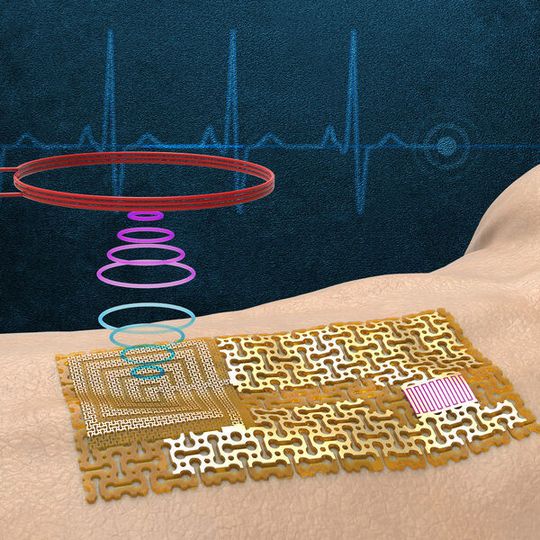
The device senses and wirelessly transmits signals without bulky chips or batteries.
(Source: Courtesy of the researchers/ MIT)
Wearable sensors are ubiquitous thanks to wireless technology that enables a person’s glucose concentrations, blood pressure, heart rate, and activity levels to be transmitted seamlessly from sensor to smartphone for further analysis.
Most wireless sensors today communicate via embedded Bluetooth chips that are themselves powered by small batteries. But these conventional chips and power sources will likely be too bulky for next-generation sensors, which are taking on smaller, thinner, more flexible forms.
A new device developed at MIT senses and wirelessly transmits signals related to pulse, sweat, and ultraviolet exposure, without bulky chips or batteries.
The team’s sensor design is a form of electronic skin, or “e-skin” — a flexible, semiconducting film that conforms to the skin like electronic Scotch tape. The heart of the sensor is an ultrathin, high-quality film of gallium nitride, a material that is known for its piezoelectric properties, meaning that it can both produce an electrical signal in response to mechanical strain and mechanically vibrate in response to an electrical impulse.
The researchers found they could harness gallium nitride’s two-way piezoelectric properties and use the material simultaneously for both sensing and wireless communication.
In their new study, the team produced pure, single-crystalline samples of gallium nitride, which they paired with a conducting layer of gold to boost any incoming or outgoing electrical signal. They showed that the device was sensitive enough to vibrate in response to a person’s heartbeat, as well as the salt in their sweat, and that the material’s vibrations generated an electrical signal that could be read by a nearby receiver. In this way, the device was able to wirelessly transmit sensing information, without the need for a chip or battery.
“Chips require a lot of power, but our device could make a system very light without having any chips that are power-hungry,” says the study’s corresponding author, Jeehwan Kim, an associate professor of mechanical engineering and of materials science and engineering, and a principal investigator in the Research Laboratory of Electronics. “You could put it on your body like a bandage, and paired with a wireless reader on your cellphone, you could wirelessly monitor your pulse, sweat, and other biological signals.”
Kim’s co-authors include first author and former MIT postdoc Yeongin Kim, who is now an assistant professor at the University of Cincinnati; co-corresponding author Jiyeon Han of the Korean cosmetics company Amorepacific, which helped motivate the current work; members of the Kim Research Group at MIT; and other collaborators at the University of Virginia, Washington University in St. Louis, and multiple institutions across South Korea.
Pure Resonance
Jeehwan Kim’s group previously developed a technique, called remote epitaxy, that they have employed to quickly grow and peel away ultrathin, high-quality semiconductors from wafers coated with graphene. Using this technique, they have fabricated and explored various flexible, multifunctional electronic films.
In their new study, the engineers used the same technique to peel away ultrathin single-crystalline films of gallium nitride, which in its pure, defect-free form is a highly sensitive piezoelectric material.
The team looked to use a pure film of gallium nitride as both a sensor and a wireless communicator of surface acoustic waves, which are essentially vibrations across the films. The patterns of these waves can indicate a person’s heart rate, or even more subtly, the presence of certain compounds on the skin, such as salt in sweat.
The researchers hypothesized that a gallium nitride-based sensor, adhered to the skin, would have its own inherent, “resonant” vibration or frequency that the piezoelectric material would simultaneously convert into an electrical signal, the frequency of which a wireless receiver could register. Any change to the skin’s conditions, such as from an accelerated heart rate, would affect the sensor’s mechanical vibrations, and the electrical signal that it automatically transmits to the recever.
Date: 08.12.2025
Naturally, we always handle your personal data responsibly. Any personal data we receive from you is processed in accordance with applicable data protection legislation. For detailed information please see our privacy policy.
Consent to the use of data for promotional purposes
I hereby consent to Vogel Communications Group GmbH & Co. KG, Max-Planck-Str. 7-9, 97082 Würzburg including any affiliated companies according to §§ 15 et seq. AktG (hereafter: Vogel Communications Group) using my e-mail address to send editorial newsletters. A list of all affiliated companies can be found here
Newsletter content may include all products and services of any companies mentioned above, including for example specialist journals and books, events and fairs as well as event-related products and services, print and digital media offers and services such as additional (editorial) newsletters, raffles, lead campaigns, market research both online and offline, specialist webportals and e-learning offers. In case my personal telephone number has also been collected, it may be used for offers of aforementioned products, for services of the companies mentioned above, and market research purposes.
Additionally, my consent also includes the processing of my email address and telephone number for data matching for marketing purposes with select advertising partners such as LinkedIn, Google, and Meta. For this, Vogel Communications Group may transmit said data in hashed form to the advertising partners who then use said data to determine whether I am also a member of the mentioned advertising partner portals. Vogel Communications Group uses this feature for the purposes of re-targeting (up-selling, cross-selling, and customer loyalty), generating so-called look-alike audiences for acquisition of new customers, and as basis for exclusion for on-going advertising campaigns. Further information can be found in section “data matching for marketing purposes”.
In case I access protected data on Internet portals of Vogel Communications Group including any affiliated companies according to §§ 15 et seq. AktG, I need to provide further data in order to register for the access to such content. In return for this free access to editorial content, my data may be used in accordance with this consent for the purposes stated here. This does not apply to data matching for marketing purposes.
Right of revocation
I understand that I can revoke my consent at will. My revocation does not change the lawfulness of data processing that was conducted based on my consent leading up to my revocation. One option to declare my revocation is to use the contact form found at https://contact.vogel.de. In case I no longer wish to receive certain newsletters, I have subscribed to, I can also click on the unsubscribe link included at the end of a newsletter. Further information regarding my right of revocation and the implementation of it as well as the consequences of my revocation can be found in the data protection declaration, section editorial newsletter.
“If there is any change in the pulse, or chemicals in sweat, or even ultraviolet exposure to skin, all of this activity can change the pattern of surface acoustic waves on the gallium nitride film,” notes Yeongin Kim. “And the sensitivity of our film is so high that it can detect these changes.”
To test their idea, the researchers produced a thin film of pure, high-quality gallium nitride and paired it with a layer of gold to boost the electrical signal. They deposited the gold in the pattern of repeating dumbbells — a lattice-like configuration that imparted some flexibility to the normally rigid metal. The gallium nitride and gold, which they consider to be a sample of electronic skin, measures just 250 nanometers thick — about 100 times thinner than the width of a human hair.
They placed the new e-skin on volunteers’ wrists and necks, and used a simple antenna, held nearby, to wirelessly register the device’s frequency without physically contacting the sensor itself. The device was able to sense and wirelessly transmit changes in the surface acoustic waves of the gallium nitride on volunteers’ skin related to their heart rate.
The team also paired the device with a thin ion-sensing membrane — a material that selectively attracts a target ion, and in this case, sodium. With this enhancement, the device could sense and wireless transmit changing sodium levels as a volunteer held onto a heat pad and began to sweat.
The researchers see their results as a first step toward chip-free wireless sensors, and they envision that the current device could be paired with other selective membranes to monitor other vital biomarkers.
“We showed sodium sensing, but if you change the sensing membrane, you could detect any target biomarker, such as glucose, or cortisol related to stress levels,” says co-author and MIT postdoc Jun Min Suh. “It’s quite a versatile platform.”




:quality(80)/p7i.vogel.de/wcms/62/32/62327aaae1415beeed47db6201e79661/0133375912v2.jpeg "A cotton trailer outfitted with benches and a sunshade offers farmworkers a reprieve from the sun as they take a break from picking cantaloupe melons in Firebaugh, Calif.
(Source: Joe Proudman/ Regents of the University of California)")
:quality(80)/p7i.vogel.de/wcms/e6/c8/e6c8bd554776ee1ad2f1f0723fb243a7/0133369387v1.jpeg "Roman road (Source: Queen Mary University of London)")
:quality(80)/p7i.vogel.de/wcms/51/68/51687ac4cc19f2757c138498b877de57/0133167039v2.jpeg "CMFs are foams that consist of hollow spheres – made of materials such as stainless steel, nickel, or other metals and alloys – embedded in a metallic matrix. The resulting material is both lightweight and remarkably strong at absorbing compressive forces. (Source: Jie Sun/ NC State University)")
:quality(80)/p7i.vogel.de/wcms/cd/c0/cdc09efd1e5b3b8f83224e7729d66c10/0133105276v2.jpeg "From the data presented in this report, the authors show how TF3-MALS-RI is uniquely able to separate large polyacrylate molecules and provide precise molecular weight and Rg values. (Source: Postnova Analytics)")
:quality(80)/p7i.vogel.de/wcms/86/01/86014d3d2a28cefc852f65c8d68317e4/0133104231v2.jpeg "Single-handed tube reading using a Handheld 2. (Source: Azenta Life Sciences)")
:quality(80)/p7i.vogel.de/wcms/0b/0f/0b0f8ed042dfc91f32582e10d54c2c7e/0133087444v2.jpeg "Offering advanced automation to increase your throughput, the Intellixcap provides secure sealing – eliminating the need for manual intervention, while preserving vital sample integrity. (Source: Azenta Life Sciences)")
:quality(80)/p7i.vogel.de/wcms/13/d3/13d35105f74a1c2e22b9c7a270e8e9b3/0132611155v2.jpeg "Circulating cell free DNA. (Source: Amsbio)")
:quality(80)/p7i.vogel.de/wcms/bc/ed/bced6850297a04dbea471a66cb6bb6fe/0132611405v2.jpeg "The latest addition to the range is a peristaltic tubing stop adapter that eliminates the need for fixed stoppers and allows custom cut lengths of peristaltic tubing to be installed on any pump head size. (Source: Biotech Fluidics )")
:quality(80)/p7i.vogel.de/wcms/8d/5c/8d5c6c7f897f91d6784825eee20b5584/0133321225v1.jpeg "Empa researcher Christoph Hüglin collects samples of particles that are washed out of the air by rain and snow or settle due to gravity. (Source: Empa)")
:quality(80)/p7i.vogel.de/wcms/a1/af/a1afbc7c8a067bbe94749ec680b4bafd/0133163762v2.jpeg "The study found in murkier water, fish took longer to move towards the food than those in clear water, but individuals in larger groups responded more quickly overall. (Source: Christos Ioannou)")
:quality(80)/p7i.vogel.de/wcms/32/80/3280aa3d44708962943c96fe2d466744/0133088560v2.jpeg "A bumble bee in flight at the University of Bristol Botanic Garden. (Source: Phil Savoie)")
:quality(80)/p7i.vogel.de/wcms/7b/e5/7be5c735140cbe28f3af0ec3d88274b9/0133045403v2.jpeg "After being buried in the ground for two months and broken down by soil organisms, a new pair of cotton underwear (left) shows clear signs of decomposition (right). (Source: Nicolas Zonvi)")
:quality(80)/p7i.vogel.de/wcms/ee/ad/eead38ab1e3c36f262bd889dfc8c5039/0133409909v2.jpeg "Eating a diet rich in wholegrain food is likely to prevent heart disease by reducing body weight, blood pressure and the levels of cholesterol and glucose in the blood. (Source: Unsplash)")
:quality(80)/p7i.vogel.de/wcms/ef/68/ef68375729607984e5bb0c143afdae70/0133375119v2.jpeg "Printed Rice-Lentil 3D structures
(Source: SUTD)")
:quality(80)/p7i.vogel.de/wcms/bf/d0/bfd087349a85956a7aefad57ac1204c7/0133241961v2.jpeg "The Thermo Scientific Suretect Beverage Spoilage Multiplex PCR Assay provides a fast, broad-range molecular solution for detecting key spoilage microorganisms that threaten beverage quality. (Source: © OlegDoroshin - stock.adobe.com)")
:quality(80)/p7i.vogel.de/wcms/d4/61/d461ce0bd5743897993c6475f69e7ad6/0133067478v2.jpeg "In Harris County, 50 % of households with children reported food insecurity, compared with 33 % of households without children. (Source: Rice University)")
:quality(80)/p7i.vogel.de/wcms/f5/d3/f5d3af7b7479d0573bec5c1fb9f1fd7b/0133409927v2.jpeg "The Match study looked at over 500 cancer survivors with varying types and stages of cancer and found that patients experienced less pain, fatigue, and sleep problems after participating in the interventions. (Source: Unsplash)")
:quality(80)/p7i.vogel.de/wcms/22/49/224964dd6850b62cccdbc4bde2d34693/0133372964v1.jpeg "Brain activity recorded during a video game helped researchers predict whether participants would take or avoid a risk half a second before they acted. (Source: free licensed)")
:quality(80)/p7i.vogel.de/wcms/48/a7/48a761934161543f70fef2403b44d714/0133372328v2.jpeg "The link between pollution and coughing persisted in the data, even when pollution levels were below the WHO’s recommended safe daily exposure limit. (Source: free licensed)")
:quality(80)/images.vogel.de/vogelonline/bdb/1710600/1710675/original.jpg "Discover how to set yourself up for success when performing balance-based density determination of solids such as jewelry and precious metals. (Mettler Toledo)")
:quality(80)/images.vogel.de/vogelonline/bdb/1682500/1682579/original.jpg "The new XPR Analytical balance redesigned to meet the needs of laboratory technicians of working fast and lean. (Mettler Toledo)")
:quality(80)/images.vogel.de/vogelonline/bdb/1677000/1677080/original.jpg "Enhance your weighing accuracy, comfort and productivity with the redesigned XPR Analytical balance. (Mettler Toledo)")
:quality(80)/images.vogel.de/vogelonline/bdb/1919000/1919041/original.jpg "Onera Health introduces Onera Biomedical-Lab-on-Chip, an ultra-low-power biosignal sensor hub for wearable health. (Business Wire)")
:quality(80)/p7i.vogel.de/wcms/7f/e8/7fe8a32e155eeda78509d15f0d151283/0105518945.jpeg "Stretchy sensor. Although very thin, the gold nanomesh sensor is very durable and can be stretched and deformed without breaking. Therefore, it can be adhered to many different kinds of surfaces — not just human skin — for different sensing purposes. (Source: ©2022 Goda et al.)")
:quality(80)/p7i.vogel.de/wcms/a6/11/a611c82a457f79f6ba3dcdcc603ae5fd/0131776472v1.jpeg "Wei Gao and a team at Caltech have developed a bioelectronic material called a stretchable interface for resilient electrochemical sensing (Sires), meeting a key need for the next generation of wearable and implantable sensors. The photographs show Sires-based bioelectronics under stretching (top) and twisting (bottom). Scale bar is 1 cm. (Source: Wei Gao Lab/ Caltech)")
:quality(80)/p7i.vogel.de/wcms/bc/f3/bcf32d0a9e410836dab7c95a777ad9b4/0131367205v2.jpeg "Wearable polygraph device in the palm of a hand for scale. (Source: John A. Rogers/Northwestern University)")