Creatine, the organic acid that is popularly taken as a supplement by athletes and bodybuilders, supercharges a critical class of immune cells that activate and prepare the body’s key cancer-fighters, according to new UCLA research.
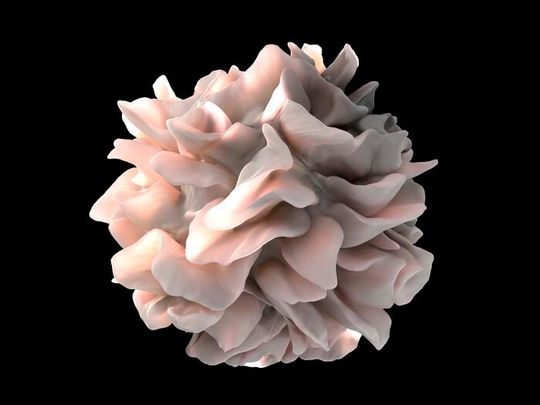
Artistic rendering of a human dendritic cell
(Source: Don Bliss & Sriram Subramaniam, National Cancer Institute)
A study, conducted in mouse models and human cells and published in iScience, builds directly on earlier work from the same lab showing that creatine powers killer T cells in their battle against tumors. Now, the team has discovered that creatine also fuels dendritic cells, specialized immune cells that capture tumor fragments and direct killer T cells to attack.
Most approved cancer immunotherapies work by targeting killer T cells directly, yet only about 20%-40% of patients respond to them. Bolstering the dendritic cells that train and activate T cells could potentially offer a way to bring the benefits of immunotherapy to more patients.
“Immunotherapy has shown remarkable promise, but it only works for a subset of patients,” said Lili Yang, the study’s senior author, a professor of microbiology, immunology and molecular genetics and a member of the Eli and Edythe Broad Center of Regenerative Medicine and Stem Cell Research at UCLA. “What this study shows is that creatine doesn’t just help the T cells fighting cancer — it also energizes the entire infrastructure supports and guides them. That makes creatine a promising supplement to holistically support the immune response that modern immunotherapies depend on.”
The researchers began by examining which metabolic genes were most active in dendritic cells that had infiltrated tumors in mice. They found that the gene encoding the creatine transporter — a protein that pulls creatine inside cells — was markedly elevated in dendritic cells inside tumors compared to those in healthy tissue.
To find out why, the team grew and studied dendritic cells that had been engineered to lack the creatine transporter entirely. These cells showed impaired survival, reduced activation and a weakened ability to prime T cells to mount a response against tumors. When creatine-deficient dendritic cells were grown alongside T cells in a lab dish, those T cells divided less and produced fewer of the signaling molecules needed to fight cancer.
The team then tested the opposite intervention: Instead of reducing creatine levels, the researchers increased them to see whether this could enhance the dendritic cells’ function. Giving daily creatine injections to mouse models of melanoma significantly slowed tumor growth and boosted both the abundance and the activation of tumor-infiltrating dendritic cells. Creatine-treated dendritic cells also produced higher levels of chemical signals that draw additional immune cells into the tumor.
Using metabolomics analyses, the researchers found that creatine supplementation raised intracellular ATP levels in dendritic cells — ATP is the energy currency cells use to power virtually every function — and sustained the key inflammatory signaling pathways needed for activation. Like a battery storing and releasing excess energy on demand, creatine helps dendritic cells maintain stable energy levels even when competing with fast-growing tumor cells for nutrients.
The researchers also tested creatine’s effects on human dendritic cells. Creatine treatment enhanced the activation of human monocyte-derived dendritic cells, which are often used in dendritic cell cancer vaccines, and improved their ability to stimulate human T cells against a cancer-associated target. The findings suggest that incorporating creatine during the manufacturing of dendritic cell vaccines may boost their therapeutic potency.
“The potential we see here is that creatine could be used in two complementary ways: as a supplement to enhance the immune response of patients already receiving immunotherapy, and as a tool to improve the quality of dendritic cell-based vaccines before they're administered,” said James Elsten-Brown, a co-first author and graduate student in Yang's lab.
Date: 08.12.2025
Naturally, we always handle your personal data responsibly. Any personal data we receive from you is processed in accordance with applicable data protection legislation. For detailed information please see our privacy policy.
Consent to the use of data for promotional purposes
I hereby consent to Vogel Communications Group GmbH & Co. KG, Max-Planck-Str. 7-9, 97082 Würzburg including any affiliated companies according to §§ 15 et seq. AktG (hereafter: Vogel Communications Group) using my e-mail address to send editorial newsletters. A list of all affiliated companies can be found here
Newsletter content may include all products and services of any companies mentioned above, including for example specialist journals and books, events and fairs as well as event-related products and services, print and digital media offers and services such as additional (editorial) newsletters, raffles, lead campaigns, market research both online and offline, specialist webportals and e-learning offers. In case my personal telephone number has also been collected, it may be used for offers of aforementioned products, for services of the companies mentioned above, and market research purposes.
Additionally, my consent also includes the processing of my email address and telephone number for data matching for marketing purposes with select advertising partners such as LinkedIn, Google, and Meta. For this, Vogel Communications Group may transmit said data in hashed form to the advertising partners who then use said data to determine whether I am also a member of the mentioned advertising partner portals. Vogel Communications Group uses this feature for the purposes of re-targeting (up-selling, cross-selling, and customer loyalty), generating so-called look-alike audiences for acquisition of new customers, and as basis for exclusion for on-going advertising campaigns. Further information can be found in section “data matching for marketing purposes”.
In case I access protected data on Internet portals of Vogel Communications Group including any affiliated companies according to §§ 15 et seq. AktG, I need to provide further data in order to register for the access to such content. In return for this free access to editorial content, my data may be used in accordance with this consent for the purposes stated here. This does not apply to data matching for marketing purposes.
Right of revocation
I understand that I can revoke my consent at will. My revocation does not change the lawfulness of data processing that was conducted based on my consent leading up to my revocation. One option to declare my revocation is to use the contact form found at https://contact.vogel.de. In case I no longer wish to receive certain newsletters, I have subscribed to, I can also click on the unsubscribe link included at the end of a newsletter. Further information regarding my right of revocation and the implementation of it as well as the consequences of my revocation can be found in the data protection declaration, section editorial newsletter.
Together, the findings point to creatine as a potential tool for strengthening the immune system's anti-cancer response at multiple levels, including the cells that detect the threat and set the response in motion.
“Understanding how to metabolically support dendritic cells is about supporting the entire anti-tumor response, not just the killer T cells at the end of it,” said Elliot Kang, a co-first author of the study and former undergraduate student researcher in Yang's lab.
The researchers emphasize that while the findings are scientifically promising, this study was conducted in cells and mice, not patients, and no dietary or medical recommendations should be drawn from it. Although creatine monohydrate has been widely used as a supplement for decades and is generally considered safe at recommended doses, anyone undergoing cancer treatment should consult their doctor before adding any supplement to their routine.
Next, the team hopes to collaborate with physicians on prospective clinical trials that could test whether creatine supplementation improves outcomes in patients receiving immunotherapy.
The experimental strategies described in this study have not been tested in humans or approved by the Food and Drug Administration as safe and effective for use in humans.
Funding for the study was provided by a UCLA Broad Stem Cell Research Center Rose Hills Foundation Innovator Grant; the UCLA Health Jonsson Comprehensive Cancer Center and UCLA Broad Stem Cell Research Center Ablon Scholars Program; and a Magnolia Council Senior Investigator Grant Award and a fellowship from the Tower Cancer Research Foundation.
This newly identified potential therapeutic strategy is covered by a patent application filed by the UCLA Technology Development Group on behalf of the Regents of the University of California.




:quality(80)/p7i.vogel.de/wcms/62/32/62327aaae1415beeed47db6201e79661/0133375912v2.jpeg "A cotton trailer outfitted with benches and a sunshade offers farmworkers a reprieve from the sun as they take a break from picking cantaloupe melons in Firebaugh, Calif.
(Source: Joe Proudman/ Regents of the University of California)")
:quality(80)/p7i.vogel.de/wcms/e6/c8/e6c8bd554776ee1ad2f1f0723fb243a7/0133369387v1.jpeg "Roman road (Source: Queen Mary University of London)")
:quality(80)/p7i.vogel.de/wcms/51/68/51687ac4cc19f2757c138498b877de57/0133167039v2.jpeg "CMFs are foams that consist of hollow spheres – made of materials such as stainless steel, nickel, or other metals and alloys – embedded in a metallic matrix. The resulting material is both lightweight and remarkably strong at absorbing compressive forces. (Source: Jie Sun/ NC State University)")
:quality(80)/p7i.vogel.de/wcms/cd/c0/cdc09efd1e5b3b8f83224e7729d66c10/0133105276v2.jpeg "From the data presented in this report, the authors show how TF3-MALS-RI is uniquely able to separate large polyacrylate molecules and provide precise molecular weight and Rg values. (Source: Postnova Analytics)")
:quality(80)/p7i.vogel.de/wcms/86/01/86014d3d2a28cefc852f65c8d68317e4/0133104231v2.jpeg "Single-handed tube reading using a Handheld 2. (Source: Azenta Life Sciences)")
:quality(80)/p7i.vogel.de/wcms/0b/0f/0b0f8ed042dfc91f32582e10d54c2c7e/0133087444v2.jpeg "Offering advanced automation to increase your throughput, the Intellixcap provides secure sealing – eliminating the need for manual intervention, while preserving vital sample integrity. (Source: Azenta Life Sciences)")
:quality(80)/p7i.vogel.de/wcms/13/d3/13d35105f74a1c2e22b9c7a270e8e9b3/0132611155v2.jpeg "Circulating cell free DNA. (Source: Amsbio)")
:quality(80)/p7i.vogel.de/wcms/bc/ed/bced6850297a04dbea471a66cb6bb6fe/0132611405v2.jpeg "The latest addition to the range is a peristaltic tubing stop adapter that eliminates the need for fixed stoppers and allows custom cut lengths of peristaltic tubing to be installed on any pump head size. (Source: Biotech Fluidics )")
:quality(80)/p7i.vogel.de/wcms/8d/5c/8d5c6c7f897f91d6784825eee20b5584/0133321225v1.jpeg "Empa researcher Christoph Hüglin collects samples of particles that are washed out of the air by rain and snow or settle due to gravity. (Source: Empa)")
:quality(80)/p7i.vogel.de/wcms/a1/af/a1afbc7c8a067bbe94749ec680b4bafd/0133163762v2.jpeg "The study found in murkier water, fish took longer to move towards the food than those in clear water, but individuals in larger groups responded more quickly overall. (Source: Christos Ioannou)")
:quality(80)/p7i.vogel.de/wcms/32/80/3280aa3d44708962943c96fe2d466744/0133088560v2.jpeg "A bumble bee in flight at the University of Bristol Botanic Garden. (Source: Phil Savoie)")
:quality(80)/p7i.vogel.de/wcms/7b/e5/7be5c735140cbe28f3af0ec3d88274b9/0133045403v2.jpeg "After being buried in the ground for two months and broken down by soil organisms, a new pair of cotton underwear (left) shows clear signs of decomposition (right). (Source: Nicolas Zonvi)")
:quality(80)/p7i.vogel.de/wcms/ef/68/ef68375729607984e5bb0c143afdae70/0133375119v2.jpeg "Printed Rice-Lentil 3D structures
(Source: SUTD)")
:quality(80)/p7i.vogel.de/wcms/bf/d0/bfd087349a85956a7aefad57ac1204c7/0133241961v2.jpeg "The Thermo Scientific Suretect Beverage Spoilage Multiplex PCR Assay provides a fast, broad-range molecular solution for detecting key spoilage microorganisms that threaten beverage quality. (Source: © OlegDoroshin - stock.adobe.com)")
:quality(80)/p7i.vogel.de/wcms/d4/61/d461ce0bd5743897993c6475f69e7ad6/0133067478v2.jpeg "In Harris County, 50 % of households with children reported food insecurity, compared with 33 % of households without children. (Source: Rice University)")
:quality(80)/p7i.vogel.de/wcms/79/76/7976d17b980bedfe35acaa532d690046/0132713841v2.jpeg "Observed rice yield losses from 1°C warming are more than twice as high as model estimates due to underestimated heat stress. (Source: AdobeStock/ducvien)")
:quality(80)/p7i.vogel.de/wcms/22/49/224964dd6850b62cccdbc4bde2d34693/0133372964v1.jpeg "Brain activity recorded during a video game helped researchers predict whether participants would take or avoid a risk half a second before they acted. (Source: free licensed)")
:quality(80)/p7i.vogel.de/wcms/48/a7/48a761934161543f70fef2403b44d714/0133372328v2.jpeg "The link between pollution and coughing persisted in the data, even when pollution levels were below the WHO’s recommended safe daily exposure limit. (Source: free licensed)")
:quality(80)/p7i.vogel.de/wcms/83/b4/83b4563a65c6036b61990931507428b4/0133363611v2.jpeg "Magnesium sulphate uptake and the north / south divide for the Precept program. (Source: University of Bristol )")
:quality(80)/p7i.vogel.de/wcms/bb/06/bb06c1c3c5d250f3f93016366c56525d/0133363201v2.jpeg "The team identified more than 1,200 associated genetic variants and found that these influences are remarkably consistent across countries, ages and methods of measuring personality. (Source: Pixabay - PublicDomainPictures)")
:quality(80)/images.vogel.de/vogelonline/bdb/1710600/1710675/original.jpg "Discover how to set yourself up for success when performing balance-based density determination of solids such as jewelry and precious metals. (Mettler Toledo)")
:quality(80)/images.vogel.de/vogelonline/bdb/1682500/1682579/original.jpg "The new XPR Analytical balance redesigned to meet the needs of laboratory technicians of working fast and lean. (Mettler Toledo)")
:quality(80)/images.vogel.de/vogelonline/bdb/1677000/1677080/original.jpg "Enhance your weighing accuracy, comfort and productivity with the redesigned XPR Analytical balance. (Mettler Toledo)")
:fill(fff,0)/images.vogel.de/vogelonline/companyimg/107800/107832/65.jpg "logoDueperthal.jpg ()")
:fill(fff,0)/images.vogel.de/vogelonline/companyimg/131900/131910/65.jpg "Xylem_tag_rgb.jpg ()")
:fill(fff,0)/p7i.vogel.de/companies/69/b7/69b7f63f311d9/logo-bimos-tif--2-.jpeg "logo-bimos-tif--2- (https://www.bimos.com/de-de/)")
:quality(80)/p7i.vogel.de/wcms/0c/b9/0cb96da70497caa99aad708187b1f980/0125348739v2.jpeg "Researchers measured inflammation using biomarkers in the blood and found higher levels of omega-3 fats – naturally occurring in oily fish and commonly taken in supplements for anti-inflammatory benefits – were actually associated with increased levels of inflammation. (Source: Pixabay)")
:quality(80)/p7i.vogel.de/wcms/a9/37/a9376f1d9a893570023d9aa97c085bc5/0129927485v2.jpeg "Examples of foods high in PUFAs include fatty fish and soybeans, while MUFAs include olive oil and avocadoes. (Source: free licensed)")
:quality(80)/p7i.vogel.de/wcms/6a/6d/6a6dcde919c7ddcd0b38c082e67d7096/0131442912v2.jpeg "The findings in mice as well as human cells and tumor samples point to a practical, new way to improve treatment for tough tumors, such as triple-negative breast cancer, where immunotherapy often fails. (Source: Unsplash)")
:quality(80)/p7i.vogel.de/wcms/6f/e9/6fe9d920eca2c0b3bdeb55cbe9f01908/0130299237v2.jpeg "Study authors Jason Miska and Leah Billingham reading out enzymatic activity of microglia in cell cultures. (Source: Northwestern University.)")