Snake EvolutionFossil Reveals New Clues About the Origin of Snakes
Source:
Fapesp
6 min Reading Time
An unusually well-preserved snake fossil from Brazil is adding a new dimension to the debate over how snakes evolved. Hidden within its 80-million-year-old skull, researchers have uncovered clues to how the animal lived and sensed its surroundings.
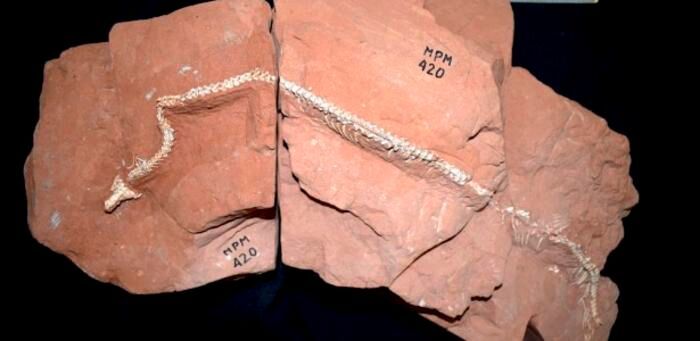
Articulated fossil of Tametara mirim, with part of the skull and spine preserved in rock blocks
(Source: Agustín Martinelli)
The fossil of a 42-centimeter snake that lived 80 million years ago in the interior of the state of São Paulo, Brazil, is reigniting a century-long evolutionary debate among paleontologists regarding the environment in which the first snakes emerged: the sea, underground, or the Earth’s surface. The species, named Tametara mirim, had an endocranial anatomy and inner ear consistent with an underground lifestyle, according to a study supported by Fapesp and published in Nature.
To determine the uniqueness of this anatomy, the researchers applied the same analysis to a fossil of the Argentine species Dinilysia patagonica. This species lived during the same period as Tametara and is the only other member of the stem group with a well-preserved skull and publicly available CT scan data. The stem group belongs to an extinct lineage outside the group that includes all modern snakes but is evolutionarily close to it. The casts of the internal skull cavities of the two species were quite different, with Dinilysia exhibiting an anatomy consistent with a lifestyle not adapted to subterranean (fossorial) or, most likely, terrestrial life.
In 2020, William Nava and Giovanna Paixão from the Marília Museum of Paleontology discovered the Tametara fossil in a quarry in the municipality of Presidente Prudente in the far west of São Paulo. The rock is estimated to be between 85 and 75 million years old and belongs to the Adamantina Formation of the Bauru Group. This series of Upper Cretaceous sedimentary rock outcrops in the states of São Paulo, Minas Gerais, Mato Grosso do Sul, Paraná, and Goiás is famous for its dinosaur fossils. According to the authors, this is the first articulated snake fossil found in Brazil, with the bones still connected as they were at the time of the animal’s death. Previous records of Cretaceous-period snakes in Brazil consisted only of isolated vertebrae.
The study was led by Tiago Simões of Princeton University, Nicolas Di-Poï of the University of Helsinki, and Annie Hsiou of the University of São Paulo (USP), and it was supported by Fapesp through projects 24/17970-7 and 25/01077-4.
“Almost everything we know about the origin of snakes is based on a very limited number of well-preserved fossils from the Mesozoic Era,” explains Simões, the first author of the study and a professor in the Department of Ecology and Evolutionary Biology at Princeton University in the United States. He adds that fewer than ten articulated snake fossils are known from the entire Mesozoic Era, which spanned from approximately 252 to 66 million years ago and comprises the Triassic, Jurassic, and Cretaceous periods. Only three other fossils have three-dimensional preservation comparable to that of Tametara. “Every new species from that era with this degree of preservation holds enormous potential for shedding light on questions about their origins,” he says.
While the study does not resolve the debate over where snakes first appeared, it shows that they had already diversified ecologically by the Cretaceous period. Closely related lineages on the evolutionary tree occupied very different environments, indicating that subterranean, terrestrial, and marine habitats coexisted early in the group’s history rather than originating from a single common ancestral environment.
Digital Analysis
In order to reconstruct the internal anatomy of the skull without destroying the fossil, the team used computed microtomography. This technology is similar to that used in hospital X-ray exams, but it has a much higher resolution. Gabriela Sobral, an associate researcher at the Natural History Museum in Stuttgart, Germany, and at the University of Brasília (UnB), was responsible for separating the structures in the images. “Based on the CT scans, we segment the structures of interest. We can draw and color each one to tell the program what should be separated from the rest,” Sobral explains. This process generates a three-dimensional model that can be rotated and zoomed in on a computer screen.
This work revealed a set of clues pointing to Tametara’s subterranean lifestyle. The bones of the cranial vault were dense and heavily overlapping, a pattern that distinguishes fossorial and semifossorial animals, which are adapted to digging burrows and living underground, from non-fossorial ones. The inner ear reinforced this suspicion with its large, rounded vestibule and thin semicircular canals. “The reduced semicircular canals indicate that the animal’s spatial orientation isn’t critical for its perception, which makes sense when living underground,” Sobral explains. The large, globular vestibule suggests that low-frequency sounds, which travel better through the ground than through the air, were important to the animal.
Date: 08.12.2025
Naturally, we always handle your personal data responsibly. Any personal data we receive from you is processed in accordance with applicable data protection legislation. For detailed information please see our privacy policy.
Consent to the use of data for promotional purposes
I hereby consent to Vogel Communications Group GmbH & Co. KG, Max-Planck-Str. 7-9, 97082 Würzburg including any affiliated companies according to §§ 15 et seq. AktG (hereafter: Vogel Communications Group) using my e-mail address to send editorial newsletters. A list of all affiliated companies can be found here
Newsletter content may include all products and services of any companies mentioned above, including for example specialist journals and books, events and fairs as well as event-related products and services, print and digital media offers and services such as additional (editorial) newsletters, raffles, lead campaigns, market research both online and offline, specialist webportals and e-learning offers. In case my personal telephone number has also been collected, it may be used for offers of aforementioned products, for services of the companies mentioned above, and market research purposes.
Additionally, my consent also includes the processing of my email address and telephone number for data matching for marketing purposes with select advertising partners such as LinkedIn, Google, and Meta. For this, Vogel Communications Group may transmit said data in hashed form to the advertising partners who then use said data to determine whether I am also a member of the mentioned advertising partner portals. Vogel Communications Group uses this feature for the purposes of re-targeting (up-selling, cross-selling, and customer loyalty), generating so-called look-alike audiences for acquisition of new customers, and as basis for exclusion for on-going advertising campaigns. Further information can be found in section “data matching for marketing purposes”.
In case I access protected data on Internet portals of Vogel Communications Group including any affiliated companies according to §§ 15 et seq. AktG, I need to provide further data in order to register for the access to such content. In return for this free access to editorial content, my data may be used in accordance with this consent for the purposes stated here. This does not apply to data matching for marketing purposes.
Right of revocation
I understand that I can revoke my consent at will. My revocation does not change the lawfulness of data processing that was conducted based on my consent leading up to my revocation. One option to declare my revocation is to use the contact form found at https://contact.vogel.de. In case I no longer wish to receive certain newsletters, I have subscribed to, I can also click on the unsubscribe link included at the end of a newsletter. Further information regarding my right of revocation and the implementation of it as well as the consequences of my revocation can be found in the data protection declaration, section editorial newsletter.
The focus in the brain was on a poorly developed region. The optic roof, a structure involved in visual processing, was more atrophied in Tametara than in most burrowing snakes and lizards studied to date. “Atrophied regions indicate that function isn’t vital,” says Sobral. However, she offers an important methodological caveat: the virtual cast of the interior of the skull, the endocast, does not reproduce the brain itself, but rather the set of structures that were juxtaposed within the skull when the animal was alive. In Tametara's case, the region corresponding to the optic roof formed a very thin band. “That’s an extremely unusual condition, even among modern burrowing snakes, which rely almost entirely on vision to survive,” she summarizes.
Evolutionary Implications
When the endocranial anatomy reconstructions of Tametara and Dinilysia were compared side by side, they proved to be different from one another and distinct from most modern lizard and snake lineages. For Simões, this suggests that the two animals inhabited different environments and likely perceived the world differently. “They exhibited broad neuroanatomical – and likely sensory – diversity early in their evolutionary history,” the researcher says.
By combining quantitative analyses of telencephalic shape (the most anterior portion of the brain, where the olfactory bulb and tract are located) and bone microstructure with anatomical evidence from the inner ear, the team was able to demonstrate, for the first time using statistical methods, that Cretaceous snakes exhibited ecological diversity. This finding has implications that extend beyond the biology of Tametara.
“To better understand the group’s origin, we need to discover highly preserved fossils, such as Tametara, from earlier periods, especially the Jurassic period, which spanned from 201 million to 145 million years ago,” says Simões.
The species’ name reflects its uniqueness. “Tametara” means “adorned,” referring to the pronounced crest on top of the skull, and “mirim,” of Tupi-Guarani origin, indicates the animal’s small size.
The discovery also expands our knowledge of historically understudied groups within the Bauru Group. “The region’s potential for understanding life in the Cretaceous period has long been recognized internationally. However, research has historically focused more on other groups, such as non-avian dinosaurs,” Simões notes. There are still gaps in our understanding of Tametara itself. It is unclear if the animal had developed hind limbs because the region of the body where they would have been located, near the cloaca, was not preserved in the fossil.
“From the very beginning, I knew I was looking at a very special fossil because of those unusual characteristics. As the work progressed, Tametara revealed itself to be truly unique,” Sobral summarizes. “Unfortunately, I wasn’t part of the discovery of this fossil. It must have been thrilling to find a gem like this. Maybe on the next field trip?” he adds.
Original Article: Exceptional brain and ecological diversity in the earliest snakes; Nature; DOI:10.1038/s41586-026-10809-9




:quality(80)/p7i.vogel.de/wcms/3f/2b/3f2b75ae816c4c7d2834642c675d1b72/0133864426v1.jpeg "Researchers recently found that spending just 10 minutes relying on an AI tool significantly impairs the user's ability to focus and persist with difficult tasks. A preliminary draft made waves earlier this year, and the team presented the updated, peer-reviewed paper this week at the Conference on Language Modeling. (Source: free licensed)")
:quality(80)/p7i.vogel.de/wcms/24/31/24319808d44e55ba97ce10223c21791b/0133864445v1.jpeg "This new battery binder could reduce the toxic ingredients, energy use and waste when building and recycling lithium-ion batteries. (Source: David Baillot | UC San Diego Jacobs School of Engineering (CC BY-ND 4.0))")
:quality(80)/p7i.vogel.de/wcms/a0/22/a0220cebf4618cef31ba3a3c28411770/0133693882v1.jpeg "Researchers have demonstrated a technique that uses powdered eggshells to produce high-quality magnesium alloys, which have a wide variety of automotive, aerospace and biomedical applications. The eggshells are used as a low-cost, environmentally sustainable alternative to conventional calcium materials, which are manufactured from ore using an energy-intensive process. This photo shows an eggshell next to a rod of egg-shell modified magnesium alloy. (Source: Bharat Gwalani, NC State University)")
:quality(80)/p7i.vogel.de/wcms/83/7b/837b7447733daa56e185cb8f61e8d3bf/0133694425v2.jpeg "Researcher Jinlong Wang stands beside a garbage bin fitted with a solar-powered insert on the lid that efficiently removes food waste smells compared to a garbage bin with a typical lid. (Source: Pan Yan)")
:quality(80)/p7i.vogel.de/wcms/3e/3c/3e3cc29b52fedebf1c97dea23b92a760/0133673542v2.jpeg "Fig.1: The path to accurate pH measurements starts with precise calibration. Use fresh buffers and verify mV response for optimal electrode performance. (Source: METTLER TOLEDO)")
:quality(80)/p7i.vogel.de/wcms/2d/92/2d9231a37601aa58b40d4688f609f004/0133687591v2.jpeg "Horiba’s new CE IVDR certified Yumizen H500 CRP benchtop hematology analyzer delivers a simultaneous complete blood count with 5-part extended differential and rapid CRP whole blood measurement. (Source: Horiba )")
:quality(80)/p7i.vogel.de/wcms/e5/e9/e5e97a3c76cbf47308ce21c4a567a812/0133686320v2.jpeg "The picture shows the Kern PDS precision scale in combination with Kern Balanceconnection software. (Source: Kern & Sohn)")
:quality(80)/p7i.vogel.de/wcms/a8/6e/a86e9b1f1561a67038b6d8a9fe629117/0133465534v2.jpeg "Clean, calibrate, and store pH electrodes properly to ensure accurate, reliable measurements every time. (Source: METTLER TOLEDO)")
:quality(80)/p7i.vogel.de/wcms/d6/ef/d6ef487a821a27ff89287c75b9a94dec/0133693832v1.jpeg "Extent of ice loss at Konkordiaplatz on the Great Aletsch Glacier, canton Valais between 2022 and 2026, compared with the average of measurements taken between 1953 and 1983. (Source: M. Huss / A. Linsbauer)")
:quality(80)/p7i.vogel.de/wcms/ef/7c/ef7cd23997787d020fc225c2677625cf/0133621949v2.jpeg "The team recorded over 1.6 million individual flowers and more than 5,000 plant-pollinator interactions across 58 plant species and 405 pollinator species. (Source: University of Bristol)")
:quality(80)/p7i.vogel.de/wcms/6f/ea/6feaf3edd34eb4a9f1df201dc2e6448d/0133548706v2.jpeg "The researchers studied people’s perceptions, beliefs and knowledge about climate change in two coastal regions, one low-lying island and the other a mainland coast. (Source: P Afna)")
:quality(80)/p7i.vogel.de/wcms/8d/5c/8d5c6c7f897f91d6784825eee20b5584/0133321225v1.jpeg "Empa researcher Christoph Hüglin collects samples of particles that are washed out of the air by rain and snow or settle due to gravity. (Source: Empa)")
:quality(80)/p7i.vogel.de/wcms/e1/f4/e1f48a0c4b6d5c00059370affdc13113/0133694409v2.jpeg "Broccoli growing beneath semi-transparent, colored solar panels at the experimental site at Kärrbo Prästgård farm in Sweden. (Source: Silvia Ma Lu)")
:quality(80)/p7i.vogel.de/wcms/95/3e/953e490f1819f6638bc08fe3d4d43e87/0133566684v1.jpeg "The soy protein isolate the researchers fed to the mice. (Source: KyotoU / Tomoko T. Asai)")
:quality(80)/p7i.vogel.de/wcms/ba/38/ba38179dbcd20fbc3887b2709193d0a8/0133566669v2.jpeg "Consumers in a Cornell study showed no consistent bias against the colour of hybrid red wines, with several ranking among the most visually appealing. (Source: free licensed)")
:quality(80)/p7i.vogel.de/wcms/ac/d1/acd1a8888f6e78206f11f2b4eb33926f/0133566582v1.jpeg "A claim on the front of a box of food products is a hint, not a verdict. The nutrition label on the back – added sugars, sodium, saturated fat, all of it together – still tells the fuller story. (Source: free licensed)")
:quality(80)/p7i.vogel.de/wcms/79/e7/79e7c5ee90d19fe72bdae3627024c168/0133864685v2.jpeg "Findings suggest cannabis-related sleep disruptions may go unnoticed by users themselves (Source: free licensed)")
:quality(80)/p7i.vogel.de/wcms/84/a1/84a11f4028b2f1f578f7d8e1f1c717c1/0133864641v1.jpeg "Articulated fossil of Tametara mirim, with part of the skull and spine preserved in rock blocks (Source: Agustín Martinelli)")
:quality(80)/p7i.vogel.de/wcms/ff/3b/ff3bf65648dacb3de4130a75b63f009d/0133864567v2.jpeg "Big dogs tend to age faster than small dogs. Now, we know why. A new study led by researchers at Arizona State University offers the first compelling molecular explanation of why large dogs live shorter lives: the answer may lie in how hallmarks of aging reshape dog DNA.
(Source: Charlie Leight, Arizona State University)")
:quality(80)/p7i.vogel.de/wcms/20/cf/20cfcbf3af8ae6e5d837de9a236d146a/0133694093v1.jpeg "Research findings could help researchers develop personalized treatments for liver disease. (Source: University of Missouri)")
:quality(80)/images.vogel.de/vogelonline/bdb/1710600/1710675/original.jpg "Discover how to set yourself up for success when performing balance-based density determination of solids such as jewelry and precious metals. (Mettler Toledo)")
:quality(80)/images.vogel.de/vogelonline/bdb/1682500/1682579/original.jpg "The new XPR Analytical balance redesigned to meet the needs of laboratory technicians of working fast and lean. (Mettler Toledo)")
:quality(80)/images.vogel.de/vogelonline/bdb/1677000/1677080/original.jpg "Enhance your weighing accuracy, comfort and productivity with the redesigned XPR Analytical balance. (Mettler Toledo)")
:quality(80)/p7i.vogel.de/wcms/e6/49/e649f8e8a4b990611fd1c1d8a1aa50a5/0129797212v2.jpeg "Case 6, photographed by Dr Jose de la Fuente. Amber now held in the KGJ Colección, Ciudad Real. (Source: Dr Jose de la Fuente)")
:quality(80)/p7i.vogel.de/wcms/bb/e6/bbe6e158b1d43f32cb7a95cd771dccd7/0133321323v1.jpeg "An illustration of a Surinam toad with its toes if they were proportioned according to the amount of space they take up in the frog’s tiny brain. (Source: Rebeca Fuquen)")
:quality(80)/p7i.vogel.de/wcms/66/b9/66b943e8e2040aa56fe26aa4af267970/0130610299v1.jpeg "Lystrosaurus embryo within its partially preserved shell , reconstruction of the animal (Source: Professor Julien Benoit/ Sophie Vrard)")
:quality(80)/p7i.vogel.de/wcms/e6/49/e649f8e8a4b990611fd1c1d8a1aa50a5/0129797212v2.jpeg "Case 6, photographed by Dr Jose de la Fuente. Amber now held in the KGJ Colección, Ciudad Real. (Source: Dr Jose de la Fuente)")
:quality(80)/p7i.vogel.de/wcms/66/b9/66b943e8e2040aa56fe26aa4af267970/0130610299v1.jpeg "Lystrosaurus embryo within its partially preserved shell , reconstruction of the animal (Source: Professor Julien Benoit/ Sophie Vrard)")