The genetic origins of the first agriculturalists in the Neolithic period long seemed to lie in the Near East. A new study published in the journal Cell shows that the first farmers actually represented a mixture of Ice Age hunter-gatherer groups, spread from the Near East all the way to south-eastern Europe.
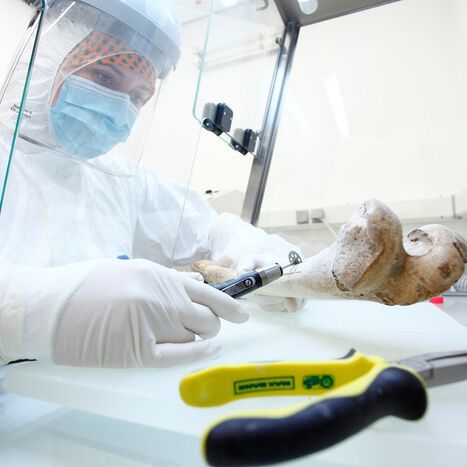
Ancient DNA extraction in Mainz’s lab. Work done in sterile conditions to avoid contamination from modern DNA.
(Source: Joachim Burger / JGU)
Bern/Switzerland — Researchers from the University of Bern and the SIB Swiss Institute of Bioinformatics as well as from the Johannes Gutenberg University Mainz and the University of Fribourg developed a method that revealed the origin of the world’s first farmers. This method could help reveal other human evolution patterns with unmatched resolution.
The first signs of agriculture and a sedentary lifestyle are found in the so-called ‘Fertile Crescent’, a region in the Near East where people began to settle down and domesticate animals and plants about 11,000 years ago. The question of the origin of agriculture and sedentism has occupied researchers for over 100 years: did farming spread from the Near East through cultural diffusion or through migration? Genetic analyses of prehistoric skeletons so far supported the idea that Europe’s first farmers were descended from hunter-gatherer populations in Anatolia. While that may well be the case, this new study shows that the Neolithic genetic origins cannot clearly be attributed to a single region. Unexpected and complex population dynamics occurred at the end of the Ice Age, and led to the ancestral genetic makeup of the populations who invented agriculture and a sedentary life-style i.e. the first Neolithic farmers.
First Farmers Emerged from a Mixing Process Starting 14,000 Years Ago
Previous analyses had suggested that the first Neolithic people were genetically different from other human groups from that time. Little was known about their origins. Nina Marchi, one of the study's first authors from the Institute of Ecology and Evolution at the University of Bern and SIB says: “We now find that the first farmers of Anatolia and Europe emerged from a population admixed between hunter-gatherers from Europe and the Near East.” According to the authors, the mixing process started around 14,000 years ago, which was followed by a period of extreme genetic differentiation lasting several thousand years.
This research was made possible by combining two techniques: the production of high-quality ancient genomes from prehistoric skeletons, coupled with demographic modeling on the resulting data. The research team coined the term “demogenomic modeling” for this purpose. “It is necessary to have genome data of the best possible quality so that the latest statistical genomic methods can reconstruct the subtle demographic processes of the last 30 thousand years at high resolution”, says Laurent Excoffier, one of the senior authors of the study.
Europe's first farmers seem to be descended from hunter-gatherer populations that lived all the way from the Near East to the Balkans. This was not foreseeable archaeologically.
Maxime Brami
Laurent Excoffier is a professor at the Institute of Ecology and Evolution at the University of Bern and group leader at SIB. He initiated the project together with Joachim Burger of the Johannes Gutenberg University in Mainz and Daniel Wegmann of the University of Fribourg. Nina Marchi adds: “Simply comparing the similarity of different ancient genomes is not enough to understand how they evolved. We had to reconstruct the actual histories of the populations studied as accurately as possible. This is only possible with complex population genetic statistics.”
Interdisciplinarity Key to Solve such Ancient Puzzles
Joachim Burger of the University of Mainz and second senior author emphasizes the necessity of interdisciplinarity: “It took close to ten years to gather and analyze the skeletons suitable for such a study. This was only possible by collaborating with numerous archaeologists and anthropologists, who helped us to anchor our models historically”. The historical contextualisation was coordinated by Maxime Brami, who works with Burger at Johannes Gutenberg University. The young prehistorian was surprised by some of the study's findings: “Europe's first farmers seem to be descended from hunter-gatherer populations that lived all the way from the Near East to the Balkans. This was not foreseeable archaeologically”.
Towards a general model of human population evolution
Genetic data from fossils (skeletons) are badly damaged and must be processed accordingly using bioinformatics, as Daniel Wegmann from the University of Fribourg and group leader at SIB explains: “The high-resolution reconstruction of the prehistory of the Europeans was only possible thanks to methods that we specifically developed to analyse ancient fossil genomes.” Joachim Burger adds: “With these approaches, we have not only elucidated the origins of the world’s first Neolithic populations, but we have established a general model of the evolution of human populations in Southwest Asia and Europe.”
“Of course, spatial and temporal gaps remain, and this does not imply the end of studies on the evolution of humans in this area”, concludes Laurent Excoffier. Thus, the team's research plan is already set; they want to supplement their demographic model with genomes from the later phases of the Neolithic and Bronze Ages to provide an increasingly detailed picture of human evolution.
Date: 08.12.2025
Naturally, we always handle your personal data responsibly. Any personal data we receive from you is processed in accordance with applicable data protection legislation. For detailed information please see our privacy policy.
Consent to the use of data for promotional purposes
I hereby consent to Vogel Communications Group GmbH & Co. KG, Max-Planck-Str. 7-9, 97082 Würzburg including any affiliated companies according to §§ 15 et seq. AktG (hereafter: Vogel Communications Group) using my e-mail address to send editorial newsletters. A list of all affiliated companies can be found here
Newsletter content may include all products and services of any companies mentioned above, including for example specialist journals and books, events and fairs as well as event-related products and services, print and digital media offers and services such as additional (editorial) newsletters, raffles, lead campaigns, market research both online and offline, specialist webportals and e-learning offers. In case my personal telephone number has also been collected, it may be used for offers of aforementioned products, for services of the companies mentioned above, and market research purposes.
Additionally, my consent also includes the processing of my email address and telephone number for data matching for marketing purposes with select advertising partners such as LinkedIn, Google, and Meta. For this, Vogel Communications Group may transmit said data in hashed form to the advertising partners who then use said data to determine whether I am also a member of the mentioned advertising partner portals. Vogel Communications Group uses this feature for the purposes of re-targeting (up-selling, cross-selling, and customer loyalty), generating so-called look-alike audiences for acquisition of new customers, and as basis for exclusion for on-going advertising campaigns. Further information can be found in section “data matching for marketing purposes”.
In case I access protected data on Internet portals of Vogel Communications Group including any affiliated companies according to §§ 15 et seq. AktG, I need to provide further data in order to register for the access to such content. In return for this free access to editorial content, my data may be used in accordance with this consent for the purposes stated here. This does not apply to data matching for marketing purposes.
Right of revocation
I understand that I can revoke my consent at will. My revocation does not change the lawfulness of data processing that was conducted based on my consent leading up to my revocation. One option to declare my revocation is to use the contact form found at https://contact.vogel.de. In case I no longer wish to receive certain newsletters, I have subscribed to, I can also click on the unsubscribe link included at the end of a newsletter. Further information regarding my right of revocation and the implementation of it as well as the consequences of my revocation can be found in the data protection declaration, section editorial newsletter.
References: The genomic origins of the world's first farmers; Cell, DOI: 10.1016/j.cell.2022.04.00




:quality(80)/p7i.vogel.de/wcms/62/32/62327aaae1415beeed47db6201e79661/0133375912v2.jpeg "A cotton trailer outfitted with benches and a sunshade offers farmworkers a reprieve from the sun as they take a break from picking cantaloupe melons in Firebaugh, Calif.
(Source: Joe Proudman/ Regents of the University of California)")
:quality(80)/p7i.vogel.de/wcms/e6/c8/e6c8bd554776ee1ad2f1f0723fb243a7/0133369387v1.jpeg "Roman road (Source: Queen Mary University of London)")
:quality(80)/p7i.vogel.de/wcms/51/68/51687ac4cc19f2757c138498b877de57/0133167039v2.jpeg "CMFs are foams that consist of hollow spheres – made of materials such as stainless steel, nickel, or other metals and alloys – embedded in a metallic matrix. The resulting material is both lightweight and remarkably strong at absorbing compressive forces. (Source: Jie Sun/ NC State University)")
:quality(80)/p7i.vogel.de/wcms/cd/c0/cdc09efd1e5b3b8f83224e7729d66c10/0133105276v2.jpeg "From the data presented in this report, the authors show how TF3-MALS-RI is uniquely able to separate large polyacrylate molecules and provide precise molecular weight and Rg values. (Source: Postnova Analytics)")
:quality(80)/p7i.vogel.de/wcms/86/01/86014d3d2a28cefc852f65c8d68317e4/0133104231v2.jpeg "Single-handed tube reading using a Handheld 2. (Source: Azenta Life Sciences)")
:quality(80)/p7i.vogel.de/wcms/0b/0f/0b0f8ed042dfc91f32582e10d54c2c7e/0133087444v2.jpeg "Offering advanced automation to increase your throughput, the Intellixcap provides secure sealing – eliminating the need for manual intervention, while preserving vital sample integrity. (Source: Azenta Life Sciences)")
:quality(80)/p7i.vogel.de/wcms/13/d3/13d35105f74a1c2e22b9c7a270e8e9b3/0132611155v2.jpeg "Circulating cell free DNA. (Source: Amsbio)")
:quality(80)/p7i.vogel.de/wcms/bc/ed/bced6850297a04dbea471a66cb6bb6fe/0132611405v2.jpeg "The latest addition to the range is a peristaltic tubing stop adapter that eliminates the need for fixed stoppers and allows custom cut lengths of peristaltic tubing to be installed on any pump head size. (Source: Biotech Fluidics )")
:quality(80)/p7i.vogel.de/wcms/8d/5c/8d5c6c7f897f91d6784825eee20b5584/0133321225v1.jpeg "Empa researcher Christoph Hüglin collects samples of particles that are washed out of the air by rain and snow or settle due to gravity. (Source: Empa)")
:quality(80)/p7i.vogel.de/wcms/a1/af/a1afbc7c8a067bbe94749ec680b4bafd/0133163762v2.jpeg "The study found in murkier water, fish took longer to move towards the food than those in clear water, but individuals in larger groups responded more quickly overall. (Source: Christos Ioannou)")
:quality(80)/p7i.vogel.de/wcms/32/80/3280aa3d44708962943c96fe2d466744/0133088560v2.jpeg "A bumble bee in flight at the University of Bristol Botanic Garden. (Source: Phil Savoie)")
:quality(80)/p7i.vogel.de/wcms/7b/e5/7be5c735140cbe28f3af0ec3d88274b9/0133045403v2.jpeg "After being buried in the ground for two months and broken down by soil organisms, a new pair of cotton underwear (left) shows clear signs of decomposition (right). (Source: Nicolas Zonvi)")
:quality(80)/p7i.vogel.de/wcms/ee/ad/eead38ab1e3c36f262bd889dfc8c5039/0133409909v2.jpeg "Eating a diet rich in wholegrain food is likely to prevent heart disease by reducing body weight, blood pressure and the levels of cholesterol and glucose in the blood. (Source: Unsplash)")
:quality(80)/p7i.vogel.de/wcms/ef/68/ef68375729607984e5bb0c143afdae70/0133375119v2.jpeg "Printed Rice-Lentil 3D structures
(Source: SUTD)")
:quality(80)/p7i.vogel.de/wcms/bf/d0/bfd087349a85956a7aefad57ac1204c7/0133241961v2.jpeg "The Thermo Scientific Suretect Beverage Spoilage Multiplex PCR Assay provides a fast, broad-range molecular solution for detecting key spoilage microorganisms that threaten beverage quality. (Source: © OlegDoroshin - stock.adobe.com)")
:quality(80)/p7i.vogel.de/wcms/d4/61/d461ce0bd5743897993c6475f69e7ad6/0133067478v2.jpeg "In Harris County, 50 % of households with children reported food insecurity, compared with 33 % of households without children. (Source: Rice University)")
:quality(80)/p7i.vogel.de/wcms/f5/d3/f5d3af7b7479d0573bec5c1fb9f1fd7b/0133409927v2.jpeg "The Match study looked at over 500 cancer survivors with varying types and stages of cancer and found that patients experienced less pain, fatigue, and sleep problems after participating in the interventions. (Source: Unsplash)")
:quality(80)/p7i.vogel.de/wcms/22/49/224964dd6850b62cccdbc4bde2d34693/0133372964v1.jpeg "Brain activity recorded during a video game helped researchers predict whether participants would take or avoid a risk half a second before they acted. (Source: free licensed)")
:quality(80)/p7i.vogel.de/wcms/48/a7/48a761934161543f70fef2403b44d714/0133372328v2.jpeg "The link between pollution and coughing persisted in the data, even when pollution levels were below the WHO’s recommended safe daily exposure limit. (Source: free licensed)")
:quality(80)/images.vogel.de/vogelonline/bdb/1710600/1710675/original.jpg "Discover how to set yourself up for success when performing balance-based density determination of solids such as jewelry and precious metals. (Mettler Toledo)")
:quality(80)/images.vogel.de/vogelonline/bdb/1682500/1682579/original.jpg "The new XPR Analytical balance redesigned to meet the needs of laboratory technicians of working fast and lean. (Mettler Toledo)")
:quality(80)/images.vogel.de/vogelonline/bdb/1677000/1677080/original.jpg "Enhance your weighing accuracy, comfort and productivity with the redesigned XPR Analytical balance. (Mettler Toledo)")
:fill(fff,0)/images.vogel.de/vogelonline/companyimg/107800/107832/65.jpg "logoDueperthal.jpg ()")
:quality(80)/images.vogel.de/vogelonline/bdb/1399000/1399074/original.jpg "Skeletal remains of HBV positive individual from the Stone Age site of Karsdorf, Germany, it is from a male with an age at death of around 25-30 years. (Nicole Nicklisch)")
:quality(80)/p7i.vogel.de/wcms/6f/cd/6fcd456c6031a20b33bb7db5c1e76984/0128355923v2.jpeg "The Matjes River Rockshelter in the Western Cape, South Africa, 540 km east of Cape Town. Eight people who lived here between 10,200 and 3000 years ago contributed DNA to this study. (Source: Nicholas Wiltshire)")
:quality(80)/p7i.vogel.de/wcms/76/25/762549a8bc3df4ccf1470edbc46d78d3/0133321089v1.jpeg "The CPL-2a skeleton in the trench
(Source: Fakhri)")