Sample preparation is key in all areas of analytical science however, it is probably the most laborious, disliked and often the trickiest part of the whole analytical workflow. It also has the biggest impact on the final results.
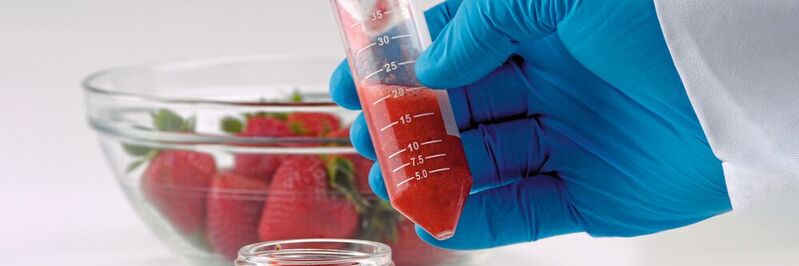
A standard Quechers solid-liquid extraction tube.
(Source: Thermo Fisher Scientific)
If you are working in food analysis you will know, how challenging it can be, but why exactly is it so time consuming and complicated? It all starts with the sample itself. Food samples can encompass anything from sodas to baked goods, fruits and vegetables to dairy products and it is due to the huge variety of samples and matrices that are encountered where the challenges begin. In this article, common pitfalls that are made when processing food samples will be discussed and a starting point in sample preparation for many different types of matrices will be shown.
The Different Sample Matrix Problem
Dairy products are an example of a food group with a large variety from milk to cheese to yoghurt. Milk contains milk sugar, cheese has a high amount of fat, in yoghurt there are flavors, sugars, and in some cases even sugar alcohols are found. It is this that makes it a different matrix every time and to make it even more challenging, the detection limits are different for adults and infant formulas. Just this one example shows, how many things need to be taken into consideration. Now think about all the other groups of foods and sub-groups. An avocado is a fruit, and a strawberry is also a fruit, however, they contain completely different amounts of water and fat.
With these examples, it is obvious that there is not one single sample preparation method that works for all matrices even within one food type. The large variety of samples and analytes makes it so complicated to take the right approach. Figure 2 in the gallery below shows common food matrices and frequently used sample preparation techniques.
Gallery
The Sample Preparation and Processing Issue
For as many different matrices, there are as many sample preparation options available! Some are more regulated by the government than others. A highly water-based matrix is a different challenge to a fat or protein containing matrix. The job of the sample preparation is the separation of the analytes from the matrix, to concentrate and then provide them in a way, that they are analytically compatible and that necessary detection limits are accomplished.
Think about a sample matrix you really dislike. For some, this is a meat sample containing maggots, for others it might be a fish. However, that is not what makes it complicated. The matrix itself, as well as the analytes and their chemical properties are the bases for preparing the right sample.
Other things that could impact heavily on the analytical results may occur even before samples reach the laboratory. Such as, when samples are collected, the way they are then stored or even during transportation. Hopefully, you are not using plastic, which can contaminate your sample with phthalates and other extractables. Be aware of other issues, such as cross contamination from cutting tools and even air!
Most samples, if not all, must be homogenized to achieve comparable and reliable results, it can be one of the most time-consuming steps. In the case of liquid samples, it is usually easier. For samples like fruits, it is less complicated if the shell or peel can easily be removed (citrus fruits). Sometimes the fruit or vegetable needs to be cut into small pieces with the risk that the temperature could get too high during this mechanical process, as a result analytes like pesticides may degrade and not be detected. Cooled ball mills or dry ice could be one solution to avoid losing analytes during the homogenization process.
And finally one last thing to think about… how do you wash up? There are special dishwashers available for labs, but really good ones are expensive. Now, are you separating the glassware you use for low concentrations from those with high concentrations? In most of the cases the answer is no. However, a sticky, fat and/or protein containing matrix, can leave traces on your glassware. This leads to cross contamination and in some cases to false positive results. And the problems can vary from matrix to matrix.
The Sample Extraction and Clean-up Challenge — Choices
If you are looking into solids or oil, liquid-liquid-extraction (LLE) is the route to go first. The compounds of interest need to be extracted, the matrix removed, and the analytes need to be extracted into a more analytical solution. Now you think this is universal enough, however, is it clean enough? The analytical system can be easily contaminated and requires a lot of maintenance afterwards, in other words cleaning becomes necessary. This costs time as well as resources and this is not what is needed in a lab that needs to produce results.
Date: 08.12.2025
Naturally, we always handle your personal data responsibly. Any personal data we receive from you is processed in accordance with applicable data protection legislation. For detailed information please see our privacy policy.
Consent to the use of data for promotional purposes
I hereby consent to Vogel Communications Group GmbH & Co. KG, Max-Planck-Str. 7-9, 97082 Würzburg including any affiliated companies according to §§ 15 et seq. AktG (hereafter: Vogel Communications Group) using my e-mail address to send editorial newsletters. A list of all affiliated companies can be found here
Newsletter content may include all products and services of any companies mentioned above, including for example specialist journals and books, events and fairs as well as event-related products and services, print and digital media offers and services such as additional (editorial) newsletters, raffles, lead campaigns, market research both online and offline, specialist webportals and e-learning offers. In case my personal telephone number has also been collected, it may be used for offers of aforementioned products, for services of the companies mentioned above, and market research purposes.
Additionally, my consent also includes the processing of my email address and telephone number for data matching for marketing purposes with select advertising partners such as LinkedIn, Google, and Meta. For this, Vogel Communications Group may transmit said data in hashed form to the advertising partners who then use said data to determine whether I am also a member of the mentioned advertising partner portals. Vogel Communications Group uses this feature for the purposes of re-targeting (up-selling, cross-selling, and customer loyalty), generating so-called look-alike audiences for acquisition of new customers, and as basis for exclusion for on-going advertising campaigns. Further information can be found in section “data matching for marketing purposes”.
In case I access protected data on Internet portals of Vogel Communications Group including any affiliated companies according to §§ 15 et seq. AktG, I need to provide further data in order to register for the access to such content. In return for this free access to editorial content, my data may be used in accordance with this consent for the purposes stated here. This does not apply to data matching for marketing purposes.
Right of revocation
I understand that I can revoke my consent at will. My revocation does not change the lawfulness of data processing that was conducted based on my consent leading up to my revocation. One option to declare my revocation is to use the contact form found at https://contact.vogel.de. In case I no longer wish to receive certain newsletters, I have subscribed to, I can also click on the unsubscribe link included at the end of a newsletter. Further information regarding my right of revocation and the implementation of it as well as the consequences of my revocation can be found in the data protection declaration, section editorial newsletter.
The other issue is that it is not possible to run extremely low concentrations defined by regulatory methods, such as those required in infant formulas, and then run high concentration extracts on the same instrument. This is when more sophisticated clean-up, such as solid-phase-extraction (SPE) comes into play. Surely, this is cost and labor intensive, however, it gives you more specific and analytical results. The more specific you get, the better the detection limits will be. Within SPE, there are different stationary phase options available and it all depends on the chemistry and properties of your analytes as to which one you use. But there are solutions out there, proven and widely used.
Another route to try might be the Quechers (quick, easy, cheap, effective, rugged, and safe) technique, which is a solid-liquid-extraction (SLE) that might also require a SPE step afterwards. The image above shows the standard Quechers tube. If you have a liquid sample, you might dilute, derivatize and inject, however, are you absolutely sure that the matrix won’t contaminate your analytical system? Remember, the better the cleanup, the better the results!
If your focus is on volatile substances, there are also additional sample extraction methods that can be used to treat the sample, such as static headspace (HSS), solid-phase-micro-extraction (SPME), or in some cases, purge and trap (P+T). Also, last but not least, let’s not forget accelerated solvent extraction (ASE), just to add to the mix of techniques and your hands won’t get as dirty. Figures 3 and 4 in the gallery below show common analytes and sample preparation techniques used in food analysis.
Gallery
Food Analysis: The Sample of Success
After reading all of this, you can see why food analysis can be such a challenge, and what is discussed literally only touched the tip of the iceberg, showing a few examples and what kind of difficulties can be encountered and as a result questions that can be generated. But, as many matrices as there are and as many complications that can occur, the real difficulty is all the different options that are available and the choices that you have to make.
When it comes down to the sample, always know what you want to get rid of and what you need to detect and how low. Occasionally, it will be necessary to adopt new methods and adapt existing methods to a group of analytes or one specific new analyte, which may have not been on the radar two years ago. In this case, the same strategy applies, matrix and analyte properties determine the sample extraction method.
It is always the goal to find a fast, reliable and economical method that works. However, sometimes a little more effort is recommended to really accomplish the necessary detection limits.
The worst-case scenario from the analytical analysis is a false negative result, or a round robin test that has not been passed. This really reduces the reliability of the lab. In some cases, the lab will lose the authorization to test for certain analytes and this is not what is needed in a demanding and competitive situation in the food testing market.
* P. Gerhards is an Engineer and Regional Marketing Manager EMEA at Thermo Fisher Scientific, Dreieich/Germany.




:quality(80)/p7i.vogel.de/wcms/92/ad/92adbafb37924cea35ea3cf05b7a23e5/0130206318v2.jpeg "The world’s first fully functioning proof-of-concept quantum battery
(Source: Csiro)")
:quality(80)/p7i.vogel.de/wcms/9f/8b/9f8bc2b8491d7a514ca154e9588a07b7/0130205846v1.jpeg "The researchers’ new material, based on mineralised sawdust, is an excellent fire retardant. (Source: Dan Vivas Glaser / from Kürsteiner R et al. Chem Circularity 2026)")
:quality(80)/p7i.vogel.de/wcms/fd/73/fd73fcb3ceda89d1419de1083fcab7b4/0130081520v2.jpeg "The fingers at the heart of this technology were inspired by the fin-ray effect — a design principle derived from the natural structure of fish fins. (Source: University of Texas at Austin )")
:quality(80)/p7i.vogel.de/wcms/fe/64/fe649767c802d53ac63ee2c2a40b7e0d/0130060830v2.jpeg "Sample tube with light-active substance (Source: Elvira Eberhardt / Ulm University)")
:quality(80)/p7i.vogel.de/wcms/8f/b9/8fb98a958e4afe679865fbe52a473680/0129940982v2.jpeg "pH measurement in various nanoparticles using the Nine-Focus meter ensures precise stability and performance control. (Source: Mettler Toledo)")
:quality(80)/p7i.vogel.de/wcms/11/74/1174e5d4c8b07a64637dced8c9506b40/0129787561v2.jpeg "The Multicell Plus high-pressure reactor sets a new benchmark for operator safety, all-round accessibility and ease-of-use. (Source: Asynt)")
:quality(80)/p7i.vogel.de/wcms/ef/6e/ef6e96191183411973b77041fb6b1e16/0129785957v2.jpeg "Manufactured from high-quality crystal polystyrene - these new automation-ready plates are available in a choice of ANSI / SLAS standard (96-well and breakable 8-well strip) formats. (Source: Porvair Sciences)")
:quality(80)/p7i.vogel.de/wcms/ad/ca/adcaa20ef5ccaf7e3b325788b1e349c4/0129784872v2.jpeg "The high performance Degasi Flat Film in-line degasser. (Source: Biotech Fluidics)")
:quality(80)/p7i.vogel.de/wcms/af/40/af40b535eb65c287fbd22ed5483d1d0e/0130206243v2.jpeg "The researchers dug soil pits in order to measure the carbon storage in soil
(Source: Johanna Asch)")
:quality(80)/p7i.vogel.de/wcms/2d/45/2d45aba62f5042baa00f7fd4fa629839/0130036533v2.jpeg "The population of Pune, India, is expected to reach 11 million by 2050. (Source: free licensed)")
:quality(80)/p7i.vogel.de/wcms/52/f8/52f8d5521fdab07ed0a865ec0d8919fd/0130009438v2.jpeg "Drylands support around half of global livestock production and sustain the livelihoods of close to a billion people, while also underpinning soil stability and carbon storage. (Source: Kaust )")
:quality(80)/p7i.vogel.de/wcms/fe/49/fe494ada322615b6e6f6ff0f5bb7c5cf/0129926008v2.jpeg "A mandrill eating fruit. (Source: University of Bristol )")
:quality(80)/p7i.vogel.de/wcms/6f/ba/6fba92196d0cbb1467334f8a2ecc520a/0130203021v2.jpeg "Low to moderate wine consumption shows lower risk compared with spirits, beer and cider (Source: free licensed)")
:quality(80)/p7i.vogel.de/wcms/a9/37/a9376f1d9a893570023d9aa97c085bc5/0129927485v2.jpeg "Examples of foods high in PUFAs include fatty fish and soybeans, while MUFAs include olive oil and avocadoes. (Source: free licensed)")
:quality(80)/p7i.vogel.de/wcms/ea/88/ea88ef8810e21cdd9bb852c70f385ba1/0129797385v2.jpeg "A team of NUS food scientists consisting of Assoc Prof Liu Shao Quan (centre), Dr Lu Yuyun (right) and Ms Geng Chenhan (left) pioneered a co-fermentation method that improves both the nutrient and flavor profile of kombu. (Source: NUS)")
:quality(80)/p7i.vogel.de/wcms/84/2c/842c7c1678ceeec7147ea3a36e238e75/0129356324v2.jpeg "Kaust and Nadec have signed a MOU that establishes a framework for long-term cooperation across agricultural research, technology development, and professional training. (Source: Kaust )")
:quality(80)/p7i.vogel.de/wcms/e9/73/e9732473361377610267347df55071a1/0130205830v2.jpeg "Sleep EEG signals may reveal whether the brain is aging faster than the body — and help identify elevated dementia risk earlier. (Source: free licensed)")
:quality(80)/p7i.vogel.de/wcms/ed/c0/edc0c1a86229b11efd17c5e3f94d14da/0130081211v2.jpeg "A new study finds that virtual visits did not make it easier for psychiatrists, psychologists and therapists to reach significantly more people in areas where access to care has long been limited. (Source: Pixabay)")
:quality(80)/p7i.vogel.de/wcms/9c/52/9c52318bc94be17e6662dfceffa4a0c0/0130060546v2.jpeg "Domestic cat ‘Lanni’ from co-author of the study, Latasha Ludwig, Assistant Clinical Professor at Cornell University, USA. (Source: © Latasha Ludwig)")
:quality(80)/p7i.vogel.de/wcms/4b/f4/4bf4cc9e28e65e11a27dd41da2d1a7f5/0130038185v2.jpeg "The biomarker p-tau217 could help identify women at elevated dementia risk decades before clinical symptoms begin. (Source: free licensed)")
:quality(80)/images.vogel.de/vogelonline/bdb/1710600/1710675/original.jpg "Discover how to set yourself up for success when performing balance-based density determination of solids such as jewelry and precious metals. (Mettler Toledo)")
:quality(80)/images.vogel.de/vogelonline/bdb/1682500/1682579/original.jpg "The new XPR Analytical balance redesigned to meet the needs of laboratory technicians of working fast and lean. (Mettler Toledo)")
:quality(80)/images.vogel.de/vogelonline/bdb/1677000/1677080/original.jpg "Enhance your weighing accuracy, comfort and productivity with the redesigned XPR Analytical balance. (Mettler Toledo)")
:quality(80)/p7i.vogel.de/wcms/4e/05/4e05533c752f479242485678f1c730ef/0101694198.jpeg "A standard Quechers solid-liquid extraction tube. (Source: Thermo Fisher Scientific)")
:quality(80)/p7i.vogel.de/wcms/93/cb/93cbf9483f3c523206878cc9490867b1/96724458.jpeg "(Source: LAB worldwide)")
:quality(80)/p7i.vogel.de/wcms/65/46/6546f8d952eab8b306671006e2e5cfc8/96724457.jpeg "(Source: LAB worldwide)")
:quality(80)/p7i.vogel.de/wcms/30/b7/30b715957e687d2db56c79a7fbc838f1/96724459.jpeg "(Source: LAB worldwide)")
:quality(80)/images.vogel.de/vogelonline/bdb/1776400/1776464/original.jpg "Fig.1: Food testing laboratories have to deal with ever larger amounts of data due to increased regulatory requirements. (©Andrey Popov - stock.adobe.com)")
:quality(80)/images.vogel.de/vogelonline/bdb/1797000/1797011/original.jpg "Rice Investigation, Communication and Education (Rice) Facility at the University of Delaware where the Seyfferth Lab conducts rice experiments in outdoor rice paddies. (Matt Limmer)")
:quality(80)/p7i.vogel.de/wcms/c4/d9/c4d9fa934cb666178b8ce5832bc0ab5e/0124357318v2.jpeg "The TOC-L series delivers a wide measurement range, from 4.0 µg/L to 30,000 mg/L. (Source: Shimadzu Europe)")
:quality(80)/p7i.vogel.de/wcms/b4/4a/b44abe3996c0f2f2c2e40a23f6a67e1f/0125818584v2.jpeg "The article highlights an 8-minute analytical method for the quantification of chlorate and perchlorate in milk and infant formula. (Source: Pixabay)")