Researchers have discovered the significance behind spiders stretching their silk threads. They found out that the stretching process aligns the protein chains within the fibers and increases the number of bonds between those chains, thus, leading to stronger, tougher fibers.
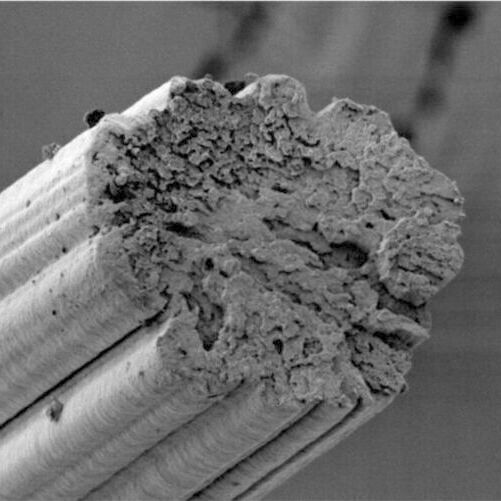
Scanning electron microscopy images of fibers from engineered spider silk.
(Source: Washington University in St. Louis)
Illinois/USA – When spiders spin their webs, they use their hind legs to pull silk threads from their spinnerets. This pulling action doesn’t just help the spider release the silk; it’s also a crucial step in strengthening the silk fibers for a more durable web.
In a new study, Northwestern University researchers have discovered why the role of stretching is so important. By simulating spider silk in a computational model, the team discovered the stretching process aligns the protein chains within the fibers and increases the number of bonds between those chains. Both factors lead to stronger, tougher fibers.
The team then validated these computational predictions through laboratory experiments using engineered spider silk. These insights could help researchers design engineered silk-inspired proteins and spinning processes for various applications, including strong, biodegradable sutures and tough, high-performance, blast-proof body armor.
The study was published on March 7 in the journal Science Advances.
“Researchers already knew this stretching, or drawing, is necessary for making really strong fibers,” said Northwestern’s Sinan Keten, the study’s senior author. “But no one necessarily knew why. With our computational method, we were able to probe what’s happening at the nanoscale to gain insights that cannot be seen experimentally. We could examine how drawing relates to the silk’s mechanical properties.”
“Spiders perform the drawing process naturally,” said Northwestern Jacob Graham, the study’s first author. “When they spin silk out of their silk gland, spiders use their hind legs to grab the fiber and pull it out. That stretches the fiber as it’s being formed. It makes the fiber very strong and very elastic. We found that you can modify the fiber’s mechanical properties simply through modifying the amount of stretching.”
An expert in bioinspired materials, Keten is the Jerome B. Cohen Professor of Engineering, professor and associate chair of mechanical engineering and professor of civil and environmental engineering at Northwestern’s McCormick School of Engineering. Graham is a Ph.D. student in Keten’s research group.
Stronger than steel, tougher than Kevlar
Researchers long have been interested in spider silk because of its remarkable properties. It’s stronger than steel, tougher than Kevlar and stretchy like rubber. But farming spiders for their natural silk is expensive, energy-intensive and difficult. So, scientists instead want to recreate silk-like materials in the lab.
“Spider silk is the strongest organic fiber,” Graham said. “It also has the advantage of being biodegradable. So, it’s an ideal material for medical applications. It could be used for surgical sutures and adhesive gels for wound-closure because it would naturally, harmlessly degrade in the body.”
Study coauthor Fuzhong Zhang, the Francis F. Ahmann Professor at Washington University (WashU) in St. Louis, has been engineering microbes to produce spider-silk materials for several years. By extruding engineered spider silk proteins and then stretching them by hand, the team has developed artificial fibers similar to threads from the golden silk orb weaver, a large spider with a spectacularly strong web.
Simulating stretchiness
Despite developing this “recipe” for spider silk, researchers still don’t fully understand how the spinning process changes fiber structure and strength. To tackle this open-ended question, Keten and Graham developed a computational model to simulate the molecular dynamics within Zhang’s artificial silk.
Through these simulations, the Northwestern team explored how stretching effects the proteins’ arrangement within the fibers. Specifically, they looked at how stretching changes the order of proteins, the connection of proteins to one another and the movement of molecules within the fibers.
Keten and Graham found that stretching caused the proteins to “line up,” which increased the fiber’s overall strength. They also found that stretching increased the number of hydrogen bonds, which act like bridges between the protein chains to make up the fiber. The increase in hydrogen bonds contributes to the fiber’s overall strength, toughness and elasticity, the researchers found.
Date: 08.12.2025
Naturally, we always handle your personal data responsibly. Any personal data we receive from you is processed in accordance with applicable data protection legislation. For detailed information please see our privacy policy.
Consent to the use of data for promotional purposes
I hereby consent to Vogel Communications Group GmbH & Co. KG, Max-Planck-Str. 7-9, 97082 Würzburg including any affiliated companies according to §§ 15 et seq. AktG (hereafter: Vogel Communications Group) using my e-mail address to send editorial newsletters. A list of all affiliated companies can be found here
Newsletter content may include all products and services of any companies mentioned above, including for example specialist journals and books, events and fairs as well as event-related products and services, print and digital media offers and services such as additional (editorial) newsletters, raffles, lead campaigns, market research both online and offline, specialist webportals and e-learning offers. In case my personal telephone number has also been collected, it may be used for offers of aforementioned products, for services of the companies mentioned above, and market research purposes.
Additionally, my consent also includes the processing of my email address and telephone number for data matching for marketing purposes with select advertising partners such as LinkedIn, Google, and Meta. For this, Vogel Communications Group may transmit said data in hashed form to the advertising partners who then use said data to determine whether I am also a member of the mentioned advertising partner portals. Vogel Communications Group uses this feature for the purposes of re-targeting (up-selling, cross-selling, and customer loyalty), generating so-called look-alike audiences for acquisition of new customers, and as basis for exclusion for on-going advertising campaigns. Further information can be found in section “data matching for marketing purposes”.
In case I access protected data on Internet portals of Vogel Communications Group including any affiliated companies according to §§ 15 et seq. AktG, I need to provide further data in order to register for the access to such content. In return for this free access to editorial content, my data may be used in accordance with this consent for the purposes stated here. This does not apply to data matching for marketing purposes.
Right of revocation
I understand that I can revoke my consent at will. My revocation does not change the lawfulness of data processing that was conducted based on my consent leading up to my revocation. One option to declare my revocation is to use the contact form found at https://contact.vogel.de. In case I no longer wish to receive certain newsletters, I have subscribed to, I can also click on the unsubscribe link included at the end of a newsletter. Further information regarding my right of revocation and the implementation of it as well as the consequences of my revocation can be found in the data protection declaration, section editorial newsletter.
“Once a fiber is extruded, its mechanical properties are actually quite weak,” Graham said. “But when it’s stretch up to six times its initial length, it becomes very strong.”
Experimental validation
To validate their computational findings, the team used spectroscopy techniques to examine how the protein chains stretched and aligned in real fibers from the WashU team. They also used tensile testing to see how much stretching the fibers could tolerate before breaking. The experimental results agreed with the simulation’s predictions.
“If you don’t stretch the material, you have these spherical globs of proteins,” Graham said. “But stretching turns these globs into more of an interconnected network. The protein chains stack on top of one another, and the network becomes more and more interconnected. Bundled proteins have more potential to unravel and extend further before the fiber breaks, but initially extended proteins make for less extensible fibers that require more force to break.”
Although Graham used to think spiders were just creepy-crawlies, he now sees their potential to help solve real problems. He notes that engineered spider silk provides a stronger, biodegradable alternative to other synthetic materials, which are mostly petroleum-derived plastics.
“I definitely look at spiders in a new light,” Graham said. “I used to think they were nuisances. Now, I see them as a source of fascination.”
The study, “Charting the envelope of mechanical properties of synthetic silk fibers through predictive modeling of the drawing process,” was supported by the National Science Foundation (grant numbers OIA-2219142 and DMR-2207879).




:quality(80)/p7i.vogel.de/wcms/06/a1/06a11f1d752afb35854aa9e1afb62e98/0129209625v2.jpeg "“Unsinkable\" metal tube made from chemically-etched aluminum floats in distilled water at the lab of University of Rochester professor Chunlei Guo. (Source: J. Adam Fenster / University of Rochester)")
:quality(80)/p7i.vogel.de/wcms/6d/df/6ddf023361ec7f8fbfb6c56521577960/0129056554v2.jpeg "The evolution of carburization (depicted by the spheres) under kinetic control (illustrated by the surface contours). The molecular beams represent gas evolution under synthesis conditions while the fiery sphere highlights the formation of the pure tungsten semi-carbide phase with additional molecular beams at the top to illustrate its catalytic performance. (Source: Sinhara M. H. D. Perera)")
:quality(80)/p7i.vogel.de/wcms/26/3d/263d97f8f2797267ecf2781b56882758/0129056451v1.jpeg "A study by the Complexity Science Hub finds that AI systems are already involved in nearly one-third of newly written software code, with rapid adoption in the United States and Europe and measurable productivity gains mainly for experienced developers. (Source: free licensed)")
:quality(80)/p7i.vogel.de/wcms/63/0c/630cf9ab0cafdcdd9b33802d53c5b943/0128938770v1.jpeg "A microscopic close-up of the bubbles in foam, whose movements mathematically mirror the process of deep learning, used to train modern AI systems. (Source: Crocker Lab)")
:quality(80)/p7i.vogel.de/wcms/21/03/21030cc2541c455da0769decca8d1f82/0129146048v2.jpeg "Vyon porous plastics from Porvair Sciences are the perfect material for filtration applications in the healthcare and medical device market. (Source: Porvair Sciences)")
:quality(80)/p7i.vogel.de/wcms/bd/aa/bdaae5b9d381e2471ab37f479ad43d79/0129143884v2.jpeg "The Solvent Line Monitor from Testa Analytical is a true plug-and-play addition to any HPLC system designed to detect when one or more of its pump solvent reservoirs are empty and automatically shut-off the system. (Source: Testa Analytical)")
:quality(80)/p7i.vogel.de/wcms/8f/66/8f66b8acbb3037ca8e6b320bcad1c817/0129118043v2.jpeg "The Plasmaquant 9200 series is ideal for applications in research, trace analysis and quality control. (Source: Analytik Jena )")
:quality(80)/p7i.vogel.de/wcms/66/82/66825163ab842baded640db1a484e729/0129117548v2.jpeg "Biotech Fluidics has announced the Smartsaver solvent recycling unit which is designed to recover up to 90 % of your mobile phase by redirection of the pure solvent to the solvent reservoir during isocratic HPLC. (Source: Biotech Fluidics )")
:quality(80)/p7i.vogel.de/wcms/90/f8/90f8c3152a59205a7cac1cc182eb186b/0129209634v2.jpeg "Nitrate in drinking water linked to increased dementia risk while nitrate from vegetables is linked to a lower risk, researchers find . (Source: free licensed)")
:quality(80)/p7i.vogel.de/wcms/53/ac/53acd3796c0d43ad0f7cfd80dd7ab82e/0129209615v1.jpeg "Prenatal exposure to NO2, black carbon, and PM2.5 may reduce recognition memory in newborns, with effects more pronounced in boys than in girls. (Source: free licensed)")
:quality(80)/p7i.vogel.de/wcms/a3/cd/a3cdc440f6f0f426b85042082678018f/0129165252v2.jpeg "People exposed to wildfire smoke have a higher risk of suffering a stroke, according to research published in the European Heart Journal recently. (Source: Pixabay)")
:quality(80)/p7i.vogel.de/wcms/6c/15/6c15f7685b6076b906f2d572f6c71bb8/0129103298v2.jpeg "Although only 2 % of U.S. homes rely on wood as their primary heating source, residential wood burning accounts for more than one-fifth of Americans’ wintertime exposure to outdoor fine particulate matter (PM2.5), the new study found. (Source: Pixabay)")
:quality(80)/p7i.vogel.de/wcms/d1/3c/d13c2ad34af600dbd360c0bb0990b922/0129045715v2.jpeg "Replacing animal products with plant-based foods helps reduce the risk of heart disease and type 2 diabetes, finds a new review by the Physicians Committee for Responsible Medicine. (Source: Pixabay)")
:quality(80)/p7i.vogel.de/wcms/e1/b3/e1b3e26d03101ba93b76b304da150c9a/0129025388v2.jpeg "The research reanalyzed data from a seminal clinical trial, led by US National Institutes of Health veteran Dr Kevin Hall, which first exposed how eating exclusively UPFs results in excessive calorie consumption and weight gain. (Source: Pixabay)")
:quality(80)/p7i.vogel.de/wcms/75/db/75db8afe45607bee750df705e22b60e9/0128938816v1.jpeg "A new academic review suggests that bamboo shoots could offer significant health benefits, including improved blood sugar control, gut health and antioxidant activity. (Source: free licensed)")
:quality(80)/p7i.vogel.de/wcms/85/42/85423f3382c25d1ae0ac5645e969cd36/0128898289v2.jpeg "Dr Arya Gopinath Madathil Pulikkal (left) and Asst Prof Andy Tay (right) in front of a small greenhouse containing Choy Sum plants. (Source: NUS)")
:quality(80)/p7i.vogel.de/wcms/f1/ea/f1eac0379480f4aa25ab2db9e0a396ed/0129209654v2.jpeg "Roe deer in study plot (Source: Walter Di Nicola)")
:quality(80)/p7i.vogel.de/wcms/34/a4/34a44fab2ba6af4b5f7cb8c3ecfc6362/0129207768v1.jpeg "AI generated image of the New Zealand cave (Source: P Scofield, Canterbury Museum)")
:quality(80)/p7i.vogel.de/wcms/a4/12/a412474313fc7d83bc51a4b99ef0af73/0129189645v2.jpeg "Around age 35, men’s risk for cardiovascular risk began to rise faster and stayed higher through midlife. (Source: Pixabay)")
:quality(80)/images.vogel.de/vogelonline/bdb/1710600/1710675/original.jpg "Discover how to set yourself up for success when performing balance-based density determination of solids such as jewelry and precious metals. (Mettler Toledo)")
:quality(80)/images.vogel.de/vogelonline/bdb/1682500/1682579/original.jpg "The new XPR Analytical balance redesigned to meet the needs of laboratory technicians of working fast and lean. (Mettler Toledo)")
:quality(80)/images.vogel.de/vogelonline/bdb/1677000/1677080/original.jpg "Enhance your weighing accuracy, comfort and productivity with the redesigned XPR Analytical balance. (Mettler Toledo)")
:quality(80)/p7i.vogel.de/wcms/e4/a4/e4a4c0052425933c3e3dff66a6084554/0123895785v2.jpeg "With full freedom of motion, new device can generate a variety of sensations, including pulling, stretching, sliding, vibrations, pressure and twisting. (Source: John A. Rogers/ Northwestern University)")
:quality(80)/p7i.vogel.de/wcms/e6/aa/e6aab8f624f2443c3a22f86840e334d5/0123503316v1.jpeg "Silica nanoparticles affixed with a distribution of polystyrene chains (purple) self-assemble into hexagonal lattices. Depending on how the chains are organized on the particle surface, they tangle together (purple) or unravel (blue) when compressed. (Source: Tiffany Chen/ Ting Xu)")