Materials SciencesGoodbye Permanent Bonds: New Material Uses ‘Pseudo-Bonds’ for Recyclable Strength
Source:
Lawrence Berkeley National Laboratory
3 min Reading Time
Composite adhesives like epoxy resins are excellent tools for joining and filling materials including wood, metal, and concrete. But there’s one problem: once a composite sets, it’s there forever. Now there’s a better way.
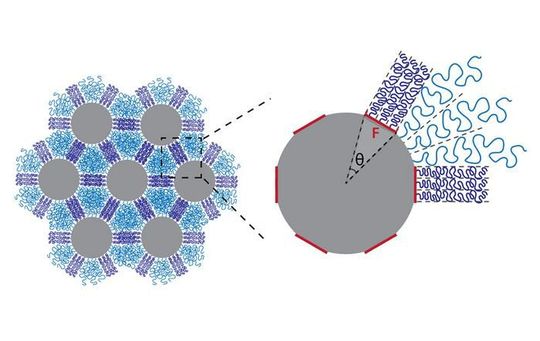
Silica nanoparticles affixed with a distribution of polystyrene chains (purple) self-assemble into hexagonal lattices. Depending on how the chains are organized on the particle surface, they tangle together (purple) or unravel (blue) when compressed.
(Source: Tiffany Chen/ Ting Xu)
A new study led by researchers at the Department of Energy’s Lawrence Berkeley National Laboratory (Berkeley Lab) outlines a way to engineer pseudo-bonds in materials. Instead of forming chemical bonds, which is what makes epoxies and other composites so tough, the chains of molecules entangle in a way that is fully reversible. The research is published in the journal Advanced Materials.
“This is a brand new way of solidifying materials. We open a new path to composites that doesn’t go with the traditional ways,” said Ting Xu, a faculty senior scientist at Berkeley Lab and one of the lead authors for the study.
Traditionally, there are two ways to make polymer materials strong and tough. In the first, adding a setting agent creates a crosslinked network of polymer molecules held together by permanent chemical bonds. In the second, increasing the length of polymer molecule chains causes them to get more and more entangled, so they can’t come apart. The latter, Xu proposed, offers the possibility of a reversible design. She likened the concept to folded proteins that interact without chemical bonds to create sturdy structures in nature, and can later unfold into their constituent strands.
Xu along with her colleagues in Berkeley Lab’s Materials Sciences Division wanted to build on this concept and start with a collection of simple polystyrene chains, tangle them together into a tough and stable structure, and then take the material back to its starting point. “Let’s say you have a ball of yarn, and it’s a mess. You can’t untangle it,” said Xu. “But if you play with the yarn, maybe you can trick it to untangle.”
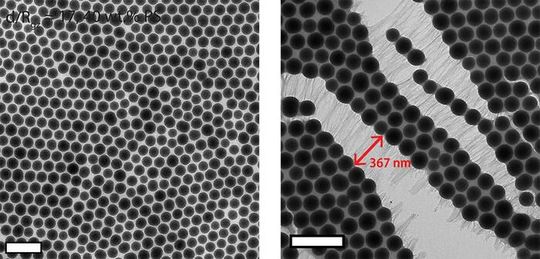
Microscope images of nanoparticles with polymer chains attached before (left) and after (right) deformation, showing long nanofiber formation with polymer chains stretching out.
(Source: Tiffany Chen/ Ting Xu)
With this in mind, the researchers attached polystyrene chains to hundred-nanometers-diameter silica particles, to create what Xu dubbed “hairy particles.” By forming nanocomposites, these hairy particles self-assembled into a crystal-like structure, providing different spaces between each unit for the hairy polymers to fill. The space available to each polystyrene chain depended on its position in the structure — and, therefore, determined how much it tangled together with its neighbors.
By confining the polymer chains into these tiny spaces with different geometries, Xu reduced the freedom with which any cluster of polystyrene chains could move — thus exercising control over how entangled they became. Or, as it turns out, how not entangled: for certain arrangements, the response to squeezing was that a specific cluster of polystyrene chains loosened up in response to an applied force.
“How much entanglement happens with the particles determines their response to an external force,” said Xu, who is also a professor in UC Berkeley’s College of Engineering and College of Chemistry. By adjusting the polystyrene chain size, as well as precisely where and how many chains were affixed to each facet of the silica particle, she could tweak how the structure responded to dissipate external stresses. Ultimately, these parameters provided the key to engineering entanglement-based “pseudo bonds.”
Microscopy studies revealed that while some chains became rigid under confinement, others ultimately disentangled and stretched to dissipate the external stress. The result was a strong, tough, thin-film material, held firmly together by pseudo bonds of tangled polystyrene chains. Adding small amounts of polystyrene chains themselves to the nanoparticle assemblies increased the final load-bearing properties by another 50 %.
“We were really excited that now we can maneuver amorphous polymer organization using nanoconfinement,” said Xu. Until now, amorphous polymers are often randomly entangled, whereas proteins fold nicely. The variations in polystyrene chain arrangement now hits a sweet spot that can be used to engineer composites in a smart way. Moreover, adding a drop of solvent and stirring dissolved the nanocomposite back into its constituent particles suspended: there were no chemical bonds to break, allowing the materials to be reprocessed.
According to Xu, the Berkeley Lab study can readily be extended to other polymers and fillers. Polystyrene is one of the most common polymers and silica is a cheap nanoparticle; nonetheless, Xu hypothesizes that the results will apply to other composites as well. She imagines a future with particles that have other optical or magnetic properties, for example, to create composites for optoelectronic devices. “We can have both strength and toughness, just by modulating how the polymers are distributed,” said Xu.
Original Article: A New Way to Engineer Composite Materials; Advanced Materials; DOI:10.1002/adma.202415352
Date: 08.12.2025
Naturally, we always handle your personal data responsibly. Any personal data we receive from you is processed in accordance with applicable data protection legislation. For detailed information please see our privacy policy.
Consent to the use of data for promotional purposes
I hereby consent to Vogel Communications Group GmbH & Co. KG, Max-Planck-Str. 7-9, 97082 Würzburg including any affiliated companies according to §§ 15 et seq. AktG (hereafter: Vogel Communications Group) using my e-mail address to send editorial newsletters. A list of all affiliated companies can be found here
Newsletter content may include all products and services of any companies mentioned above, including for example specialist journals and books, events and fairs as well as event-related products and services, print and digital media offers and services such as additional (editorial) newsletters, raffles, lead campaigns, market research both online and offline, specialist webportals and e-learning offers. In case my personal telephone number has also been collected, it may be used for offers of aforementioned products, for services of the companies mentioned above, and market research purposes.
Additionally, my consent also includes the processing of my email address and telephone number for data matching for marketing purposes with select advertising partners such as LinkedIn, Google, and Meta. For this, Vogel Communications Group may transmit said data in hashed form to the advertising partners who then use said data to determine whether I am also a member of the mentioned advertising partner portals. Vogel Communications Group uses this feature for the purposes of re-targeting (up-selling, cross-selling, and customer loyalty), generating so-called look-alike audiences for acquisition of new customers, and as basis for exclusion for on-going advertising campaigns. Further information can be found in section “data matching for marketing purposes”.
In case I access protected data on Internet portals of Vogel Communications Group including any affiliated companies according to §§ 15 et seq. AktG, I need to provide further data in order to register for the access to such content. In return for this free access to editorial content, my data may be used in accordance with this consent for the purposes stated here. This does not apply to data matching for marketing purposes.
Right of revocation
I understand that I can revoke my consent at will. My revocation does not change the lawfulness of data processing that was conducted based on my consent leading up to my revocation. One option to declare my revocation is to use the contact form found at https://contact.vogel.de. In case I no longer wish to receive certain newsletters, I have subscribed to, I can also click on the unsubscribe link included at the end of a newsletter. Further information regarding my right of revocation and the implementation of it as well as the consequences of my revocation can be found in the data protection declaration, section editorial newsletter.




:quality(80)/p7i.vogel.de/wcms/06/a1/06a11f1d752afb35854aa9e1afb62e98/0129209625v2.jpeg "“Unsinkable\" metal tube made from chemically-etched aluminum floats in distilled water at the lab of University of Rochester professor Chunlei Guo. (Source: J. Adam Fenster / University of Rochester)")
:quality(80)/p7i.vogel.de/wcms/6d/df/6ddf023361ec7f8fbfb6c56521577960/0129056554v2.jpeg "The evolution of carburization (depicted by the spheres) under kinetic control (illustrated by the surface contours). The molecular beams represent gas evolution under synthesis conditions while the fiery sphere highlights the formation of the pure tungsten semi-carbide phase with additional molecular beams at the top to illustrate its catalytic performance. (Source: Sinhara M. H. D. Perera)")
:quality(80)/p7i.vogel.de/wcms/26/3d/263d97f8f2797267ecf2781b56882758/0129056451v1.jpeg "A study by the Complexity Science Hub finds that AI systems are already involved in nearly one-third of newly written software code, with rapid adoption in the United States and Europe and measurable productivity gains mainly for experienced developers. (Source: free licensed)")
:quality(80)/p7i.vogel.de/wcms/63/0c/630cf9ab0cafdcdd9b33802d53c5b943/0128938770v1.jpeg "A microscopic close-up of the bubbles in foam, whose movements mathematically mirror the process of deep learning, used to train modern AI systems. (Source: Crocker Lab)")
:quality(80)/p7i.vogel.de/wcms/21/03/21030cc2541c455da0769decca8d1f82/0129146048v2.jpeg "Vyon porous plastics from Porvair Sciences are the perfect material for filtration applications in the healthcare and medical device market. (Source: Porvair Sciences)")
:quality(80)/p7i.vogel.de/wcms/bd/aa/bdaae5b9d381e2471ab37f479ad43d79/0129143884v2.jpeg "The Solvent Line Monitor from Testa Analytical is a true plug-and-play addition to any HPLC system designed to detect when one or more of its pump solvent reservoirs are empty and automatically shut-off the system. (Source: Testa Analytical)")
:quality(80)/p7i.vogel.de/wcms/8f/66/8f66b8acbb3037ca8e6b320bcad1c817/0129118043v2.jpeg "The Plasmaquant 9200 series is ideal for applications in research, trace analysis and quality control. (Source: Analytik Jena )")
:quality(80)/p7i.vogel.de/wcms/66/82/66825163ab842baded640db1a484e729/0129117548v2.jpeg "Biotech Fluidics has announced the Smartsaver solvent recycling unit which is designed to recover up to 90 % of your mobile phase by redirection of the pure solvent to the solvent reservoir during isocratic HPLC. (Source: Biotech Fluidics )")
:quality(80)/p7i.vogel.de/wcms/90/f8/90f8c3152a59205a7cac1cc182eb186b/0129209634v2.jpeg "Nitrate in drinking water linked to increased dementia risk while nitrate from vegetables is linked to a lower risk, researchers find . (Source: free licensed)")
:quality(80)/p7i.vogel.de/wcms/53/ac/53acd3796c0d43ad0f7cfd80dd7ab82e/0129209615v1.jpeg "Prenatal exposure to NO2, black carbon, and PM2.5 may reduce recognition memory in newborns, with effects more pronounced in boys than in girls. (Source: free licensed)")
:quality(80)/p7i.vogel.de/wcms/a3/cd/a3cdc440f6f0f426b85042082678018f/0129165252v2.jpeg "People exposed to wildfire smoke have a higher risk of suffering a stroke, according to research published in the European Heart Journal recently. (Source: Pixabay)")
:quality(80)/p7i.vogel.de/wcms/6c/15/6c15f7685b6076b906f2d572f6c71bb8/0129103298v2.jpeg "Although only 2 % of U.S. homes rely on wood as their primary heating source, residential wood burning accounts for more than one-fifth of Americans’ wintertime exposure to outdoor fine particulate matter (PM2.5), the new study found. (Source: Pixabay)")
:quality(80)/p7i.vogel.de/wcms/d1/3c/d13c2ad34af600dbd360c0bb0990b922/0129045715v2.jpeg "Replacing animal products with plant-based foods helps reduce the risk of heart disease and type 2 diabetes, finds a new review by the Physicians Committee for Responsible Medicine. (Source: Pixabay)")
:quality(80)/p7i.vogel.de/wcms/e1/b3/e1b3e26d03101ba93b76b304da150c9a/0129025388v2.jpeg "The research reanalyzed data from a seminal clinical trial, led by US National Institutes of Health veteran Dr Kevin Hall, which first exposed how eating exclusively UPFs results in excessive calorie consumption and weight gain. (Source: Pixabay)")
:quality(80)/p7i.vogel.de/wcms/75/db/75db8afe45607bee750df705e22b60e9/0128938816v1.jpeg "A new academic review suggests that bamboo shoots could offer significant health benefits, including improved blood sugar control, gut health and antioxidant activity. (Source: free licensed)")
:quality(80)/p7i.vogel.de/wcms/85/42/85423f3382c25d1ae0ac5645e969cd36/0128898289v2.jpeg "Dr Arya Gopinath Madathil Pulikkal (left) and Asst Prof Andy Tay (right) in front of a small greenhouse containing Choy Sum plants. (Source: NUS)")
:quality(80)/p7i.vogel.de/wcms/f1/ea/f1eac0379480f4aa25ab2db9e0a396ed/0129209654v2.jpeg "Roe deer in study plot (Source: Walter Di Nicola)")
:quality(80)/p7i.vogel.de/wcms/34/a4/34a44fab2ba6af4b5f7cb8c3ecfc6362/0129207768v1.jpeg "AI generated image of the New Zealand cave (Source: P Scofield, Canterbury Museum)")
:quality(80)/p7i.vogel.de/wcms/a4/12/a412474313fc7d83bc51a4b99ef0af73/0129189645v2.jpeg "Around age 35, men’s risk for cardiovascular risk began to rise faster and stayed higher through midlife. (Source: Pixabay)")
:quality(80)/images.vogel.de/vogelonline/bdb/1710600/1710675/original.jpg "Discover how to set yourself up for success when performing balance-based density determination of solids such as jewelry and precious metals. (Mettler Toledo)")
:quality(80)/images.vogel.de/vogelonline/bdb/1682500/1682579/original.jpg "The new XPR Analytical balance redesigned to meet the needs of laboratory technicians of working fast and lean. (Mettler Toledo)")
:quality(80)/images.vogel.de/vogelonline/bdb/1677000/1677080/original.jpg "Enhance your weighing accuracy, comfort and productivity with the redesigned XPR Analytical balance. (Mettler Toledo)")
:quality(80)/p7i.vogel.de/wcms/95/f2/95f265acecd99375327c2b0f3b312e81/0124276650v2.jpeg "Illustration of 2D mechanically interlocked polymer (Source: Dengke Shen/ Anhui University)")
:quality(80)/p7i.vogel.de/wcms/04/01/0401ab4a2d065c6789686f7d58a0924c/0124381992v2.jpeg "Bendable ceramic origami material created in the UH lab of Maksud Rahman, assistant professor of mechanical and aerospace engineering. The new material could power next-gen prosthetics and aerospace technology. (Source: University of Houston)")