What if your skin could feel virtual silk, sense direction, or even hear music? While most haptics are stuck on simple buzzes, Northwestern engineers have cracked the code to complex touch. Their new device doesn’t just vibrate — it stretches, twists, slides, and taps, bringing the full language of touch into the digital age.
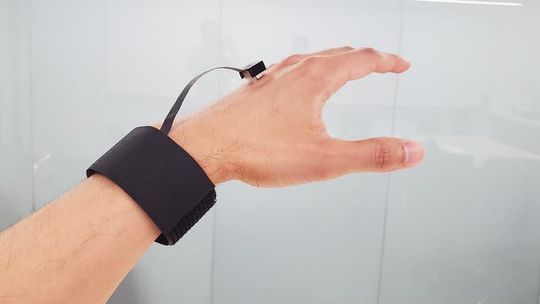
With full freedom of motion, new device can generate a variety of sensations, including pulling, stretching, sliding, vibrations, pressure and twisting.
(Source: John A. Rogers/ Northwestern University)
When it comes to haptic feedback, most technologies are limited to simple vibrations. But our skin is loaded with tiny sensors that detect pressure, vibration, stretching and more. Now, Northwestern University engineers have unveiled a new technology that creates precise movements to mimic these complex sensations.
While sitting on the skin, the compact, lightweight, wireless device applies force in any direction to generate a variety of sensations, including vibrations, stretching, pressure, sliding and twisting. The device also can combine sensations and operate fast or slow to simulate a more nuanced, realistic sense of touch.
Gallery
Powered by a small rechargeable battery, the device uses Bluetooth to wirelessly connect to virtual reality headsets and smartphones. It also is small and efficient, so it could be placed anywhere on the body, combined with other actuators in arrays or integrated into current wearable electronics.
The researchers envision their device eventually could enhance virtual experiences, help individuals with visual impairments navigate their surroundings, reproduce the feeling of different textures on flat screens for online shopping, provide tactile feedback for remote health care visits and even enable people with hearing impairments to “feel” music.
“Almost all haptic actuators really just poke at the skin,” said Northwestern’s John A. Rogers, who led the device design. “But skin is receptive to much more sophisticated senses of touch. We wanted to create a device that could apply forces in any direction — not just poking but pushing, twisting and sliding. We built a tiny actuator that can push the skin in any direction and in any combination of directions. With it, we can finely control the complex sensation of touch in a fully programmable way.”
A pioneer in bioelectronics, Rogers is the Louis A. Simpson and Kimberly Querrey Professor of Materials Science and Engineering, Biomedical Engineering, and Neurological Surgery, with appointments in the McCormick School of Engineering and Northwestern University Feinberg School of Medicine. He also directs the Querrey Simpson Institute for Bioelectronics. Rogers co-led the work with Northwestern’s Yonggang Huang, the Jan and Marcia Achenbach Professor in Mechanical Engineering and professor of civil and environmental engineering at McCormick. Northwestern’s Kyoung-Ho Ha, Jaeyoung Yoo and Shupeng Li are the study’s co-first authors.
The study builds on previous work from Rogers’ and Huang’s labs, in which they designed a programmable array of miniature vibrating actuators to convey a sense of touch.
In recent years, visual and auditory technologies have experienced explosive growth, delivering unprecedented immersion through devices like high-fidelity, deeply detailed surround-sound speakers and fully immersive virtual-reality goggles. Haptics technologies, however, mostly have plateaued. Even state-of-the-art systems only offer buzzing patterns of vibrations.
This developmental gap stems largely from the extraordinary complexity of human touch. The sense of touch involves different types of mechanoreceptors (or sensors) — each with its own sensitivity and response characteristics — located at varying depths within the skin. When these mechanoreceptors are stimulated, they send signals to the brain, which are translated as touch.
Replicating that sophistication and nuance requires precise control over the type, magnitude and timing of stimuli delivered to the skin. This presents a massive challenge, which current technologies have struggled — and failed — to overcome.
“Part of the reason haptic technology lags video and audio in its richness and realism is that the mechanics of skin deformation are complicated,” said Northwestern’s J. Edward Colgate, a haptics pioneer and study co-author. “Skin can be poked in or stretched sideways. Skin stretching can happen slowly or quickly, and it can happen in complex patterns across a full surface, such as the full palm of the hand.”
Date: 08.12.2025
Naturally, we always handle your personal data responsibly. Any personal data we receive from you is processed in accordance with applicable data protection legislation. For detailed information please see our privacy policy.
Consent to the use of data for promotional purposes
I hereby consent to Vogel Communications Group GmbH & Co. KG, Max-Planck-Str. 7-9, 97082 Würzburg including any affiliated companies according to §§ 15 et seq. AktG (hereafter: Vogel Communications Group) using my e-mail address to send editorial newsletters. A list of all affiliated companies can be found here
Newsletter content may include all products and services of any companies mentioned above, including for example specialist journals and books, events and fairs as well as event-related products and services, print and digital media offers and services such as additional (editorial) newsletters, raffles, lead campaigns, market research both online and offline, specialist webportals and e-learning offers. In case my personal telephone number has also been collected, it may be used for offers of aforementioned products, for services of the companies mentioned above, and market research purposes.
Additionally, my consent also includes the processing of my email address and telephone number for data matching for marketing purposes with select advertising partners such as LinkedIn, Google, and Meta. For this, Vogel Communications Group may transmit said data in hashed form to the advertising partners who then use said data to determine whether I am also a member of the mentioned advertising partner portals. Vogel Communications Group uses this feature for the purposes of re-targeting (up-selling, cross-selling, and customer loyalty), generating so-called look-alike audiences for acquisition of new customers, and as basis for exclusion for on-going advertising campaigns. Further information can be found in section “data matching for marketing purposes”.
In case I access protected data on Internet portals of Vogel Communications Group including any affiliated companies according to §§ 15 et seq. AktG, I need to provide further data in order to register for the access to such content. In return for this free access to editorial content, my data may be used in accordance with this consent for the purposes stated here. This does not apply to data matching for marketing purposes.
Right of revocation
I understand that I can revoke my consent at will. My revocation does not change the lawfulness of data processing that was conducted based on my consent leading up to my revocation. One option to declare my revocation is to use the contact form found at https://contact.vogel.de. In case I no longer wish to receive certain newsletters, I have subscribed to, I can also click on the unsubscribe link included at the end of a newsletter. Further information regarding my right of revocation and the implementation of it as well as the consequences of my revocation can be found in the data protection declaration, section editorial newsletter.
Actuator Unleashed
To simulate that complexity, the Northwestern team developed the first actuator with full freedom of motion (FOM). This means the actuator is not constrained to a single type of movement or limited set of movements. Instead, it can move and apply forces in all directions along the skin. These dynamic forces engage all mechanoreceptors in the skin, both individually and in combination with one another.
“It's a big step toward managing the complexity of the sense of touch,” said Colgate, Walter P. Murphy Professor of Mechanical Engineering at McCormick. “The FOM actuator is the first small, compact haptic device that can poke or stretch skin, operate slow or fast, and be used in arrays. As a result, it can be used to produce a remarkable range of tactile sensations.”
Measuring just a few millimeters in size, the device harnesses a tiny magnet and set of wire coils, arranged in a nesting configuration. As electricity flows through the coils, it generates a magnetic field. When that magnetic field interacts with the magnet, it produces a force strong enough to move, push, pull or twist the magnet. By combining actuators into arrays, they can reproduce the feeling of pinching, stretching, squeezing and tapping.
“Achieving both a compact design and strong force output is crucial,” said Huang, who led the theoretical work. “Our team developed computational and analytical models to identify optimal designs, ensuring each mode generates its maximum force component while minimizing unwanted forces or torques.”
On the other side of the device, the team added an accelerometer, which enables it to gauge its orientation in space. With this information, the system can provide haptic feedback based on the user’s context. If the actuator is on a hand, for example, the accelerometer can detect if the user’s hand is palm up or palm down. The accelerator also can track the actuator’s movement, providing information about its speed, acceleration and rotation.
Rogers said this motion-tracking capability is especially useful when navigating spaces or touching different textures on a flat screen.
“If you run your finger along a piece a silk, it will have less friction and slide faster than when touching corduroy or burlap,” he said. “You can imagine shopping for clothes or fabrics online and wanting to feel the texture.”
Beyond replicating everyday tactile experiences, the platform also can transfer information through the skin. By changing the frequency, intensity and rhythm of haptic feedback, the team converted the sound of music into physical touch, for example. They also were able to alter tones just by changing the direction of the vibrations. Feeling these vibrations enabled users to differentiate between various instruments.
“We were able to break down all the characteristics of music and map them into haptic sensations without losing the subtle information associated with specific instruments,” Rogers said. “It’s just one example of how the sense of touch could be used to complement another sensory experience. We think our system could help further close the gap between the digital and physical worlds. By adding a true sense of touch, digital interactions can feel more natural and engaging.”
Original Article: Full freedom-of-motion actuators as advanced haptic interfaces; Science; DOI:10.1126/science.adt2481




:quality(80)/p7i.vogel.de/wcms/fd/73/fd73fcb3ceda89d1419de1083fcab7b4/0130081520v2.jpeg "The fingers at the heart of this technology were inspired by the fin-ray effect — a design principle derived from the natural structure of fish fins. (Source: University of Texas at Austin )")
:quality(80)/p7i.vogel.de/wcms/fe/64/fe649767c802d53ac63ee2c2a40b7e0d/0130060830v2.jpeg "Sample tube with light-active substance (Source: Elvira Eberhardt / Ulm University)")
:quality(80)/p7i.vogel.de/wcms/db/e2/dbe2ae4e02f702b30153a882ef705089/0129978032v1.jpeg "Each of the isolated indium atoms (in gold color) can catalyse the synthesis of methanol (top right). (Source: Constance Ko/ ETH Zurich)")
:quality(80)/p7i.vogel.de/wcms/c1/e6/c1e6ac26eb18993236c100e7f01a78f2/0129937639v1.jpeg "Dogs evolved from highly social ancestors and have been shaped by thousands of years of interacting with humans. (Source: free licensed)")
:quality(80)/p7i.vogel.de/wcms/8f/b9/8fb98a958e4afe679865fbe52a473680/0129940982v2.jpeg "pH measurement in various nanoparticles using the Nine-Focus meter ensures precise stability and performance control. (Source: Mettler Toledo)")
:quality(80)/p7i.vogel.de/wcms/11/74/1174e5d4c8b07a64637dced8c9506b40/0129787561v2.jpeg "The Multicell Plus high-pressure reactor sets a new benchmark for operator safety, all-round accessibility and ease-of-use. (Source: Asynt)")
:quality(80)/p7i.vogel.de/wcms/ef/6e/ef6e96191183411973b77041fb6b1e16/0129785957v2.jpeg "Manufactured from high-quality crystal polystyrene - these new automation-ready plates are available in a choice of ANSI / SLAS standard (96-well and breakable 8-well strip) formats. (Source: Porvair Sciences)")
:quality(80)/p7i.vogel.de/wcms/ad/ca/adcaa20ef5ccaf7e3b325788b1e349c4/0129784872v2.jpeg "The high performance Degasi Flat Film in-line degasser. (Source: Biotech Fluidics)")
:quality(80)/p7i.vogel.de/wcms/2d/45/2d45aba62f5042baa00f7fd4fa629839/0130036533v2.jpeg "The population of Pune, India, is expected to reach 11 million by 2050. (Source: free licensed)")
:quality(80)/p7i.vogel.de/wcms/52/f8/52f8d5521fdab07ed0a865ec0d8919fd/0130009438v2.jpeg "Drylands support around half of global livestock production and sustain the livelihoods of close to a billion people, while also underpinning soil stability and carbon storage. (Source: Kaust )")
:quality(80)/p7i.vogel.de/wcms/fe/49/fe494ada322615b6e6f6ff0f5bb7c5cf/0129926008v2.jpeg "A mandrill eating fruit. (Source: University of Bristol )")
:quality(80)/p7i.vogel.de/wcms/af/4e/af4ea968647ee9cae82b39800c611819/0129865630v2.jpeg "Map of a simulated risk of water stress in 2050 where hydrogen is used in transport and industry. Baseline risk (regardless of hydrogen use) is represented by the background color in each area. Dashed areas show water use exceeding available resources due to hydrogen production. Blue dots show areas where the risk of water stress increases by more than 50 percent in the simulation. (Source: Chalmers University of Technology / Joel Löfving)")
:quality(80)/p7i.vogel.de/wcms/6f/ba/6fba92196d0cbb1467334f8a2ecc520a/0130203021v2.jpeg "Low to moderate wine consumption shows lower risk compared with spirits, beer and cider (Source: free licensed)")
:quality(80)/p7i.vogel.de/wcms/a9/37/a9376f1d9a893570023d9aa97c085bc5/0129927485v2.jpeg "Examples of foods high in PUFAs include fatty fish and soybeans, while MUFAs include olive oil and avocadoes. (Source: free licensed)")
:quality(80)/p7i.vogel.de/wcms/ea/88/ea88ef8810e21cdd9bb852c70f385ba1/0129797385v2.jpeg "A team of NUS food scientists consisting of Assoc Prof Liu Shao Quan (centre), Dr Lu Yuyun (right) and Ms Geng Chenhan (left) pioneered a co-fermentation method that improves both the nutrient and flavor profile of kombu. (Source: NUS)")
:quality(80)/p7i.vogel.de/wcms/84/2c/842c7c1678ceeec7147ea3a36e238e75/0129356324v2.jpeg "Kaust and Nadec have signed a MOU that establishes a framework for long-term cooperation across agricultural research, technology development, and professional training. (Source: Kaust )")
:quality(80)/p7i.vogel.de/wcms/ed/c0/edc0c1a86229b11efd17c5e3f94d14da/0130081211v2.jpeg "A new study finds that virtual visits did not make it easier for psychiatrists, psychologists and therapists to reach significantly more people in areas where access to care has long been limited. (Source: Pixabay)")
:quality(80)/p7i.vogel.de/wcms/9c/52/9c52318bc94be17e6662dfceffa4a0c0/0130060546v2.jpeg "Domestic cat ‘Lanni’ from co-author of the study, Latasha Ludwig, Assistant Clinical Professor at Cornell University, USA. (Source: © Latasha Ludwig)")
:quality(80)/p7i.vogel.de/wcms/4b/f4/4bf4cc9e28e65e11a27dd41da2d1a7f5/0130038185v2.jpeg "The biomarker p-tau217 could help identify women at elevated dementia risk decades before clinical symptoms begin. (Source: free licensed)")
:quality(80)/p7i.vogel.de/wcms/4f/29/4f292f402b157e2ab8c57e9f2a3e3199/0130036120v2.jpeg "The chemistry is powered by an LED lamp that triggers a self-sustaining chain reaction, forging new carbon–carbon bonds under mild conditions without toxic or expensive chemicals. (Source: Nordin Ćatić/ St John’s College, Cambridge)")
:quality(80)/images.vogel.de/vogelonline/bdb/1710600/1710675/original.jpg "Discover how to set yourself up for success when performing balance-based density determination of solids such as jewelry and precious metals. (Mettler Toledo)")
:quality(80)/images.vogel.de/vogelonline/bdb/1682500/1682579/original.jpg "The new XPR Analytical balance redesigned to meet the needs of laboratory technicians of working fast and lean. (Mettler Toledo)")
:quality(80)/images.vogel.de/vogelonline/bdb/1677000/1677080/original.jpg "Enhance your weighing accuracy, comfort and productivity with the redesigned XPR Analytical balance. (Mettler Toledo)")
:quality(80)/p7i.vogel.de/wcms/7d/c0/7dc0e3756e1e6ccc11038a17b3578fe1/0123895769v1.jpeg "One device comprises a tiny magnet, wire coils, an accelerometer, a small rechargeable battery and Bluetooth capabilities.(Source: John A. Rogers/ Northwestern University)")
:quality(80)/p7i.vogel.de/wcms/00/f3/00f3515e0b1257d0c357763bd2916abe/0123895770v1.jpeg "Small and efficient, devices can be placed anywhere on the body, combined with other actuators in arrays or integrated into current wearable electronics.(Source: John A. Rogers/ Northwestern University)")
:quality(80)/p7i.vogel.de/wcms/2f/d6/2fd68092814bb0a40a6593625fdd57dd/0123895774v1.jpeg "With full freedom of motion, new device can generate a variety of sensations, including pulling, stretching, sliding, vibrations, pressure and twisting.(Source: John A. Rogers/ Northwestern University)")
:quality(80)/p7i.vogel.de/wcms/ba/d0/bad03565c8b1c0f58aa447079fdb40c0/0122323410v1.jpeg "E-textile swatches wired for testing (Source: Marzia Dulal)")
:quality(80)/p7i.vogel.de/wcms/09/5d/095d8630b88ce566e9d255fcd50099b3/0121658877v2.jpeg "A user wears the new device on her neck for sensory feedback. (Source: John A. Rogers/Northwestern University)")
:quality(80)/p7i.vogel.de/wcms/5a/86/5a8642196d701a7a631c87404a9b1ec5/0128407231v2.jpeg "Northwestern University scientists have developed a wireless device that uses light to send information directly to the brain — bypassing the body’s natural sensory pathways. (Source: Mingzheng Wu/Rogers Research Group)")
:quality(80)/p7i.vogel.de/wcms/ec/c1/ecc1313beba111e5dfcce0a9c8801d63/0125849242v2.jpeg "A composite image of the robotic leg — with integrated artificial muscles — bending at the ankle and knee. (Source: Ryan Truby/Taekyoung Kim/Northwestern University)")