The electrode is an essential component for any pH measurement. Here you will find tips for the correct handling of the pH electrode.
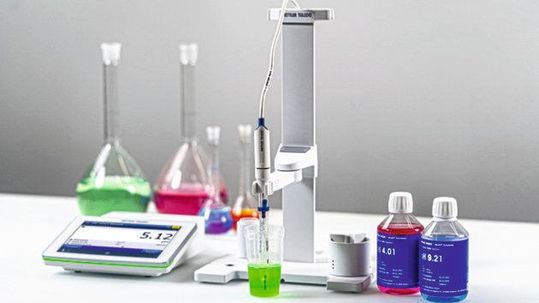
Choosing the right electrode for your sample helps ensure accurate pH measurements.
(Source: Mettler Toledo)
Accurate pH measurements are indispensable in diverse fields. For instance, in industries like food and beverage, pharmaceuticals, and cosmetics, pH levels can directly influence the quality, safety, and shelf life of products. Even a slight deviation in required pH measurements can lead to product failures or safety issues.
In industrial processes like chemical manufacturing and wastewater treatment, it is crucial to maintain the right pH levels for optimal reactions and meeting regulatory standards. In scientific research, accurate pH measurements are essential for ensuring valid and reproducible results in experiments. Mistakes in pH can cause incorrect conclusions and unreliable data.
Moreover, accurate pH measurements are important for assessing water quality and the health of ecosystems. An incorrect pH reading can misrepresent the condition of water bodies, leading to inappropriate management decisions.
So, how do we ensure precise pH readings? Proper electrode maintenance is important. It also requires accurate calibration of buffer solutions and pH meters.
This article provides some important tips to achieve accurate pH measurements.
1. Selecting the Right Electrode
Choosing the right electrode for your sample is essential for achieving precise pH measurements. Different electrodes are designed to perform optimally in specific conditions. Factors such as temperature, ionic strength, and the presence of interfering substances can affect the electrode's performance and accuracy. Using a compatible electrode ensures reliable readings. It also minimizes the risk of contamination or damage to your sample.
You can use Mettler Toledo’s GEP Recommendation tool. It helps you choose the right sensor suited for your sample.
2. Using the Right Calibration Buffers
Using the right calibration buffers is vital for achieving accurate pH measurements. It directly influences the calibration process. For example, if your sample is expected to have a pH of 7.45, calibrate with buffers that bracket this value. Use pH 7.00 and 9.21 (or similar) buffers for calibration. Using at least two fresh buffers during calibration helps ensure that your readings are precise and reliable.
It is also important to use fresh buffers each time you calibrate to avoid inaccuracies caused by contamination, and using single-use buffer sachets is a great way to eliminate this risk.
3. Regular Calibration of pH Electrode
Over time, electrodes can drift due to factors like usage, contamination, or changes in the environment. This can lead to unreliable readings. That is why calibrating your pH electrode regularly is essential for obtaining accurate results. Some specific applications may require calibration before every measurement. As a general rule, calibrate at least every 24 hours. This routine calibration helps ensure that your measurements remain consistent and trustworthy. It gives you confidence in your data and any decisions based on it. Regular calibration also prolongs the lifespan of your electrode by preventing potential damage from prolonged inaccuracies.
4. Opt for Fresh Buffers When Calibrating
Using fresh buffers for pH measurement is essential for achieving accurate results. First, always check the expiry date of calibration buffers. Expired buffers may not provide reliable reference points, leading to skewed measurements. It is also important not to calibrate the sensor directly in the buffer bottle, as this can contaminate the solution and affect future calibrations.
Never reuse calibration buffers. Pouring them back into the bottle can introduce impurities that compromise their effectiveness. By closing the bottles promptly after use and storing them at room temperature, you help maintain their integrity. This ensures that your calibrations are based on the most accurate and reliable standards.
5. Evaluating Calibration Results
The outcomes of your electrode calibration can provide insights into its condition. Ideally, the calibration curve's slope should fall within 95% to 102% of the theoretical value. Also, ensure the zero-point offset (0 mV at pH seven) remains stable, not exceeding ±30 mV.
For further guidance, consider downloading the pH theory guide.
6. Keep the Electrode Cleaned
A dirty electrode can cause significant errors in pH measurement. Regularly rinse the electrode with distilled water. Use a suitable cleaning solution for any stubborn residues. Store the electrode in a proper storage solution when not in use to maintain its functionality.
7. Rinse, but do not Wipe the Electrode
After rinsing the electrode with distilled water to remove salt deposits or any contamination, dry it by dabbing with a tissue. Avoid wiping it. The rough surface of the paper tissue can scratch the pH-sensitive glass membrane. It can also create an electrostatic charge that might cause the measured signal to become very unstable.
Date: 08.12.2025
Naturally, we always handle your personal data responsibly. Any personal data we receive from you is processed in accordance with applicable data protection legislation. For detailed information please see our privacy policy.
Consent to the use of data for promotional purposes
I hereby consent to Vogel Communications Group GmbH & Co. KG, Max-Planck-Str. 7-9, 97082 Würzburg including any affiliated companies according to §§ 15 et seq. AktG (hereafter: Vogel Communications Group) using my e-mail address to send editorial newsletters. A list of all affiliated companies can be found here
Newsletter content may include all products and services of any companies mentioned above, including for example specialist journals and books, events and fairs as well as event-related products and services, print and digital media offers and services such as additional (editorial) newsletters, raffles, lead campaigns, market research both online and offline, specialist webportals and e-learning offers. In case my personal telephone number has also been collected, it may be used for offers of aforementioned products, for services of the companies mentioned above, and market research purposes.
Additionally, my consent also includes the processing of my email address and telephone number for data matching for marketing purposes with select advertising partners such as LinkedIn, Google, and Meta. For this, Vogel Communications Group may transmit said data in hashed form to the advertising partners who then use said data to determine whether I am also a member of the mentioned advertising partner portals. Vogel Communications Group uses this feature for the purposes of re-targeting (up-selling, cross-selling, and customer loyalty), generating so-called look-alike audiences for acquisition of new customers, and as basis for exclusion for on-going advertising campaigns. Further information can be found in section “data matching for marketing purposes”.
In case I access protected data on Internet portals of Vogel Communications Group including any affiliated companies according to §§ 15 et seq. AktG, I need to provide further data in order to register for the access to such content. In return for this free access to editorial content, my data may be used in accordance with this consent for the purposes stated here. This does not apply to data matching for marketing purposes.
Right of revocation
I understand that I can revoke my consent at will. My revocation does not change the lawfulness of data processing that was conducted based on my consent leading up to my revocation. One option to declare my revocation is to use the contact form found at https://contact.vogel.de. In case I no longer wish to receive certain newsletters, I have subscribed to, I can also click on the unsubscribe link included at the end of a newsletter. Further information regarding my right of revocation and the implementation of it as well as the consequences of my revocation can be found in the data protection declaration, section editorial newsletter.
8.Stir the Sample
When measuring pH, gently stir the sample to ensure that it is homogeneous. It is important that calibration and measurement are done under the same conditions. Do not use the electrode to stir.
9. Measure the Temperature of the Sample
Each sample exhibits unique pH behavior that can vary with temperature, making it essential to measure the temperature during pH measurements. A temperature probe is either integrated into the pH electrode or can be used externally to monitor the sample's temperature. If the electrode temperature differs from the sample temperature, allow sufficient time for the system to equilibrate. This ensures accurate readings. To ensure valid comparisons between the pH of different samples, all measurements must be conducted at the same temperature. Temperature fluctuations can lead to inconsistent pH readings.
10. Proper Storage of the Electrode
Electrodes should be stored in ion-rich, aqueous solutions. Never allow the electrode to dry out. Storing it in distilled water can damage the pH-sensitive glass membrane and reduce its lifespan. If you are uncertain about the appropriate storage solution, consult the electrode's manual for specific instructions.




:quality(80)/p7i.vogel.de/wcms/45/87/458714daead8bb6b83d5305ff764e8c1/0130386255v1.jpeg "Examples of drawings from each category, with the scores they received from humans, independent AI and the human-guided AI. (Source: Advanced Science)")
:quality(80)/p7i.vogel.de/wcms/66/7c/667c242f45cc06eb5bee090c7723ba0b/0130384415v2.jpeg "Inspired by arm-wrestling, the NUS team built a self-training platform (left) where two rings of muscle tissues continuously and autonomously pull against each other. Ostrabot (right), made from a single trained ring of muscle and two flexible tails, swims 3 times faster than counterparts with conventionally cultured muscle. (Source: National University of Singapore)")
:quality(80)/p7i.vogel.de/wcms/92/ad/92adbafb37924cea35ea3cf05b7a23e5/0130206318v2.jpeg "The world’s first fully functioning proof-of-concept quantum battery
(Source: Csiro)")
:quality(80)/p7i.vogel.de/wcms/9f/8b/9f8bc2b8491d7a514ca154e9588a07b7/0130205846v1.jpeg "The researchers’ new material, based on mineralised sawdust, is an excellent fire retardant. (Source: Dan Vivas Glaser / from Kürsteiner R et al. Chem Circularity 2026)")
:quality(80)/p7i.vogel.de/wcms/6e/7c/6e7c762e933c938a92431a785df4690f/0130440213v2.jpeg "Biotech Fluidics' valving solutions offer low swept volume and eliminate reagent carryover concerns. (Source: Biotech Fluidics)")
:quality(80)/p7i.vogel.de/wcms/b0/0b/b00b237311ce4ceb03b2ba1136b6b074/0130440144v2.jpeg "Azenta Life Sciences offers a range of low binding consumables that deliver consistent performance from sensitive applications that require low DNA input such as Next Generation Sequencing and Molecular Biology. (Source: Azenta)")
:quality(80)/p7i.vogel.de/wcms/6c/ef/6cef060860810f12200fbd6d56884e9d/0130440127v2.jpeg "The Automated Plate Seal Remover from Azenta Life Sciences is a compact system for removing seals from a wide range of microplates at the single touch of a button, without damaging the plate or seal. (Source: Azenta )")
:quality(80)/p7i.vogel.de/wcms/14/ca/14ca189a5a6a5ac4c434039fc35af36c/0130440109v2.jpeg "Afys3G has launched the Information Marking System Lambda768. (Source: Afys3G)")
:quality(80)/p7i.vogel.de/wcms/5d/bb/5dbb962b09bae1c078a8ff996666bc8e/0130386229v2.jpeg "This image created using Gemini Pro, depicts an activated carbon fiber functionalized with amine groups (–NH2) at adjacent positions. This arrangement improves the energy efficacy of key interactions, enabling the desorption of captured carbon dioxide at lower temperatures. (Source: Gemini / Yasuhiro Yamada/ Chiba University / KI-generiert)")
:quality(80)/p7i.vogel.de/wcms/21/9b/219b000051ab1ea14ab5f92e4fd0f9bb/0130384937v2.jpeg "Deforestation in the Appalachian mountains. (Source: Alex Diaz on Unsplash)")
:quality(80)/p7i.vogel.de/wcms/e9/9c/e99cb19231197af70c489cb4acc2ead0/0130293444v2.jpeg "A new global study, led by researchers at Kaust in Saudi Arabia, shows that forests are most effective for climate regulation when conserved or restored in their natural or native locations. (Source: Kaust )")
:quality(80)/p7i.vogel.de/wcms/af/40/af40b535eb65c287fbd22ed5483d1d0e/0130206243v2.jpeg "The researchers dug soil pits in order to measure the carbon storage in soil
(Source: Johanna Asch)")
:quality(80)/p7i.vogel.de/wcms/c3/11/c3116fd7b394726eee766f62ca041009/0130435223v2.jpeg "Peaches are climacteric fruits, which means they continue to ripen after being picked. The recommended storage temperature is 0°C, otherwise there is a risk of cold damage. (Source: © Esther Hildebrandt - stock.adobe.com)")
:quality(80)/p7i.vogel.de/wcms/2a/07/2a0737995810d504b318f8a0f9ac2c3d/0130386209v1.jpeg "Simple, repeatable eating habits may help people stick to diets, see better results, study says (Source: free licensed)")
:quality(80)/p7i.vogel.de/wcms/6f/ba/6fba92196d0cbb1467334f8a2ecc520a/0130203021v2.jpeg "Low to moderate wine consumption shows lower risk compared with spirits, beer and cider (Source: free licensed)")
:quality(80)/p7i.vogel.de/wcms/a9/37/a9376f1d9a893570023d9aa97c085bc5/0129927485v2.jpeg "Examples of foods high in PUFAs include fatty fish and soybeans, while MUFAs include olive oil and avocadoes. (Source: free licensed)")
:quality(80)/p7i.vogel.de/wcms/40/c0/40c0c09c2bad7b925a069edbbac90621/0130385557v1.jpeg "When a stroke damages brain tissue (red) along an important movement pathway (yellow), the injured side of the brain may show faster aging (red), while parts of the opposite side may appear relatively “younger” (blue) as the brain tries to compensate. This pattern is linked to more severe movement problems and less recovery.
(Bild: Stevens INI)")
:quality(80)/p7i.vogel.de/wcms/32/14/3214c28a03f71ad067c5f27e5bd6772b/0130386218v1.jpeg "Antimicrobial-resistant Salmonella poses severe challenges to global food safety and public health. (Source: free licensed)")
:quality(80)/p7i.vogel.de/wcms/30/2e/302e195d532fc9aced73406b07642b57/0130384900v2.jpeg "Sleeping for 11 minutes more, doing an additional 4.5 minutes of moderate-to-vigorous physical activity, and eating additional quarter of a cup of vegetables were associated with a 10 % reduction in major cardiovascular events. (Source: Pixabay)")
:quality(80)/p7i.vogel.de/wcms/47/41/4741ee3c589369a09ab0e3a26b7143f0/0130384858v2.jpeg "A female, Aedes aegypti mosquito, after taking her blood meal. (Source: Lauren Bishop CDC)")
:quality(80)/images.vogel.de/vogelonline/bdb/1710600/1710675/original.jpg "Discover how to set yourself up for success when performing balance-based density determination of solids such as jewelry and precious metals. (Mettler Toledo)")
:quality(80)/images.vogel.de/vogelonline/bdb/1682500/1682579/original.jpg "The new XPR Analytical balance redesigned to meet the needs of laboratory technicians of working fast and lean. (Mettler Toledo)")
:quality(80)/images.vogel.de/vogelonline/bdb/1677000/1677080/original.jpg "Enhance your weighing accuracy, comfort and productivity with the redesigned XPR Analytical balance. (Mettler Toledo)")
:fill(fff,0)/p7i.vogel.de/companies/5f/3f/5f3f63ceedc78/knf-logo.jpg "KNF_Logo.jpg (www.knf.com)")
:quality(80)/p7i.vogel.de/wcms/17/f8/17f8ef59b5aae232d1e29fa385facd30/0125171586v2.jpeg "There are various strategies for compensating for the influence of temperature on pH measurement. (Source: Mettler Toledo)")
:quality(80)/p7i.vogel.de/wcms/5a/f5/5af5ec78094e70217709f00fb2c4998a/0125689232v2.jpeg "pH is a crucial parameter in the production process of yogurt. (Source: © Igor Dudchak - stock.adobe.com)")