The pH measurement is extremely important in the development of paint. In this article, you can read more on the connection between pH and paint quality.
The pH value is an important parameter in the development of paint (symbolic image).
(Source: Mettler Toledo)
When you talk about painting, vibrant colors, and smooth textures are what catch your attention first. However, beyond what stands out to you, there is a crucial element that ensures the quality of your artwork: pH. pH plays a pivotal role in paint performance, influencing everything from drying time to color consistency.
This article provides an overview of pH and paint connection, along with important points to consider when measuring pH in paint using the Mettler Toledo sensors.
The pH in Paint Production — why does it matter?
The pH value of paint is far more than just a number — it is the key to unlocking optimal performance and longevity. A slight pH imbalance can lead to a cascade of issues:
Unstable formulations that separate or clump
Inconsistent color reproduction
Poor adhesion to surfaces
Reduced durability and longevity
Paint manufacturers must carefully balance the pH level, much like walking a tightrope. If the pH is too high, the paint can become too thick, dry too quickly, and cause color shifts in the pigments. On the other hand, a low pH can make the paint too runny, slow to dry, and susceptible to microbial contamination.
Paints are categorized into two primary types: oil-based and water-based. Each type possesses distinct chemical properties, needing the use of different sensors for accurate pH measurement. Oil-based paints, which use an oil-based binder, usually exhibit higher pH levels, whereas water-based paints, formulated with a water-based binder, tend to have lower pH levels.
That is why selecting the right sensor for pH measurement based on the specific type of paint is essential for achieving the desired results.
Precision pH Measurement
Needless to mention, selecting the appropriate sensor is the first step toward measurement accuracy. It involves several key considerations:
Type of Paint: Determine whether the paint is oil-based or water-based, as this affects the chemical environment. Oil-based paints generally require sensors that can handle higher pH levels, while water-based paints are better suited to sensors designed for lower pH levels.
Temperature Range: Consider the temperature at which the paint will be measured. Ensure that the sensor is rated for the temperature range of your application, as some sensors can drift or provide inaccurate readings at elevated temperatures.
Sensor Material: Choose a sensor that is compatible with the paint's components. For example, some paints contain solvents or additives that can corrode certain sensor materials. Look for sensors designed for harsh environments if necessary.
Calibration: Ensure that the sensor can be easily calibrated and maintained. Regular calibration is crucial for accurate measurements, so select a sensor that allows for straightforward calibration procedures.
Response Time and Accuracy: Opt for a sensor with a fast response time and high accuracy to ensure reliable pH readings. That is important in paint production, where even slight variations in pH can impact the final product's quality.
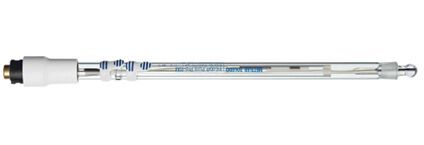
The Mettler Toledo InLab Pure Pro-ISM sensor
(Source: Mettler Toledo)
Mettler Toledo’s Inlab Pure Pro-ISM sensor and the Inlab Science Pro-ISMInlab Science Pro-ISM sensors are ideal choices for pH measurements in paint. For viscous or sticky samples, the Inlab Viscous Pro-ISM sensor is the most suitable choice. In contrast, the Inlab Pure Pro-ISM sensor works best for low ionic strength samples like water-based paints. The Inlab Science Pro-ISM sensor offers versatility and can be used across a wide range of samples, including different types of paints. All sensors feature the ISM system, which guarantees accurate and reliable pH measurements along with straightforward calibration and verification processes.
Points to Be Considered While Using These Sensors:
Calibration: The pH sensor needs to be calibrated before use to ensure accurate measurements. Use fresh buffer solutions with known pH values.
Cleanliness: The sensor should be clean and free of any contaminants that could interfere with the pH reading.
Sample preparation: The paint sample should be properly mixed to ensure an even distribution of the pigment.
Temperature: The temperature of the paint sample should be considered as it can affect the pH reading.
Repeat measurements: The pH measurement should be repeated multiple times to ensure accuracy and consistency.
How to Measure the pH of Water-Based Paints Using a Mettler Toledo Sensor. Here are the steps:
Calibration:
Start by cleaning the pH sensor to ensure accurate readings.
Immerse the sensor in two calibration solutions with known pH values that are close to the expected pH of your paint.
Record the pH values from the solutions.
Remember to calibrate the sensor regularly for reliable measurements.
Verification:
Clean the sensor again before verifying its accuracy.
Place the sensor in a verification solution with a known pH value.
Compare the reading on the pH meter to the known value. If there's a discrepancy, adjust or recalibrate the sensor as needed.
Measurement:
Prepare your water-based paint sample.
Clean the sensor to remove any residue.
Immerse the sensor in the paint and wait for the reading to stabilize on the pH meter.
Record the stabilized pH value and rinse the sensor after use.
For greater accuracy, take multiple measurements and calculate the average of those readings.
Accurate pH measurement in paints is essential for ensuring product quality, stability, and performance. By following proper calibration, verification, and measurement procedures with a reliable pH sensor, manufacturers can achieve consistent results that meet industry standards.
Mettler Toledo offers various specialized pH electrodes and probes to ensure accurate readings for laboratory and field applications. Find the right sensor for your wide range of applications.
Date: 08.12.2025
Naturally, we always handle your personal data responsibly. Any personal data we receive from you is processed in accordance with applicable data protection legislation. For detailed information please see our privacy policy.
Consent to the use of data for promotional purposes
I hereby consent to Vogel Communications Group GmbH & Co. KG, Max-Planck-Str. 7-9, 97082 Würzburg including any affiliated companies according to §§ 15 et seq. AktG (hereafter: Vogel Communications Group) using my e-mail address to send editorial newsletters. A list of all affiliated companies can be found here
Newsletter content may include all products and services of any companies mentioned above, including for example specialist journals and books, events and fairs as well as event-related products and services, print and digital media offers and services such as additional (editorial) newsletters, raffles, lead campaigns, market research both online and offline, specialist webportals and e-learning offers. In case my personal telephone number has also been collected, it may be used for offers of aforementioned products, for services of the companies mentioned above, and market research purposes.
Additionally, my consent also includes the processing of my email address and telephone number for data matching for marketing purposes with select advertising partners such as LinkedIn, Google, and Meta. For this, Vogel Communications Group may transmit said data in hashed form to the advertising partners who then use said data to determine whether I am also a member of the mentioned advertising partner portals. Vogel Communications Group uses this feature for the purposes of re-targeting (up-selling, cross-selling, and customer loyalty), generating so-called look-alike audiences for acquisition of new customers, and as basis for exclusion for on-going advertising campaigns. Further information can be found in section “data matching for marketing purposes”.
In case I access protected data on Internet portals of Vogel Communications Group including any affiliated companies according to §§ 15 et seq. AktG, I need to provide further data in order to register for the access to such content. In return for this free access to editorial content, my data may be used in accordance with this consent for the purposes stated here. This does not apply to data matching for marketing purposes.
Right of revocation
I understand that I can revoke my consent at will. My revocation does not change the lawfulness of data processing that was conducted based on my consent leading up to my revocation. One option to declare my revocation is to use the contact form found at https://contact.vogel.de. In case I no longer wish to receive certain newsletters, I have subscribed to, I can also click on the unsubscribe link included at the end of a newsletter. Further information regarding my right of revocation and the implementation of it as well as the consequences of my revocation can be found in the data protection declaration, section editorial newsletter.




:quality(80)/p7i.vogel.de/wcms/06/a1/06a11f1d752afb35854aa9e1afb62e98/0129209625v2.jpeg "“Unsinkable\" metal tube made from chemically-etched aluminum floats in distilled water at the lab of University of Rochester professor Chunlei Guo. (Source: J. Adam Fenster / University of Rochester)")
:quality(80)/p7i.vogel.de/wcms/6d/df/6ddf023361ec7f8fbfb6c56521577960/0129056554v2.jpeg "The evolution of carburization (depicted by the spheres) under kinetic control (illustrated by the surface contours). The molecular beams represent gas evolution under synthesis conditions while the fiery sphere highlights the formation of the pure tungsten semi-carbide phase with additional molecular beams at the top to illustrate its catalytic performance. (Source: Sinhara M. H. D. Perera)")
:quality(80)/p7i.vogel.de/wcms/26/3d/263d97f8f2797267ecf2781b56882758/0129056451v1.jpeg "A study by the Complexity Science Hub finds that AI systems are already involved in nearly one-third of newly written software code, with rapid adoption in the United States and Europe and measurable productivity gains mainly for experienced developers. (Source: free licensed)")
:quality(80)/p7i.vogel.de/wcms/63/0c/630cf9ab0cafdcdd9b33802d53c5b943/0128938770v1.jpeg "A microscopic close-up of the bubbles in foam, whose movements mathematically mirror the process of deep learning, used to train modern AI systems. (Source: Crocker Lab)")
:quality(80)/p7i.vogel.de/wcms/21/03/21030cc2541c455da0769decca8d1f82/0129146048v2.jpeg "Vyon porous plastics from Porvair Sciences are the perfect material for filtration applications in the healthcare and medical device market. (Source: Porvair Sciences)")
:quality(80)/p7i.vogel.de/wcms/bd/aa/bdaae5b9d381e2471ab37f479ad43d79/0129143884v2.jpeg "The Solvent Line Monitor from Testa Analytical is a true plug-and-play addition to any HPLC system designed to detect when one or more of its pump solvent reservoirs are empty and automatically shut-off the system. (Source: Testa Analytical)")
:quality(80)/p7i.vogel.de/wcms/8f/66/8f66b8acbb3037ca8e6b320bcad1c817/0129118043v2.jpeg "The Plasmaquant 9200 series is ideal for applications in research, trace analysis and quality control. (Source: Analytik Jena )")
:quality(80)/p7i.vogel.de/wcms/66/82/66825163ab842baded640db1a484e729/0129117548v2.jpeg "Biotech Fluidics has announced the Smartsaver solvent recycling unit which is designed to recover up to 90 % of your mobile phase by redirection of the pure solvent to the solvent reservoir during isocratic HPLC. (Source: Biotech Fluidics )")
:quality(80)/p7i.vogel.de/wcms/90/f8/90f8c3152a59205a7cac1cc182eb186b/0129209634v2.jpeg "Nitrate in drinking water linked to increased dementia risk while nitrate from vegetables is linked to a lower risk, researchers find . (Source: free licensed)")
:quality(80)/p7i.vogel.de/wcms/53/ac/53acd3796c0d43ad0f7cfd80dd7ab82e/0129209615v1.jpeg "Prenatal exposure to NO2, black carbon, and PM2.5 may reduce recognition memory in newborns, with effects more pronounced in boys than in girls. (Source: free licensed)")
:quality(80)/p7i.vogel.de/wcms/a3/cd/a3cdc440f6f0f426b85042082678018f/0129165252v2.jpeg "People exposed to wildfire smoke have a higher risk of suffering a stroke, according to research published in the European Heart Journal recently. (Source: Pixabay)")
:quality(80)/p7i.vogel.de/wcms/6c/15/6c15f7685b6076b906f2d572f6c71bb8/0129103298v2.jpeg "Although only 2 % of U.S. homes rely on wood as their primary heating source, residential wood burning accounts for more than one-fifth of Americans’ wintertime exposure to outdoor fine particulate matter (PM2.5), the new study found. (Source: Pixabay)")
:quality(80)/p7i.vogel.de/wcms/d1/3c/d13c2ad34af600dbd360c0bb0990b922/0129045715v2.jpeg "Replacing animal products with plant-based foods helps reduce the risk of heart disease and type 2 diabetes, finds a new review by the Physicians Committee for Responsible Medicine. (Source: Pixabay)")
:quality(80)/p7i.vogel.de/wcms/e1/b3/e1b3e26d03101ba93b76b304da150c9a/0129025388v2.jpeg "The research reanalyzed data from a seminal clinical trial, led by US National Institutes of Health veteran Dr Kevin Hall, which first exposed how eating exclusively UPFs results in excessive calorie consumption and weight gain. (Source: Pixabay)")
:quality(80)/p7i.vogel.de/wcms/75/db/75db8afe45607bee750df705e22b60e9/0128938816v1.jpeg "A new academic review suggests that bamboo shoots could offer significant health benefits, including improved blood sugar control, gut health and antioxidant activity. (Source: free licensed)")
:quality(80)/p7i.vogel.de/wcms/85/42/85423f3382c25d1ae0ac5645e969cd36/0128898289v2.jpeg "Dr Arya Gopinath Madathil Pulikkal (left) and Asst Prof Andy Tay (right) in front of a small greenhouse containing Choy Sum plants. (Source: NUS)")
:quality(80)/p7i.vogel.de/wcms/f1/ea/f1eac0379480f4aa25ab2db9e0a396ed/0129209654v2.jpeg "Roe deer in study plot (Source: Walter Di Nicola)")
:quality(80)/p7i.vogel.de/wcms/34/a4/34a44fab2ba6af4b5f7cb8c3ecfc6362/0129207768v1.jpeg "AI generated image of the New Zealand cave (Source: P Scofield, Canterbury Museum)")
:quality(80)/p7i.vogel.de/wcms/a4/12/a412474313fc7d83bc51a4b99ef0af73/0129189645v2.jpeg "Around age 35, men’s risk for cardiovascular risk began to rise faster and stayed higher through midlife. (Source: Pixabay)")
:quality(80)/images.vogel.de/vogelonline/bdb/1710600/1710675/original.jpg "Discover how to set yourself up for success when performing balance-based density determination of solids such as jewelry and precious metals. (Mettler Toledo)")
:quality(80)/images.vogel.de/vogelonline/bdb/1682500/1682579/original.jpg "The new XPR Analytical balance redesigned to meet the needs of laboratory technicians of working fast and lean. (Mettler Toledo)")
:quality(80)/images.vogel.de/vogelonline/bdb/1677000/1677080/original.jpg "Enhance your weighing accuracy, comfort and productivity with the redesigned XPR Analytical balance. (Mettler Toledo)")
:fill(fff,0)/p7i.vogel.de/companies/5f/3f/5f3f63ceedc78/knf-logo.jpg "KNF_Logo.jpg (www.knf.com)")

:quality(80)/p7i.vogel.de/wcms/a9/2c/a92cd727f9ad27c3531b5c030f27e137/0124868185v2.jpeg "Fig.1: Sensors suitable for small sample volumes (Source: Mettler Toledo)")
:quality(80)/p7i.vogel.de/wcms/6c/19/6c19712454c1ea447b855ac8104bdca4/0128418996v2.jpeg "Impact of silver nitrate on the performance of solar panels (Source: © Awais - stock.adobe.com)")