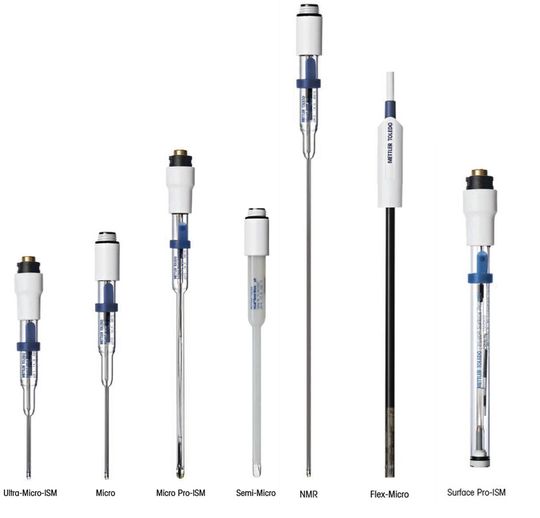
Small sample volumes — a common situation in laboratories. This can cause problems when measuring pH. Various problems can be solved by using specific sensors.
Fig.1: Sensors suitable for small sample volumes
(Source: Mettler Toledo)
In life sciences, many applications necessitate the analysis of small samples, often requiring multiple testing protocols. These limited-volume samples, representing valuable experiments, are susceptible to errors introduced during sample manipulation. However, an appropriate pH sensor and the right measurement practices, can significantly reduce the required sample size and the extent of manipulation needed, thereby enhancing the accuracy of the results.
Some of the common small-volume applications include:
RNA sample analysis through microarrays,
DNA sample analysis via PCR,
Protein sample analysis using immunoprecipitation.
So, why is it challenging to measure pH in small samples? It can be tricky because of three main factors: the sensing glass, the reference junction, and the temperature. The sensing glass is the part of the pH sensor that interacts with the solution. It’s designed to generate a voltage when it comes into contact with hydronium ions. For accurate readings, the sensing glass needs to be fully immersed in the sample. That’s why regular-sized sensors don’t work well for tiny samples — they often leave the sensing glass partly exposed, which leads to errors.
The reference junction, located just above the sensing glass, is essential for allowing the reference electrolyte to flow into the sample. If small samples don't reach this junction, the electrolyte flow stops, and the readings can be inaccurate.
Also, pH results are only correct if the sample temperature is taken into account during the measurement. When working with very small samples, their mass is tiny compared to the sensor. This means the sensor might take a long time to reach the right temperature. If the sensor’s temperature isn’t accurately matched to the sample’s temperature, the pH reading can be off. To get reliable results with small samples, it's important to use the right sensor with an internal sensor temperature probe. Fortunately, there are sensors designed to measure pH in small samples directly without diluting them.
Micro sensors
Micro sensors include the same components as a standard pH sensor, configured to optimize measurements in small containers. Whereas a standard sized sensor requires a few milliliters of sample to measure accurately, a micro sensor has miniaturized components and can be successfully used in much smaller samples.
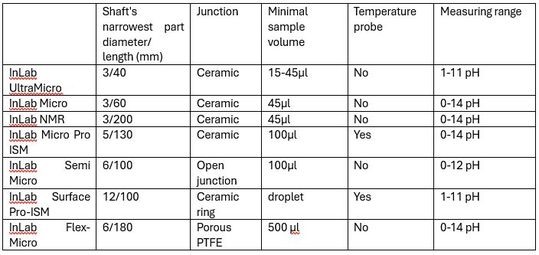
Table 1: Technical data for the various Mettler Toledo sensors for measuring small sample volumes
(Source: Mettler Toledo)
Mettler Toledo has multiple sensors that have a micro membrane that is hemispherical — InLab UltraMicro-ISM, Inlab Micro, Inlab Micro Pro-ISM, Inlab Semi–Micro, and Inlab NMR. The electrodes differ in their membrane glass, size, junction and temperature probe, and the sample size and type vary.
Surface sensor
Sometimes, some samples are just too small for even micro sensors to handle accurately. In these situations, surface sensors provide an ideal solution.
Mettler Toledo’s Inlab Surface-Pro-ISM features flat sensing glass membranes paired with a ceramic ring junction. Thanks to the ceramic ring junction, the reference electrolyte can escape and come into contact with the sample. This setup ensures accurate measurements while preventing any contamination of the sample from the reference electrolyte.
The sensor also features a built-in temperature probe and low-temperature glass, making it capable of detecting low ionic concentrations.
Selecting the Right Sensor
As the first step, choosing the right sensor becomes crucial. To do so, consider these important questions:
The maximum size of the sample: Determine how much sample you can use for accurate measurement.
Temperatures match: Check if the sample, buffer, and probes can all be at the same temperature, or if you need a temperature probe in the sensor.
Dirty sample or with particles: If the sample contains dirt or particles, you may need a sensor with an open junction.
The shape of the container and tube diameter: Consider how the sensor will fit into the container and if it will be fully immersed in the solution.
To make your decision easier, refer to Table 1 for guidance on choosing the right sensor for your needs.
The second step involves calibration. Calibrate the sensor with at least two-point calibration and make sure that the slope is in the range of 95 to 105 per cent and offset between 0 and 20 mV. If it is outside this range, the sensor might need cleaning; if the slope is below 89 per cent, the probe needs to be replaced. Clean the electrode between each buffer.
After the calibration, measure the sample and make sure that the probe membrane and junction are fully covered in the sample. For the micro electrodes the container should not too large or too small. While using Inlab Surface Pro-ISM, place a droplet on a clean and dry surface and place the sensor on top of it making sure that the sample spreads across the membrane and junction surface. Clean the electrode between each sample.
To learn more about how to measure pH in small-volume samples, you can also download an application note.
Date: 08.12.2025
Naturally, we always handle your personal data responsibly. Any personal data we receive from you is processed in accordance with applicable data protection legislation. For detailed information please see our privacy policy.
Consent to the use of data for promotional purposes
I hereby consent to Vogel Communications Group GmbH & Co. KG, Max-Planck-Str. 7-9, 97082 Würzburg including any affiliated companies according to §§ 15 et seq. AktG (hereafter: Vogel Communications Group) using my e-mail address to send editorial newsletters. A list of all affiliated companies can be found here
Newsletter content may include all products and services of any companies mentioned above, including for example specialist journals and books, events and fairs as well as event-related products and services, print and digital media offers and services such as additional (editorial) newsletters, raffles, lead campaigns, market research both online and offline, specialist webportals and e-learning offers. In case my personal telephone number has also been collected, it may be used for offers of aforementioned products, for services of the companies mentioned above, and market research purposes.
Additionally, my consent also includes the processing of my email address and telephone number for data matching for marketing purposes with select advertising partners such as LinkedIn, Google, and Meta. For this, Vogel Communications Group may transmit said data in hashed form to the advertising partners who then use said data to determine whether I am also a member of the mentioned advertising partner portals. Vogel Communications Group uses this feature for the purposes of re-targeting (up-selling, cross-selling, and customer loyalty), generating so-called look-alike audiences for acquisition of new customers, and as basis for exclusion for on-going advertising campaigns. Further information can be found in section “data matching for marketing purposes”.
In case I access protected data on Internet portals of Vogel Communications Group including any affiliated companies according to §§ 15 et seq. AktG, I need to provide further data in order to register for the access to such content. In return for this free access to editorial content, my data may be used in accordance with this consent for the purposes stated here. This does not apply to data matching for marketing purposes.
Right of revocation
I understand that I can revoke my consent at will. My revocation does not change the lawfulness of data processing that was conducted based on my consent leading up to my revocation. One option to declare my revocation is to use the contact form found at https://contact.vogel.de. In case I no longer wish to receive certain newsletters, I have subscribed to, I can also click on the unsubscribe link included at the end of a newsletter. Further information regarding my right of revocation and the implementation of it as well as the consequences of my revocation can be found in the data protection declaration, section editorial newsletter.




:quality(80)/p7i.vogel.de/wcms/6b/9a/6b9a2f9d820c458d6518f7d3c0cc990e/0131057985v2.jpeg "The collaboration marks a major step forward in how Dupont scales digital lab workflows, expands access to high-quality experimental data and turns insights into faster, more efficient innovation across its R&D organization. (Source: Dupont )")
:quality(80)/p7i.vogel.de/wcms/ed/07/ed0756a2495cf3591db2f3c23bedd39c/0131055520v2.jpeg "E. coli cultures and other experimental materials used in the study, shown with a 3D-printed model of the engineered phage (extreme left). (Source: National University of Singapore )")
:quality(80)/p7i.vogel.de/wcms/f1/87/f187c86e791dfcf8ecccf615a6a3d054/0131055400v2.jpeg "The new center brings together advanced bioproduction capabilities and hands-on collaboration to help customers accelerate process development and bring transformative therapies to patients faster. (Source: Thermo Fisher Scientific)")
:quality(80)/p7i.vogel.de/wcms/cb/39/cb3902f5777a11e07655ba29d00a0394/0131003637v1.jpeg "Lighting along riverbanks or streams at night disrupts the exchange of energy and nutrients between bodies of water and their adjacent riparian habitats. This can have far-reaching ecological consequences. (Source: RPTU)")
:quality(80)/p7i.vogel.de/wcms/52/2e/522e60883334ab2d806e6038a11e9204/0131030069v3.jpeg "“With Cellcelector, your team moves from single cell → validated clone → production ready line through one tightly integrated, automation driven workflow.” – Dr. Darius Wilson, Head of Product Management, Cell Selection & Retrieval, Sartorius Lab Product & Services (Source: Sartorius)")
:quality(80)/p7i.vogel.de/wcms/06/0e/060e08234d208d1faca16ad0cf582ff3/0131026470v2.jpeg "For enzymatic shearing from fixed cells or tissue – both these detergent-based buffers are ideal for effective fragmentation of nuclear material. (Source: © Kateryna_Kon - stock.adobe.com)")
:quality(80)/p7i.vogel.de/wcms/21/6a/216a1b69d48ac4ef7fe694d4c7791531/0131025888v2.jpeg "Biotech Fluidics has announced the Degasi Integration HFIP – a high-performance online system designed to efficiently degas even the toughest solvents. (Source: Biotech Fluidics )")
:quality(80)/p7i.vogel.de/wcms/4a/8d/4a8d7b8aa03d413a2bbcf34fdf463306/0131025869v2.jpeg "Suitable for reaction temperatures up to 200°C, the Drysyn Vortex is the perfect process development tool to efficiently, and safely, drive three stirrer shafts with one overhead stirrer. (Source: Drysyn Vortex)")
:quality(80)/p7i.vogel.de/wcms/2b/5e/2b5e4798cb0d86b0f29ba4de833c1412/0131003303v1.jpeg "33-month-old acacias in Manaus: ADEs result from the decomposition of organic matter and the use of fire by pre-Columbian populations and continue to be created by present-day peoples
(Source: Tsai Siu Mui/ Cena-USP)")
:quality(80)/p7i.vogel.de/wcms/54/50/5450b302b2cfe1f29c6f3d5c300123ce/0131004604v2.jpeg "Dr. Iván Hernández-Almeida, Science Officer, Past Global Changes, University of Bern
(Source: © Courtesy of Iván Hernández-Almeida)")
:quality(80)/p7i.vogel.de/wcms/f1/71/f1711b934d493949c55d6e9b9ddcffe9/0131003077v1.jpeg "Plastics – rich in carbon and hydrogen – can be converted into a clean energy source, using sunlight. (Source: Adelaide University)")
:quality(80)/p7i.vogel.de/wcms/60/54/6054287023c79b93d166c8b7802f9ad4/0130972957v2.jpeg "Scientists have discovered extensive, ancient and modern deep-sea coral reefs within the Galápagos Marine Reserve – the first of their kind ever to be documented inside the marine protected area since it was established in 1998. (Source: WHOI/NSF)")
:quality(80)/p7i.vogel.de/wcms/f6/a8/f6a8a2ac333baa08d168cc68ac2192c0/0131001826v2.jpeg "University of Oregon researchers find a way to measure the flavor profile of coffee. (Source: free licensed)")
:quality(80)/p7i.vogel.de/wcms/34/ff/34ff3de563d63ac821f789f8ca397070/0130971132v2.jpeg "Mixed nuts on a wooden platter. (Source: Piviso from Pixabay)")
:quality(80)/p7i.vogel.de/wcms/e7/08/e708baaa36f8929e985dfe5baea8bc68/0130734917v2.jpeg "A simple cafeteria menu change can make a measurable difference: replacing one meat-based lunch with a vegetarian option increased vegetarian meal choices by 41 percent in six English workplace canteens, while also reducing calories and greenhouse-gas emissions without hurting sales. (Source: free licensed)")
:quality(80)/p7i.vogel.de/wcms/ea/5a/ea5a5ed15b2c98730c7111bb56b1a7aa/0130612537v1.jpeg "A healthful plant-based diet prioritizes whole grains, fruits, vegetables, vegetable oils, nuts, legumes, tea and coffee. (Source: free licensed)")
:quality(80)/p7i.vogel.de/wcms/33/50/3350efd72f2c620af7c2133ce55c901f/0131086519v2.jpeg "A new Northwestern study examined all 130,267 babies born in Georgia in 2017 and tracked whether their fathers died at any point during the following five years, through 2022. (Source: Unsplash )")
:quality(80)/p7i.vogel.de/wcms/ca/fa/cafafb635ff66815b96824c2f099968a/0131058329v2.jpeg "Clinical trial participant Matthew Husar lived for roughly two years after starting the trial. (Source: Madeline Husar)")
:quality(80)/p7i.vogel.de/wcms/56/d7/56d73ff8d8ffc3ce50e3ff2188b7aada/0131004724v2.jpeg "Among Black players, major cardiac conditions occurred most commonly in those of West African origin (1.6 %), followed by Caribbean origin (0.7 %). (Source: Pixabay)")
:quality(80)/p7i.vogel.de/wcms/87/d5/87d5890059d61e8107148c2039ff9bd8/0131004713v2.jpeg "Using radio waves from a portable device, a reader, the movements of the tags could be recorded and displayed as graphs on a monitor. (Source: Chalmers University of Technology | Mia Halleröd Palmgren)")
:quality(80)/images.vogel.de/vogelonline/bdb/1710600/1710675/original.jpg "Discover how to set yourself up for success when performing balance-based density determination of solids such as jewelry and precious metals. (Mettler Toledo)")
:quality(80)/images.vogel.de/vogelonline/bdb/1682500/1682579/original.jpg "The new XPR Analytical balance redesigned to meet the needs of laboratory technicians of working fast and lean. (Mettler Toledo)")
:quality(80)/images.vogel.de/vogelonline/bdb/1677000/1677080/original.jpg "Enhance your weighing accuracy, comfort and productivity with the redesigned XPR Analytical balance. (Mettler Toledo)")
:fill(fff,0)/p7i.vogel.de/companies/5f/3f/5f3f63ceedc78/knf-logo.jpg "KNF_Logo.jpg (www.knf.com)")
:fill(fff,0)/images.vogel.de/vogelonline/companyimg/131900/131910/65.jpg "Xylem_tag_rgb.jpg ()")
:quality(80)/p7i.vogel.de/wcms/6c/19/6c19712454c1ea447b855ac8104bdca4/0128418996v2.jpeg "Impact of silver nitrate on the performance of solar panels (Source: © Awais - stock.adobe.com)")
:quality(80)/p7i.vogel.de/wcms/5a/f5/5af5ec78094e70217709f00fb2c4998a/0125689232v2.jpeg "pH is a crucial parameter in the production process of yogurt. (Source: © Igor Dudchak - stock.adobe.com)")