Water is the most commonly used solvent in the laboratory. It is available in several grades of purity. An important parameter here is the pH value.
The pH measurement of water has some challenges for the user.
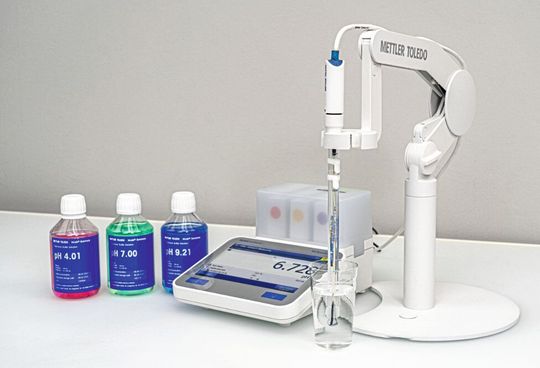
(Source: Mettler Toledo)
Water is extremely important in many industries and segments, including Pharma, Food and Beverage, Chemical, Biotechnology, and Electronics. In each of these industries, the measurement of pH is one of the most important criteria in water analysis. At different workplaces within these industries, the pH of water implies varied parameters as in estimation of soluble trace minerals, ability to corrode metals, suitability for aquatic life, quality of potable drinking water and so on.
For industries like packaged bottled water, beverages and snack food manufacturers, water analysis is required to evaluate its purity and efficiency for various process and production activities. Water is used as a solvent in many of these industries. In pharma industries, water is used as an excipient or during synthesis, reconstitution, or as a cleaning agent. The quality of water required for a specific application is as per international standards or Pharmacopeia guidelines.
Water used in laboratories are graded as types of water, based on technical specifications, viz Type 1, Type 2 and Type 3. Type 1 has least electrical conductivity (0.056 μS/cm at 298 K) termed as ultrapure water and has the highest purity.
This article explores the challenges associated with pH measurement in pure water, its key applications, and provides guidance on how to select the right instruments to achieve accurate measurements.
Why is the Accuracy of pH Measurement in Pure Water Important
The accuracy of pH levels in pure water is crucial for many reasons.
Baseline for Calibration: Pure water is often used as a reference point for calibrating pH meters and sensors. The accuracy of its pH level helps ensure the instruments’ reliable readings in other solutions.
Scientific Research: In scientific experiments, many chemical reactions and biological processes depend on specific pH levels. Precise pH measurements are important for reproducibility and consistency.
Water Quality Assessment: pH influences the solubility of minerals and the behavior of contaminants in the water, which can impact environmental health and safety.
Regulatory Compliance: Many industries are subject to regulations that require monitoring of water pH. Measurement accuracy ensures compliance with environmental standards and safety guidelines.
Industrial Processes: In industries, such as pharmaceuticals, food and beverage, and chemical manufacturing, the pH of water used in processes can affect product quality and consistency.
Measurement Challenges
Pure water has a pH value of 7.00 at 25 °C. However, pH measurement of pure water samples requires special attention due to its low ionic nature (conductivity of ≤100 μS/cm). These samples lack both hydrogen ions (H+) and other conducting ions. Pure water samples are prone to CO2 absorption from the atmosphere. This leads to carbonic acid formation and makes the pH value drift to 5.5 pH. ASTM D1293 describes the pH measurement of water samples, and ASTM D5464 is specific for measuring the pH of low-conductivity water.
Expert Tips for pH Measurement of Water
When measuring the pH of high purity water, it’s crucial to take maximum care to avoid any exposure to air and atmospheric CO2 during sample handling. Whenever possible, take measurements directly from the source and use glass containers. Additionally, try to keep the storage time of the sample to a minimum.
Make sure all the containers and tubing used during the pH measurement are clean and well rinsed with deionized water to avoid any contamination.
Periodic reconditioning of the electrode in 0.01 M HCl is recommended, based on the sensor performance. Frequency of reconditioning would depend upon the number of samples analyzed per day and life of the sensor. An old sensor may require frequent conditioning compared to a new sensor. Remember to re-calibrate the sensor after reconditioning.
Make sure that the electrolyte filling hole for both the reference (inner and outer) electrolytes are open during pH calibration and measurement.
The pH range for this sensor is 1 to 11 pH units and hence should not be exposed to harsh acidic (below pH 1.00) or alkaline (above pH 11.00) solutions.
Always use the correct buffers in the proper sequence, and make sure they are fresh. Be sure to check the expiration dates on the buffers before use.
Measuring pH accurately in pure water is challenging, especially when using a conventional pH electrode. Such electrodes normally cause fluctuations during pH measurement due to the high liquid junction potential and lack of sensitivity of the glass membrane. As a result, users may experience increased response times, leading to inaccurate and non-reproducible results.
Date: 08.12.2025
Naturally, we always handle your personal data responsibly. Any personal data we receive from you is processed in accordance with applicable data protection legislation. For detailed information please see our privacy policy.
Consent to the use of data for promotional purposes
I hereby consent to Vogel Communications Group GmbH & Co. KG, Max-Planck-Str. 7-9, 97082 Würzburg including any affiliated companies according to §§ 15 et seq. AktG (hereafter: Vogel Communications Group) using my e-mail address to send editorial newsletters. A list of all affiliated companies can be found here
Newsletter content may include all products and services of any companies mentioned above, including for example specialist journals and books, events and fairs as well as event-related products and services, print and digital media offers and services such as additional (editorial) newsletters, raffles, lead campaigns, market research both online and offline, specialist webportals and e-learning offers. In case my personal telephone number has also been collected, it may be used for offers of aforementioned products, for services of the companies mentioned above, and market research purposes.
Additionally, my consent also includes the processing of my email address and telephone number for data matching for marketing purposes with select advertising partners such as LinkedIn, Google, and Meta. For this, Vogel Communications Group may transmit said data in hashed form to the advertising partners who then use said data to determine whether I am also a member of the mentioned advertising partner portals. Vogel Communications Group uses this feature for the purposes of re-targeting (up-selling, cross-selling, and customer loyalty), generating so-called look-alike audiences for acquisition of new customers, and as basis for exclusion for on-going advertising campaigns. Further information can be found in section “data matching for marketing purposes”.
In case I access protected data on Internet portals of Vogel Communications Group including any affiliated companies according to §§ 15 et seq. AktG, I need to provide further data in order to register for the access to such content. In return for this free access to editorial content, my data may be used in accordance with this consent for the purposes stated here. This does not apply to data matching for marketing purposes.
Right of revocation
I understand that I can revoke my consent at will. My revocation does not change the lawfulness of data processing that was conducted based on my consent leading up to my revocation. One option to declare my revocation is to use the contact form found at https://contact.vogel.de. In case I no longer wish to receive certain newsletters, I have subscribed to, I can also click on the unsubscribe link included at the end of a newsletter. Further information regarding my right of revocation and the implementation of it as well as the consequences of my revocation can be found in the data protection declaration, section editorial newsletter.
The membrane type and shape of the pH sensor can affect the sample interaction. Fluctuations and erroneous results lead to high standard deviations during pH measurement. The outflow of the reference electrolyte depends on the type of junction. For pH determination of low ionic samples in pure water, the outflow should be ideal enough to avoid an unstable junction potential.
Some main challenges when using a conventional sensor include:
Low-ionic sample nature
Reading fluctuations
Presence of atmospheric carbon dioxide
Selecting the Right Sensor
Measuring pH in pure water requires a careful approach, and choosing the right sensor is key to getting accurate results. The Inlab Pure Pro-ISM is specifically designed for this purpose, making it an ideal choice for high-purity water applications. This sensor stands out because it features a built-in temperature probe and Intelligent Sensor Management (ISM) technology, which help capture all important measurement details easily.
What makes this sensor particularly effective is its LoT glass membrane, which has a low resistance of less than 50 MΩ at 25 °C. This low resistance enhances sensitivity, even in low ionic environments. Additionally, the sensor's immovable glass sleeve ensures a consistent flow of electrolyte, which is crucial for measuring pH in water with very few ions. The spherical design of the sensor increases its interaction with the sample, resulting in even better sensitivity.
Another advantage is the use of a bridge electrolyte (1 mol/L KCl), which helps minimize junction potential and speeds up response time in low-conductivity water samples.




:quality(80)/p7i.vogel.de/wcms/06/a1/06a11f1d752afb35854aa9e1afb62e98/0129209625v2.jpeg "“Unsinkable\" metal tube made from chemically-etched aluminum floats in distilled water at the lab of University of Rochester professor Chunlei Guo. (Source: J. Adam Fenster / University of Rochester)")
:quality(80)/p7i.vogel.de/wcms/6d/df/6ddf023361ec7f8fbfb6c56521577960/0129056554v2.jpeg "The evolution of carburization (depicted by the spheres) under kinetic control (illustrated by the surface contours). The molecular beams represent gas evolution under synthesis conditions while the fiery sphere highlights the formation of the pure tungsten semi-carbide phase with additional molecular beams at the top to illustrate its catalytic performance. (Source: Sinhara M. H. D. Perera)")
:quality(80)/p7i.vogel.de/wcms/26/3d/263d97f8f2797267ecf2781b56882758/0129056451v1.jpeg "A study by the Complexity Science Hub finds that AI systems are already involved in nearly one-third of newly written software code, with rapid adoption in the United States and Europe and measurable productivity gains mainly for experienced developers. (Source: free licensed)")
:quality(80)/p7i.vogel.de/wcms/63/0c/630cf9ab0cafdcdd9b33802d53c5b943/0128938770v1.jpeg "A microscopic close-up of the bubbles in foam, whose movements mathematically mirror the process of deep learning, used to train modern AI systems. (Source: Crocker Lab)")
:quality(80)/p7i.vogel.de/wcms/21/03/21030cc2541c455da0769decca8d1f82/0129146048v2.jpeg "Vyon porous plastics from Porvair Sciences are the perfect material for filtration applications in the healthcare and medical device market. (Source: Porvair Sciences)")
:quality(80)/p7i.vogel.de/wcms/bd/aa/bdaae5b9d381e2471ab37f479ad43d79/0129143884v2.jpeg "The Solvent Line Monitor from Testa Analytical is a true plug-and-play addition to any HPLC system designed to detect when one or more of its pump solvent reservoirs are empty and automatically shut-off the system. (Source: Testa Analytical)")
:quality(80)/p7i.vogel.de/wcms/8f/66/8f66b8acbb3037ca8e6b320bcad1c817/0129118043v2.jpeg "The Plasmaquant 9200 series is ideal for applications in research, trace analysis and quality control. (Source: Analytik Jena )")
:quality(80)/p7i.vogel.de/wcms/66/82/66825163ab842baded640db1a484e729/0129117548v2.jpeg "Biotech Fluidics has announced the Smartsaver solvent recycling unit which is designed to recover up to 90 % of your mobile phase by redirection of the pure solvent to the solvent reservoir during isocratic HPLC. (Source: Biotech Fluidics )")
:quality(80)/p7i.vogel.de/wcms/90/f8/90f8c3152a59205a7cac1cc182eb186b/0129209634v2.jpeg "Nitrate in drinking water linked to increased dementia risk while nitrate from vegetables is linked to a lower risk, researchers find . (Source: free licensed)")
:quality(80)/p7i.vogel.de/wcms/53/ac/53acd3796c0d43ad0f7cfd80dd7ab82e/0129209615v1.jpeg "Prenatal exposure to NO2, black carbon, and PM2.5 may reduce recognition memory in newborns, with effects more pronounced in boys than in girls. (Source: free licensed)")
:quality(80)/p7i.vogel.de/wcms/a3/cd/a3cdc440f6f0f426b85042082678018f/0129165252v2.jpeg "People exposed to wildfire smoke have a higher risk of suffering a stroke, according to research published in the European Heart Journal recently. (Source: Pixabay)")
:quality(80)/p7i.vogel.de/wcms/6c/15/6c15f7685b6076b906f2d572f6c71bb8/0129103298v2.jpeg "Although only 2 % of U.S. homes rely on wood as their primary heating source, residential wood burning accounts for more than one-fifth of Americans’ wintertime exposure to outdoor fine particulate matter (PM2.5), the new study found. (Source: Pixabay)")
:quality(80)/p7i.vogel.de/wcms/d1/3c/d13c2ad34af600dbd360c0bb0990b922/0129045715v2.jpeg "Replacing animal products with plant-based foods helps reduce the risk of heart disease and type 2 diabetes, finds a new review by the Physicians Committee for Responsible Medicine. (Source: Pixabay)")
:quality(80)/p7i.vogel.de/wcms/e1/b3/e1b3e26d03101ba93b76b304da150c9a/0129025388v2.jpeg "The research reanalyzed data from a seminal clinical trial, led by US National Institutes of Health veteran Dr Kevin Hall, which first exposed how eating exclusively UPFs results in excessive calorie consumption and weight gain. (Source: Pixabay)")
:quality(80)/p7i.vogel.de/wcms/75/db/75db8afe45607bee750df705e22b60e9/0128938816v1.jpeg "A new academic review suggests that bamboo shoots could offer significant health benefits, including improved blood sugar control, gut health and antioxidant activity. (Source: free licensed)")
:quality(80)/p7i.vogel.de/wcms/85/42/85423f3382c25d1ae0ac5645e969cd36/0128898289v2.jpeg "Dr Arya Gopinath Madathil Pulikkal (left) and Asst Prof Andy Tay (right) in front of a small greenhouse containing Choy Sum plants. (Source: NUS)")
:quality(80)/p7i.vogel.de/wcms/f1/ea/f1eac0379480f4aa25ab2db9e0a396ed/0129209654v2.jpeg "Roe deer in study plot (Source: Walter Di Nicola)")
:quality(80)/p7i.vogel.de/wcms/34/a4/34a44fab2ba6af4b5f7cb8c3ecfc6362/0129207768v1.jpeg "AI generated image of the New Zealand cave (Source: P Scofield, Canterbury Museum)")
:quality(80)/p7i.vogel.de/wcms/a4/12/a412474313fc7d83bc51a4b99ef0af73/0129189645v2.jpeg "Around age 35, men’s risk for cardiovascular risk began to rise faster and stayed higher through midlife. (Source: Pixabay)")
:quality(80)/images.vogel.de/vogelonline/bdb/1710600/1710675/original.jpg "Discover how to set yourself up for success when performing balance-based density determination of solids such as jewelry and precious metals. (Mettler Toledo)")
:quality(80)/images.vogel.de/vogelonline/bdb/1682500/1682579/original.jpg "The new XPR Analytical balance redesigned to meet the needs of laboratory technicians of working fast and lean. (Mettler Toledo)")
:quality(80)/images.vogel.de/vogelonline/bdb/1677000/1677080/original.jpg "Enhance your weighing accuracy, comfort and productivity with the redesigned XPR Analytical balance. (Mettler Toledo)")
:fill(fff,0)/p7i.vogel.de/companies/5f/3f/5f3f63ceedc78/knf-logo.jpg "KNF_Logo.jpg (www.knf.com)")
:quality(80)/p7i.vogel.de/wcms/a9/2c/a92cd727f9ad27c3531b5c030f27e137/0124868185v2.jpeg "Fig.1: Sensors suitable for small sample volumes (Source: Mettler Toledo)")
:quality(80)/p7i.vogel.de/wcms/17/f8/17f8ef59b5aae232d1e29fa385facd30/0125171586v2.jpeg "There are various strategies for compensating for the influence of temperature on pH measurement. (Source: Mettler Toledo)")