Researchers have developed flexible, low-cost devices that have the capacity to generate electrical signals which can activate living brain cells.
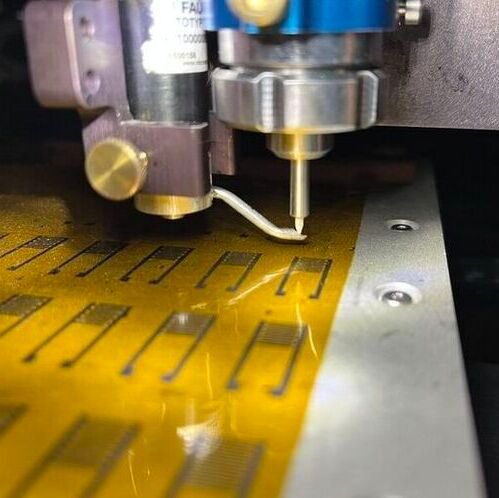
An aerosol jet printer in Hersam's laboratory deposits electronic inks onto a flexible polymer substrate.
(Source: Mark Hersam/Northwestern University)
Illinois/USA – Northwestern University engineers printed artificial neurons that don’t just imitate the brain — they talk to it.
In a new study, the Northwestern team developed flexible, low-cost devices that generate electrical signals realistic enough to activate living brain cells. When tested on slices of tissue from mouse brains, the artificial neurons successfully triggered responses from real neurons, demonstrating a new level of biocompatibility.
The work marks a step toward electronics that can communicate directly with the nervous system, with potential applications in brain-machine interfaces and neuroprosthetics, including implants for hearing, vision and movement.
It also lays the groundwork for more efficient, brain-like computing systems. By mimicking how neurons signal — a key feature of the brain, which is the most energy-efficient computer known — futuristic systems could perform complex operations using far less power than today’s data-hungry technologies.
The study was published on April 15 in the journal Nature Nanotechnology.
“The world we live in today is dominated by artificial intelligence (AI),” said Northwestern’s Mark C. Hersam, who led the study. “The way you make AI smarter is by training it on more and more data. This data-intensive training leads to a massive power-consumption problem. Therefore, we have to come up with more efficient hardware to handle big data and AI. Because the brain is five orders of magnitude more energy efficient than a digital computer, it makes sense to look to the brain for inspiration for next-generation computing.”
An expert in brain-like computing, Hersam is the Walter P. Murphy Professor of Materials Science and Engineering at Northwestern’s McCormick School of Engineering, professor of medicine at Northwestern University Feinberg School of Medicine and professor of chemistry at Northwestern’s Weinberg College of Arts and Sciences. He also is the chair of the department of materials science and engineering, director of the Materials Research Science and Engineering Center and member of the International Institute for Nanotechnology. Hersam co-led the study with Vinod K. Sangwan, a research associate professor at McCormick.
From rigid silicon to dynamic brains
As computing tasks become more complex and data-intensive, computers meet these demands by adding more identical components — billions of transistors packed onto rigid, two-dimensional silicon chips. Each transistor behaves the same way. And, once fabricated, those systems remain fixed.
The brain operates in a strikingly different way. Rather than comprising uniform building blocks, the brain relies on diverse types of neurons — each performing specialized roles — organized across regions. These soft, three-dimensional networks constantly change, forming and reshaping connections over time as people learn and adapt.
“Silicon achieves complexity by having billions of identical devices,” Hersam said. “Everything is the same, rigid and fixed once it’s fabricated. The brain is the opposite. It’s heterogeneous, dynamic and three-dimensional. To move in that direction, we need new materials and new ways to build electronics.”
While other artificial neurons do exist, they fall short of biological realism. Most produce simplified signals, forcing engineers to rely on large, energy-intensive networks of devices to achieve complex behavior.
Turning an imperfection into a feature
To move closer to a biological model, Hersam’s team developed artificial neurons using soft, printable materials that better mimic the brain’s structure and behavior. The backbone of that advance is a series of electronic inks, formulated from nanoscale flakes of molybdenum disulfide (MoS2), which acts as a semiconductor, and graphene, which serves an electrical conductor. Using a specialized printing technique called aerosol jet printing, the researchers deposited these inks onto flexible polymer substrates.
Date: 08.12.2025
Naturally, we always handle your personal data responsibly. Any personal data we receive from you is processed in accordance with applicable data protection legislation. For detailed information please see our privacy policy.
Consent to the use of data for promotional purposes
I hereby consent to Vogel Communications Group GmbH & Co. KG, Max-Planck-Str. 7-9, 97082 Würzburg including any affiliated companies according to §§ 15 et seq. AktG (hereafter: Vogel Communications Group) using my e-mail address to send editorial newsletters. A list of all affiliated companies can be found here
Newsletter content may include all products and services of any companies mentioned above, including for example specialist journals and books, events and fairs as well as event-related products and services, print and digital media offers and services such as additional (editorial) newsletters, raffles, lead campaigns, market research both online and offline, specialist webportals and e-learning offers. In case my personal telephone number has also been collected, it may be used for offers of aforementioned products, for services of the companies mentioned above, and market research purposes.
Additionally, my consent also includes the processing of my email address and telephone number for data matching for marketing purposes with select advertising partners such as LinkedIn, Google, and Meta. For this, Vogel Communications Group may transmit said data in hashed form to the advertising partners who then use said data to determine whether I am also a member of the mentioned advertising partner portals. Vogel Communications Group uses this feature for the purposes of re-targeting (up-selling, cross-selling, and customer loyalty), generating so-called look-alike audiences for acquisition of new customers, and as basis for exclusion for on-going advertising campaigns. Further information can be found in section “data matching for marketing purposes”.
In case I access protected data on Internet portals of Vogel Communications Group including any affiliated companies according to §§ 15 et seq. AktG, I need to provide further data in order to register for the access to such content. In return for this free access to editorial content, my data may be used in accordance with this consent for the purposes stated here. This does not apply to data matching for marketing purposes.
Right of revocation
I understand that I can revoke my consent at will. My revocation does not change the lawfulness of data processing that was conducted based on my consent leading up to my revocation. One option to declare my revocation is to use the contact form found at https://contact.vogel.de. In case I no longer wish to receive certain newsletters, I have subscribed to, I can also click on the unsubscribe link included at the end of a newsletter. Further information regarding my right of revocation and the implementation of it as well as the consequences of my revocation can be found in the data protection declaration, section editorial newsletter.
In the past, other researchers viewed the stabilizing polymer in the inks as a problem that interfered with electrical current flow, so they burned the polymer away after printing the electronic circuit. But Hersam leveraged this minor imperfection to add brain-like functionality to his device.
“Instead of fully removing the polymer, we partially decompose it,” he said. “Then, when we pass current through the device, we drive further decomposition of the polymer. This decomposition occurs in a spatially inhomogeneous manner, leading to formation of a conductive filament, such that all the current is constricted into a narrow region in space.”
This narrow region becomes a localized pathway that produces a sudden, neuron-like electrical response. The result is a new type of artificial neuron that can generate a rich range of electrical signals. Instead of generating simple, one-off pulses, the new device produces more complex signaling patterns — including single spikes, continuous firing and bursting patterns — that resemble how real neurons communicate.
By capturing this signaling diversity, each neuron can encode more information and perform more sophisticated functions. And that can reduce the number of components needed in a computing system, drastically improving overall efficiency.
Putting artificial neurons to the test
To test whether its artificial neurons truly could interface with biology, Hersam’s team collaborated with Indira M. Raman, the Bill and Gayle Cook Professor of Neurobiology at Weinberg. Raman’s team applied electrical signals from the artificial neurons to slices of mouse cerebellum. They found the artificial voltage spikes matched key biological features, including timing and duration of living neuron voltage spikes. This reliably triggered activity in real neurons, activating neural circuits in a way similar to natural signals.
“Other labs have tried to make artificial neurons with organic materials, and they spiked too slowly,” Hersam said. “Or they used metal oxides, which are too fast. We are within a temporal range that was not previously demonstrated for artificial neurons. You can see the living neurons respond to our artificial neuron. So, we’ve demonstrated signals that are not only the right timescale but also the right spike shape to interact directly with living neurons.”
The approach comes with several environmentally friendly advantages. In addition to improving energy efficiency, the neuron’s manufacturing process is simple and low-cost. Because the printing process is additive — placing material only where it’s needed — it also reduces waste.
“To meet the energy demands of AI, tech companies are building gigawatt data centers powered by dedicated nuclear power plants,” Hersam said. “It is evident that this massive power consumption will limit further scaling of computing since it’s hard to imagine a next-generation data center requiring 100 nuclear power plants. The other issue is that when you’re dissipating gigawatts of power, there’s a lot of heat. Because data centers are cooled with water, AI is putting severe stress on the water supply. However you look at it, we need to come up with more energy-efficient hardware for AI.”
The study, “Multi-order complexity spiking neurons enabled by printed MoS2 memristive nanosheet networks,” was supported by the National Science Foundation.




:quality(80)/p7i.vogel.de/wcms/62/32/62327aaae1415beeed47db6201e79661/0133375912v2.jpeg "A cotton trailer outfitted with benches and a sunshade offers farmworkers a reprieve from the sun as they take a break from picking cantaloupe melons in Firebaugh, Calif.
(Source: Joe Proudman/ Regents of the University of California)")
:quality(80)/p7i.vogel.de/wcms/e6/c8/e6c8bd554776ee1ad2f1f0723fb243a7/0133369387v1.jpeg "Roman road (Source: Queen Mary University of London)")
:quality(80)/p7i.vogel.de/wcms/51/68/51687ac4cc19f2757c138498b877de57/0133167039v2.jpeg "CMFs are foams that consist of hollow spheres – made of materials such as stainless steel, nickel, or other metals and alloys – embedded in a metallic matrix. The resulting material is both lightweight and remarkably strong at absorbing compressive forces. (Source: Jie Sun/ NC State University)")
:quality(80)/p7i.vogel.de/wcms/cd/c0/cdc09efd1e5b3b8f83224e7729d66c10/0133105276v2.jpeg "From the data presented in this report, the authors show how TF3-MALS-RI is uniquely able to separate large polyacrylate molecules and provide precise molecular weight and Rg values. (Source: Postnova Analytics)")
:quality(80)/p7i.vogel.de/wcms/86/01/86014d3d2a28cefc852f65c8d68317e4/0133104231v2.jpeg "Single-handed tube reading using a Handheld 2. (Source: Azenta Life Sciences)")
:quality(80)/p7i.vogel.de/wcms/0b/0f/0b0f8ed042dfc91f32582e10d54c2c7e/0133087444v2.jpeg "Offering advanced automation to increase your throughput, the Intellixcap provides secure sealing – eliminating the need for manual intervention, while preserving vital sample integrity. (Source: Azenta Life Sciences)")
:quality(80)/p7i.vogel.de/wcms/13/d3/13d35105f74a1c2e22b9c7a270e8e9b3/0132611155v2.jpeg "Circulating cell free DNA. (Source: Amsbio)")
:quality(80)/p7i.vogel.de/wcms/bc/ed/bced6850297a04dbea471a66cb6bb6fe/0132611405v2.jpeg "The latest addition to the range is a peristaltic tubing stop adapter that eliminates the need for fixed stoppers and allows custom cut lengths of peristaltic tubing to be installed on any pump head size. (Source: Biotech Fluidics )")
:quality(80)/p7i.vogel.de/wcms/8d/5c/8d5c6c7f897f91d6784825eee20b5584/0133321225v1.jpeg "Empa researcher Christoph Hüglin collects samples of particles that are washed out of the air by rain and snow or settle due to gravity. (Source: Empa)")
:quality(80)/p7i.vogel.de/wcms/a1/af/a1afbc7c8a067bbe94749ec680b4bafd/0133163762v2.jpeg "The study found in murkier water, fish took longer to move towards the food than those in clear water, but individuals in larger groups responded more quickly overall. (Source: Christos Ioannou)")
:quality(80)/p7i.vogel.de/wcms/32/80/3280aa3d44708962943c96fe2d466744/0133088560v2.jpeg "A bumble bee in flight at the University of Bristol Botanic Garden. (Source: Phil Savoie)")
:quality(80)/p7i.vogel.de/wcms/7b/e5/7be5c735140cbe28f3af0ec3d88274b9/0133045403v2.jpeg "After being buried in the ground for two months and broken down by soil organisms, a new pair of cotton underwear (left) shows clear signs of decomposition (right). (Source: Nicolas Zonvi)")
:quality(80)/p7i.vogel.de/wcms/ef/68/ef68375729607984e5bb0c143afdae70/0133375119v2.jpeg "Printed Rice-Lentil 3D structures
(Source: SUTD)")
:quality(80)/p7i.vogel.de/wcms/bf/d0/bfd087349a85956a7aefad57ac1204c7/0133241961v2.jpeg "The Thermo Scientific Suretect Beverage Spoilage Multiplex PCR Assay provides a fast, broad-range molecular solution for detecting key spoilage microorganisms that threaten beverage quality. (Source: © OlegDoroshin - stock.adobe.com)")
:quality(80)/p7i.vogel.de/wcms/d4/61/d461ce0bd5743897993c6475f69e7ad6/0133067478v2.jpeg "In Harris County, 50 % of households with children reported food insecurity, compared with 33 % of households without children. (Source: Rice University)")
:quality(80)/p7i.vogel.de/wcms/79/76/7976d17b980bedfe35acaa532d690046/0132713841v2.jpeg "Observed rice yield losses from 1°C warming are more than twice as high as model estimates due to underestimated heat stress. (Source: AdobeStock/ducvien)")
:quality(80)/p7i.vogel.de/wcms/22/49/224964dd6850b62cccdbc4bde2d34693/0133372964v1.jpeg "Brain activity recorded during a video game helped researchers predict whether participants would take or avoid a risk half a second before they acted. (Source: free licensed)")
:quality(80)/p7i.vogel.de/wcms/48/a7/48a761934161543f70fef2403b44d714/0133372328v2.jpeg "The link between pollution and coughing persisted in the data, even when pollution levels were below the WHO’s recommended safe daily exposure limit. (Source: free licensed)")
:quality(80)/p7i.vogel.de/wcms/83/b4/83b4563a65c6036b61990931507428b4/0133363611v2.jpeg "Magnesium sulphate uptake and the north / south divide for the Precept program. (Source: University of Bristol )")
:quality(80)/p7i.vogel.de/wcms/bb/06/bb06c1c3c5d250f3f93016366c56525d/0133363201v2.jpeg "The team identified more than 1,200 associated genetic variants and found that these influences are remarkably consistent across countries, ages and methods of measuring personality. (Source: Pixabay - PublicDomainPictures)")
:quality(80)/images.vogel.de/vogelonline/bdb/1710600/1710675/original.jpg "Discover how to set yourself up for success when performing balance-based density determination of solids such as jewelry and precious metals. (Mettler Toledo)")
:quality(80)/images.vogel.de/vogelonline/bdb/1682500/1682579/original.jpg "The new XPR Analytical balance redesigned to meet the needs of laboratory technicians of working fast and lean. (Mettler Toledo)")
:quality(80)/images.vogel.de/vogelonline/bdb/1677000/1677080/original.jpg "Enhance your weighing accuracy, comfort and productivity with the redesigned XPR Analytical balance. (Mettler Toledo)")
:fill(fff,0)/images.vogel.de/vogelonline/companyimg/107800/107832/65.jpg "logoDueperthal.jpg ()")
:quality(80)/p7i.vogel.de/wcms/83/90/839049b296905df2a07deb4e867ff2cb/0129594701v2.jpeg "The full device next to a quarter for scale. (Source: John A. Rogers/Northwestern University)")
:quality(80)/p7i.vogel.de/wcms/aa/39/aa398d3e6667bdb43ad57abf38dc394c/0129347450v2.jpeg "An illustration shows a strand of engineered DNA passing through a nanoscale sensor, where its physical structure can be decoded as digital information. DNA nanostructures could one day serve as ultra-dense carriers of digital information and advance the field of data encryption. (Source: Jason Drees/ ASU)")