What looks like a bundle of tangled staples could point to a new class of engineered materials: researchers at CU Boulder are studying interlocking particles that can stiffen or loosen depending on how they are moved or vibrated. The concept could open the door to strong, adaptable and potentially recyclable structures.
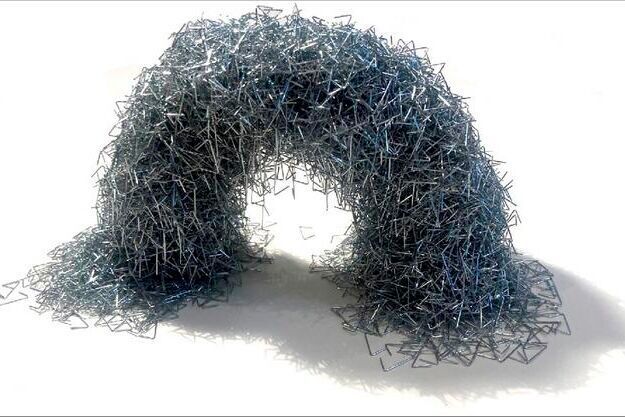
A close look at a free-standing arch made of crown-leg staples.
(Source: CU Boulder)
A tightly packed ball of office staples can be surprisingly strong. Try to pull it apart and the tangled metal resists like a solid object. But with the right movement or vibration, that same bundle can quickly fall back into loose pieces.
A team of engineers and materials scientists in the Paul M. Rady Department of Mechanical Engineering at CU Boulder are exploring how this rare combination of strength and flexibility could inspire a new class of materials built on interlocking particles. By mimicking the way staples lock together and release, these emerging materials could one day form structures that are strong, adaptable and even recyclable, the researchers said.
“We’ve been playing around with the idea of building blocks and geometry for many years, but we started looking at interlocking, entangled particles only recently,” said Professor Francois Barthelat, the leader of the Laboratory for Advanced Materials & Bioinspiration. “We are excited about the combination of properties we can get out of these systems and we believe this technology has the potential to go in many directions.”
The work, recently published in the Journal of Applied Physics, focuses on what the researchers call “entanglement”—when multiple particles become intertwined with one another, creating a link.
It’s not a new concept. In fact, nature is filled with examples of objects or materials that tangle and interlock with each other to create strong structures. Think about a bird's nest made out of interwoven sticks and fibers, or the interplay of hard minerals and soft proteins in bones.
How can scientists recreate that kind of natural entanglement in manufactured materials? The researchers in Barthelat’s lab say the answer revolves around one key concept: particle shape.
“Let’s take sand as an example. Sand is smooth and convex-shaped, meaning it cannot interlock from grain to grain,” PhD student Youhan Sohn said. “However, we found that if we change the shape of a grain of sand, we can drastically affect its behavior and mechanical properties, including the particle’s ability to link with other particles.”
Once the group came to this realization, they began running Monte Carlo simulations, a type of computational analysis, to predict exactly how the particles interlock with each other. Their goal was to find the optimal geometry that delivered the maximum entanglement.
After finding the optimal shape, the team performed pickup tests to see how the entangled particles actually behaved.
The tests showed that a “two-legged” particle — similar in shape to a staple — had the greatest potential for entanglement. But the researchers also discovered several unexpected advantages that made the design even more intriguing.
The first was its rare blend of tensile strength and toughness, a combination the researchers say conventional materials rarely achieve simultaneously.
Our entangled granular material using the staple-like particle demonstrates both high strength and toughness at the same time.
Saeed Pezeshki, PhD student, CU Bolder
Next, was its unique ability to rapidly assemble — and just as quickly come apart.
By applying different vibrational patterns to the material, the team was able to change its level of entanglement on demand. A light vibration, for example, could be used to interlock and strengthen the particles, while a larger vibration could cause them to completely unravel.
“It’s a strange material because it’s obviously not a liquid. However, it’s also not quite solid. This opens new and intriguing engineering possibilities,” Barthelat said. “Handling a bundle of these entangled particles feels very remote and exotic.”
One of those possibilities comes in the realm of sustainability. The group believes that one day, large buildings and structures like bridges can be designed using entangled materials, allowing them to be disassembled when no longer needed or even fully recycled.
Date: 08.12.2025
Naturally, we always handle your personal data responsibly. Any personal data we receive from you is processed in accordance with applicable data protection legislation. For detailed information please see our privacy policy.
Consent to the use of data for promotional purposes
I hereby consent to Vogel Communications Group GmbH & Co. KG, Max-Planck-Str. 7-9, 97082 Würzburg including any affiliated companies according to §§ 15 et seq. AktG (hereafter: Vogel Communications Group) using my e-mail address to send editorial newsletters. A list of all affiliated companies can be found here
Newsletter content may include all products and services of any companies mentioned above, including for example specialist journals and books, events and fairs as well as event-related products and services, print and digital media offers and services such as additional (editorial) newsletters, raffles, lead campaigns, market research both online and offline, specialist webportals and e-learning offers. In case my personal telephone number has also been collected, it may be used for offers of aforementioned products, for services of the companies mentioned above, and market research purposes.
Additionally, my consent also includes the processing of my email address and telephone number for data matching for marketing purposes with select advertising partners such as LinkedIn, Google, and Meta. For this, Vogel Communications Group may transmit said data in hashed form to the advertising partners who then use said data to determine whether I am also a member of the mentioned advertising partner portals. Vogel Communications Group uses this feature for the purposes of re-targeting (up-selling, cross-selling, and customer loyalty), generating so-called look-alike audiences for acquisition of new customers, and as basis for exclusion for on-going advertising campaigns. Further information can be found in section “data matching for marketing purposes”.
In case I access protected data on Internet portals of Vogel Communications Group including any affiliated companies according to §§ 15 et seq. AktG, I need to provide further data in order to register for the access to such content. In return for this free access to editorial content, my data may be used in accordance with this consent for the purposes stated here. This does not apply to data matching for marketing purposes.
Right of revocation
I understand that I can revoke my consent at will. My revocation does not change the lawfulness of data processing that was conducted based on my consent leading up to my revocation. One option to declare my revocation is to use the contact form found at https://contact.vogel.de. In case I no longer wish to receive certain newsletters, I have subscribed to, I can also click on the unsubscribe link included at the end of a newsletter. Further information regarding my right of revocation and the implementation of it as well as the consequences of my revocation can be found in the data protection declaration, section editorial newsletter.
Or maybe entangled materials can make their way into the world’s next great robotic systems.
“I was talking with other students who believe this technology can be used in swarm robotics— where small robots can entangle, do a task and then disentangle when they are done,” said Pezeshki.
“Yes, kind of like that liquid metal T-1000 in Terminator 2 who can change shape to slide under a door and then transform back to a human’s size on the other side,” added Barthelat. “It’s expensive and scaling up is a challenge, but it’s something that’s on everybody’s mind.”
For now, the group is focused on building out the next phase of their research. They are currently testing a new particle shape with added protruding “legs” — similar to those spiky plant burrs that stick relentlessly to your shoes when you step on them — which they believe can generate even stronger entanglement properties.
Original Article: Combined effects of particle geometry and applied vibrations on the mechanics and strength of entangled materials; Journal of Applied Physics; DOI:10.1063/5.0308921




:quality(80)/p7i.vogel.de/wcms/62/32/62327aaae1415beeed47db6201e79661/0133375912v2.jpeg "A cotton trailer outfitted with benches and a sunshade offers farmworkers a reprieve from the sun as they take a break from picking cantaloupe melons in Firebaugh, Calif.
(Source: Joe Proudman/ Regents of the University of California)")
:quality(80)/p7i.vogel.de/wcms/e6/c8/e6c8bd554776ee1ad2f1f0723fb243a7/0133369387v1.jpeg "Roman road (Source: Queen Mary University of London)")
:quality(80)/p7i.vogel.de/wcms/51/68/51687ac4cc19f2757c138498b877de57/0133167039v2.jpeg "CMFs are foams that consist of hollow spheres – made of materials such as stainless steel, nickel, or other metals and alloys – embedded in a metallic matrix. The resulting material is both lightweight and remarkably strong at absorbing compressive forces. (Source: Jie Sun/ NC State University)")
:quality(80)/p7i.vogel.de/wcms/cd/c0/cdc09efd1e5b3b8f83224e7729d66c10/0133105276v2.jpeg "From the data presented in this report, the authors show how TF3-MALS-RI is uniquely able to separate large polyacrylate molecules and provide precise molecular weight and Rg values. (Source: Postnova Analytics)")
:quality(80)/p7i.vogel.de/wcms/86/01/86014d3d2a28cefc852f65c8d68317e4/0133104231v2.jpeg "Single-handed tube reading using a Handheld 2. (Source: Azenta Life Sciences)")
:quality(80)/p7i.vogel.de/wcms/0b/0f/0b0f8ed042dfc91f32582e10d54c2c7e/0133087444v2.jpeg "Offering advanced automation to increase your throughput, the Intellixcap provides secure sealing – eliminating the need for manual intervention, while preserving vital sample integrity. (Source: Azenta Life Sciences)")
:quality(80)/p7i.vogel.de/wcms/13/d3/13d35105f74a1c2e22b9c7a270e8e9b3/0132611155v2.jpeg "Circulating cell free DNA. (Source: Amsbio)")
:quality(80)/p7i.vogel.de/wcms/bc/ed/bced6850297a04dbea471a66cb6bb6fe/0132611405v2.jpeg "The latest addition to the range is a peristaltic tubing stop adapter that eliminates the need for fixed stoppers and allows custom cut lengths of peristaltic tubing to be installed on any pump head size. (Source: Biotech Fluidics )")
:quality(80)/p7i.vogel.de/wcms/8d/5c/8d5c6c7f897f91d6784825eee20b5584/0133321225v1.jpeg "Empa researcher Christoph Hüglin collects samples of particles that are washed out of the air by rain and snow or settle due to gravity. (Source: Empa)")
:quality(80)/p7i.vogel.de/wcms/a1/af/a1afbc7c8a067bbe94749ec680b4bafd/0133163762v2.jpeg "The study found in murkier water, fish took longer to move towards the food than those in clear water, but individuals in larger groups responded more quickly overall. (Source: Christos Ioannou)")
:quality(80)/p7i.vogel.de/wcms/32/80/3280aa3d44708962943c96fe2d466744/0133088560v2.jpeg "A bumble bee in flight at the University of Bristol Botanic Garden. (Source: Phil Savoie)")
:quality(80)/p7i.vogel.de/wcms/7b/e5/7be5c735140cbe28f3af0ec3d88274b9/0133045403v2.jpeg "After being buried in the ground for two months and broken down by soil organisms, a new pair of cotton underwear (left) shows clear signs of decomposition (right). (Source: Nicolas Zonvi)")
:quality(80)/p7i.vogel.de/wcms/ef/68/ef68375729607984e5bb0c143afdae70/0133375119v2.jpeg "Printed Rice-Lentil 3D structures
(Source: SUTD)")
:quality(80)/p7i.vogel.de/wcms/bf/d0/bfd087349a85956a7aefad57ac1204c7/0133241961v2.jpeg "The Thermo Scientific Suretect Beverage Spoilage Multiplex PCR Assay provides a fast, broad-range molecular solution for detecting key spoilage microorganisms that threaten beverage quality. (Source: © OlegDoroshin - stock.adobe.com)")
:quality(80)/p7i.vogel.de/wcms/d4/61/d461ce0bd5743897993c6475f69e7ad6/0133067478v2.jpeg "In Harris County, 50 % of households with children reported food insecurity, compared with 33 % of households without children. (Source: Rice University)")
:quality(80)/p7i.vogel.de/wcms/79/76/7976d17b980bedfe35acaa532d690046/0132713841v2.jpeg "Observed rice yield losses from 1°C warming are more than twice as high as model estimates due to underestimated heat stress. (Source: AdobeStock/ducvien)")
:quality(80)/p7i.vogel.de/wcms/22/49/224964dd6850b62cccdbc4bde2d34693/0133372964v1.jpeg "Brain activity recorded during a video game helped researchers predict whether participants would take or avoid a risk half a second before they acted. (Source: free licensed)")
:quality(80)/p7i.vogel.de/wcms/48/a7/48a761934161543f70fef2403b44d714/0133372328v2.jpeg "The link between pollution and coughing persisted in the data, even when pollution levels were below the WHO’s recommended safe daily exposure limit. (Source: free licensed)")
:quality(80)/p7i.vogel.de/wcms/83/b4/83b4563a65c6036b61990931507428b4/0133363611v2.jpeg "Magnesium sulphate uptake and the north / south divide for the Precept program. (Source: University of Bristol )")
:quality(80)/p7i.vogel.de/wcms/bb/06/bb06c1c3c5d250f3f93016366c56525d/0133363201v2.jpeg "The team identified more than 1,200 associated genetic variants and found that these influences are remarkably consistent across countries, ages and methods of measuring personality. (Source: Pixabay - PublicDomainPictures)")
:quality(80)/images.vogel.de/vogelonline/bdb/1710600/1710675/original.jpg "Discover how to set yourself up for success when performing balance-based density determination of solids such as jewelry and precious metals. (Mettler Toledo)")
:quality(80)/images.vogel.de/vogelonline/bdb/1682500/1682579/original.jpg "The new XPR Analytical balance redesigned to meet the needs of laboratory technicians of working fast and lean. (Mettler Toledo)")
:quality(80)/images.vogel.de/vogelonline/bdb/1677000/1677080/original.jpg "Enhance your weighing accuracy, comfort and productivity with the redesigned XPR Analytical balance. (Mettler Toledo)")
:fill(fff,0)/p7i.vogel.de/companies/69/b7/69b7f63f311d9/logo-bimos-tif--2-.jpeg "logo-bimos-tif--2- (https://www.bimos.com/de-de/)")
:quality(80)/p7i.vogel.de/wcms/99/cf/99cf937080dc1f2dea423e3ca0dcc6d8/0128496742v2.jpeg "Abram Fluckiger holds up a sample panel square that has five sandwiched layers of a new material nearly transparent insulation material called Mochi, which was designed buy CU Boulder researchers in physics professor Ivan Smalyukh’s lab. (Source: Glenn J. Asakawa/CU Boulder)")
:quality(80)/p7i.vogel.de/wcms/45/47/4547a006853506f31157fb435ce1449f/0129504589v1.jpeg "Elephant trunk whiskers shine (Source: MPI-IS/A. Posada)")
:quality(80)/p7i.vogel.de/wcms/d8/42/d842014a015e22475805914990ad2fd6/0127562647v1.jpeg "Researchers at the University of Washington created a recyclable composite material made of tiny droplets of liquid metal infused into a stretchy polymer. The droplets, pictured in this microscope image, can be connected easily together to form an electrical circuit. (Source: Y. Han/ Advanced Functional Materials)")