A team of food scientists co-fermented the enzyme-treated kombu with lactic acid bacteria and an aroma-producing yeast to produce a novel probiotic kombu-based blend that is both healthier and more flavorful.
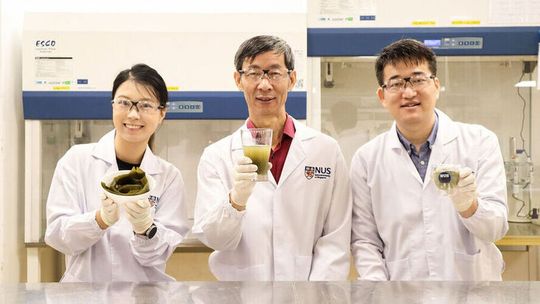
A team of NUS food scientists consisting of Assoc Prof Liu Shao Quan (centre), Dr Lu Yuyun (right) and Ms Geng Chenhan (left) pioneered a co-fermentation method that improves both the nutrient and flavor profile of kombu.
(Source: NUS)
Queenstown/Singapore – Kombu (Saccharina japonica) is a brown seaweed extensively cultivated and consumed in Japan, Korea and China. Despite its nutritional value, its strong fishy and grassy odor can deter some consumers. Additionally, many of kombu’s nutrients are locked inside rigid cell walls and dense networks that the human digestive system cannot easily break down. As a result, much of this treasure trove of nutrients passes through the body without being absorbed.
A team of food scientists at NUS has found a way to unlock the trapped nutrients in kombu and replace the unpleasant odors with more appealing scents, directly overcoming the two major challenges – limited nutrient bioaccessibility and poor sensory experience.
Enzymes and lactic acid bacteria (LAB) fermentation have been commonly used to improve kombu’s nutritional value by breaking down large proteins and carbohydrates into smaller, more digestible components. However, these approaches cannot effectively remove the compounds that give kombu its characteristic fishy and grassy odor.
Building on the knowledge that yeast fermentation can naturally produce pleasant fruity and floral aromas; the NUS scientists took the process a step further by co-fermenting enzyme-treated kombu with LAB and an aroma-producing yeast. The result is a novel probiotic kombu-based blend that is both healthier and more flavorful.
The team’s work was published in the scientific journal International Journal of Food Microbiology on 2 December 2025.
Banana and pear-flavored kombu, anyone?
In their earlier work published in October 2025, the NUS team demonstrated that fermenting enzyme-treated kombu with LAB effectively releases trapped nutrients. In their latest work, enzyme-treated kombu was fermented using LAB together with an aroma-producing yeast. Analysis of the fermented kombu blend revealed that the LAB-yeast co-fermentation promotes the growth and survival of probiotics compared to LAB-only fermentation. One particular co-fermentation mixture (using the LAB, L. plantarum and the yeast, P. kluyveri) yielded more γ-aminobutyric acid (Gaba), a well-known bioactive compound commonly linked to calming effects, stress reduction, and potential benefits for mental health. Importantly, the co-fermentation greatly reduced unpleasant off-flavor compounds while introducing compounds associated with the aromas of bananas and pears.
“Kombu has a tremendous amount of untapped potential to be a superfood, but for its health benefits to reach a wider population, kombu has to be more palatable and its nutrients more accessible,” said Associate Professor Liu Shao Quan from the Department of Food Science and Technology in NUS Faculty of Science. “While enzymatic treatment followed by lactic acid bacteria fermentation liberates beneficial nutrients, the combination with yeast fermentation further produces fruity aroma compounds, improving the flavor profile of the fermented kombu.”
Fermented kombu as a functional food
Following LAB-yeast co-fermentation, the fermented kombu product becomes exceptionally nutritious and is fortified with probiotics and Gaba, which positively influences gut and mental health respectively. Subsequently, the fermented kombu blend could be used to develop fermented kombu-based functional foods – foods that provide health benefits beyond their basic nutritional value – and beverages that are healthy and tasty.
“Our unique co-fermentation method of processing kombu is the gateway to creating new health products. With our tastier fermented kombu, we could create fermented seaweed drinks, probiotic seaweed-based supplements or even use it as ingredients in plant-based foods,” said Dr Lu Yuyun, Senior Research Fellow and co-corresponding author of the research paper. “This approach may also be adapted to other seaweed species to broaden the range of appealing seaweed-derived products.”
Currently, few if any commercial kombu products are made using LAB-yeast fermentation, underscoring the innovative nature of this research.
“Elevating the flavor profile of kombu makes it more enticing to a broader range of consumers. Our next goal is to optimize fermentation conditions, such as fermentation sequence, time and temperature, to further improve process efficiency and product quality,” said Ms Geng Chenhan, third-year PhD student and first author of the research paper. “In future, we will also conduct sensory evaluation to better understand consumer preferences for seaweed-based foods.”
Date: 08.12.2025
Naturally, we always handle your personal data responsibly. Any personal data we receive from you is processed in accordance with applicable data protection legislation. For detailed information please see our privacy policy.
Consent to the use of data for promotional purposes
I hereby consent to Vogel Communications Group GmbH & Co. KG, Max-Planck-Str. 7-9, 97082 Würzburg including any affiliated companies according to §§ 15 et seq. AktG (hereafter: Vogel Communications Group) using my e-mail address to send editorial newsletters. A list of all affiliated companies can be found here
Newsletter content may include all products and services of any companies mentioned above, including for example specialist journals and books, events and fairs as well as event-related products and services, print and digital media offers and services such as additional (editorial) newsletters, raffles, lead campaigns, market research both online and offline, specialist webportals and e-learning offers. In case my personal telephone number has also been collected, it may be used for offers of aforementioned products, for services of the companies mentioned above, and market research purposes.
Additionally, my consent also includes the processing of my email address and telephone number for data matching for marketing purposes with select advertising partners such as LinkedIn, Google, and Meta. For this, Vogel Communications Group may transmit said data in hashed form to the advertising partners who then use said data to determine whether I am also a member of the mentioned advertising partner portals. Vogel Communications Group uses this feature for the purposes of re-targeting (up-selling, cross-selling, and customer loyalty), generating so-called look-alike audiences for acquisition of new customers, and as basis for exclusion for on-going advertising campaigns. Further information can be found in section “data matching for marketing purposes”.
In case I access protected data on Internet portals of Vogel Communications Group including any affiliated companies according to §§ 15 et seq. AktG, I need to provide further data in order to register for the access to such content. In return for this free access to editorial content, my data may be used in accordance with this consent for the purposes stated here. This does not apply to data matching for marketing purposes.
Right of revocation
I understand that I can revoke my consent at will. My revocation does not change the lawfulness of data processing that was conducted based on my consent leading up to my revocation. One option to declare my revocation is to use the contact form found at https://contact.vogel.de. In case I no longer wish to receive certain newsletters, I have subscribed to, I can also click on the unsubscribe link included at the end of a newsletter. Further information regarding my right of revocation and the implementation of it as well as the consequences of my revocation can be found in the data protection declaration, section editorial newsletter.




:quality(80)/p7i.vogel.de/wcms/aa/39/aa398d3e6667bdb43ad57abf38dc394c/0129347450v2.jpeg "An illustration shows a strand of engineered DNA passing through a nanoscale sensor, where its physical structure can be decoded as digital information. DNA nanostructures could one day serve as ultra-dense carriers of digital information and advance the field of data encryption. (Source: Jason Drees/ ASU)")
:quality(80)/p7i.vogel.de/wcms/06/a1/06a11f1d752afb35854aa9e1afb62e98/0129209625v2.jpeg "“Unsinkable\" metal tube made from chemically-etched aluminum floats in distilled water at the lab of University of Rochester professor Chunlei Guo. (Source: J. Adam Fenster / University of Rochester)")
:quality(80)/p7i.vogel.de/wcms/6d/df/6ddf023361ec7f8fbfb6c56521577960/0129056554v2.jpeg "The evolution of carburization (depicted by the spheres) under kinetic control (illustrated by the surface contours). The molecular beams represent gas evolution under synthesis conditions while the fiery sphere highlights the formation of the pure tungsten semi-carbide phase with additional molecular beams at the top to illustrate its catalytic performance. (Source: Sinhara M. H. D. Perera)")
:quality(80)/p7i.vogel.de/wcms/26/3d/263d97f8f2797267ecf2781b56882758/0129056451v1.jpeg "A study by the Complexity Science Hub finds that AI systems are already involved in nearly one-third of newly written software code, with rapid adoption in the United States and Europe and measurable productivity gains mainly for experienced developers. (Source: free licensed)")
:quality(80)/p7i.vogel.de/wcms/11/74/1174e5d4c8b07a64637dced8c9506b40/0129787561v2.jpeg "The Multicell Plus high-pressure reactor sets a new benchmark for operator safety, all-round accessibility and ease-of-use. (Source: Asynt)")
:quality(80)/p7i.vogel.de/wcms/ef/6e/ef6e96191183411973b77041fb6b1e16/0129785957v2.jpeg "Manufactured from high-quality crystal polystyrene - these new automation-ready plates are available in a choice of ANSI / SLAS standard (96-well and breakable 8-well strip) formats. (Source: Porvair Sciences)")
:quality(80)/p7i.vogel.de/wcms/ad/ca/adcaa20ef5ccaf7e3b325788b1e349c4/0129784872v2.jpeg "The high performance Degasi Flat Film in-line degasser. (Source: Biotech Fluidics)")
:quality(80)/p7i.vogel.de/wcms/22/d8/22d876eb82626568e404ebae75053986/0129781861v2.jpeg "Uniqsis has introduced a novel Tube-in-plate reactor that provides a cost-effective alternative to glass static mixer reactor blocks for highly exothermic or fast, mixing-dependent reactions. (Source: Uniqsis)")
:quality(80)/p7i.vogel.de/wcms/a3/52/a3527437a0f0bba5e58559a5c78e4f7a/0129797135v2.jpeg "PFAS have been used in a range of products, including non-stick cookware, cosmetics and fire extinguisher foam. (Source: free licensed)")
:quality(80)/p7i.vogel.de/wcms/05/94/0594c8529e29bf70b31c0f8db2e7a3cd/0129797089v1.jpeg "In related research, a team led by Princeton Professors Z. Jason Ren and Mark Zondlo studied emissions from U.S. wastewater plants.
(Source: Nathan Li/ Princeton University)")
:quality(80)/p7i.vogel.de/wcms/b5/05/b505af30c4c5d568073b613a9e9a1541/0129779931v2.jpeg "Researchers tested what factors improve or worsen the quality of sleep in mice. (Source: Pixabay)")
:quality(80)/p7i.vogel.de/wcms/8c/39/8c392d01443d1dd972c8c1b498514199/0129776466v2.jpeg "Individuals exposed as children to indoor air pollution from solid fuels performed significantly worse on cognitive tests in adulthood. (Source: Pixabay)")
:quality(80)/p7i.vogel.de/wcms/ea/88/ea88ef8810e21cdd9bb852c70f385ba1/0129797385v2.jpeg "A team of NUS food scientists consisting of Assoc Prof Liu Shao Quan (centre), Dr Lu Yuyun (right) and Ms Geng Chenhan (left) pioneered a co-fermentation method that improves both the nutrient and flavor profile of kombu. (Source: NUS)")
:quality(80)/p7i.vogel.de/wcms/84/2c/842c7c1678ceeec7147ea3a36e238e75/0129356324v2.jpeg "Kaust and Nadec have signed a MOU that establishes a framework for long-term cooperation across agricultural research, technology development, and professional training. (Source: Kaust )")
:quality(80)/p7i.vogel.de/wcms/d1/3c/d13c2ad34af600dbd360c0bb0990b922/0129045715v2.jpeg "Replacing animal products with plant-based foods helps reduce the risk of heart disease and type 2 diabetes, finds a new review by the Physicians Committee for Responsible Medicine. (Source: Pixabay)")
:quality(80)/p7i.vogel.de/wcms/e1/b3/e1b3e26d03101ba93b76b304da150c9a/0129025388v2.jpeg "The research reanalyzed data from a seminal clinical trial, led by US National Institutes of Health veteran Dr Kevin Hall, which first exposed how eating exclusively UPFs results in excessive calorie consumption and weight gain. (Source: Pixabay)")
:quality(80)/p7i.vogel.de/wcms/2d/94/2d944012449fc004fb7d86ec1cba9b9e/0129797407v2.jpeg "Adequate sleep and physical exercise are cornerstones of a healthy lifestyle. (Source: Pixabay)")
:quality(80)/p7i.vogel.de/wcms/03/4e/034e39bc9a2ef1ee8f868d4a50c3a3e7/0129797396v2.jpeg "A donated Super Ager brain. (Source: Shane Collins, Northwestern University)")
:quality(80)/p7i.vogel.de/wcms/9f/57/9f57b90c78864d1e4450a54e1ad30f90/0129797374v2.jpeg "A new Physicians Committee for Responsible Medicine poll found that nearly half of Americans aren’t aware that eating processed meat increases the risk of developing colorectal cancer. (Source: Getty Images)")
:quality(80)/p7i.vogel.de/wcms/e6/49/e649f8e8a4b990611fd1c1d8a1aa50a5/0129797212v2.jpeg "Case 6, photographed by Dr Jose de la Fuente. Amber now held in the KGJ Colección, Ciudad Real. (Source: Dr Jose de la Fuente)")
:quality(80)/images.vogel.de/vogelonline/bdb/1710600/1710675/original.jpg "Discover how to set yourself up for success when performing balance-based density determination of solids such as jewelry and precious metals. (Mettler Toledo)")
:quality(80)/images.vogel.de/vogelonline/bdb/1682500/1682579/original.jpg "The new XPR Analytical balance redesigned to meet the needs of laboratory technicians of working fast and lean. (Mettler Toledo)")
:quality(80)/images.vogel.de/vogelonline/bdb/1677000/1677080/original.jpg "Enhance your weighing accuracy, comfort and productivity with the redesigned XPR Analytical balance. (Mettler Toledo)")
:fill(fff,0)/p7i.vogel.de/companies/5f/3f/5f3f63ceedc78/knf-logo.jpg "KNF_Logo.jpg (www.knf.com)")
:quality(80)/p7i.vogel.de/wcms/e2/7d/e27d4de337b33096780df36b9c0126d6/0128390973v2.jpeg "The NUS research team pioneered two innovative techniques using easy-to-obtain enzymes that alter the flavour of roasted carob pulp, enabling it to more closely mimic the rich bitterness and sweetness of cocoa. (Source: NUS Faculty of Science)")
:quality(80)/p7i.vogel.de/wcms/5a/f5/5af5ec78094e70217709f00fb2c4998a/0125689232v2.jpeg "pH is a crucial parameter in the production process of yogurt. (Source: © Igor Dudchak - stock.adobe.com)")