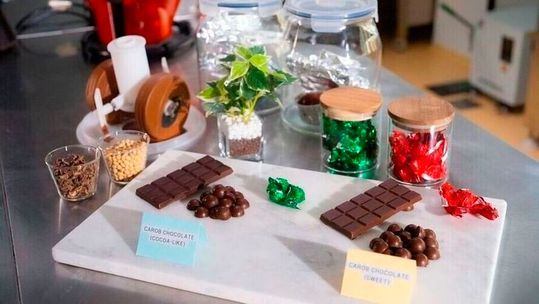
The global cocoa production and supply is currently at risk due to climate change and crop diseases. In this background, researchers have developed two flavour-boosting techniques to transform carob pulp into a delicious and sustainable alternative to cocoa.
The NUS research team pioneered two innovative techniques using easy-to-obtain enzymes that alter the flavour of roasted carob pulp, enabling it to more closely mimic the rich bitterness and sweetness of cocoa.
(Source: NUS Faculty of Science)
Queenstown/Singapore – With climate change and higher incidence of crop diseases, global cocoa production and supply is being threatened. A research team from the National University of Singapore (NUS), motivated by these reports, set out to enhance the taste of carob, making it a more appealing and sustainable alternative to cocoa.
Derived from a hardy, climate-resilient plant known as Ceratonia siliqua (carob), carob pulp has gained attention as a promising cocoa alternative. After roasting, it releases a unique aroma that resembles that of cocoa. However, its flavor still falls short, posing a major hurdle for wider adoption.
The NUS team, led by Associate Professor Liu Shao Quan from the Department of Food Science and Technology (FST) at the NUS Faculty of Science, has developed two innovative techniques to enhance the taste of carob pulp.
“Our carob-based innovation meets the relatively untapped and nascent market of alternative chocolate sources. Additionally, our new techniques improve the taste of carob itself, without the use of additives such as flavorings. So, consumers can have the best of both worlds – better flavor and a simple ingredients list. With these innovations, we aim to make a meaningful contribution towards addressing the current challenges and needs of the chocolate industry,” said Assoc Prof Liu.
A worthy, sustainable successor to cocoa
The carob tree is a leguminous tree native to the Mediterranean and it thrives in hot, arid climates with very low water requirements. In contrast to the Theobroma cacao tree – the source of cocoa – which grows only in narrow climatic conditions, the carob tree is highly drought-tolerant, making it more resilient to climate change and drastic weather conditions.
Beyond its climate resilience, carob also offers some nutritional advantages. With its natural sugar content, it could be used to create chocolate alternatives without added sweeteners – an increasingly desirable feature for health-conscious consumers. Carob is also caffeine-free and rich in d-pinitol, a compound that has been shown to have anti-diabetic effects.
Carob pulp is generated as a by-product during the production of locust bean gum, a common thickening agent in the food industry. Its flavor differs significantly from chocolate, with less bitterness and fewer of the rich, roasted notes that define cocoa-based products. These differences have so far limited the widespread use of carob pulp as a cocoa-substitute.
Two innovations to mimic the flavor of cocoa
To overcome carob pulp’s sensory limitations, the research team devised two innovative techniques using easy-to-obtain enzymes that alter the profile of flavor precursors (substances which affect the flavors of a product during processing) in roasted carob pulp, enabling it to more closely mimic the taste and aroma of cocoa:
1. 1. Enzyme-treated soy protein enhancement to increase bitterness – A novel application of enzyme-treated soy protein that intensifies roasted carob pulp’s cocoa-like aroma and balances its overall flavor. This enzyme increases amino acid and peptide content, which gives the product the rich, bitter taste associated with dark cocoa chocolate. The research findings were published in Journal of Food Science on 18 July 2025.
2. 2. Enzyme-aided monosaccharide generation to enhance sweetness – A process that promotes the generation of naturally occurring simple sugars, which then react during roasting to generate sweet, roasted and caramel-like aroma compounds. The steps and results of this technique were published in the journal Food Chemistry on 16 June 2025.
The first method targets the creation of two key flavor compounds – 2-methylbutanal and 3-methylbutanal – which are essential to chocolate’s distinctive aroma. This novel technique also modulates some of carob’s less desirable intrinsic odors, resulting in a smoother and more familiar chocolaty taste.
The second method focuses on the production of a group of compounds known as oxygenated-heterocycles which gives a sweet, roasted aroma. Enzyme treatment is a straightforward and clean method that requires minimal processing, compared to other methods which involve harsh chemicals such as hydrochloric acid to enhance flavor. In addition, as the enzymes are widely used in conventional food processing, these innovative approaches can be easily scaled for commercial production.
Date: 08.12.2025
Naturally, we always handle your personal data responsibly. Any personal data we receive from you is processed in accordance with applicable data protection legislation. For detailed information please see our privacy policy.
Consent to the use of data for promotional purposes
I hereby consent to Vogel Communications Group GmbH & Co. KG, Max-Planck-Str. 7-9, 97082 Würzburg including any affiliated companies according to §§ 15 et seq. AktG (hereafter: Vogel Communications Group) using my e-mail address to send editorial newsletters. A list of all affiliated companies can be found here
Newsletter content may include all products and services of any companies mentioned above, including for example specialist journals and books, events and fairs as well as event-related products and services, print and digital media offers and services such as additional (editorial) newsletters, raffles, lead campaigns, market research both online and offline, specialist webportals and e-learning offers. In case my personal telephone number has also been collected, it may be used for offers of aforementioned products, for services of the companies mentioned above, and market research purposes.
Additionally, my consent also includes the processing of my email address and telephone number for data matching for marketing purposes with select advertising partners such as LinkedIn, Google, and Meta. For this, Vogel Communications Group may transmit said data in hashed form to the advertising partners who then use said data to determine whether I am also a member of the mentioned advertising partner portals. Vogel Communications Group uses this feature for the purposes of re-targeting (up-selling, cross-selling, and customer loyalty), generating so-called look-alike audiences for acquisition of new customers, and as basis for exclusion for on-going advertising campaigns. Further information can be found in section “data matching for marketing purposes”.
In case I access protected data on Internet portals of Vogel Communications Group including any affiliated companies according to §§ 15 et seq. AktG, I need to provide further data in order to register for the access to such content. In return for this free access to editorial content, my data may be used in accordance with this consent for the purposes stated here. This does not apply to data matching for marketing purposes.
Right of revocation
I understand that I can revoke my consent at will. My revocation does not change the lawfulness of data processing that was conducted based on my consent leading up to my revocation. One option to declare my revocation is to use the contact form found at https://contact.vogel.de. In case I no longer wish to receive certain newsletters, I have subscribed to, I can also click on the unsubscribe link included at the end of a newsletter. Further information regarding my right of revocation and the implementation of it as well as the consequences of my revocation can be found in the data protection declaration, section editorial newsletter.
Carob’s impact on the industry and sustainability
By improving carob pulp’s flavor profile, these techniques could encourage confectioners to incorporate carob into food products that require cocoa, such as chocolate bars, cocoa powders, malt drinks, and other cocoa-based products. If adopted at scale, this could significantly reduce the chocolate industry’s dependence on cocoa, making supply chains more resilient to climate change and crop disease outbreaks.
“Our research is not just about replicating the flavor of cocoa – it’s about diversifying the ingredients we use to make chocolate alternatives,” explained Manfred Ku, first author of the research paper, and a PhD student at NUS FST. “By turning to hardy, climate-resilient crops like carob, we can help the industry adapt to environmental challenges while giving consumers a product they will enjoy.”
The NUS researchers also anticipate that carob’s lower production costs will make it an attractive alternative. Since carob pulp is a side-stream of locust bean gum manufacturing, its utilization in the production of chocolate substitutes could add value to an existing supply chain, reduce agricultural waste, and potentially lower prices for manufacturers and consumers alike.
Next steps and commercialization
The NUS team aims to continue investigating other techniques to further enhance the flavor of carob during roasting. They also plan to explore new techniques to introduce pleasant, novel flavor notes into carob-based chocolate alternatives, catering to diverse consumer preferences worldwide. Looking ahead, the NUS researchers plan to collaborate with industry partners to commercialize these techniques through licensing, venture co-creating or other modes of partnership.




:quality(80)/p7i.vogel.de/wcms/62/32/62327aaae1415beeed47db6201e79661/0133375912v2.jpeg "A cotton trailer outfitted with benches and a sunshade offers farmworkers a reprieve from the sun as they take a break from picking cantaloupe melons in Firebaugh, Calif.
(Source: Joe Proudman/ Regents of the University of California)")
:quality(80)/p7i.vogel.de/wcms/e6/c8/e6c8bd554776ee1ad2f1f0723fb243a7/0133369387v1.jpeg "Roman road (Source: Queen Mary University of London)")
:quality(80)/p7i.vogel.de/wcms/51/68/51687ac4cc19f2757c138498b877de57/0133167039v2.jpeg "CMFs are foams that consist of hollow spheres – made of materials such as stainless steel, nickel, or other metals and alloys – embedded in a metallic matrix. The resulting material is both lightweight and remarkably strong at absorbing compressive forces. (Source: Jie Sun/ NC State University)")
:quality(80)/p7i.vogel.de/wcms/cd/c0/cdc09efd1e5b3b8f83224e7729d66c10/0133105276v2.jpeg "From the data presented in this report, the authors show how TF3-MALS-RI is uniquely able to separate large polyacrylate molecules and provide precise molecular weight and Rg values. (Source: Postnova Analytics)")
:quality(80)/p7i.vogel.de/wcms/86/01/86014d3d2a28cefc852f65c8d68317e4/0133104231v2.jpeg "Single-handed tube reading using a Handheld 2. (Source: Azenta Life Sciences)")
:quality(80)/p7i.vogel.de/wcms/0b/0f/0b0f8ed042dfc91f32582e10d54c2c7e/0133087444v2.jpeg "Offering advanced automation to increase your throughput, the Intellixcap provides secure sealing – eliminating the need for manual intervention, while preserving vital sample integrity. (Source: Azenta Life Sciences)")
:quality(80)/p7i.vogel.de/wcms/13/d3/13d35105f74a1c2e22b9c7a270e8e9b3/0132611155v2.jpeg "Circulating cell free DNA. (Source: Amsbio)")
:quality(80)/p7i.vogel.de/wcms/bc/ed/bced6850297a04dbea471a66cb6bb6fe/0132611405v2.jpeg "The latest addition to the range is a peristaltic tubing stop adapter that eliminates the need for fixed stoppers and allows custom cut lengths of peristaltic tubing to be installed on any pump head size. (Source: Biotech Fluidics )")
:quality(80)/p7i.vogel.de/wcms/8d/5c/8d5c6c7f897f91d6784825eee20b5584/0133321225v1.jpeg "Empa researcher Christoph Hüglin collects samples of particles that are washed out of the air by rain and snow or settle due to gravity. (Source: Empa)")
:quality(80)/p7i.vogel.de/wcms/a1/af/a1afbc7c8a067bbe94749ec680b4bafd/0133163762v2.jpeg "The study found in murkier water, fish took longer to move towards the food than those in clear water, but individuals in larger groups responded more quickly overall. (Source: Christos Ioannou)")
:quality(80)/p7i.vogel.de/wcms/32/80/3280aa3d44708962943c96fe2d466744/0133088560v2.jpeg "A bumble bee in flight at the University of Bristol Botanic Garden. (Source: Phil Savoie)")
:quality(80)/p7i.vogel.de/wcms/7b/e5/7be5c735140cbe28f3af0ec3d88274b9/0133045403v2.jpeg "After being buried in the ground for two months and broken down by soil organisms, a new pair of cotton underwear (left) shows clear signs of decomposition (right). (Source: Nicolas Zonvi)")
:quality(80)/p7i.vogel.de/wcms/ee/ad/eead38ab1e3c36f262bd889dfc8c5039/0133409909v2.jpeg "Eating a diet rich in wholegrain food is likely to prevent heart disease by reducing body weight, blood pressure and the levels of cholesterol and glucose in the blood. (Source: Unsplash)")
:quality(80)/p7i.vogel.de/wcms/ef/68/ef68375729607984e5bb0c143afdae70/0133375119v2.jpeg "Printed Rice-Lentil 3D structures
(Source: SUTD)")
:quality(80)/p7i.vogel.de/wcms/bf/d0/bfd087349a85956a7aefad57ac1204c7/0133241961v2.jpeg "The Thermo Scientific Suretect Beverage Spoilage Multiplex PCR Assay provides a fast, broad-range molecular solution for detecting key spoilage microorganisms that threaten beverage quality. (Source: © OlegDoroshin - stock.adobe.com)")
:quality(80)/p7i.vogel.de/wcms/d4/61/d461ce0bd5743897993c6475f69e7ad6/0133067478v2.jpeg "In Harris County, 50 % of households with children reported food insecurity, compared with 33 % of households without children. (Source: Rice University)")
:quality(80)/p7i.vogel.de/wcms/f5/d3/f5d3af7b7479d0573bec5c1fb9f1fd7b/0133409927v2.jpeg "The Match study looked at over 500 cancer survivors with varying types and stages of cancer and found that patients experienced less pain, fatigue, and sleep problems after participating in the interventions. (Source: Unsplash)")
:quality(80)/p7i.vogel.de/wcms/22/49/224964dd6850b62cccdbc4bde2d34693/0133372964v1.jpeg "Brain activity recorded during a video game helped researchers predict whether participants would take or avoid a risk half a second before they acted. (Source: free licensed)")
:quality(80)/p7i.vogel.de/wcms/48/a7/48a761934161543f70fef2403b44d714/0133372328v2.jpeg "The link between pollution and coughing persisted in the data, even when pollution levels were below the WHO’s recommended safe daily exposure limit. (Source: free licensed)")
:quality(80)/images.vogel.de/vogelonline/bdb/1710600/1710675/original.jpg "Discover how to set yourself up for success when performing balance-based density determination of solids such as jewelry and precious metals. (Mettler Toledo)")
:quality(80)/images.vogel.de/vogelonline/bdb/1682500/1682579/original.jpg "The new XPR Analytical balance redesigned to meet the needs of laboratory technicians of working fast and lean. (Mettler Toledo)")
:quality(80)/images.vogel.de/vogelonline/bdb/1677000/1677080/original.jpg "Enhance your weighing accuracy, comfort and productivity with the redesigned XPR Analytical balance. (Mettler Toledo)")
:fill(fff,0)/images.vogel.de/vogelonline/companyimg/107800/107832/65.jpg "logoDueperthal.jpg ()")
:fill(fff,0)/images.vogel.de/vogelonline/companyimg/131900/131910/65.jpg "Xylem_tag_rgb.jpg ()")
:fill(fff,0)/p7i.vogel.de/companies/69/b7/69b7f63f311d9/logo-bimos-tif--2-.jpeg "logo-bimos-tif--2- (https://www.bimos.com/de-de/)")
:quality(80)/p7i.vogel.de/wcms/ea/88/ea88ef8810e21cdd9bb852c70f385ba1/0129797385v2.jpeg "A team of NUS food scientists consisting of Assoc Prof Liu Shao Quan (centre), Dr Lu Yuyun (right) and Ms Geng Chenhan (left) pioneered a co-fermentation method that improves both the nutrient and flavor profile of kombu. (Source: NUS)")
:quality(80)/p7i.vogel.de/wcms/3f/88/3f880e6ae4e489c7e34f542e63cc20c5/0128661583v2.jpeg "The research combined survey data from 365 cocoa-producing households with rainfall measured via satellites covering 44 villages across five major cocoa-growing regions in Ghana. (Source: Amanda Cooke)")