Researchers in Austria have shown that swimming E. coli can generate enough hydrodynamic torque in confined spaces to rotate tiny symmetric discs. The finding sheds new light on how bacteria behave in tight environments and could help inspire new soft materials and microscopic contactless engines.
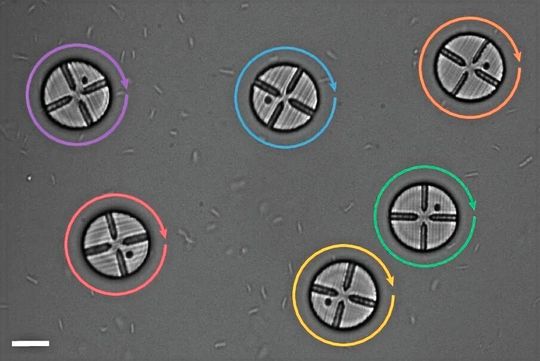
Experiment with six pucks with chambers suspended in a bath of motile E. coli. All pucks spin clockwise, marking a first step towards the development of chiral fluids of spinners.
(Source: Grober et al./Nature Physics; DOI: 10.1038/s41567-026-03189-4)
At the Institute of Science and Technology Austria (Ista), researchers resemble blacksmiths as they toil with bacteria. When placed in water, E. coli help form gel-like aggregates and, as now demonstrated by the Materiali Molli Lab, rotate tiny hockey puck-like discs by generating torque. Published in Nature Physics, this insight adds to the understanding of bacteria in confined spaces and could lead to the creation of soft materials.
Sparks fly. A hammer repeatedly strikes an anvil. Hit after hit, the red-hot piece of metal slowly takes the shape of a sword. The blacksmith, satisfied, holds it up in the air before returning it to the blazing oven to reheat it until it glows. This scene could easily belong in a medieval fantasy series such as The Witcher or video games like Elden Ring.
At the Institute of Science and Technology Austria (Ista), Jérémie Palacci’s research group is venturing into metallurgy — albeit with a twist. Instead of traditional tools, the scientists use E. coli bacteria, often associated with infection linked to contaminated food. When placed in water, their long flagella — tails that propel them forward — create a so-called active bath. This dynamic environment helps form gel-like aggregates by acting like a small fire and raising the ‘temperature’ to an equivalent of 2000 °C, similar to one a blacksmith needs to craft metals. It even manages to spin tiny micro discs.
In their new joint publication, Ista’s Daniel Grober and Jérémie Palacci, along with Tanumoy Dhar and David Saintillan from the University of California, San Diego, reveal the process behind this discovery. They conducted their research in the Materiali Molli Lab, which is located on Ista’s campus, in collaboration with the Department of Physics at UC San Diego.
Micro Rotors
In a 2023 Nature Physics publication, Palacci, Grober, and colleagues demonstrated that these bacteria-fueled active baths successfully propel sticky colloids — round beads that stick together when in contact — to form gel-like aggregates that rotate clockwise, originating from the clockwise spin of the E. coli flagella. However, the reasoning behind this behavior was unclear.
Inspired by a 2010 study where bacteria interacting with gears — both symmetric or asymmetric — caused only asymmetrical gears to turn, Grober and Palacci investigated further.
“In this work, bacteria acted like tiny vehicles, constantly nudging the asymmetric gear to spin,” Palacci theorized at the time.
The researchers speculated that the asymmetrical shape might also be the cause of their rotating clumps (Video 1). However, measuring this effect proved challenging, as the random asymmetry in the clumps led to too much data noise.
Spinning ‘Hockey Pucks’
The scientists, therefore, needed to take a step back and come up with an experiment to clarify what was happening. To do so, Grober used a 3D nanoprinter to create smooth, symmetrical micro discs similar to hockey pucks. After introducing these ‘pucks’ into the active baths filled with E. coli, they were surprised to see them spin clockwise, which negated the earlier hypothesis that symmetrical shapes do not turn (Video 2).
The researchers also found that a slightly more detailed puck with, for example, four compartments extending toward the center, spun even faster than its more basic counterparts (Video 3). The confined spaces allowed the bacteria to act like tiny paddles, enhancing the spin. Interestingly, a single-compartment puck with no closed end rotated as soon as one E. coli swam through implying that mechanical contact with the wall of the chamber was not necessary for its movement (Video 4).
Hydrodynamic Interaction
Palacci clarified that direct contact is not the key to spinning the discs. This is unlike what had been seen with asymmetrical gears. Instead, the new study shows that swimming E. coli twist the fluid around them simply because of how they swim. Their bodies rotate in one direction while the flagella spin in the opposite.
This twisting action, or torque, causes the liquid to swirl both in front of and behind the swimming E. coli, creating a traction force on the top wall of the chamber. Even though these rotational movements cancel each other out and the center of the puck remains stable, an overall torque is created that causes the puck to spin. This is because the rotations occur at different points along the chamber.
Think of trying to open a jam jar by trying to twist the lid off, but the center does not budge. Mathematical models aligned with these observations, offering evidence that E. coli drive motion through hydrodynamic interaction.
“It is a well-known result in our field that the counter-rotation of the body and flagella (tail) of an E. coli cause it to swim in clockwise circles near a solid surface,” Grober explains. “We realized that we could flip these dynamics upside down by confining the E. coli in a microscopic channel beneath the puck. These experiments utilize the exact same hydrodynamic effect to create, essentially, a microscopic and contactless engine, which drives the persistent rotation of the puck.”
Date: 08.12.2025
Naturally, we always handle your personal data responsibly. Any personal data we receive from you is processed in accordance with applicable data protection legislation. For detailed information please see our privacy policy.
Consent to the use of data for promotional purposes
I hereby consent to Vogel Communications Group GmbH & Co. KG, Max-Planck-Str. 7-9, 97082 Würzburg including any affiliated companies according to §§ 15 et seq. AktG (hereafter: Vogel Communications Group) using my e-mail address to send editorial newsletters. A list of all affiliated companies can be found here
Newsletter content may include all products and services of any companies mentioned above, including for example specialist journals and books, events and fairs as well as event-related products and services, print and digital media offers and services such as additional (editorial) newsletters, raffles, lead campaigns, market research both online and offline, specialist webportals and e-learning offers. In case my personal telephone number has also been collected, it may be used for offers of aforementioned products, for services of the companies mentioned above, and market research purposes.
Additionally, my consent also includes the processing of my email address and telephone number for data matching for marketing purposes with select advertising partners such as LinkedIn, Google, and Meta. For this, Vogel Communications Group may transmit said data in hashed form to the advertising partners who then use said data to determine whether I am also a member of the mentioned advertising partner portals. Vogel Communications Group uses this feature for the purposes of re-targeting (up-selling, cross-selling, and customer loyalty), generating so-called look-alike audiences for acquisition of new customers, and as basis for exclusion for on-going advertising campaigns. Further information can be found in section “data matching for marketing purposes”.
In case I access protected data on Internet portals of Vogel Communications Group including any affiliated companies according to §§ 15 et seq. AktG, I need to provide further data in order to register for the access to such content. In return for this free access to editorial content, my data may be used in accordance with this consent for the purposes stated here. This does not apply to data matching for marketing purposes.
Right of revocation
I understand that I can revoke my consent at will. My revocation does not change the lawfulness of data processing that was conducted based on my consent leading up to my revocation. One option to declare my revocation is to use the contact form found at https://contact.vogel.de. In case I no longer wish to receive certain newsletters, I have subscribed to, I can also click on the unsubscribe link included at the end of a newsletter. Further information regarding my right of revocation and the implementation of it as well as the consequences of my revocation can be found in the data protection declaration, section editorial newsletter.
Impact on Medical Therapeutics and Sustainability?
This is an important finding because the ability of flagellated bacteria to rotate objects relies on confinement and is cumulative and agnostic to the shape of the object it rotates. Essentially, this phenomenon should be observable whenever bacteria are in tight spaces — a common occurrence in nature, whether within biofilms, which are crucial to bacterial resistance, or in soils, where bacteria play a vital role in maintaining ecosystem balance.
“Despite its significance, this effect has been overlooked until now,” Palacci says. “We hope that this novel understanding will have a meaningful impact on medical therapeutics or sustainability efforts.”
Publication: Grober et al. 2026. The hydrodynamic torque dipole from rotary bacterial flagella powers symmetric discs. Nature Physics. DOI: 10.1038/s41567-026-03189-4




:quality(80)/p7i.vogel.de/wcms/84/78/8478fcee08360056b226cb8d5032d50c/0130489771v2.jpeg "Saharsh Davuluri will assume the role of Chief Executive Officer and Managing Director, effective immediately, as the company moves into its next stage of CDMO growth. (Source: Neuland Laboratories)")
:quality(80)/p7i.vogel.de/wcms/5e/ae/5eae9dcbba6d172fac2b07b7aef05d3f/0130484643v2.jpeg "The chemical processes occurring when the light interacts with the plastic when it is dissolved causes the reaction to glow blue. (Source: University of Bath)")
:quality(80)/p7i.vogel.de/wcms/e5/9c/e59c5dd9fe4308acae7d5c6de8038c88/0130484607v1.jpeg "A close-up of a laser-directed energy deposition (LDED) system fabricating the novel AI-designed ultra-high strength steel, which achieves a rare balance of strength and ductility, excellent corrosion resistance, and requires only 6 hours of single-step heat treatment at low cost. (Source: Yating Luo et. al.)")
:quality(80)/p7i.vogel.de/wcms/5b/b6/5bb6c39a72c5852361fa904e2e9d8a49/0130484591v1.jpeg "Vehicle-to-grid (V2G) technology — software that allows charging stations to communicate with the grid — bridges both challenges, allowing EVs to both draw power and send it back when needed. (Source: free licensed)")
:quality(80)/p7i.vogel.de/wcms/fa/d5/fad569bcba4d112b811bbdfcc9b4137d/0130612345v2.jpeg "This visual illustration shows compressed spectral-temporal coherent modulation femtosecond imaging (CST-CMFI). A chirped laser pulse with time-varying spectral components illuminates a dynamic scene, enabling different wavelengths to capture successive temporal transients. By utilizing dispersion-encoded coherent modulation imaging, CST-CMFI retrieves both the intensity and phase evolutions. (Source: Yunhua Yao, East China Normal University)")
:quality(80)/p7i.vogel.de/wcms/6e/7c/6e7c762e933c938a92431a785df4690f/0130440213v2.jpeg "Biotech Fluidics' valving solutions offer low swept volume and eliminate reagent carryover concerns. (Source: Biotech Fluidics)")
:quality(80)/p7i.vogel.de/wcms/b0/0b/b00b237311ce4ceb03b2ba1136b6b074/0130440144v2.jpeg "Azenta Life Sciences offers a range of low binding consumables that deliver consistent performance from sensitive applications that require low DNA input such as Next Generation Sequencing and Molecular Biology. (Source: Azenta)")
:quality(80)/p7i.vogel.de/wcms/6c/ef/6cef060860810f12200fbd6d56884e9d/0130440127v2.jpeg "The Automated Plate Seal Remover from Azenta Life Sciences is a compact system for removing seals from a wide range of microplates at the single touch of a button, without damaging the plate or seal. (Source: Azenta )")
:quality(80)/p7i.vogel.de/wcms/f6/3d/f63d5aa4c99a79e3cfe9e1bf8c1595f3/0130484550v1.jpeg "A robot designed to assist with precision irrigation in action, in a citrus orchard. (Source: Elia Scudiero/ UCR)")
:quality(80)/p7i.vogel.de/wcms/5d/bb/5dbb962b09bae1c078a8ff996666bc8e/0130386229v2.jpeg "This image created using Gemini Pro, depicts an activated carbon fiber functionalized with amine groups (–NH2) at adjacent positions. This arrangement improves the energy efficacy of key interactions, enabling the desorption of captured carbon dioxide at lower temperatures. (Source: Gemini / Yasuhiro Yamada/ Chiba University / KI-generiert)")
:quality(80)/p7i.vogel.de/wcms/21/9b/219b000051ab1ea14ab5f92e4fd0f9bb/0130384937v2.jpeg "Deforestation in the Appalachian mountains. (Source: Alex Diaz on Unsplash)")
:quality(80)/p7i.vogel.de/wcms/e9/9c/e99cb19231197af70c489cb4acc2ead0/0130293444v2.jpeg "A new global study, led by researchers at Kaust in Saudi Arabia, shows that forests are most effective for climate regulation when conserved or restored in their natural or native locations. (Source: Kaust )")
:quality(80)/p7i.vogel.de/wcms/ea/5a/ea5a5ed15b2c98730c7111bb56b1a7aa/0130612537v1.jpeg "A healthful plant-based diet prioritizes whole grains, fruits, vegetables, vegetable oils, nuts, legumes, tea and coffee. (Source: free licensed)")
:quality(80)/p7i.vogel.de/wcms/4c/df/4cdf172835be728c9ecb68ec309acca1/0130465673v2.jpeg "Peaches are climacteric fruits, which means they continue to ripen after being picked. The recommended storage temperature is 0°C, otherwise there is a risk of cold damage. (Source: Dall-e)")
:quality(80)/p7i.vogel.de/wcms/2a/07/2a0737995810d504b318f8a0f9ac2c3d/0130386209v1.jpeg "Simple, repeatable eating habits may help people stick to diets, see better results, study says (Source: free licensed)")
:quality(80)/p7i.vogel.de/wcms/6f/ba/6fba92196d0cbb1467334f8a2ecc520a/0130203021v2.jpeg "Low to moderate wine consumption shows lower risk compared with spirits, beer and cider (Source: free licensed)")
:quality(80)/p7i.vogel.de/wcms/08/89/0889115963b144f7ec7a4bb237bdfe4c/0130612552v1.jpeg "Experiment with six pucks with chambers suspended in a bath of motile E. coli. All pucks spin clockwise, marking a first step towards the development of chiral fluids of spinners. (Source: Grober et al./Nature Physics; DOI: 10.1038/s41567-026-03189-4)")
:quality(80)/p7i.vogel.de/wcms/b2/9a/b29a8bf4702d30734e883bd7a99019e6/0130612510v2.jpeg "A team led by Janelia Research Campus Group Leader Jiefu Li has developed a new method to examine the proteins lining the inside surface of blood vessels. Like a cave diver, the new method illuminates the luminal surface of the vascular network. (Source: Jiefu Li and Biovisart)")
:quality(80)/p7i.vogel.de/wcms/66/b9/66b943e8e2040aa56fe26aa4af267970/0130610299v1.jpeg "Lystrosaurus embryo within its partially preserved shell , reconstruction of the animal (Source: Professor Julien Benoit/ Sophie Vrard)")
:quality(80)/p7i.vogel.de/wcms/a4/81/a48131e4ace9b91159e1d6f9f33da3a7/0130549685v2.jpeg "Although the number of participants was limited, the researchers note that the study's reliability is increased by its follow-up design and the rigorous imaging and laboratory tests conducted on the participants. (Source: Pixabay )")
:quality(80)/images.vogel.de/vogelonline/bdb/1710600/1710675/original.jpg "Discover how to set yourself up for success when performing balance-based density determination of solids such as jewelry and precious metals. (Mettler Toledo)")
:quality(80)/images.vogel.de/vogelonline/bdb/1682500/1682579/original.jpg "The new XPR Analytical balance redesigned to meet the needs of laboratory technicians of working fast and lean. (Mettler Toledo)")
:quality(80)/images.vogel.de/vogelonline/bdb/1677000/1677080/original.jpg "Enhance your weighing accuracy, comfort and productivity with the redesigned XPR Analytical balance. (Mettler Toledo)")
:fill(fff,0)/p7i.vogel.de/companies/69/b7/69b7f63f311d9/logo-bimos-tif--2-.jpeg "logo-bimos-tif--2- (https://www.bimos.com/de-de/)")
:quality(80)/p7i.vogel.de/wcms/35/e6/35e63695cb0a5e15894b0e30f1280cc9/0124380908v1.jpeg "Researchers control the metabot’s shape and motion using a magnetic field. (Source: Aaron Nathans)")
:quality(80)/p7i.vogel.de/wcms/c5/8b/c58bfd727f85ee1d7baa0d3ac9b7eaa2/0128661542v2.jpeg "Stripe patterns which appear when red blood cells are separated in a centrifuge are primarily caused by the cells’ own attraction and adhesion to neighbouring cells. (Source: University of Bristol)")