Material or Robot?A Shape-Shifting Revolution: Princeton Engineers Develop Metabot Material
Source:
Princetion Engineering
4 min Reading Time
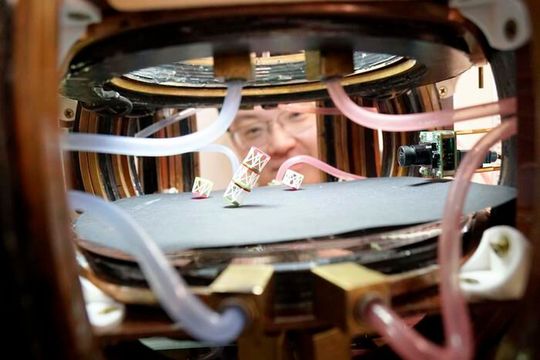
Inspired by origami and powered by magnetic fields, a new metamaterial developed at Princeton University blurs the line between robots and materials — expanding, twisting, and moving without motors or gears. Could this groundbreaking invention transform fields from medicine to aerospace?
Researchers control the metabot’s shape and motion using a magnetic field.
(Source: Aaron Nathans)
In an experiment reminiscent of the “Transformers” movie franchise, engineers at Princeton University have created a type of material that can expand, assume new shapes, move and follow electromagnetic commands like a remotely controlled robot even though it lacks any motor or internal gears.
“You can transform between a material and a robot, and it is controllable with an external magnetic field,” said researcher Glaucio Paulino, the Margareta Engman Augustine Professor of Engineering at Princeton.
In an article published April 23 in the journal Nature, the researchers describe how they drew inspiration from the folding art of origami to create a structure that blurs the lines between robotics and materials. The invention is a metamaterial, which is a material engineered to feature new and unusual properties that depend on the material’s physical structure rather than its chemical composition. In this case, the researchers built their metamaterial using a combination of simple plastics and custom-made magnetic composites. Using a magnetic field, the researchers changed the metamaterial’s structure, causing it to expand, move and deform in different directions, all remotely without touching the metamaterial.
The team called their creation a “metabot” — a metamaterial that can shift its shape and move.
“The electromagnetic fields carry power and signal at the same time. Each behavior is very simple but when you put them together the behavior can be very complex,” said Minjie Chen, an author of the paper and an associate professor of electrical and computer engineering and Andlinger Center for Energy and the Environment at Princeton. “This research has pushed the boundaries of power electronics by demonstrating that torque can be passed remotely, instantaneously, and precisely over a distance to trigger intricate robotic motions.”
The metabot is a modular conglomeration of many reconfigurable unit cells that are mirror images of each other. This mirroring, called chirality, allows for complex behavior. Tuo Zhao, a postdoctoral researcher in Paulino’s lab said the metabot can make large contortions — twisting, contracting and shrinking — in response to a simple push.
Xuanhe Zhao, an expert in materials and robotics who was not involved in the research, said the “work opens a new and exciting avenue in origami design and applications.”
“The current work has achieved extremely versatile mechanical metamaterials by controlling the assembly and chiral state of the modules,” said Zhao, the Uncas and Helen Whitaker Professor at MIT. “The versatility and potential functionality of the modular, chiral origami metamaterials are truly impressive.”
Davide Bigoni, a professor of solid and structural mechanics at the Universita’ di Trento in Italy, called the work groundbreaking and said it could “drive a paradigm shift across multiple fields including soft robotics, aerospace engineering, energy absorption, and spontaneous thermoregulation.”
Exploring the technology’s robotics applications, Tuo Zhao, an author of the paper, used a laser lithography machine at the Princeton Materials Institute to create a prototype metabot that was 100 microns in height (a little thicker than a human hair). The researchers said similar robots could one day deliver medicines to specific parts of the body or help surgeons repair damaged bones or tissue.
The researchers also used the metamaterial to create a thermoregulator that works by shifting between a light-absorbing black surface and reflective one. In an experiment, the researchers exposed the metamaterial to bright sunlight and were able to adjust the surface temperature from 27 °C to 70 °C and back again.
Another possible use lies in applications for antennae, lenses and devices that deal with wavelengths of light.
Geometry holds the key to the new material. The researchers built plastic tubes with supporting struts arranged so the tubes twist when compressed, and compress when twisted. In origami, these tubes are called Kresling patterns. The researchers created the building blocks of their design by connecting two mirror-image Kresling tubes at the base to make one long cylinder. As a result, one end of the cylinder folds when twisted in one direction and the other end folds when twisted in the opposite direction.
This simple pattern of repeating tubes makes it possible to move each section of the tube independently using precisely engineering magnetic fields. The magnetic field causes the Kresling tubes to twist, collapse, or pop open, creating complex behaviors.
Date: 08.12.2025
Naturally, we always handle your personal data responsibly. Any personal data we receive from you is processed in accordance with applicable data protection legislation. For detailed information please see our privacy policy.
Consent to the use of data for promotional purposes
I hereby consent to Vogel Communications Group GmbH & Co. KG, Max-Planck-Str. 7-9, 97082 Würzburg including any affiliated companies according to §§ 15 et seq. AktG (hereafter: Vogel Communications Group) using my e-mail address to send editorial newsletters. A list of all affiliated companies can be found here
Newsletter content may include all products and services of any companies mentioned above, including for example specialist journals and books, events and fairs as well as event-related products and services, print and digital media offers and services such as additional (editorial) newsletters, raffles, lead campaigns, market research both online and offline, specialist webportals and e-learning offers. In case my personal telephone number has also been collected, it may be used for offers of aforementioned products, for services of the companies mentioned above, and market research purposes.
Additionally, my consent also includes the processing of my email address and telephone number for data matching for marketing purposes with select advertising partners such as LinkedIn, Google, and Meta. For this, Vogel Communications Group may transmit said data in hashed form to the advertising partners who then use said data to determine whether I am also a member of the mentioned advertising partner portals. Vogel Communications Group uses this feature for the purposes of re-targeting (up-selling, cross-selling, and customer loyalty), generating so-called look-alike audiences for acquisition of new customers, and as basis for exclusion for on-going advertising campaigns. Further information can be found in section “data matching for marketing purposes”.
In case I access protected data on Internet portals of Vogel Communications Group including any affiliated companies according to §§ 15 et seq. AktG, I need to provide further data in order to register for the access to such content. In return for this free access to editorial content, my data may be used in accordance with this consent for the purposes stated here. This does not apply to data matching for marketing purposes.
Right of revocation
I understand that I can revoke my consent at will. My revocation does not change the lawfulness of data processing that was conducted based on my consent leading up to my revocation. One option to declare my revocation is to use the contact form found at https://contact.vogel.de. In case I no longer wish to receive certain newsletters, I have subscribed to, I can also click on the unsubscribe link included at the end of a newsletter. Further information regarding my right of revocation and the implementation of it as well as the consequences of my revocation can be found in the data protection declaration, section editorial newsletter.
Paulino said that one consequence of chirality — the mirror-image sections — is that the material can defy the typical rules of actions and reactions in physical objects. “Usually, if I twist a rubber-beam clockwise and then counter-clockwise, it returns to its starting point.” Paulino said. The group created a simple metabot that collapses when twisted clockwise, then reopens when twisted counterclockwise — a normal behavior. However, if twisted in the opposite sequence — counterclockwise then clockwise — the same device collapses, then collapses further.
Paulino said this asymmetrical behavior simulates a phenomenon called hysteresis, in which a system’s response to a stimulus depends on the history of changes within the system. Such systems, which are found in engineering, physics and economics, are difficult to model mathematically. Paulino said the metamaterial offers a way to directly simulate these systems.
A more distant use for the new material would be to design physical structures that mimic the performance of logic gates made with transistors in a computer.
“This gives us a physical method to simulate complex behavior, such as non-commutative states” Paulino said.




:quality(80)/p7i.vogel.de/wcms/fd/73/fd73fcb3ceda89d1419de1083fcab7b4/0130081520v2.jpeg "The fingers at the heart of this technology were inspired by the fin-ray effect — a design principle derived from the natural structure of fish fins. (Source: University of Texas at Austin )")
:quality(80)/p7i.vogel.de/wcms/fe/64/fe649767c802d53ac63ee2c2a40b7e0d/0130060830v2.jpeg "Sample tube with light-active substance (Source: Elvira Eberhardt / Ulm University)")
:quality(80)/p7i.vogel.de/wcms/db/e2/dbe2ae4e02f702b30153a882ef705089/0129978032v1.jpeg "Each of the isolated indium atoms (in gold color) can catalyse the synthesis of methanol (top right). (Source: Constance Ko/ ETH Zurich)")
:quality(80)/p7i.vogel.de/wcms/c1/e6/c1e6ac26eb18993236c100e7f01a78f2/0129937639v1.jpeg "Dogs evolved from highly social ancestors and have been shaped by thousands of years of interacting with humans. (Source: free licensed)")
:quality(80)/p7i.vogel.de/wcms/8f/b9/8fb98a958e4afe679865fbe52a473680/0129940982v2.jpeg "pH measurement in various nanoparticles using the Nine-Focus meter ensures precise stability and performance control. (Source: Mettler Toledo)")
:quality(80)/p7i.vogel.de/wcms/11/74/1174e5d4c8b07a64637dced8c9506b40/0129787561v2.jpeg "The Multicell Plus high-pressure reactor sets a new benchmark for operator safety, all-round accessibility and ease-of-use. (Source: Asynt)")
:quality(80)/p7i.vogel.de/wcms/ef/6e/ef6e96191183411973b77041fb6b1e16/0129785957v2.jpeg "Manufactured from high-quality crystal polystyrene - these new automation-ready plates are available in a choice of ANSI / SLAS standard (96-well and breakable 8-well strip) formats. (Source: Porvair Sciences)")
:quality(80)/p7i.vogel.de/wcms/ad/ca/adcaa20ef5ccaf7e3b325788b1e349c4/0129784872v2.jpeg "The high performance Degasi Flat Film in-line degasser. (Source: Biotech Fluidics)")
:quality(80)/p7i.vogel.de/wcms/2d/45/2d45aba62f5042baa00f7fd4fa629839/0130036533v2.jpeg "The population of Pune, India, is expected to reach 11 million by 2050. (Source: free licensed)")
:quality(80)/p7i.vogel.de/wcms/52/f8/52f8d5521fdab07ed0a865ec0d8919fd/0130009438v2.jpeg "Drylands support around half of global livestock production and sustain the livelihoods of close to a billion people, while also underpinning soil stability and carbon storage. (Source: Kaust )")
:quality(80)/p7i.vogel.de/wcms/fe/49/fe494ada322615b6e6f6ff0f5bb7c5cf/0129926008v2.jpeg "A mandrill eating fruit. (Source: University of Bristol )")
:quality(80)/p7i.vogel.de/wcms/af/4e/af4ea968647ee9cae82b39800c611819/0129865630v2.jpeg "Map of a simulated risk of water stress in 2050 where hydrogen is used in transport and industry. Baseline risk (regardless of hydrogen use) is represented by the background color in each area. Dashed areas show water use exceeding available resources due to hydrogen production. Blue dots show areas where the risk of water stress increases by more than 50 percent in the simulation. (Source: Chalmers University of Technology / Joel Löfving)")
:quality(80)/p7i.vogel.de/wcms/6f/ba/6fba92196d0cbb1467334f8a2ecc520a/0130203021v2.jpeg "Low to moderate wine consumption shows lower risk compared with spirits, beer and cider (Source: free licensed)")
:quality(80)/p7i.vogel.de/wcms/a9/37/a9376f1d9a893570023d9aa97c085bc5/0129927485v2.jpeg "Examples of foods high in PUFAs include fatty fish and soybeans, while MUFAs include olive oil and avocadoes. (Source: free licensed)")
:quality(80)/p7i.vogel.de/wcms/ea/88/ea88ef8810e21cdd9bb852c70f385ba1/0129797385v2.jpeg "A team of NUS food scientists consisting of Assoc Prof Liu Shao Quan (centre), Dr Lu Yuyun (right) and Ms Geng Chenhan (left) pioneered a co-fermentation method that improves both the nutrient and flavor profile of kombu. (Source: NUS)")
:quality(80)/p7i.vogel.de/wcms/84/2c/842c7c1678ceeec7147ea3a36e238e75/0129356324v2.jpeg "Kaust and Nadec have signed a MOU that establishes a framework for long-term cooperation across agricultural research, technology development, and professional training. (Source: Kaust )")
:quality(80)/p7i.vogel.de/wcms/ed/c0/edc0c1a86229b11efd17c5e3f94d14da/0130081211v2.jpeg "A new study finds that virtual visits did not make it easier for psychiatrists, psychologists and therapists to reach significantly more people in areas where access to care has long been limited. (Source: Pixabay)")
:quality(80)/p7i.vogel.de/wcms/9c/52/9c52318bc94be17e6662dfceffa4a0c0/0130060546v2.jpeg "Domestic cat ‘Lanni’ from co-author of the study, Latasha Ludwig, Assistant Clinical Professor at Cornell University, USA. (Source: © Latasha Ludwig)")
:quality(80)/p7i.vogel.de/wcms/4b/f4/4bf4cc9e28e65e11a27dd41da2d1a7f5/0130038185v2.jpeg "The biomarker p-tau217 could help identify women at elevated dementia risk decades before clinical symptoms begin. (Source: free licensed)")
:quality(80)/p7i.vogel.de/wcms/4f/29/4f292f402b157e2ab8c57e9f2a3e3199/0130036120v2.jpeg "The chemistry is powered by an LED lamp that triggers a self-sustaining chain reaction, forging new carbon–carbon bonds under mild conditions without toxic or expensive chemicals. (Source: Nordin Ćatić/ St John’s College, Cambridge)")
:quality(80)/images.vogel.de/vogelonline/bdb/1710600/1710675/original.jpg "Discover how to set yourself up for success when performing balance-based density determination of solids such as jewelry and precious metals. (Mettler Toledo)")
:quality(80)/images.vogel.de/vogelonline/bdb/1682500/1682579/original.jpg "The new XPR Analytical balance redesigned to meet the needs of laboratory technicians of working fast and lean. (Mettler Toledo)")
:quality(80)/images.vogel.de/vogelonline/bdb/1677000/1677080/original.jpg "Enhance your weighing accuracy, comfort and productivity with the redesigned XPR Analytical balance. (Mettler Toledo)")
:quality(80)/p7i.vogel.de/wcms/46/1d/461d751849d21fb17fe48faa0e257d16/0123258677v2.jpeg "A robot observes its reflection in a mirror, learning its own morphology and kinematics for autonomous self-simulation. The process highlights the intersection of vision-based learning and robotics, where the robot refines its movements and predicts its spatial motion through self-observation. (Source: Jane Nisselson/ Columbia Engineering)")
:quality(80)/p7i.vogel.de/wcms/32/ae/32ae11ef4154e0a95f766875fd10ad47/0124884486v2.jpeg "An intercrystal formed by overlaying twisted graphene on hexagonal boron nitride. (Source: Andrei Lab/ Rutgers University)")
:quality(80)/p7i.vogel.de/wcms/04/01/0401ab4a2d065c6789686f7d58a0924c/0124381992v2.jpeg "Bendable ceramic origami material created in the UH lab of Maksud Rahman, assistant professor of mechanical and aerospace engineering. The new material could power next-gen prosthetics and aerospace technology. (Source: University of Houston)")