Scientists have unveiled the most detailed view yet of a key plant enzyme, metacaspase 9, revealing how it helps plants fend off disease and stress. Using advanced crystallography and molecular modeling, the team decoded how the enzyme activates — paving the way for new crop protection strategies and environmentally friendly treatments to combat major agricultural threats.
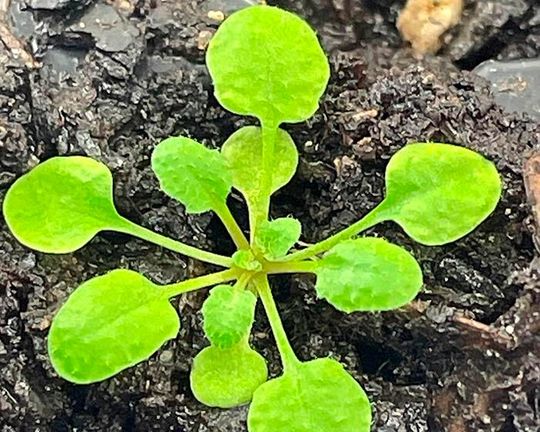
The oft-studied Arabidopsis thaliana plant provided the enzyme for a discovery by Rutgers and Brookhaven scientists.
(Source: Rutgers University)
In a study published in Nature Communications, a team led by Eric Lam at Rutgers University-New Brunswick and Qun Liu at Brookhaven National Laboratory in New York reported that advanced crystallography and computer modeling techniques have enabled them to obtain the best picture yet of a pivotal plant protease, a protein enzyme that cuts other proteins, known as metacaspase 9.
“Understanding the shape and mode of activation for metacaspase 9 means we can now design long-sought tools to harness its known biological functions to protect plants from diseases and environmental stresses that could decimate crops,” said Liu, a structural biologist in the Biology Department at Brookhaven.
The team has already started. Lam and Liu have filed for a provisional patent with the U.S. Patent and Trademark Office on technologies that can be developed from the discovery.
“This work could usher in much safer and effective treatments for our crops worldwide,” said Lam, a Distinguished Professor in the Department of Plant Biology in the Rutgers School of Environmental and Biological Sciences and an author of the study.
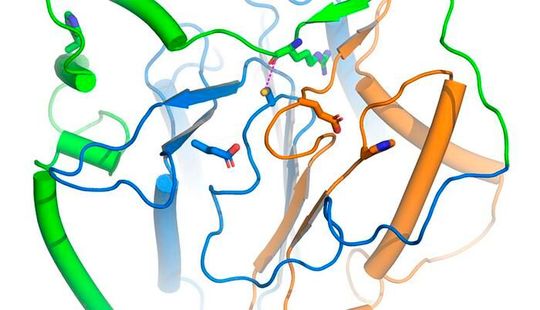
Structure of plant Metacaspase 9 from Arabidopsis.
(Source: Brookhaven National Laboratory)
Using Arabidopsis thaliana, an oft-studied plant also known as mouse-ear cress, the researchers employed a method known as X-ray crystallography at Brookhaven’s National Synchrotron Light Source II (NSLS-II) to reveal the shape of metacaspase 9 at the atomic level. Knowing from previous research that the enzyme is activated by increased acidity, they observed and recorded how the enzyme changes shape when exposed to different concentrations of acid to reveal the key changes in the protein during its activation.
Their newly acquired complex understanding combines crystallography data with molecular dynamic simulations also completed at Brookhaven. This computer-based method allowed them to observe how the enzyme behaved and changed under different conditions. The team also performed laboratory experiments, including site-specific mutagenesis, a technique used by scientists to make precise changes to a specific part of a DNA sequence and validate the importance of specific parts of the protein that are needed for its activity.
By integrating this knowledge, the researchers discovered different parts of the enzyme act like either brakes or accelerators to ensure that it only will be active at an acidic pH.
Lam and his team have collaborated with Liu and his Brookhaven team for a decade in pursuit of a better understanding of the enzyme along with a related version, metacaspase 4. Lam has studied the process at the heart of the enzyme’s pivotal role in plant health – a phenomenon known as programmed cell death or cell suicide – for the past 30 years.
Programmed cell death is a process where cells intentionally die as part of a natural and controlled mechanism, Lam said. It is the cell's way of committing suicide for the greater good of the organism. The process helps remove damaged or unnecessary cells, allowing an organism to stay healthy and develop properly. In plants, programmed cell death is crucial for fighting diseases and responding to stress.
Work by other researchers has shown that metacaspase 9, which exists in plants but not in animals, is connected with programmed cell death and centrally involved in two major types of disease-causing agents for plants. When dealing with biotrophs, which are organisms that feed off living cells, metacaspase 9 helps kill infected cells to stop the disease. But with necrotrophs, organisms that kill plant cells before eating them, metacaspase 9 is hijacked into destroying the plant’s own cells faster, which helps the invaders.
The researchers reason that strengthening metacaspase 9 may prevent biotrophic diseases. Conversely, jamming its function means the enzyme won’t assist necrotrophs in killing healthy cells.
An example of a biotroph is the fungus-like oomycetes Phytophthora infestans, which caused the potato blight in Ireland and the ensuing famine in the mid-1800s. “For many of the plant diseases, especially fungi, effective fungicide treatment options are few and, in many cases, environmental concerns are quite serious,” Lam said. “By creating hyperactive versions of metacaspase 9, we may protect plants from these biotrophs by causing cell death at the invasion site earlier, thus cutting off their food supply.”
Date: 08.12.2025
Naturally, we always handle your personal data responsibly. Any personal data we receive from you is processed in accordance with applicable data protection legislation. For detailed information please see our privacy policy.
Consent to the use of data for promotional purposes
I hereby consent to Vogel Communications Group GmbH & Co. KG, Max-Planck-Str. 7-9, 97082 Würzburg including any affiliated companies according to §§ 15 et seq. AktG (hereafter: Vogel Communications Group) using my e-mail address to send editorial newsletters. A list of all affiliated companies can be found here
Newsletter content may include all products and services of any companies mentioned above, including for example specialist journals and books, events and fairs as well as event-related products and services, print and digital media offers and services such as additional (editorial) newsletters, raffles, lead campaigns, market research both online and offline, specialist webportals and e-learning offers. In case my personal telephone number has also been collected, it may be used for offers of aforementioned products, for services of the companies mentioned above, and market research purposes.
Additionally, my consent also includes the processing of my email address and telephone number for data matching for marketing purposes with select advertising partners such as LinkedIn, Google, and Meta. For this, Vogel Communications Group may transmit said data in hashed form to the advertising partners who then use said data to determine whether I am also a member of the mentioned advertising partner portals. Vogel Communications Group uses this feature for the purposes of re-targeting (up-selling, cross-selling, and customer loyalty), generating so-called look-alike audiences for acquisition of new customers, and as basis for exclusion for on-going advertising campaigns. Further information can be found in section “data matching for marketing purposes”.
In case I access protected data on Internet portals of Vogel Communications Group including any affiliated companies according to §§ 15 et seq. AktG, I need to provide further data in order to register for the access to such content. In return for this free access to editorial content, my data may be used in accordance with this consent for the purposes stated here. This does not apply to data matching for marketing purposes.
Right of revocation
I understand that I can revoke my consent at will. My revocation does not change the lawfulness of data processing that was conducted based on my consent leading up to my revocation. One option to declare my revocation is to use the contact form found at https://contact.vogel.de. In case I no longer wish to receive certain newsletters, I have subscribed to, I can also click on the unsubscribe link included at the end of a newsletter. Further information regarding my right of revocation and the implementation of it as well as the consequences of my revocation can be found in the data protection declaration, section editorial newsletter.
The research team has done just that, creating what Lam described as “super-active variants” of the enzyme that can be produced by plant genes when prodded to do so and could provide novel resistance traits to a slew of important diseases, such as powdery mildew and rusts.
The severe plant disease known as white mold is caused by the necrotrophic fungal pathogen Sclerotinia sclerotiorum, which can infect many crops. It is one of the diseases caused by fungal pathogens that could cause annual crop losses of between 10% and 20% of a total yield. This translates to financial losses of between $100 billion and $200 billion each year for agriculture, according to statistics compiled by the U.S. Department of Agriculture.
“To combat necrotrophic organisms that kill cells to feed on them, understanding how metacaspase 9 changes at the molecular level can help us create new agri- chemicals that block this enzyme efficiently without harming animals or the environment,” Lam said. “They could be used in agriculture to stop harmful necrotrophs from growing, leading to safer and more effective treatments for crops around the world.”
Original Article: Structural determinants for pH-dependentactivation of a plant metacaspase; Nature Communications; DOI:10.1038/s41467-025-60253-y




:quality(80)/p7i.vogel.de/wcms/6b/9a/6b9a2f9d820c458d6518f7d3c0cc990e/0131057985v2.jpeg "The collaboration marks a major step forward in how Dupont scales digital lab workflows, expands access to high-quality experimental data and turns insights into faster, more efficient innovation across its R&D organization. (Source: Dupont )")
:quality(80)/p7i.vogel.de/wcms/ed/07/ed0756a2495cf3591db2f3c23bedd39c/0131055520v2.jpeg "E. coli cultures and other experimental materials used in the study, shown with a 3D-printed model of the engineered phage (extreme left). (Source: National University of Singapore )")
:quality(80)/p7i.vogel.de/wcms/f1/87/f187c86e791dfcf8ecccf615a6a3d054/0131055400v2.jpeg "The new center brings together advanced bioproduction capabilities and hands-on collaboration to help customers accelerate process development and bring transformative therapies to patients faster. (Source: Thermo Fisher Scientific)")
:quality(80)/p7i.vogel.de/wcms/cb/39/cb3902f5777a11e07655ba29d00a0394/0131003637v1.jpeg "Lighting along riverbanks or streams at night disrupts the exchange of energy and nutrients between bodies of water and their adjacent riparian habitats. This can have far-reaching ecological consequences. (Source: RPTU)")
:quality(80)/p7i.vogel.de/wcms/52/2e/522e60883334ab2d806e6038a11e9204/0131030069v3.jpeg "“With Cellcelector, your team moves from single cell → validated clone → production ready line through one tightly integrated, automation driven workflow.” – Dr. Darius Wilson, Head of Product Management, Cell Selection & Retrieval, Sartorius Lab Product & Services (Source: Sartorius)")
:quality(80)/p7i.vogel.de/wcms/06/0e/060e08234d208d1faca16ad0cf582ff3/0131026470v2.jpeg "For enzymatic shearing from fixed cells or tissue – both these detergent-based buffers are ideal for effective fragmentation of nuclear material. (Source: © Kateryna_Kon - stock.adobe.com)")
:quality(80)/p7i.vogel.de/wcms/21/6a/216a1b69d48ac4ef7fe694d4c7791531/0131025888v2.jpeg "Biotech Fluidics has announced the Degasi Integration HFIP – a high-performance online system designed to efficiently degas even the toughest solvents. (Source: Biotech Fluidics )")
:quality(80)/p7i.vogel.de/wcms/4a/8d/4a8d7b8aa03d413a2bbcf34fdf463306/0131025869v2.jpeg "Suitable for reaction temperatures up to 200°C, the Drysyn Vortex is the perfect process development tool to efficiently, and safely, drive three stirrer shafts with one overhead stirrer. (Source: Drysyn Vortex)")
:quality(80)/p7i.vogel.de/wcms/2b/5e/2b5e4798cb0d86b0f29ba4de833c1412/0131003303v1.jpeg "33-month-old acacias in Manaus: ADEs result from the decomposition of organic matter and the use of fire by pre-Columbian populations and continue to be created by present-day peoples
(Source: Tsai Siu Mui/ Cena-USP)")
:quality(80)/p7i.vogel.de/wcms/54/50/5450b302b2cfe1f29c6f3d5c300123ce/0131004604v2.jpeg "Dr. Iván Hernández-Almeida, Science Officer, Past Global Changes, University of Bern
(Source: © Courtesy of Iván Hernández-Almeida)")
:quality(80)/p7i.vogel.de/wcms/f1/71/f1711b934d493949c55d6e9b9ddcffe9/0131003077v1.jpeg "Plastics – rich in carbon and hydrogen – can be converted into a clean energy source, using sunlight. (Source: Adelaide University)")
:quality(80)/p7i.vogel.de/wcms/60/54/6054287023c79b93d166c8b7802f9ad4/0130972957v2.jpeg "Scientists have discovered extensive, ancient and modern deep-sea coral reefs within the Galápagos Marine Reserve – the first of their kind ever to be documented inside the marine protected area since it was established in 1998. (Source: WHOI/NSF)")
:quality(80)/p7i.vogel.de/wcms/f6/a8/f6a8a2ac333baa08d168cc68ac2192c0/0131001826v2.jpeg "University of Oregon researchers find a way to measure the flavor profile of coffee. (Source: free licensed)")
:quality(80)/p7i.vogel.de/wcms/34/ff/34ff3de563d63ac821f789f8ca397070/0130971132v2.jpeg "Mixed nuts on a wooden platter. (Source: Piviso from Pixabay)")
:quality(80)/p7i.vogel.de/wcms/e7/08/e708baaa36f8929e985dfe5baea8bc68/0130734917v2.jpeg "A simple cafeteria menu change can make a measurable difference: replacing one meat-based lunch with a vegetarian option increased vegetarian meal choices by 41 percent in six English workplace canteens, while also reducing calories and greenhouse-gas emissions without hurting sales. (Source: free licensed)")
:quality(80)/p7i.vogel.de/wcms/ea/5a/ea5a5ed15b2c98730c7111bb56b1a7aa/0130612537v1.jpeg "A healthful plant-based diet prioritizes whole grains, fruits, vegetables, vegetable oils, nuts, legumes, tea and coffee. (Source: free licensed)")
:quality(80)/p7i.vogel.de/wcms/33/50/3350efd72f2c620af7c2133ce55c901f/0131086519v2.jpeg "A new Northwestern study examined all 130,267 babies born in Georgia in 2017 and tracked whether their fathers died at any point during the following five years, through 2022. (Source: Unsplash )")
:quality(80)/p7i.vogel.de/wcms/ca/fa/cafafb635ff66815b96824c2f099968a/0131058329v2.jpeg "Clinical trial participant Matthew Husar lived for roughly two years after starting the trial. (Source: Madeline Husar)")
:quality(80)/p7i.vogel.de/wcms/56/d7/56d73ff8d8ffc3ce50e3ff2188b7aada/0131004724v2.jpeg "Among Black players, major cardiac conditions occurred most commonly in those of West African origin (1.6 %), followed by Caribbean origin (0.7 %). (Source: Pixabay)")
:quality(80)/p7i.vogel.de/wcms/87/d5/87d5890059d61e8107148c2039ff9bd8/0131004713v2.jpeg "Using radio waves from a portable device, a reader, the movements of the tags could be recorded and displayed as graphs on a monitor. (Source: Chalmers University of Technology | Mia Halleröd Palmgren)")
:quality(80)/images.vogel.de/vogelonline/bdb/1710600/1710675/original.jpg "Discover how to set yourself up for success when performing balance-based density determination of solids such as jewelry and precious metals. (Mettler Toledo)")
:quality(80)/images.vogel.de/vogelonline/bdb/1682500/1682579/original.jpg "The new XPR Analytical balance redesigned to meet the needs of laboratory technicians of working fast and lean. (Mettler Toledo)")
:quality(80)/images.vogel.de/vogelonline/bdb/1677000/1677080/original.jpg "Enhance your weighing accuracy, comfort and productivity with the redesigned XPR Analytical balance. (Mettler Toledo)")
:fill(fff,0)/p7i.vogel.de/companies/69/b7/69b7f63f311d9/logo-bimos-tif--2-.jpeg "logo-bimos-tif--2- (https://www.bimos.com/de-de/)")
:quality(80)/p7i.vogel.de/wcms/16/cd/16cdd74e03f41e758270f88f9d917de8/0123513205v2.jpeg "Researchers in the Cox laboratory at Washington University in St. Louis used protoplasts — plant cells with their walls removed — to successfully adapt expansion microscopy for plant research. (Source: Cox laboratory, Washington University in St. Louis)")
:quality(80)/p7i.vogel.de/wcms/e2/7d/e27d4de337b33096780df36b9c0126d6/0128390973v2.jpeg "The NUS research team pioneered two innovative techniques using easy-to-obtain enzymes that alter the flavour of roasted carob pulp, enabling it to more closely mimic the rich bitterness and sweetness of cocoa. (Source: NUS Faculty of Science)")
:quality(80)/p7i.vogel.de/wcms/00/8f/008f25a45542fa457b8f4d5e6bf5d443/0128496773v2.jpeg "Stephen Long, Stanley O. Ikenberry Endowed Chair Emeritus (deceased) (Source: L. Brian Stauffer)")