For the first time, scientists have captured live images of plant cells building their own walls — a breakthrough that could lead to stronger crops, sustainable biofuels, and new bioproducts.
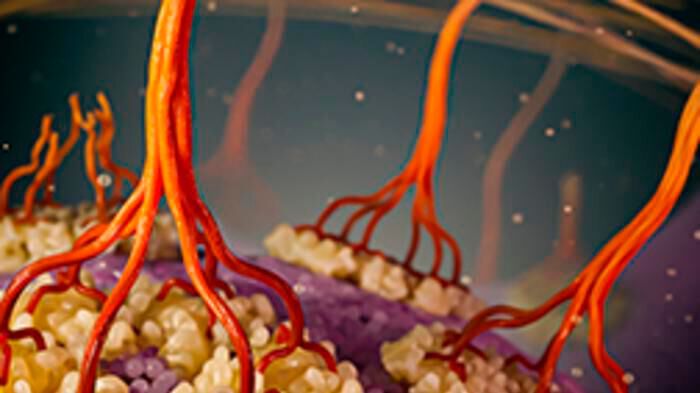
Artistic rendering of cellulose biosynthesis with zoomed in view. Individual cellulose chains (dark brown) are synthesized by plasma membrane-bound (purple) cellulose synthase enzyme complexes (cream) and associate into elementary fibrils (light brown) that further assemble into a microfibril network, forming the main scaffold for the cell wall.
(Source: Ehsan Faridi/ Inmywork Studio/ Chundawat, Lee and Lam Labs)
In a groundbreaking study on the synthesis of cellulose — a major constituent of all plant cell walls — a team of Rutgers University-New Brunswick researchers has captured images of the microscopic process of cell-wall building continuously over 24 hours with living plant cells, providing critical insights that may lead to the development of more robust plants for increased food and lower-cost biofuels production.
The discovery, published in the journal Science Advances, reveals a dynamic process never seen before and may provide practical applications for everyday products derived from plants including enhanced textiles, biofuels, biodegradable plastics, and new medical products. The research also is expected to contribute to the fundamental knowledge — while providing a new understanding — of the formation of cell walls, the scientists said.
Gallery
It represents over six years of effort and collaboration among three laboratories from differing but complementary academic disciplines at Rutgers: the School of Arts and Sciences, the School of Engineering, and the School of Environmental and Biological Sciences.
“This work is the first direct visualization of how cellulose synthesizes and self-assembles into a dense fibril network on a plant cell surface, since Robert Hook’s first microscopic observation of cell walls in 1667,” said Sang-Hyuk Lee, an associate professor in the Department of Physics and Astronomy and an author of the study. “This study also provides entirely new insights into how simple, basic physical mechanisms such as diffusion and self-organization may lead to the formation of complex cellulose networks in cells.”
The microscope-generated video images show protoplasts — cells with their walls removed — of cabbage’s cousin, the flowering plant Arabidopsis, chaotically sprouting filaments of cellulose fibers that gradually self-assemble into a complex network on the outer cell surface.
“I was very surprised by the emergence of ordered structures out of the chaotic dance of molecules when I first saw these video images,” said Lee, who also is a faculty member at the Institute for Quantitative Biomedicine. “I thought plant cellulose would be made in a lot more of an organized fashion, as depicted in classical biology textbooks.”
Cellulose is the most abundant biopolymer — large molecules naturally produced by living organisms — on Earth. A carbohydrate that is the primary structural component of plant cell walls, cellulose is widely used in industry to make a range of products, including paper and clothing. It also is used in filtration, trapping large particles more effectively and enhancing flow, and as a thickening agent in foods such as yogurt and ice cream.
“This discovery opens the door for researchers to begin dissecting the genes that could play various roles for cellulose biosynthesis in the plant,” said Eric Lam, a Distinguished Professor in the Department of Plant Biology in Rutgers School of Environmental and Biological Sciences and an author on the study. “The knowledge gained from these future studies will provide new clues for approaches to design better plants for carbon capture, improve tolerance to all kinds of environmental stresses, from drought to disease, and optimize second-generation cellulosic biofuels production.”
The work is the culmination of a childhood dream for Shishir Chundawat, an associate professor in the Department of Chemical and Biochemical Engineering in the Rutgers School of Engineering and an author on the study.
“I have always been fascinated by plants and how they capture sunlight via leaves into reduced carbon forms like cellulose that form cell walls,” Chundawat said, who plans to explore new ways to produce new, sustainable biofuels and biochemicals from diverse feedstocks like terrestrial plants and marine algae. “I remember back in middle school when I had collected many leaves of different shapes, sizes and colors for a science class report, and being very curious about how plants produce all this myriad complexity and diversity in nature. I was inspired by that experience to delve deeper into the fundamental phenomena of biomass production and its utilization using sustainable engineering to produce valuable bioproducts for societal benefit.”
Date: 08.12.2025
Naturally, we always handle your personal data responsibly. Any personal data we receive from you is processed in accordance with applicable data protection legislation. For detailed information please see our privacy policy.
Consent to the use of data for promotional purposes
I hereby consent to Vogel Communications Group GmbH & Co. KG, Max-Planck-Str. 7-9, 97082 Würzburg including any affiliated companies according to §§ 15 et seq. AktG (hereafter: Vogel Communications Group) using my e-mail address to send editorial newsletters. A list of all affiliated companies can be found here
Newsletter content may include all products and services of any companies mentioned above, including for example specialist journals and books, events and fairs as well as event-related products and services, print and digital media offers and services such as additional (editorial) newsletters, raffles, lead campaigns, market research both online and offline, specialist webportals and e-learning offers. In case my personal telephone number has also been collected, it may be used for offers of aforementioned products, for services of the companies mentioned above, and market research purposes.
Additionally, my consent also includes the processing of my email address and telephone number for data matching for marketing purposes with select advertising partners such as LinkedIn, Google, and Meta. For this, Vogel Communications Group may transmit said data in hashed form to the advertising partners who then use said data to determine whether I am also a member of the mentioned advertising partner portals. Vogel Communications Group uses this feature for the purposes of re-targeting (up-selling, cross-selling, and customer loyalty), generating so-called look-alike audiences for acquisition of new customers, and as basis for exclusion for on-going advertising campaigns. Further information can be found in section “data matching for marketing purposes”.
In case I access protected data on Internet portals of Vogel Communications Group including any affiliated companies according to §§ 15 et seq. AktG, I need to provide further data in order to register for the access to such content. In return for this free access to editorial content, my data may be used in accordance with this consent for the purposes stated here. This does not apply to data matching for marketing purposes.
Right of revocation
I understand that I can revoke my consent at will. My revocation does not change the lawfulness of data processing that was conducted based on my consent leading up to my revocation. One option to declare my revocation is to use the contact form found at https://contact.vogel.de. In case I no longer wish to receive certain newsletters, I have subscribed to, I can also click on the unsubscribe link included at the end of a newsletter. Further information regarding my right of revocation and the implementation of it as well as the consequences of my revocation can be found in the data protection declaration, section editorial newsletter.
Scientists from each of the three research teams made unique and critical contributions.
When conventional lab microscopes wouldn’t do, providing at best blurry images of the cell wall-building process, the team turned to an advanced super-resolution and minimally invasive technique called total internal reflection fluorescence microscopy. The approach, which captured images only of the underside surface of cells, was sensitive enough to take videos for 24 hours without bleaching and destroying the cells.
Lee, a biophysicist and an expert on using cutting-edge microscopy techniques to study living systems, developed a custom microscope for the project and oversaw the imaging efforts.
Chundawat led a team that pioneered a technique allowing the scientists to tag the emerging cellulose tendrils with fluorescent protein dye. He is a bioengineer and expert on protein engineering and glycosciences, the study of complex carbohydrates such as cellulose. To make the cells fluorescent and detectable by the microscope, he and his team developed a probe derived from an engineered bacterial enzyme that binds specifically to cellulose.
Lam, an expert on plant genetics and biotechnology, and his team found a way to remove the cell wall of individual cells of Arabidopsis to create a “blank slate” for new cell walls to be laid down by protoplast cells. “This provided little to no background cellulose to confound our visualization and tracking of newly synthesized cellulose under optimized conditions,” Lam said.
Original Article: Time-resolved tracking of cellulose biosynthesis and assembly during cell wall regeneration in live Arabidopsis protoplasts; Science Advances; DOI:10.1126/sciadv.ads6312




:quality(80)/p7i.vogel.de/wcms/fd/73/fd73fcb3ceda89d1419de1083fcab7b4/0130081520v2.jpeg "The fingers at the heart of this technology were inspired by the fin-ray effect — a design principle derived from the natural structure of fish fins. (Source: University of Texas at Austin )")
:quality(80)/p7i.vogel.de/wcms/fe/64/fe649767c802d53ac63ee2c2a40b7e0d/0130060830v2.jpeg "Sample tube with light-active substance (Source: Elvira Eberhardt / Ulm University)")
:quality(80)/p7i.vogel.de/wcms/db/e2/dbe2ae4e02f702b30153a882ef705089/0129978032v1.jpeg "Each of the isolated indium atoms (in gold color) can catalyse the synthesis of methanol (top right). (Source: Constance Ko/ ETH Zurich)")
:quality(80)/p7i.vogel.de/wcms/c1/e6/c1e6ac26eb18993236c100e7f01a78f2/0129937639v1.jpeg "Dogs evolved from highly social ancestors and have been shaped by thousands of years of interacting with humans. (Source: free licensed)")
:quality(80)/p7i.vogel.de/wcms/8f/b9/8fb98a958e4afe679865fbe52a473680/0129940982v2.jpeg "pH measurement in various nanoparticles using the Nine-Focus meter ensures precise stability and performance control. (Source: Mettler Toledo)")
:quality(80)/p7i.vogel.de/wcms/11/74/1174e5d4c8b07a64637dced8c9506b40/0129787561v2.jpeg "The Multicell Plus high-pressure reactor sets a new benchmark for operator safety, all-round accessibility and ease-of-use. (Source: Asynt)")
:quality(80)/p7i.vogel.de/wcms/ef/6e/ef6e96191183411973b77041fb6b1e16/0129785957v2.jpeg "Manufactured from high-quality crystal polystyrene - these new automation-ready plates are available in a choice of ANSI / SLAS standard (96-well and breakable 8-well strip) formats. (Source: Porvair Sciences)")
:quality(80)/p7i.vogel.de/wcms/ad/ca/adcaa20ef5ccaf7e3b325788b1e349c4/0129784872v2.jpeg "The high performance Degasi Flat Film in-line degasser. (Source: Biotech Fluidics)")
:quality(80)/p7i.vogel.de/wcms/2d/45/2d45aba62f5042baa00f7fd4fa629839/0130036533v2.jpeg "The population of Pune, India, is expected to reach 11 million by 2050. (Source: free licensed)")
:quality(80)/p7i.vogel.de/wcms/52/f8/52f8d5521fdab07ed0a865ec0d8919fd/0130009438v2.jpeg "Drylands support around half of global livestock production and sustain the livelihoods of close to a billion people, while also underpinning soil stability and carbon storage. (Source: Kaust )")
:quality(80)/p7i.vogel.de/wcms/fe/49/fe494ada322615b6e6f6ff0f5bb7c5cf/0129926008v2.jpeg "A mandrill eating fruit. (Source: University of Bristol )")
:quality(80)/p7i.vogel.de/wcms/af/4e/af4ea968647ee9cae82b39800c611819/0129865630v2.jpeg "Map of a simulated risk of water stress in 2050 where hydrogen is used in transport and industry. Baseline risk (regardless of hydrogen use) is represented by the background color in each area. Dashed areas show water use exceeding available resources due to hydrogen production. Blue dots show areas where the risk of water stress increases by more than 50 percent in the simulation. (Source: Chalmers University of Technology / Joel Löfving)")
:quality(80)/p7i.vogel.de/wcms/a9/37/a9376f1d9a893570023d9aa97c085bc5/0129927485v2.jpeg "Examples of foods high in PUFAs include fatty fish and soybeans, while MUFAs include olive oil and avocadoes. (Source: free licensed)")
:quality(80)/p7i.vogel.de/wcms/ea/88/ea88ef8810e21cdd9bb852c70f385ba1/0129797385v2.jpeg "A team of NUS food scientists consisting of Assoc Prof Liu Shao Quan (centre), Dr Lu Yuyun (right) and Ms Geng Chenhan (left) pioneered a co-fermentation method that improves both the nutrient and flavor profile of kombu. (Source: NUS)")
:quality(80)/p7i.vogel.de/wcms/84/2c/842c7c1678ceeec7147ea3a36e238e75/0129356324v2.jpeg "Kaust and Nadec have signed a MOU that establishes a framework for long-term cooperation across agricultural research, technology development, and professional training. (Source: Kaust )")
:quality(80)/p7i.vogel.de/wcms/d1/3c/d13c2ad34af600dbd360c0bb0990b922/0129045715v2.jpeg "Replacing animal products with plant-based foods helps reduce the risk of heart disease and type 2 diabetes, finds a new review by the Physicians Committee for Responsible Medicine. (Source: Pixabay)")
:quality(80)/p7i.vogel.de/wcms/ed/c0/edc0c1a86229b11efd17c5e3f94d14da/0130081211v2.jpeg "A new study finds that virtual visits did not make it easier for psychiatrists, psychologists and therapists to reach significantly more people in areas where access to care has long been limited. (Source: Pixabay)")
:quality(80)/p7i.vogel.de/wcms/9c/52/9c52318bc94be17e6662dfceffa4a0c0/0130060546v2.jpeg "Domestic cat ‘Lanni’ from co-author of the study, Latasha Ludwig, Assistant Clinical Professor at Cornell University, USA. (Source: © Latasha Ludwig)")
:quality(80)/p7i.vogel.de/wcms/4b/f4/4bf4cc9e28e65e11a27dd41da2d1a7f5/0130038185v2.jpeg "The biomarker p-tau217 could help identify women at elevated dementia risk decades before clinical symptoms begin. (Source: free licensed)")
:quality(80)/p7i.vogel.de/wcms/4f/29/4f292f402b157e2ab8c57e9f2a3e3199/0130036120v2.jpeg "The chemistry is powered by an LED lamp that triggers a self-sustaining chain reaction, forging new carbon–carbon bonds under mild conditions without toxic or expensive chemicals. (Source: Nordin Ćatić/ St John’s College, Cambridge)")
:quality(80)/images.vogel.de/vogelonline/bdb/1710600/1710675/original.jpg "Discover how to set yourself up for success when performing balance-based density determination of solids such as jewelry and precious metals. (Mettler Toledo)")
:quality(80)/images.vogel.de/vogelonline/bdb/1682500/1682579/original.jpg "The new XPR Analytical balance redesigned to meet the needs of laboratory technicians of working fast and lean. (Mettler Toledo)")
:quality(80)/images.vogel.de/vogelonline/bdb/1677000/1677080/original.jpg "Enhance your weighing accuracy, comfort and productivity with the redesigned XPR Analytical balance. (Mettler Toledo)")
:quality(80)/p7i.vogel.de/wcms/fd/ae/fdaecbb973c3bae9714e0066ac30cd20/0123762042v1.jpeg "Artistic rendering of cellulose regenerating on a plant protoplast cell surface with zoomed out view. Cellulose is synthesized by plasma membrane-bound enzyme complexes (green) and assembles into a microfibril network (brown), forming the main scaffold for the cell wall. (Source: Ehsan Faridi/ Inmywork Studio/ Chundawat, Lee and Lam Labs)")
:quality(80)/p7i.vogel.de/wcms/57/84/57842885966239ed4183174b18b1b959/0123762043v1.jpeg "Artistic rendering of cellulose biosynthesis with zoomed in view. Individual cellulose chains (dark brown) are synthesized by plasma membrane-bound (purple) cellulose synthase enzyme complexes (cream) and associate into elementary fibrils (light brown) that further assemble into a microfibril network, forming the main scaffold for the cell wall.(Source: Ehsan Faridi/ Inmywork Studio/ Chundawat, Lee and Lam Labs)")
:quality(80)/p7i.vogel.de/wcms/6e/01/6e01000ed1ec0f07e7d86363e2e7557e/0124984009v1.jpeg "The oft-studied Arabidopsis thaliana plant provided the enzyme for a discovery by Rutgers and Brookhaven scientists.
(Source: Rutgers University)")
:quality(80)/p7i.vogel.de/wcms/8c/a1/8ca17c040089abfd1702e38e8ee553fe/0124659200v2.jpeg "The dimeric structure of the CelOCE enzyme acting on cellulose fibers, represented by the green sticks. (Source: Mario Murakami/ CNPEM)")