Scientists from ETH Zurich’s Macromolecular Engineering and Organic Chemistry Labs and entrepreneurs from Colorado-based Nanoly Bioscience worked together to develop a safe, versatile platform to increase the thermal stability of vaccines. Their aim? To vastly improve the distribution of viable vaccines and reduce the economic costs of the cold chain.
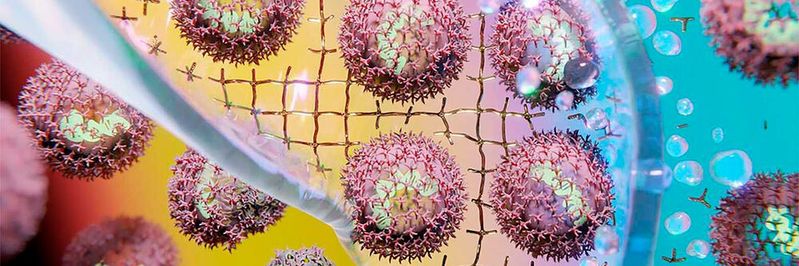
Artistic rendering of the gels encapsulating a viral vaccine.
(Source: ETH Zurich)
Nearly half of all vaccines go to waste. This is due to the logistical obstacles involved in transporting them to diverse regions of the world. Most vaccines require strict temperature regulation from the manufacturing line to injection into a human arm. Maintaining a constant temperature along the cold (supply) chain is a challenging feat in the best of circumstances. In Sub-Saharan Africa and other developing regions, for example, limited transport infrastructure and unreliable electricity compounds the already immense challenges of delivering viable vaccines.
“Think of it like an egg,” explains Bruno Marco-Dufort, a doctoral researcher in Professor Mark Tibbitt’s Macromolecular Engineering lab. “At room temperature or in the refrigerator the egg maintains its viscous-like protein structure, but once it hits boiling water or the frying pan its structure changes permanently”. It is similar for the proteins in a vaccine — once exposed to certain temperatures they clump together. Cooling them down again will not reverse their denaturation — you cannot ‘un-cook’ the egg.
So rather than altering mother nature, Marco-Dufort and the research team developed a new type of hydrogel, the details of which were just published in the journal Science Advances. The gel is based on a biocompatible, synthetic polymer known as “PEG” that serves as a protective, “cloaking device” for very large — yet invisible to the naked eye — complex molecules such as the proteins found in vaccines, antibodies, or gene therapies. The packaging works kind of like a molecular Tupperware, encapsulating the proteins and keeping them separated. It enables the proteins to withstand a higher range of temperature fluctuations. Instead of the traditional +2 to +8°C range for the cold chain, encapsulation allows for a range of 25 to 65°C. Most importantly, the encapsulated cargo is simply released by adding a sugar solution, enabling easy on-demand recovery of the vaccines at their point of use.
Usage in Cancer Research
In addition to a higher rate of vaccine viability, the real game changer of this new biomedical hydrogel technology is the potential economic effect it could have on reducing costs and health risks associated with the cold chain. “In 2020, the overall market for cold chain services (from manufacturing to distribution) was 17.2 billion dollars and forecast to rise,” the researchers reported. Rising costs pose potentially dire consequences for public health and public trust if vaccines arrive via a compromised cold chain.
“Most vaccines are sensitive to hot and cold. This creates a large barrier for global immunization campaigns, because vaccine distribution and administrative costs often exceed the costs of production,” explains Marco-Dufort. While more investment will be needed to shore up the cold chain, encapsulation offers a cost saving solution that could be put towards production of more vaccines and thus, save more lives.
Yet, there is still a long way to go in terms of further research, safety studies, and clinical trials before the hydrogels can be implemented for vaccine distribution. Their more immediate use is for transporting heat sensitive enzymes used in cancer research, for example, or protein molecules for research in lab settings.
One Step Towards Solving a Global Issue
While new biotechnologies and cost savings are a step in the right direction, there are still tremendous logistical, political, and socio-economic challenges in resolving the global issues surrounding equitable vaccine distribution and vaccine hesitancy. Marco-Dufort’s motivation is undeterred. His childhood experience living in the Democratic Republic of the Congo instilled a deep appreciation for the need for vaccines against infectious diseases, not just for Covid-19, but also for Polio, Meningitis, and Ebola. He, more than most, is aware of the tremendous challenges people living in Sub-Saharan Africa face in terms of access to vaccines where infectious diseases are still prevalent.
Mark Tibbitt, Bruno Marco-Dufort, and the team’s work represent a substantive advancement in vaccine excipient development. Their work also offers a glimmer of hope for a positive societal impact. Even a small relief of the economic factors associated with the distribution of vaccines, medicines, and biomedical research could result in larger impacts down the road.
References: Thermal stabilization of diverse biologics using reversible hydrogels; Science Advances; DOI:10.1126/sciadv.abo0502
Date: 08.12.2025
Naturally, we always handle your personal data responsibly. Any personal data we receive from you is processed in accordance with applicable data protection legislation. For detailed information please see our privacy policy.
Consent to the use of data for promotional purposes
I hereby consent to Vogel Communications Group GmbH & Co. KG, Max-Planck-Str. 7-9, 97082 Würzburg including any affiliated companies according to §§ 15 et seq. AktG (hereafter: Vogel Communications Group) using my e-mail address to send editorial newsletters. A list of all affiliated companies can be found here
Newsletter content may include all products and services of any companies mentioned above, including for example specialist journals and books, events and fairs as well as event-related products and services, print and digital media offers and services such as additional (editorial) newsletters, raffles, lead campaigns, market research both online and offline, specialist webportals and e-learning offers. In case my personal telephone number has also been collected, it may be used for offers of aforementioned products, for services of the companies mentioned above, and market research purposes.
Additionally, my consent also includes the processing of my email address and telephone number for data matching for marketing purposes with select advertising partners such as LinkedIn, Google, and Meta. For this, Vogel Communications Group may transmit said data in hashed form to the advertising partners who then use said data to determine whether I am also a member of the mentioned advertising partner portals. Vogel Communications Group uses this feature for the purposes of re-targeting (up-selling, cross-selling, and customer loyalty), generating so-called look-alike audiences for acquisition of new customers, and as basis for exclusion for on-going advertising campaigns. Further information can be found in section “data matching for marketing purposes”.
In case I access protected data on Internet portals of Vogel Communications Group including any affiliated companies according to §§ 15 et seq. AktG, I need to provide further data in order to register for the access to such content. In return for this free access to editorial content, my data may be used in accordance with this consent for the purposes stated here. This does not apply to data matching for marketing purposes.
Right of revocation
I understand that I can revoke my consent at will. My revocation does not change the lawfulness of data processing that was conducted based on my consent leading up to my revocation. One option to declare my revocation is to use the contact form found at https://contact.vogel.de. In case I no longer wish to receive certain newsletters, I have subscribed to, I can also click on the unsubscribe link included at the end of a newsletter. Further information regarding my right of revocation and the implementation of it as well as the consequences of my revocation can be found in the data protection declaration, section editorial newsletter.




:quality(80)/p7i.vogel.de/wcms/fd/73/fd73fcb3ceda89d1419de1083fcab7b4/0130081520v2.jpeg "The fingers at the heart of this technology were inspired by the fin-ray effect — a design principle derived from the natural structure of fish fins. (Source: University of Texas at Austin )")
:quality(80)/p7i.vogel.de/wcms/fe/64/fe649767c802d53ac63ee2c2a40b7e0d/0130060830v2.jpeg "Sample tube with light-active substance (Source: Elvira Eberhardt / Ulm University)")
:quality(80)/p7i.vogel.de/wcms/db/e2/dbe2ae4e02f702b30153a882ef705089/0129978032v1.jpeg "Each of the isolated indium atoms (in gold color) can catalyse the synthesis of methanol (top right). (Source: Constance Ko/ ETH Zurich)")
:quality(80)/p7i.vogel.de/wcms/c1/e6/c1e6ac26eb18993236c100e7f01a78f2/0129937639v1.jpeg "Dogs evolved from highly social ancestors and have been shaped by thousands of years of interacting with humans. (Source: free licensed)")
:quality(80)/p7i.vogel.de/wcms/8f/b9/8fb98a958e4afe679865fbe52a473680/0129940982v2.jpeg "pH measurement in various nanoparticles using the Nine-Focus meter ensures precise stability and performance control. (Source: Mettler Toledo)")
:quality(80)/p7i.vogel.de/wcms/11/74/1174e5d4c8b07a64637dced8c9506b40/0129787561v2.jpeg "The Multicell Plus high-pressure reactor sets a new benchmark for operator safety, all-round accessibility and ease-of-use. (Source: Asynt)")
:quality(80)/p7i.vogel.de/wcms/ef/6e/ef6e96191183411973b77041fb6b1e16/0129785957v2.jpeg "Manufactured from high-quality crystal polystyrene - these new automation-ready plates are available in a choice of ANSI / SLAS standard (96-well and breakable 8-well strip) formats. (Source: Porvair Sciences)")
:quality(80)/p7i.vogel.de/wcms/ad/ca/adcaa20ef5ccaf7e3b325788b1e349c4/0129784872v2.jpeg "The high performance Degasi Flat Film in-line degasser. (Source: Biotech Fluidics)")
:quality(80)/p7i.vogel.de/wcms/2d/45/2d45aba62f5042baa00f7fd4fa629839/0130036533v2.jpeg "The population of Pune, India, is expected to reach 11 million by 2050. (Source: free licensed)")
:quality(80)/p7i.vogel.de/wcms/52/f8/52f8d5521fdab07ed0a865ec0d8919fd/0130009438v2.jpeg "Drylands support around half of global livestock production and sustain the livelihoods of close to a billion people, while also underpinning soil stability and carbon storage. (Source: Kaust )")
:quality(80)/p7i.vogel.de/wcms/fe/49/fe494ada322615b6e6f6ff0f5bb7c5cf/0129926008v2.jpeg "A mandrill eating fruit. (Source: University of Bristol )")
:quality(80)/p7i.vogel.de/wcms/af/4e/af4ea968647ee9cae82b39800c611819/0129865630v2.jpeg "Map of a simulated risk of water stress in 2050 where hydrogen is used in transport and industry. Baseline risk (regardless of hydrogen use) is represented by the background color in each area. Dashed areas show water use exceeding available resources due to hydrogen production. Blue dots show areas where the risk of water stress increases by more than 50 percent in the simulation. (Source: Chalmers University of Technology / Joel Löfving)")
:quality(80)/p7i.vogel.de/wcms/6f/ba/6fba92196d0cbb1467334f8a2ecc520a/0130203021v2.jpeg "Low to moderate wine consumption shows lower risk compared with spirits, beer and cider (Source: free licensed)")
:quality(80)/p7i.vogel.de/wcms/a9/37/a9376f1d9a893570023d9aa97c085bc5/0129927485v2.jpeg "Examples of foods high in PUFAs include fatty fish and soybeans, while MUFAs include olive oil and avocadoes. (Source: free licensed)")
:quality(80)/p7i.vogel.de/wcms/ea/88/ea88ef8810e21cdd9bb852c70f385ba1/0129797385v2.jpeg "A team of NUS food scientists consisting of Assoc Prof Liu Shao Quan (centre), Dr Lu Yuyun (right) and Ms Geng Chenhan (left) pioneered a co-fermentation method that improves both the nutrient and flavor profile of kombu. (Source: NUS)")
:quality(80)/p7i.vogel.de/wcms/84/2c/842c7c1678ceeec7147ea3a36e238e75/0129356324v2.jpeg "Kaust and Nadec have signed a MOU that establishes a framework for long-term cooperation across agricultural research, technology development, and professional training. (Source: Kaust )")
:quality(80)/p7i.vogel.de/wcms/ed/c0/edc0c1a86229b11efd17c5e3f94d14da/0130081211v2.jpeg "A new study finds that virtual visits did not make it easier for psychiatrists, psychologists and therapists to reach significantly more people in areas where access to care has long been limited. (Source: Pixabay)")
:quality(80)/p7i.vogel.de/wcms/9c/52/9c52318bc94be17e6662dfceffa4a0c0/0130060546v2.jpeg "Domestic cat ‘Lanni’ from co-author of the study, Latasha Ludwig, Assistant Clinical Professor at Cornell University, USA. (Source: © Latasha Ludwig)")
:quality(80)/p7i.vogel.de/wcms/4b/f4/4bf4cc9e28e65e11a27dd41da2d1a7f5/0130038185v2.jpeg "The biomarker p-tau217 could help identify women at elevated dementia risk decades before clinical symptoms begin. (Source: free licensed)")
:quality(80)/p7i.vogel.de/wcms/4f/29/4f292f402b157e2ab8c57e9f2a3e3199/0130036120v2.jpeg "The chemistry is powered by an LED lamp that triggers a self-sustaining chain reaction, forging new carbon–carbon bonds under mild conditions without toxic or expensive chemicals. (Source: Nordin Ćatić/ St John’s College, Cambridge)")
:quality(80)/images.vogel.de/vogelonline/bdb/1710600/1710675/original.jpg "Discover how to set yourself up for success when performing balance-based density determination of solids such as jewelry and precious metals. (Mettler Toledo)")
:quality(80)/images.vogel.de/vogelonline/bdb/1682500/1682579/original.jpg "The new XPR Analytical balance redesigned to meet the needs of laboratory technicians of working fast and lean. (Mettler Toledo)")
:quality(80)/images.vogel.de/vogelonline/bdb/1677000/1677080/original.jpg "Enhance your weighing accuracy, comfort and productivity with the redesigned XPR Analytical balance. (Mettler Toledo)")
:fill(fff,0)/p7i.vogel.de/companies/5f/3f/5f3f63ceedc78/knf-logo.jpg "KNF_Logo.jpg (www.knf.com)")
:quality(80)/p7i.vogel.de/wcms/c2/53/c253207316cc639f6f878de155077e84/0106044302.jpeg "WHO Director-General Dr Tedros Adhanom Ghebreyesus gave an update on the report of the 2nd meeting of the IHR Emergency Committee regarding the multi-country outbreak of monkeypox. (Source: WHO / Lindsay Mackenzie)")
:quality(80)/p7i.vogel.de/wcms/d1/d1/d1d1789c7fdc247bd117eac111408757/0126259912v1.jpeg "Jelly ice is a reusable and compostable cooling material that doesn’t melt into a mess like regular ice. (Source: UC Regents/ UC Davis)")
:quality(80)/p7i.vogel.de/wcms/85/ea/85eacaf7a43939dcb5f98c910385d385/0125746471v2.jpeg "State-of-the-art bioreactor systems inside GEA's Janesville technology center, helping bridge the gap between innovation and commercial production. (Source: GEA)")