A squishy, reusable alternative to ice is on the horizon: researchers at UC Davis have developed “jelly ice” — a gelatin-based cooling material that keeps food and medicines cold without producing meltwater, is compostable, and can be reused across multiple freeze-thaw cycles.
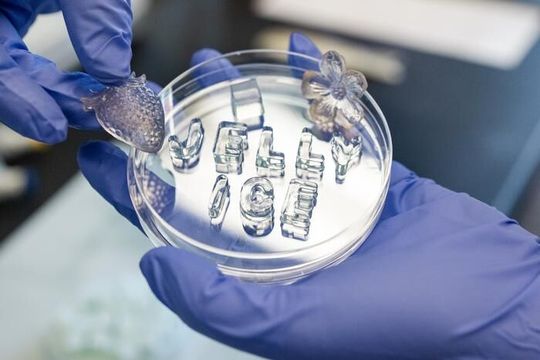
Jelly ice is a reusable and compostable cooling material that doesn’t melt into a mess like regular ice.
(Source: UC Regents/ UC Davis)
No matter whether it’s crushed or cubed, ice eventually melts into a puddle — but an alternative called jelly ice doesn’t. Researchers Jiahan Zou and Gang Sun developed a one-step process to create the reusable, compostable material from gelatin, the same ingredient in jiggly desserts. Because frozen jelly ice doesn’t leak as it thaws, it’s ideal for food supply chains and medication transport. The team is also exploring protein-based structures for food-safe coatings and lab-grown meat scaffolds.
The jelly ice project started with a question posed to Zou and Sun by Luxin Wang, a food scientist at the University of California, Davis. Wang saw ice melting in grocery store seafood display cases and worried about meltwater spreading pathogens and contaminating the entire case. She asked whether the researchers could create a reusable material that functions like regular ice but doesn’t produce a potentially contaminated puddle.
The inspiration for the new material came from freezing tofu. Sun, a materials scientist also at UC Davis who advised Zou’s graduate research, explains that “frozen tofu keeps its water inside, but when you thaw it, it releases the water. So, we tried to solve that issue with another material: gelatin.”
Gelatin proteins have two properties that the researchers wanted: They are food safe, and their long strands link together, forming hydrogels with tiny pores that hold water, unlike tofu. Early tests of the hydrogels made with this natural polymer (also called a biopolymer) were a success. The water stayed inside the pores as it went through phase changes, from liquid to ice and back again, without damaging the structures or leaking out the hydrogel.
Through the years, Zou has optimized the gelatin-based hydrogels’ formula and production methods. Now, she has a practical, one-step process to create jelly ice that’s 90 % water and can be repeatedly washed with water or diluted bleach, frozen and thawed. The cooling material jiggles and squishes at room temperature. But when cooled below the freezing point of water, 32 degrees Fahrenheit (0 °C), it transitions to a firmer, more solid state.
“Compared to regular ice of the same shape and size, jelly ice has up to 80 % of the cooling efficiency — the amount of heat the gel can absorb through phase change,” says Zou, who will talk more about this when she presents the newest version of jelly ice at ACS Fall 2025. “And we can reuse the material and maintain the heat absorbance across multiple freeze-thaw cycles, so that’s an advantage compared to regular ice.”
The team can produce jelly ice in 1-pound (0.45-kilogram) slabs, similar to the cold gel packs currently for sale that have bulky plastic sleeves. However, the new cooling material has advantages over cooling packs or dry ice: It’s customizable for any shape or design, and it’s compostable. In one set of experiments, the composted gel improved tomato plant growth when applied to the potting soil. And because the cooling material doesn’t contain synthetic polymers, it shouldn’t generate microplastics.
Zou and Sun say that jelly ice, while initially developed for food preservation applications, shows promise for medical shipping, biotechnology, and use in areas with limited water available for forming ice.
Currently, there are licenses for the jelly ice technology. Zou hopes that this means the cooling material will be available to consumers as a meltwater-free, food contact-safe, compostable alternative to ice. Though, she acknowledges there are still some steps in market analysis, product design and large-scale production tests before it can be commercialized.
But as the gelatin-based jelly ice makes its way toward the market, Zou has also become interested in other natural biopolymers. She expanded her research into plant proteins that are agricultural by-products, such as soy proteins, to make more sustainable materials. Her focus is shifting toward developing soy proteins for removable countertop coatings and cellular scaffolds for cultivated meat. She’ll present more about that work at ACS Fall 2025.
Date: 08.12.2025
Naturally, we always handle your personal data responsibly. Any personal data we receive from you is processed in accordance with applicable data protection legislation. For detailed information please see our privacy policy.
Consent to the use of data for promotional purposes
I hereby consent to Vogel Communications Group GmbH & Co. KG, Max-Planck-Str. 7-9, 97082 Würzburg including any affiliated companies according to §§ 15 et seq. AktG (hereafter: Vogel Communications Group) using my e-mail address to send editorial newsletters. A list of all affiliated companies can be found here
Newsletter content may include all products and services of any companies mentioned above, including for example specialist journals and books, events and fairs as well as event-related products and services, print and digital media offers and services such as additional (editorial) newsletters, raffles, lead campaigns, market research both online and offline, specialist webportals and e-learning offers. In case my personal telephone number has also been collected, it may be used for offers of aforementioned products, for services of the companies mentioned above, and market research purposes.
Additionally, my consent also includes the processing of my email address and telephone number for data matching for marketing purposes with select advertising partners such as LinkedIn, Google, and Meta. For this, Vogel Communications Group may transmit said data in hashed form to the advertising partners who then use said data to determine whether I am also a member of the mentioned advertising partner portals. Vogel Communications Group uses this feature for the purposes of re-targeting (up-selling, cross-selling, and customer loyalty), generating so-called look-alike audiences for acquisition of new customers, and as basis for exclusion for on-going advertising campaigns. Further information can be found in section “data matching for marketing purposes”.
In case I access protected data on Internet portals of Vogel Communications Group including any affiliated companies according to §§ 15 et seq. AktG, I need to provide further data in order to register for the access to such content. In return for this free access to editorial content, my data may be used in accordance with this consent for the purposes stated here. This does not apply to data matching for marketing purposes.
Right of revocation
I understand that I can revoke my consent at will. My revocation does not change the lawfulness of data processing that was conducted based on my consent leading up to my revocation. One option to declare my revocation is to use the contact form found at https://contact.vogel.de. In case I no longer wish to receive certain newsletters, I have subscribed to, I can also click on the unsubscribe link included at the end of a newsletter. Further information regarding my right of revocation and the implementation of it as well as the consequences of my revocation can be found in the data protection declaration, section editorial newsletter.
“In my research, I realized how powerful Mother Nature is in designing biopolymers and the vast possibilities they offer,” says Zou. “I believe there will be amazing products derived from biopolymers as the materials themselves are teaching us how to work with them.”




:quality(80)/p7i.vogel.de/wcms/65/88/658810e8f70ddd88a4dc014f211630a6/0132611511v2.jpeg "In regulated cleanrooms, control is important, but being able to demonstrate control is equally important. (Source: Vaisala)")
:quality(80)/p7i.vogel.de/wcms/87/99/87991d857ac02b67176f4c88015a4d57/0132611186v2.jpeg "Supercritical fluid extraction is an area of growing interest and CO2 is the most common supercritical fluid used in SFE procedures as a replacement for traditional hexane use. (Source: Scimed)")
:quality(80)/p7i.vogel.de/wcms/7a/1c/7a1cac56bca0dde5268e4ede1c762741/0132539982v2.jpeg "The flexible material can be customized to act like different kinds of tissue. (Source: University of Texas at Austin)")
:quality(80)/p7i.vogel.de/wcms/ed/ff/edff58efa9930f672f2e50a63e65562f/0132477775v1.jpeg "Contemporary languages and endangerment status. Made with a Natural Earth base map using data from Glottolog 5.3 and information adapted from Glottoscope. (Source: Claire Bowern)")
:quality(80)/p7i.vogel.de/wcms/13/d3/13d35105f74a1c2e22b9c7a270e8e9b3/0132611155v2.jpeg "Circulating cell free DNA. (Source: Amsbio)")
:quality(80)/p7i.vogel.de/wcms/bc/ed/bced6850297a04dbea471a66cb6bb6fe/0132611405v2.jpeg "The latest addition to the range is a peristaltic tubing stop adapter that eliminates the need for fixed stoppers and allows custom cut lengths of peristaltic tubing to be installed on any pump head size. (Source: Biotech Fluidics )")
:quality(80)/p7i.vogel.de/wcms/c2/34/c234a6626d4f6360382ca7f1f440bebb/0132611196v2.jpeg "Testa Analytical's Trinity – a powerful new triple detector for Gel Permeation Chromatography / Size Exclusion Chromatography. (Source: Testa Analytical)")
:quality(80)/p7i.vogel.de/wcms/5b/3f/5b3fc0d5fb08c1f9727125bd926b1481/0132555049v1.jpeg "On 1 and 2 December 2026, the T3 – Transform The Tomorrow conference will explore strategies that help companies future-proof their operations. (Bild: © Vogel Corporate Solutions / AdobeStock 1280236166, Oksana)")
:quality(80)/p7i.vogel.de/wcms/06/1a/061a5d3a4e85383454d9450761a67de7/0132611653v2.jpeg "Shihong Lin, associate professor of civil and environmental engineering at Rice. (Source: Alex Becker/ Rice University)")
:quality(80)/p7i.vogel.de/wcms/c4/f5/c4f55f42fdf878aec3f850e5569b84ce/0132594173v2.jpeg "The latest research sheds some light on an issue that deserves more attention, that of climate-related suicide. (Source: Unsplash)")
:quality(80)/p7i.vogel.de/wcms/22/b8/22b8fa1a4146bc06c4c15d63992ebb88/0132589504v2.jpeg "Hepa filters are known to improve air quality and clean the air of microbes in laboratory settings, but this is the largest ‘real-world’ study to date to test if they reduce infections in care homes. (Source: Unsplash)")
:quality(80)/p7i.vogel.de/wcms/31/c1/31c1b666641702292624a4e8ca799a09/0132480890v1.jpeg "Decades of PFAS-laced sewage sludge, once spread on farms as fertilizer, have left millions of acres of American cropland contaminated with “forever chemicals”. (Source: frei lizenziert)")
:quality(80)/p7i.vogel.de/wcms/28/b6/28b6114fc9915c5dadee94d5c89bd129/0132593216v2.jpeg "Eating foods that contain common preservative food additives may increase the risks of high blood pressure and cardiovascular disease. (Source: Unsplash)")
:quality(80)/p7i.vogel.de/wcms/01/bc/01bcb16a3381a1d46533861eedbbae71/0132371290v1.jpeg "Adding spice may help people eat less by slowing them down. (Source: free licensed)")
:quality(80)/p7i.vogel.de/wcms/b3/16/b316ac585e067d024da89a5156c950a9/0132370983v1.jpeg "Laboratory tests suggest that some low-calorie sweeteners can alter the growth of gut bacteria, with particularly strong effects observed when isosteviol was combined with the antidepressant duloxetine. (Source: free licensed)")
:quality(80)/p7i.vogel.de/wcms/22/50/2250f9358ba65ad3c4de05ff5ea9f74e/0132117868v1.jpeg "Japanese researchers have developed a naturally bred yeast that produces nine times more ornithine while retaining normal brewing performance, opening a route to craft beer with added fermentation value. (Source: free licensed)")
:quality(80)/p7i.vogel.de/wcms/bb/f9/bbf9cc2b059213fd10c280304a51b143/0132611525v2.jpeg "Nanoact colored cellulose nanobeads were developed by Asahi Kasei by utilizing its core technology of cellulose processing. (Source: Asahi Kasei)")
:quality(80)/p7i.vogel.de/wcms/fc/90/fc9085d5ad403446c67cd4d586f4a0d6/0132611789v2.jpeg "Metastatic BAP1-deficient melanoma is the most common intraocular malignancy in adults, but it remains rare and extremely difficult to treat once it spreads. (Source: Turun yliopisto/University of Turku)")
:quality(80)/p7i.vogel.de/wcms/32/97/32977422ebe164ada6f807d16e410900/0132611708v2.jpeg "Ground sloths, which could reach the size of small elephants, originated in South America and spread into North America via the Panamanian land bridge. (Source: Natural History Museum of Los Angeles County)")
:quality(80)/p7i.vogel.de/wcms/96/6f/966f8a0a2b0c36f08622a4c5c3abb54f/0132611669v1.jpeg "A larkspur specimen in bloom at Beal Botanical Garden. Known for their toxicity, injurious plants such as larkspur and wolfsbane have been leveraged by humans for millennia for their medicinal potential. (Source: Finn Gomez/ Paul Henderson)")
:quality(80)/images.vogel.de/vogelonline/bdb/1710600/1710675/original.jpg "Discover how to set yourself up for success when performing balance-based density determination of solids such as jewelry and precious metals. (Mettler Toledo)")
:quality(80)/images.vogel.de/vogelonline/bdb/1682500/1682579/original.jpg "The new XPR Analytical balance redesigned to meet the needs of laboratory technicians of working fast and lean. (Mettler Toledo)")
:quality(80)/images.vogel.de/vogelonline/bdb/1677000/1677080/original.jpg "Enhance your weighing accuracy, comfort and productivity with the redesigned XPR Analytical balance. (Mettler Toledo)")
:fill(fff,0)/images.vogel.de/vogelonline/companyimg/131900/131910/65.jpg "Xylem_tag_rgb.jpg ()")
:fill(fff,0)/p7i.vogel.de/companies/69/b7/69b7f63f311d9/logo-bimos-tif--2-.jpeg "logo-bimos-tif--2- (https://www.bimos.com/de-de/)")
:quality(80)/p7i.vogel.de/wcms/9f/d8/9fd8ffb67c1132b4f48dc60e4e194226/0131784166v2.jpeg "Still life featuring protein beads loaded with potassium hydroxide. The porous act as a sponge for CO2. (Source: Mezzenga Lab / ETH Zurich)")
:quality(80)/p7i.vogel.de/wcms/54/50/5450b302b2cfe1f29c6f3d5c300123ce/0131004604v2.jpeg "Dr. Iván Hernández-Almeida, Science Officer, Past Global Changes, University of Bern
(Source: © Courtesy of Iván Hernández-Almeida)")