Fungi have more to offer than meets the eye. Their thread-like cells, which grow extensively and out of sight underground like a network of roots, offer huge potential for producing sustainable, biodegradable materials. Researchers at the Fraunhofer IAP are using this mycelium to develop a wide range of recyclable products, from wallets and insulation to packaging.
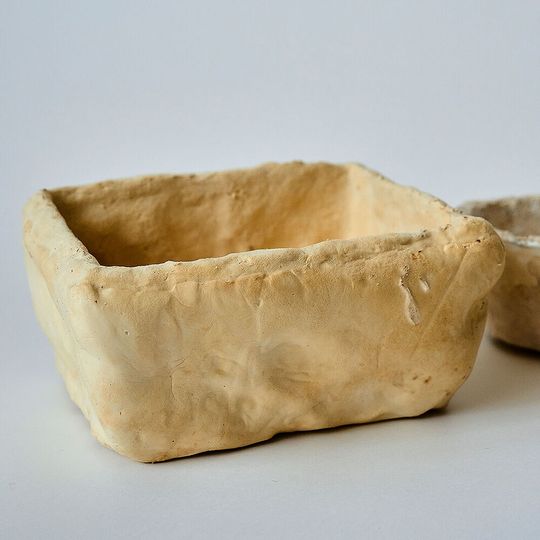
Sustainable and biodegradable: packaging made from mycelium
(Source: Fraunhofer IAP/ Jadwiga Galties)
To most of us, fungi look like a curved cap and a stem. However, the largest part of the organism consists of a network of cell filaments called mycelium, which mainly spreads below ground and can reach significant proportions. This finely branched network has been underutilized until now. However, for researchers at the Fraunhofer Institute for Applied Polymer Research IAP in Potsdam, mycelium represents a pioneering raw material with the potential to replace petroleum-based products with natural, organic mycelium composites. Organic residues from regional agricultural and forestry activities are used as the substrate for the fungal cultures. In various projects, the researchers are using mycelium-based materials to produce insulation, packaging, and animal-free alternatives to leather products.
“Faced with climate change and dwindling fossil raw materials, there is an urgent need for biodegradable materials that can be produced with lower energy consumption,” says Dr. Hannes Hinneburg, a biotechnologist at Fraunhofer IAP. Together with his team, he is using mycelium — for instance, from edible mushrooms or bracket fungi such as the oyster mushroom or tinder fungus — to transform locally available plant residues into sustainable materials. “The mycelium has properties that can be used to produce environmentally friendly, energy-efficient materials, since the growth of the fungi takes place under ambient conditions and CO2 remains stored in the residues. When cellulose and other organic residues decompose, a compact, three-dimensional network forms, enabling a self-sustaining structure to develop,” explains Hinneburg. This produces a material that is a complex compound with an organic substrate such as cereal residues, wood chips, hemp, reeds, rape or other agricultural residues. These substances are a source of nutrients for the fungus and are permeated entirely by a fine network of mycelia during the metabolic process. This produces a fully organic composite that can be made into the required shape and stabilized through thermal treatment. “First, you mix water together with agricultural residues such as straw, wood chips and sawdust to form a mass. Once the level of humidity and particle size have been determined, and the subsequent heat treatment to kill off competing germs has been completed, the substrate is ready. It provides food for the fungi and is mixed with the mycelium. Following a growth phase of around two to three weeks in the incubator, the mixture will produce, depending on the formulation and process used, a substance similar to leather or a composite that can be processed further,” says Hinneburg, summarizing the production process. No light is required for this process — a bonus as far as energy efficiency is concerned.
Gallery
Versatile Applications: Strength and Elasticity Can be Specifically Configured
The fungal materials can be cultivated with a wide range of properties. Depending on the application, they can be hard-wearing, stretchable, tear-resistant, impermeable, elastic, soft and fluffy, or open-pored. The result is determined by the combination of the type of fungus and agricultural residues, plus variable parameters such as temperature and humidity. The duration of mycelial growth also influences the end product. The versatility of the material means it can take on a huge variety of forms, from thick blocks to wafer-thin layers, and be used in a multitude of scenarios. This makes it possible to use fungi-based materials for textile upholstery, packaging, furniture, bags or insulation boards for interiors. When used as a construction material, the fungus primarily functions as a biological adhesive since a wide range of organic particles are joined together via the mycelium.
“The many positive properties of the material, heat-insulating, electrically insulating, moisture-regulating and fire-resistant, enable an important step toward circular and climate-positive construction,” says Hinneburg, one of whose current projects involves developing a novel polystyrene alternative for thermal insulation. In another project, he is working alongside the Institute for Food and Environmental Research and Agro Saarmund to produce environmentally friendly, mycelium-based packaging trays from residues and raw materials sourced from local agricultural and forestry activities. In work he has done with designers, he has also developed the base material for animal-free alternatives to leather products such as bags and wallets. As the mycelium-based materials look similar to their leather counterparts, they can be used to complement leather items in certain areas.
Date: 08.12.2025
Naturally, we always handle your personal data responsibly. Any personal data we receive from you is processed in accordance with applicable data protection legislation. For detailed information please see our privacy policy.
Consent to the use of data for promotional purposes
I hereby consent to Vogel Communications Group GmbH & Co. KG, Max-Planck-Str. 7-9, 97082 Würzburg including any affiliated companies according to §§ 15 et seq. AktG (hereafter: Vogel Communications Group) using my e-mail address to send editorial newsletters. A list of all affiliated companies can be found here
Newsletter content may include all products and services of any companies mentioned above, including for example specialist journals and books, events and fairs as well as event-related products and services, print and digital media offers and services such as additional (editorial) newsletters, raffles, lead campaigns, market research both online and offline, specialist webportals and e-learning offers. In case my personal telephone number has also been collected, it may be used for offers of aforementioned products, for services of the companies mentioned above, and market research purposes.
Additionally, my consent also includes the processing of my email address and telephone number for data matching for marketing purposes with select advertising partners such as LinkedIn, Google, and Meta. For this, Vogel Communications Group may transmit said data in hashed form to the advertising partners who then use said data to determine whether I am also a member of the mentioned advertising partner portals. Vogel Communications Group uses this feature for the purposes of re-targeting (up-selling, cross-selling, and customer loyalty), generating so-called look-alike audiences for acquisition of new customers, and as basis for exclusion for on-going advertising campaigns. Further information can be found in section “data matching for marketing purposes”.
In case I access protected data on Internet portals of Vogel Communications Group including any affiliated companies according to §§ 15 et seq. AktG, I need to provide further data in order to register for the access to such content. In return for this free access to editorial content, my data may be used in accordance with this consent for the purposes stated here. This does not apply to data matching for marketing purposes.
Right of revocation
I understand that I can revoke my consent at will. My revocation does not change the lawfulness of data processing that was conducted based on my consent leading up to my revocation. One option to declare my revocation is to use the contact form found at https://contact.vogel.de. In case I no longer wish to receive certain newsletters, I have subscribed to, I can also click on the unsubscribe link included at the end of a newsletter. Further information regarding my right of revocation and the implementation of it as well as the consequences of my revocation can be found in the data protection declaration, section editorial newsletter.
In Europe, only a few companies are currently developing mycelium-based materials for commercial use. The challenges in this area include access to biogenic residues, the ability to ensure consistent product quality and the means to scale up activities efficiently.
To address these challenges, the researchers are using a newly developed roll-to-roll method, for which they have already created a prototype. This method offers significant advantages over standard manufacturing processes involving boxes and shelving systems: By using a standardized, continuous production method under controlled process conditions (such as temperature and humidity), the researchers can ensure that the mycelium-based products have consistent material properties. What’s more, resources can be used more efficiently, and production can be scaled to an industrial level. “This is crucial in order to meet growing industry demand for sustainable materials and to become less dependent on petroleum in the long term. Production can also be improved further by using innovative technologies such as artificial intelligence to optimize the combination of residues and types of fungi,” says Hinneburg.




:quality(80)/p7i.vogel.de/wcms/92/ad/92adbafb37924cea35ea3cf05b7a23e5/0130206318v2.jpeg "The world’s first fully functioning proof-of-concept quantum battery
(Source: Csiro)")
:quality(80)/p7i.vogel.de/wcms/9f/8b/9f8bc2b8491d7a514ca154e9588a07b7/0130205846v1.jpeg "The researchers’ new material, based on mineralised sawdust, is an excellent fire retardant. (Source: Dan Vivas Glaser / from Kürsteiner R et al. Chem Circularity 2026)")
:quality(80)/p7i.vogel.de/wcms/fd/73/fd73fcb3ceda89d1419de1083fcab7b4/0130081520v2.jpeg "The fingers at the heart of this technology were inspired by the fin-ray effect — a design principle derived from the natural structure of fish fins. (Source: University of Texas at Austin )")
:quality(80)/p7i.vogel.de/wcms/fe/64/fe649767c802d53ac63ee2c2a40b7e0d/0130060830v2.jpeg "Sample tube with light-active substance (Source: Elvira Eberhardt / Ulm University)")
:quality(80)/p7i.vogel.de/wcms/8f/b9/8fb98a958e4afe679865fbe52a473680/0129940982v2.jpeg "pH measurement in various nanoparticles using the Nine-Focus meter ensures precise stability and performance control. (Source: Mettler Toledo)")
:quality(80)/p7i.vogel.de/wcms/11/74/1174e5d4c8b07a64637dced8c9506b40/0129787561v2.jpeg "The Multicell Plus high-pressure reactor sets a new benchmark for operator safety, all-round accessibility and ease-of-use. (Source: Asynt)")
:quality(80)/p7i.vogel.de/wcms/ef/6e/ef6e96191183411973b77041fb6b1e16/0129785957v2.jpeg "Manufactured from high-quality crystal polystyrene - these new automation-ready plates are available in a choice of ANSI / SLAS standard (96-well and breakable 8-well strip) formats. (Source: Porvair Sciences)")
:quality(80)/p7i.vogel.de/wcms/ad/ca/adcaa20ef5ccaf7e3b325788b1e349c4/0129784872v2.jpeg "The high performance Degasi Flat Film in-line degasser. (Source: Biotech Fluidics)")
:quality(80)/p7i.vogel.de/wcms/af/40/af40b535eb65c287fbd22ed5483d1d0e/0130206243v2.jpeg "The researchers dug soil pits in order to measure the carbon storage in soil
(Source: Johanna Asch)")
:quality(80)/p7i.vogel.de/wcms/2d/45/2d45aba62f5042baa00f7fd4fa629839/0130036533v2.jpeg "The population of Pune, India, is expected to reach 11 million by 2050. (Source: free licensed)")
:quality(80)/p7i.vogel.de/wcms/52/f8/52f8d5521fdab07ed0a865ec0d8919fd/0130009438v2.jpeg "Drylands support around half of global livestock production and sustain the livelihoods of close to a billion people, while also underpinning soil stability and carbon storage. (Source: Kaust )")
:quality(80)/p7i.vogel.de/wcms/fe/49/fe494ada322615b6e6f6ff0f5bb7c5cf/0129926008v2.jpeg "A mandrill eating fruit. (Source: University of Bristol )")
:quality(80)/p7i.vogel.de/wcms/6f/ba/6fba92196d0cbb1467334f8a2ecc520a/0130203021v2.jpeg "Low to moderate wine consumption shows lower risk compared with spirits, beer and cider (Source: free licensed)")
:quality(80)/p7i.vogel.de/wcms/a9/37/a9376f1d9a893570023d9aa97c085bc5/0129927485v2.jpeg "Examples of foods high in PUFAs include fatty fish and soybeans, while MUFAs include olive oil and avocadoes. (Source: free licensed)")
:quality(80)/p7i.vogel.de/wcms/ea/88/ea88ef8810e21cdd9bb852c70f385ba1/0129797385v2.jpeg "A team of NUS food scientists consisting of Assoc Prof Liu Shao Quan (centre), Dr Lu Yuyun (right) and Ms Geng Chenhan (left) pioneered a co-fermentation method that improves both the nutrient and flavor profile of kombu. (Source: NUS)")
:quality(80)/p7i.vogel.de/wcms/84/2c/842c7c1678ceeec7147ea3a36e238e75/0129356324v2.jpeg "Kaust and Nadec have signed a MOU that establishes a framework for long-term cooperation across agricultural research, technology development, and professional training. (Source: Kaust )")
:quality(80)/p7i.vogel.de/wcms/e9/73/e9732473361377610267347df55071a1/0130205830v2.jpeg "Sleep EEG signals may reveal whether the brain is aging faster than the body — and help identify elevated dementia risk earlier. (Source: free licensed)")
:quality(80)/p7i.vogel.de/wcms/ed/c0/edc0c1a86229b11efd17c5e3f94d14da/0130081211v2.jpeg "A new study finds that virtual visits did not make it easier for psychiatrists, psychologists and therapists to reach significantly more people in areas where access to care has long been limited. (Source: Pixabay)")
:quality(80)/p7i.vogel.de/wcms/9c/52/9c52318bc94be17e6662dfceffa4a0c0/0130060546v2.jpeg "Domestic cat ‘Lanni’ from co-author of the study, Latasha Ludwig, Assistant Clinical Professor at Cornell University, USA. (Source: © Latasha Ludwig)")
:quality(80)/p7i.vogel.de/wcms/4b/f4/4bf4cc9e28e65e11a27dd41da2d1a7f5/0130038185v2.jpeg "The biomarker p-tau217 could help identify women at elevated dementia risk decades before clinical symptoms begin. (Source: free licensed)")
:quality(80)/images.vogel.de/vogelonline/bdb/1710600/1710675/original.jpg "Discover how to set yourself up for success when performing balance-based density determination of solids such as jewelry and precious metals. (Mettler Toledo)")
:quality(80)/images.vogel.de/vogelonline/bdb/1682500/1682579/original.jpg "The new XPR Analytical balance redesigned to meet the needs of laboratory technicians of working fast and lean. (Mettler Toledo)")
:quality(80)/images.vogel.de/vogelonline/bdb/1677000/1677080/original.jpg "Enhance your weighing accuracy, comfort and productivity with the redesigned XPR Analytical balance. (Mettler Toledo)")
:quality(80)/p7i.vogel.de/wcms/cd/aa/cdaa9304006394f897996046e6ae6bed/0120460396v2.jpeg "Sustainable and biodegradable: packaging made from mycelium(Source: Fraunhofer IAP/ Jadwiga Galties)")
:quality(80)/p7i.vogel.de/wcms/6f/26/6f26b9e9e3793baac008411811ab7845/0120460397v2.jpeg "Flexible mycelium materials in different thicknesses can be used as upholstery material, insulation board or alternatives to leather.(Source: Fraunhofer IAP/ Jadwiga Galties)")
:quality(80)/p7i.vogel.de/wcms/ee/53/ee535c21498166f487dfa33456dc2e7e/0125265029v2.jpeg "When cement is mixed with water, sand and gravel, it becomes concrete – the most widely used building material in the world. However, the production of cement releases large amounts of carbon dioxide. Researchers at PSI are using artificial intelligence and computational modelling to develop alternative formulations that should be more climate-friendly. (Source: Paul Scherrer Institut/ Markus Fischer)")
:quality(80)/p7i.vogel.de/wcms/9f/8b/9f8bc2b8491d7a514ca154e9588a07b7/0130205846v1.jpeg "The researchers’ new material, based on mineralised sawdust, is an excellent fire retardant. (Source: Dan Vivas Glaser / from Kürsteiner R et al. Chem Circularity 2026)")