Stanford engineers are tackling the challenge of plant-based meat development with a fresh perspective: mechanical texture testing combined with machine learning. Their innovative method mimics human taste testers and could accelerate the creation of convincing meat alternatives, paving the way for more sustainable diets without sacrificing texture or taste.
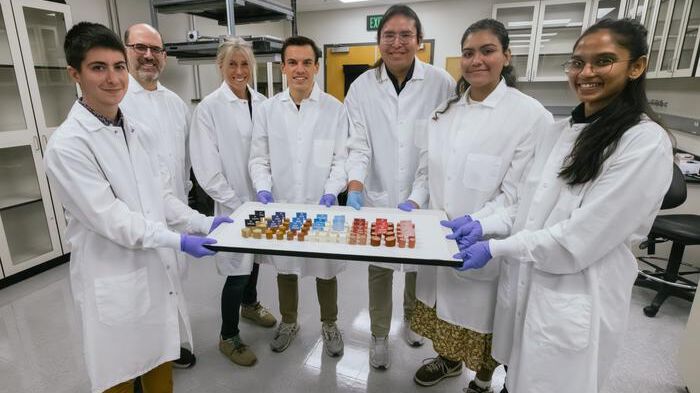
Is it possible to close the texture gap between plant-based meat and animal meat? Ellen Kuhl and her lab are trying. From left: Skyler St. Pierre, Marc Levenston, Ellen Kuhl, Reese Dunne, Ethan Darwin, Valerie Perez Medina, and Divya Adil pose with the meat and plant-based meat they analyzed.
(Source: Kurt Hickman/ Stanford University)
Cutting back on animal protein in our diets can save on resources and greenhouse gas emissions. But convincing meat-loving consumers to switch up their menu is a challenge. Looking at this problem from a mechanical engineering angle, Stanford engineers are pioneering a new approach to food texture testing that could pave the way for faux filets that fool even committed carnivores.
In a new paper in Science of Food, the team demonstrated that a combination of mechanical testing and machine learning can describe food texture with striking similarity to human taste testers. Such a method could speed up the development of new and better plant-based meats. The team also found that some plant-based products are already nailing the texture of the meats they’re mimicking.
“We were surprised to find that today’s plant-based products can reproduce the whole texture spectrum of animal meats,” said Ellen Kuhl, professor of mechanical engineering and senior author of the study. Meat substitutes have come a long way from when tofu was the only option, she added.
Industrial animal agriculture contributes to climate change, pollution, habitat loss, and antibiotic resistance. That burden on the planet can be eased by swapping animal proteins for plant proteins in diets. One study estimated that plant-based meats, on average, have half the environmental impact as animal meat. But many meat eaters are reluctant to change; only about a third of Americans in one survey indicated they were “very likely” or “extremely likely” to buy plant-based alternatives.
“People love meat,” said Skyler St. Pierre, a PhD student in mechanical engineering and lead author of the paper. “If we want to convince the hardcore meat eaters that alternatives are worth trying, the closer we can mimic animal meat with plant-based products, the more likely people might be open to trying something new.”
To successfully mimic animal meat, food scientists analyze the texture of plant-based meat products. Unfortunately, traditional food testing methods are not standardized and the results are rarely made available to science and to the public, said St. Pierre. This makes it harder for scientists to collaborate and create new recipes for alternatives.
The research grew out of a class project by St. Pierre. Looking for affordable materials to use in mechanical tests, he turned to hot dogs and tofu. Over the summer of 2023, undergraduate researchers joined in to test the foods and learn how engineers depict material responses to stress, loading, and stretching.
Realizing how this work could aid the development of plant-based meats, the Stanford team debuted a three-dimensional food test. They put eight products to the test: animal and plant-based hot dog, animal and plant-based sausage, animal and plant-based turkey, and extra firm and firm tofu. They mounted bits of meat into a machine that pulled, pushed, and sheared on the samples. “These three loading modes represent what you do when you chew,” said Kuhl, who is also the Catherine Holman Johnson Director of Stanford Bio-X and the Walter B. Reinhold Professor in the School of Engineering.
Then, they used machine learning to process the data from these tests: They designed a new type of neural network that takes the raw data from the tests and produces equations that explain the properties of the meats.
To see if these equations can explain the perception of texture, the team carried out a test survey. The testers — who first completed surveys on their openness to new foods and their attachment to meat — ate samples of the eight products and rated them on 5-point scale for 12 categories: soft, hard, brittle, chewy, gummy, viscous, springy, sticky, fibrous, fatty, moist, and meat-like.
In the mechanical testing, the plant-based hot dog and sausage behaved very similarly in the pulling, pushing, and shear tests to their animal counterparts, and showed similar stiffnesses. Meanwhile, the plant-based turkey was twice as stiff as animal turkey, and the tofu was much softer than the meat products. Strikingly, the human testers also ranked the stiffness of the hot dogs and sausages very similarly to the mechanical tests. “What’s really cool is that the ranking of the people was almost identical to the ranking of the machine,” said Kuhl. “That’s great because now we can use the machine to have a quantitative, very reproducible test.”
The findings suggest that new, data-driven methods hold promise for speeding up the process of developing tasty plant-based products. “Instead of using a trial-and-error approach to improve the texture of plant-based meat, we could envision using generative artificial intelligence to scientifically generate recipes for plant-based meat products with precisely desired properties,” the authors wrote in the paper.
Date: 08.12.2025
Naturally, we always handle your personal data responsibly. Any personal data we receive from you is processed in accordance with applicable data protection legislation. For detailed information please see our privacy policy.
Consent to the use of data for promotional purposes
I hereby consent to Vogel Communications Group GmbH & Co. KG, Max-Planck-Str. 7-9, 97082 Würzburg including any affiliated companies according to §§ 15 et seq. AktG (hereafter: Vogel Communications Group) using my e-mail address to send editorial newsletters. A list of all affiliated companies can be found here
Newsletter content may include all products and services of any companies mentioned above, including for example specialist journals and books, events and fairs as well as event-related products and services, print and digital media offers and services such as additional (editorial) newsletters, raffles, lead campaigns, market research both online and offline, specialist webportals and e-learning offers. In case my personal telephone number has also been collected, it may be used for offers of aforementioned products, for services of the companies mentioned above, and market research purposes.
Additionally, my consent also includes the processing of my email address and telephone number for data matching for marketing purposes with select advertising partners such as LinkedIn, Google, and Meta. For this, Vogel Communications Group may transmit said data in hashed form to the advertising partners who then use said data to determine whether I am also a member of the mentioned advertising partner portals. Vogel Communications Group uses this feature for the purposes of re-targeting (up-selling, cross-selling, and customer loyalty), generating so-called look-alike audiences for acquisition of new customers, and as basis for exclusion for on-going advertising campaigns. Further information can be found in section “data matching for marketing purposes”.
In case I access protected data on Internet portals of Vogel Communications Group including any affiliated companies according to §§ 15 et seq. AktG, I need to provide further data in order to register for the access to such content. In return for this free access to editorial content, my data may be used in accordance with this consent for the purposes stated here. This does not apply to data matching for marketing purposes.
Right of revocation
I understand that I can revoke my consent at will. My revocation does not change the lawfulness of data processing that was conducted based on my consent leading up to my revocation. One option to declare my revocation is to use the contact form found at https://contact.vogel.de. In case I no longer wish to receive certain newsletters, I have subscribed to, I can also click on the unsubscribe link included at the end of a newsletter. Further information regarding my right of revocation and the implementation of it as well as the consequences of my revocation can be found in the data protection declaration, section editorial newsletter.
But artificial intelligence recipe development, like other AIs, needs lots of data. That’s why the team is sharing their dataonline, making it open for other researchers to view and add to. “Historically, some researchers, and especially companies, don’t share their data and that’s a really big barrier to innovation,” said St. Pierre. Without sharing information and working together, he added, “how are we going to come up with a steak mimic together?”
The team is continuing to test foods and build a public database. This summer, St. Pierre oversaw undergraduates testing veggie and meat deli slices. The researchers also plan to test engineered fungi developed by Vayu Hill-Maini, who recently joined Stanford as an assistant professor of bioengineering. “If anybody has an artificial or a plant-based meat they want to test,” said Kuhl, “we’re so happy to test it to see how it stacks up.”
Original Article: The mechanical and sensory signature of plant-based and animal meat; npj Science of Food; DOI:10.1038/s41538-024-00330-6




:quality(80)/p7i.vogel.de/wcms/92/ad/92adbafb37924cea35ea3cf05b7a23e5/0130206318v2.jpeg "The world’s first fully functioning proof-of-concept quantum battery
(Source: Csiro)")
:quality(80)/p7i.vogel.de/wcms/9f/8b/9f8bc2b8491d7a514ca154e9588a07b7/0130205846v1.jpeg "The researchers’ new material, based on mineralised sawdust, is an excellent fire retardant. (Source: Dan Vivas Glaser / from Kürsteiner R et al. Chem Circularity 2026)")
:quality(80)/p7i.vogel.de/wcms/fd/73/fd73fcb3ceda89d1419de1083fcab7b4/0130081520v2.jpeg "The fingers at the heart of this technology were inspired by the fin-ray effect — a design principle derived from the natural structure of fish fins. (Source: University of Texas at Austin )")
:quality(80)/p7i.vogel.de/wcms/fe/64/fe649767c802d53ac63ee2c2a40b7e0d/0130060830v2.jpeg "Sample tube with light-active substance (Source: Elvira Eberhardt / Ulm University)")
:quality(80)/p7i.vogel.de/wcms/8f/b9/8fb98a958e4afe679865fbe52a473680/0129940982v2.jpeg "pH measurement in various nanoparticles using the Nine-Focus meter ensures precise stability and performance control. (Source: Mettler Toledo)")
:quality(80)/p7i.vogel.de/wcms/11/74/1174e5d4c8b07a64637dced8c9506b40/0129787561v2.jpeg "The Multicell Plus high-pressure reactor sets a new benchmark for operator safety, all-round accessibility and ease-of-use. (Source: Asynt)")
:quality(80)/p7i.vogel.de/wcms/ef/6e/ef6e96191183411973b77041fb6b1e16/0129785957v2.jpeg "Manufactured from high-quality crystal polystyrene - these new automation-ready plates are available in a choice of ANSI / SLAS standard (96-well and breakable 8-well strip) formats. (Source: Porvair Sciences)")
:quality(80)/p7i.vogel.de/wcms/ad/ca/adcaa20ef5ccaf7e3b325788b1e349c4/0129784872v2.jpeg "The high performance Degasi Flat Film in-line degasser. (Source: Biotech Fluidics)")
:quality(80)/p7i.vogel.de/wcms/e9/9c/e99cb19231197af70c489cb4acc2ead0/0130293444v2.jpeg "A new global study, led by researchers at Kaust in Saudi Arabia, shows that forests are most effective for climate regulation when conserved or restored in their natural or native locations. (Source: Kaust )")
:quality(80)/p7i.vogel.de/wcms/af/40/af40b535eb65c287fbd22ed5483d1d0e/0130206243v2.jpeg "The researchers dug soil pits in order to measure the carbon storage in soil
(Source: Johanna Asch)")
:quality(80)/p7i.vogel.de/wcms/2d/45/2d45aba62f5042baa00f7fd4fa629839/0130036533v2.jpeg "The population of Pune, India, is expected to reach 11 million by 2050. (Source: free licensed)")
:quality(80)/p7i.vogel.de/wcms/52/f8/52f8d5521fdab07ed0a865ec0d8919fd/0130009438v2.jpeg "Drylands support around half of global livestock production and sustain the livelihoods of close to a billion people, while also underpinning soil stability and carbon storage. (Source: Kaust )")
:quality(80)/p7i.vogel.de/wcms/6f/ba/6fba92196d0cbb1467334f8a2ecc520a/0130203021v2.jpeg "Low to moderate wine consumption shows lower risk compared with spirits, beer and cider (Source: free licensed)")
:quality(80)/p7i.vogel.de/wcms/a9/37/a9376f1d9a893570023d9aa97c085bc5/0129927485v2.jpeg "Examples of foods high in PUFAs include fatty fish and soybeans, while MUFAs include olive oil and avocadoes. (Source: free licensed)")
:quality(80)/p7i.vogel.de/wcms/ea/88/ea88ef8810e21cdd9bb852c70f385ba1/0129797385v2.jpeg "A team of NUS food scientists consisting of Assoc Prof Liu Shao Quan (centre), Dr Lu Yuyun (right) and Ms Geng Chenhan (left) pioneered a co-fermentation method that improves both the nutrient and flavor profile of kombu. (Source: NUS)")
:quality(80)/p7i.vogel.de/wcms/84/2c/842c7c1678ceeec7147ea3a36e238e75/0129356324v2.jpeg "Kaust and Nadec have signed a MOU that establishes a framework for long-term cooperation across agricultural research, technology development, and professional training. (Source: Kaust )")
:quality(80)/p7i.vogel.de/wcms/6e/b9/6eb95805568aa78dc2ed57f829cf33d4/0130300421v2.jpeg "A 10-minute digital program co-developed by a University of Texas psychologist significantly reduced symptoms of depression four weeks after use, according to results from one of the largest randomized controlled trials of single-session mental health interventions. (Source: University of Texas at Austin )")
:quality(80)/p7i.vogel.de/wcms/6f/e9/6fe9d920eca2c0b3bdeb55cbe9f01908/0130299237v2.jpeg "Study authors Jason Miska and Leah Billingham reading out enzymatic activity of microglia in cell cultures. (Source: Northwestern University.)")
:quality(80)/p7i.vogel.de/wcms/c4/54/c454661a9dd459cf7c5b632f79829358/0130284530v2.jpeg "The study shows that AI can be used to assess the build-up of calcium deposits in the arteries of the breast from the standard X-ray mammography scans that are currently used in routine breast cancer screening. (Source: ESC)")
:quality(80)/p7i.vogel.de/wcms/67/9b/679b140c164dbd7c4fe9eda4da91329b/0130281406v3.jpeg "This is the highest resolution molecular structure ever constructed of a key protein complex on the surface of the Andes virus, called the Gn-Gc tetramer, that enables it to infect cells. (Source: University of Texas at Austin)")
:quality(80)/images.vogel.de/vogelonline/bdb/1710600/1710675/original.jpg "Discover how to set yourself up for success when performing balance-based density determination of solids such as jewelry and precious metals. (Mettler Toledo)")
:quality(80)/images.vogel.de/vogelonline/bdb/1682500/1682579/original.jpg "The new XPR Analytical balance redesigned to meet the needs of laboratory technicians of working fast and lean. (Mettler Toledo)")
:quality(80)/images.vogel.de/vogelonline/bdb/1677000/1677080/original.jpg "Enhance your weighing accuracy, comfort and productivity with the redesigned XPR Analytical balance. (Mettler Toledo)")
:quality(80)/p7i.vogel.de/wcms/7f/c7/7fc733274aab40063a7ab0bdad87a7f8/0121533705v2.jpeg "The availability of foods based on plant proteins to substitute for meat has increased dramatically as more people choose a plant-based diet. (Source: Unsplash)")
:quality(80)/p7i.vogel.de/wcms/d1/3c/d13c2ad34af600dbd360c0bb0990b922/0129045715v2.jpeg "Replacing animal products with plant-based foods helps reduce the risk of heart disease and type 2 diabetes, finds a new review by the Physicians Committee for Responsible Medicine. (Source: Pixabay)")
:quality(80)/p7i.vogel.de/wcms/ae/30/ae30b164a2a7f05fd6ef95600fdd9be4/0127043053v1.jpeg "Study finds plant-based dog food slashes land use, emissions, and resource demand compared to red meat diets. (Source: free licensed)")