Engineers have harnessed quantum physics to detect the presence of biomolecules without the need for an external light source, overcoming a significant obstacle to the use of optical biosensors in healthcare and environmental monitoring settings.
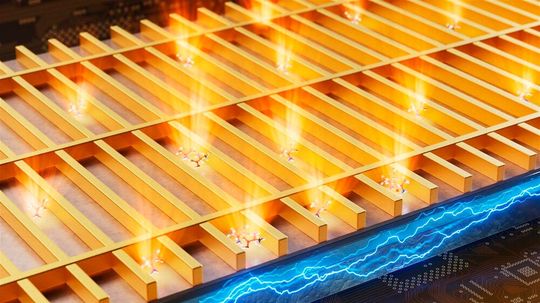
Illustration of the self-illuminating biosensor: A metasurface of gold nanowires drives quantum light emission and concentrates the resulting light waves to detect biomolecules.
(Source: Ella Maru Studio/ EPFL)
Optical biosensors use light waves as a probe to detect molecules, and are essential for precise medical diagnostics, personalized medicine, and environmental monitoring. Their performance is dramatically enhanced if they can focus light waves down to the nanometer scale — small enough to detect proteins or amino acids, for example — using nanophotonic structures that ‘squeeze’ light at the surface of a tiny chip. But the generation and detection of light for these nanophotonic biosensors requires bulky, expensive equipment that greatly limits their use in rapid diagnostics or point-of-care settings.
So, how do you make a light-based biosensor without an external light source? The answer is: with quantum physics. By harnessing a quantum phenomenon called inelastic electron tunneling, researchers in the Bionanophotonic Systems Laboratory in EPFL’s School of Engineering have created a biosensor that requires only a steady flow of electrons — in the form of an applied electrical voltage — to illuminate and detect molecules at the same time.
“If you think of an electron as a wave, rather than a particle, that wave has a certain low probability of ‘tunneling’ to the other side of an extremely thin insulating barrier while emitting a photon of light. What we have done is create a nanostructure that both forms part of this insulating barrier and increases the probability that light emission will take place,” explains Bionanophotonic Systems Lab researcher Mikhail Masharin.
Trillionth-of-a-Gram Detection
In short, the design of the team’s nanostructure creates just the right conditions for an electron passing upward through it to cross a barrier of aluminum oxide and arrive at an ultrathin layer of gold. In the process, the electron transfers some of its energy to a collective excitation called a plasmon, which then emits a photon. Their design ensures that the intensity and spectrum of this light changes in response to contact with biomolecules, resulting in a powerful method for extremely sensitive, real-time, label-free detection.
“Tests showed that our self-illuminating biosensor can detect amino acids and polymers at picogram concentrations — that’s one-trillionth of a gram — rivaling the most advanced sensors available today,” says Bionanophotonic Systems Laboratory head Hatice Altug.
The work has been published in Nature Photonics in collaboration with researchers at ETH Zurich, ICFO (Spain), and Yonsei University (Korea).
At the heart of the team’s innovation is a dual functionality: their nanostructure’s gold layer is a metasurface, meaning it exhibits special properties that create the conditions for quantum tunneling, and control the resulting light emission. This control is made possible thanks to the metasurface’s arrangement into a mesh of gold nanowires, which act as ‘nanoantennas’ to concentrate the light at the nanometer volumes required to detect biomolecules efficiently.
“Inelastic electron tunneling is a very low-probability process, but if you have a low-probability process occurring uniformly over a very large area, you can still collect enough photons. This is where we have focused our optimization, and it turns out to be a very promising new strategy for biosensing,” says former Bionanophotonic Systems Lab researcher and first author Jihye Lee, now an engineer at Samsung Electronics.
In addition to being compact and sensitive, the team’s quantum platform, fabricated at EPFL’s Center of MicroNanoTechnology, is scalable and compatible with sensor manufacturing methods. Less than a square millimeter of active area is required for sensing, creating an exciting possibility for handheld biosensors, in contrast to current table-top setups.
Date: 08.12.2025
Naturally, we always handle your personal data responsibly. Any personal data we receive from you is processed in accordance with applicable data protection legislation. For detailed information please see our privacy policy.
Consent to the use of data for promotional purposes
I hereby consent to Vogel Communications Group GmbH & Co. KG, Max-Planck-Str. 7-9, 97082 Würzburg including any affiliated companies according to §§ 15 et seq. AktG (hereafter: Vogel Communications Group) using my e-mail address to send editorial newsletters. A list of all affiliated companies can be found here
Newsletter content may include all products and services of any companies mentioned above, including for example specialist journals and books, events and fairs as well as event-related products and services, print and digital media offers and services such as additional (editorial) newsletters, raffles, lead campaigns, market research both online and offline, specialist webportals and e-learning offers. In case my personal telephone number has also been collected, it may be used for offers of aforementioned products, for services of the companies mentioned above, and market research purposes.
Additionally, my consent also includes the processing of my email address and telephone number for data matching for marketing purposes with select advertising partners such as LinkedIn, Google, and Meta. For this, Vogel Communications Group may transmit said data in hashed form to the advertising partners who then use said data to determine whether I am also a member of the mentioned advertising partner portals. Vogel Communications Group uses this feature for the purposes of re-targeting (up-selling, cross-selling, and customer loyalty), generating so-called look-alike audiences for acquisition of new customers, and as basis for exclusion for on-going advertising campaigns. Further information can be found in section “data matching for marketing purposes”.
In case I access protected data on Internet portals of Vogel Communications Group including any affiliated companies according to §§ 15 et seq. AktG, I need to provide further data in order to register for the access to such content. In return for this free access to editorial content, my data may be used in accordance with this consent for the purposes stated here. This does not apply to data matching for marketing purposes.
Right of revocation
I understand that I can revoke my consent at will. My revocation does not change the lawfulness of data processing that was conducted based on my consent leading up to my revocation. One option to declare my revocation is to use the contact form found at https://contact.vogel.de. In case I no longer wish to receive certain newsletters, I have subscribed to, I can also click on the unsubscribe link included at the end of a newsletter. Further information regarding my right of revocation and the implementation of it as well as the consequences of my revocation can be found in the data protection declaration, section editorial newsletter.
“Our work delivers a fully integrated sensor that combines light generation and detection on a single chip. With potential applications ranging from point-of-care diagnostics to detecting environmental contaminants, this technology represents a new frontier in high-performance sensing systems,” summarizes Bionanophotonic Systems Lab researcher Ivan Sinev.
Original Article: Plasmonic biosensor enabled by resonant quantum tunnelling; Nature Photonics; DOI:10.1038/s41566-025-01708-y




:quality(80)/p7i.vogel.de/wcms/c6/f2/c6f2e2b4753a0d0cec682c03df4ed37c/0133088650v2.jpeg "PMBC vials for immunology and oncology research. (Source: Amsbio)")
:quality(80)/p7i.vogel.de/wcms/e0/72/e0728dc8dcadfc4d79a734e08cf6ced3/0133088641v2.jpeg "LM20 Microfluidizer and Cambridge CNT dispersion produced by the LM20 microfluidizer. (Source: Analytik)")
:quality(80)/p7i.vogel.de/wcms/55/f2/55f26cfb29878f58625b4697bacff0b9/0132894544v2.jpeg "The programme is designed to build an integrated R&D platform for sustainable specialty polymers. (Source: NUS)")
:quality(80)/p7i.vogel.de/wcms/2d/9e/2d9ea6bd89a718c2eb6a99172c3b92ad/0132813039v2.jpeg "A new nontargeted chemical analysis of 113 personal care and cleaning products in the US found that nearly all contained unlabeled chemicals. (Source: free licensed)")
:quality(80)/p7i.vogel.de/wcms/0b/0f/0b0f8ed042dfc91f32582e10d54c2c7e/0133087444v2.jpeg "Offering advanced automation to increase your throughput, the Intellixcap provides secure sealing – eliminating the need for manual intervention, while preserving vital sample integrity. (Source: Azenta Life Sciences)")
:quality(80)/p7i.vogel.de/wcms/13/d3/13d35105f74a1c2e22b9c7a270e8e9b3/0132611155v2.jpeg "Circulating cell free DNA. (Source: Amsbio)")
:quality(80)/p7i.vogel.de/wcms/bc/ed/bced6850297a04dbea471a66cb6bb6fe/0132611405v2.jpeg "The latest addition to the range is a peristaltic tubing stop adapter that eliminates the need for fixed stoppers and allows custom cut lengths of peristaltic tubing to be installed on any pump head size. (Source: Biotech Fluidics )")
:quality(80)/p7i.vogel.de/wcms/c2/34/c234a6626d4f6360382ca7f1f440bebb/0132611196v2.jpeg "Testa Analytical's Trinity – a powerful new triple detector for Gel Permeation Chromatography / Size Exclusion Chromatography. (Source: Testa Analytical)")
:quality(80)/p7i.vogel.de/wcms/32/80/3280aa3d44708962943c96fe2d466744/0133088560v2.jpeg "A bumble bee in flight at the University of Bristol Botanic Garden. (Source: Phil Savoie)")
:quality(80)/p7i.vogel.de/wcms/7b/e5/7be5c735140cbe28f3af0ec3d88274b9/0133045403v2.jpeg "After being buried in the ground for two months and broken down by soil organisms, a new pair of cotton underwear (left) shows clear signs of decomposition (right). (Source: Nicolas Zonvi)")
:quality(80)/p7i.vogel.de/wcms/c7/5e/c75e9b334a94b8b5c2a758f20ba080a8/0133039712v1.jpeg "Researchers have developed a microaerobic activated sludge process that enables ammonium to be recovered from fermentation industry wastewater instead of releasing nitrogen into the atmosphere. (Source: free licensed)")
:quality(80)/p7i.vogel.de/wcms/9a/a0/9aa0a7f2d93c4f3a9c6297fb39a5c756/0133018161v2.jpeg "Volcanic activity and hydroclimatic anomalies. Eruptions produce a repeating wave pattern in high-altitude winds (left panels) that line up with widespread drying across Asia (right panels). This pattern appears regardless of background climate conditions. (Source: ©2026 Nie et al. CC-BY-ND)")
:quality(80)/p7i.vogel.de/wcms/d4/61/d461ce0bd5743897993c6475f69e7ad6/0133067478v2.jpeg "In Harris County, 50 % of households with children reported food insecurity, compared with 33 % of households without children. (Source: Rice University)")
:quality(80)/p7i.vogel.de/wcms/79/76/7976d17b980bedfe35acaa532d690046/0132713841v2.jpeg "Observed rice yield losses from 1°C warming are more than twice as high as model estimates due to underestimated heat stress. (Source: AdobeStock/ducvien)")
:quality(80)/p7i.vogel.de/wcms/28/b6/28b6114fc9915c5dadee94d5c89bd129/0132593216v2.jpeg "Eating foods that contain common preservative food additives may increase the risks of high blood pressure and cardiovascular disease. (Source: Unsplash)")
:quality(80)/p7i.vogel.de/wcms/01/bc/01bcb16a3381a1d46533861eedbbae71/0132371290v1.jpeg "Adding spice may help people eat less by slowing them down. (Source: free licensed)")
:quality(80)/p7i.vogel.de/wcms/54/c2/54c20d95b1b4b4cc7d56674ef58b7c25/0133097847v2.jpeg "Staree was a double-blind trial conducted among people aged 70 years and over with no history of clinical cardiovascular disease, diabetes or dementia recruited from Australian general practice. (Source: Unsplash)")
:quality(80)/p7i.vogel.de/wcms/1c/64/1c64bf757ace04243990f44dce11f5ed/0133067501v2.jpeg "Despite the proven benefits of blood pressure-lowering medication in reducing cardiovascular events, around half of patients do not take them as prescribed. (Source: Pixabay)")
:quality(80)/p7i.vogel.de/wcms/13/7a/137a844cf32c194b2c3d8227b6970b1d/0133067490v2.jpeg "The wearable U-Rhythm device, developed by the University of Bristol. (Source: David Hills (Glude.tv))")
:quality(80)/p7i.vogel.de/wcms/f1/32/f132088425218bad1ff90ee035189cf8/0133067467v2.jpeg "Researchers have discovered a molecular mechanism that regulates whether the cells of an aggressive colorectal cancer are conventional or inverted when they spread in the body. (Source: Turun yliopiston viestintä/University of Turku Communications)")
:quality(80)/images.vogel.de/vogelonline/bdb/1710600/1710675/original.jpg "Discover how to set yourself up for success when performing balance-based density determination of solids such as jewelry and precious metals. (Mettler Toledo)")
:quality(80)/images.vogel.de/vogelonline/bdb/1682500/1682579/original.jpg "The new XPR Analytical balance redesigned to meet the needs of laboratory technicians of working fast and lean. (Mettler Toledo)")
:quality(80)/images.vogel.de/vogelonline/bdb/1677000/1677080/original.jpg "Enhance your weighing accuracy, comfort and productivity with the redesigned XPR Analytical balance. (Mettler Toledo)")
:fill(fff,0)/images.vogel.de/vogelonline/companyimg/107800/107832/65.jpg "logoDueperthal.jpg ()")
:quality(80)/p7i.vogel.de/wcms/58/81/588112c3e4163be0a78b5d16ec21aede/0124176493v1.jpeg "New observations could lead to more efficient catalysts for green hydrogen production. (Source: Northwestern University)")
:quality(80)/p7i.vogel.de/wcms/6f/c5/6fc52dbf643d8d412a8302c83ec796e7/0131985387v1.jpeg "A new solid-state material from Kyushu University turns visible light into high-energy UV at sunlight intensity. By attaching alkyl chains to the sp³ carbon atoms of an organic molecule, the researchers create precisely controlled gaps between neighboring molecules. This spacing enables efficient triplet energy transfer, achieving a quantum yield above 60% in the solid state. (Source: Naoyuki Harada / Kyushu University)")
:quality(80)/p7i.vogel.de/wcms/a6/11/a611c82a457f79f6ba3dcdcc603ae5fd/0131776472v1.jpeg "Wei Gao and a team at Caltech have developed a bioelectronic material called a stretchable interface for resilient electrochemical sensing (Sires), meeting a key need for the next generation of wearable and implantable sensors. The photographs show Sires-based bioelectronics under stretching (top) and twisting (bottom). Scale bar is 1 cm. (Source: Wei Gao Lab/ Caltech)")