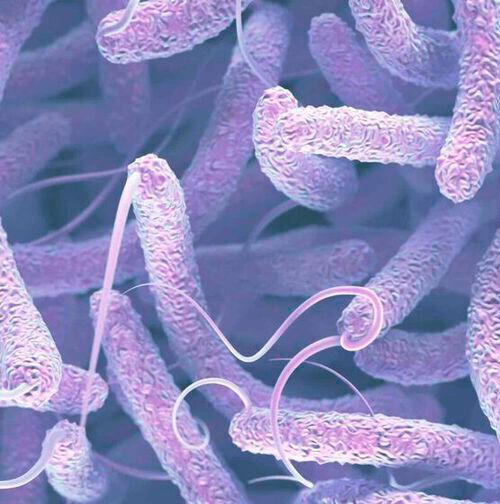
In a new study, researchers have discovered a potential new avenue to treat or prevent cholera. They have identified a unique quirk of the immune system that protects the cholera bacteria from a key driver of bacterial evolution.
Researchers from The University of Texas at Austin have discovered how this dangerous strain has held out over decades.
(Source: University of Texas)
Texas/USA – A deadly strain of cholera bacteria that emerged in Indonesia back in 1961 continues to spread widely to this day, claiming thousands of lives around the world every year, sickening millions — and, with its persistence, baffling scientists. Finally, in a study published in Nature, researchers from The University of Texas at Austin have discovered how this dangerous strain has held out over decades.
A longstanding mystery about the strain of Vibrio cholerae (V. cholerae) responsible for the seventh global cholera pandemic is how this lineage has managed to out-compete other pathogenic variants. The UT team identified a unique quirk of the immune system that protects the bacteria from a key driver of bacterial evolution.
“This component of the immune system is unique to this strain, and it has likely given it an extraordinary advantage over other V. Cholerae lineages,” said Jack Bravo, a UT postdoctoral researcher in molecular biosciences and corresponding author on the paper. “It has also allowed it to defend against parasitic mobile genetic elements, which has likely played a key part in the ecology and evolution of this strain and ultimately contributed to the longevity of this pandemic lineage.”
Cholera and other bacteria, like all living things, evolve through a series of mutations and adaptations over time, allowing for new developments in a changing environment, such as antibiotic resistance. Some of the drivers of evolution in microbes are even smaller DNA structures called plasmids that infect, exist and replicate inside a bacterium in ways that can change bacterial DNA. Plasmids also can use up energy and cause mutations that are less advantageous for the bacteria.
Through a combination of laboratory analysis and cryo-electron-microscope imaging, the research team identified a unique two-part defense system that these bacteria have that essentially destroys plasmids, thus protecting and preserving the bacterial strain.
The World Health Organization estimates that cholera infects 1.3 million to 4 million people a year and that between 21,000 and 143,000 die annually. The bacterium is usually spread through contaminated water and food or contact with an infected person’s fluids. Severe cases are marked by diarrhea, vomiting and muscle cramps that can lead to dehydration, sometimes fatally. Outbreaks occur mostly in areas with poor sanitation and drinking water infrastructure. Although there is currently a vaccine to fight cholera, protection against severe symptoms drops after only three months. With new interventions needed, researchers say their study offers a potential new avenue for drugmakers to explore.
“This unique defense system could be a target for treatment or prevention,” said David Taylor, associate professor of molecular biosciences at UT and an author on the paper. “If we can remove this defense, it could leave it vulnerable, or if we can turn its own immune system back on the bacteria, it would be an effective way to destroy it.”
The defense system outlined in the paper consists of two parts that work together. One protein targets the DNA of plasmids with remarkable accuracy, and a complementary enzyme shreds the DNA of the plasmid, unwinding the helix of the DNA moving in opposite directions.
Researchers noted that this system is also similar to some of the Crispr-Cascade complexes, which are also based on bacterial immune systems. The Crispr discovery eventually revolutionized gene-editing technologies that have brought about massive biomedical breakthroughs.
Date: 08.12.2025
Naturally, we always handle your personal data responsibly. Any personal data we receive from you is processed in accordance with applicable data protection legislation. For detailed information please see our privacy policy.
Consent to the use of data for promotional purposes
I hereby consent to Vogel Communications Group GmbH & Co. KG, Max-Planck-Str. 7-9, 97082 Würzburg including any affiliated companies according to §§ 15 et seq. AktG (hereafter: Vogel Communications Group) using my e-mail address to send editorial newsletters. A list of all affiliated companies can be found here
Newsletter content may include all products and services of any companies mentioned above, including for example specialist journals and books, events and fairs as well as event-related products and services, print and digital media offers and services such as additional (editorial) newsletters, raffles, lead campaigns, market research both online and offline, specialist webportals and e-learning offers. In case my personal telephone number has also been collected, it may be used for offers of aforementioned products, for services of the companies mentioned above, and market research purposes.
Additionally, my consent also includes the processing of my email address and telephone number for data matching for marketing purposes with select advertising partners such as LinkedIn, Google, and Meta. For this, Vogel Communications Group may transmit said data in hashed form to the advertising partners who then use said data to determine whether I am also a member of the mentioned advertising partner portals. Vogel Communications Group uses this feature for the purposes of re-targeting (up-selling, cross-selling, and customer loyalty), generating so-called look-alike audiences for acquisition of new customers, and as basis for exclusion for on-going advertising campaigns. Further information can be found in section “data matching for marketing purposes”.
In case I access protected data on Internet portals of Vogel Communications Group including any affiliated companies according to §§ 15 et seq. AktG, I need to provide further data in order to register for the access to such content. In return for this free access to editorial content, my data may be used in accordance with this consent for the purposes stated here. This does not apply to data matching for marketing purposes.
Right of revocation
I understand that I can revoke my consent at will. My revocation does not change the lawfulness of data processing that was conducted based on my consent leading up to my revocation. One option to declare my revocation is to use the contact form found at https://contact.vogel.de. In case I no longer wish to receive certain newsletters, I have subscribed to, I can also click on the unsubscribe link included at the end of a newsletter. Further information regarding my right of revocation and the implementation of it as well as the consequences of my revocation can be found in the data protection declaration, section editorial newsletter.
Delisa A. Ramos, Rodrigo Fregoso Ocampo and Caiden Ingram of UT were also authors on the paper. The research was funded by the National Institute of General Medical Sciences (NIGMS) of the National Institutes of Health and a Welch Foundation research grant.




:quality(80)/p7i.vogel.de/wcms/62/32/62327aaae1415beeed47db6201e79661/0133375912v2.jpeg "A cotton trailer outfitted with benches and a sunshade offers farmworkers a reprieve from the sun as they take a break from picking cantaloupe melons in Firebaugh, Calif.
(Source: Joe Proudman/ Regents of the University of California)")
:quality(80)/p7i.vogel.de/wcms/e6/c8/e6c8bd554776ee1ad2f1f0723fb243a7/0133369387v1.jpeg "Roman road (Source: Queen Mary University of London)")
:quality(80)/p7i.vogel.de/wcms/51/68/51687ac4cc19f2757c138498b877de57/0133167039v2.jpeg "CMFs are foams that consist of hollow spheres – made of materials such as stainless steel, nickel, or other metals and alloys – embedded in a metallic matrix. The resulting material is both lightweight and remarkably strong at absorbing compressive forces. (Source: Jie Sun/ NC State University)")
:quality(80)/p7i.vogel.de/wcms/cd/c0/cdc09efd1e5b3b8f83224e7729d66c10/0133105276v2.jpeg "From the data presented in this report, the authors show how TF3-MALS-RI is uniquely able to separate large polyacrylate molecules and provide precise molecular weight and Rg values. (Source: Postnova Analytics)")
:quality(80)/p7i.vogel.de/wcms/86/01/86014d3d2a28cefc852f65c8d68317e4/0133104231v2.jpeg "Single-handed tube reading using a Handheld 2. (Source: Azenta Life Sciences)")
:quality(80)/p7i.vogel.de/wcms/0b/0f/0b0f8ed042dfc91f32582e10d54c2c7e/0133087444v2.jpeg "Offering advanced automation to increase your throughput, the Intellixcap provides secure sealing – eliminating the need for manual intervention, while preserving vital sample integrity. (Source: Azenta Life Sciences)")
:quality(80)/p7i.vogel.de/wcms/13/d3/13d35105f74a1c2e22b9c7a270e8e9b3/0132611155v2.jpeg "Circulating cell free DNA. (Source: Amsbio)")
:quality(80)/p7i.vogel.de/wcms/bc/ed/bced6850297a04dbea471a66cb6bb6fe/0132611405v2.jpeg "The latest addition to the range is a peristaltic tubing stop adapter that eliminates the need for fixed stoppers and allows custom cut lengths of peristaltic tubing to be installed on any pump head size. (Source: Biotech Fluidics )")
:quality(80)/p7i.vogel.de/wcms/8d/5c/8d5c6c7f897f91d6784825eee20b5584/0133321225v1.jpeg "Empa researcher Christoph Hüglin collects samples of particles that are washed out of the air by rain and snow or settle due to gravity. (Source: Empa)")
:quality(80)/p7i.vogel.de/wcms/a1/af/a1afbc7c8a067bbe94749ec680b4bafd/0133163762v2.jpeg "The study found in murkier water, fish took longer to move towards the food than those in clear water, but individuals in larger groups responded more quickly overall. (Source: Christos Ioannou)")
:quality(80)/p7i.vogel.de/wcms/32/80/3280aa3d44708962943c96fe2d466744/0133088560v2.jpeg "A bumble bee in flight at the University of Bristol Botanic Garden. (Source: Phil Savoie)")
:quality(80)/p7i.vogel.de/wcms/7b/e5/7be5c735140cbe28f3af0ec3d88274b9/0133045403v2.jpeg "After being buried in the ground for two months and broken down by soil organisms, a new pair of cotton underwear (left) shows clear signs of decomposition (right). (Source: Nicolas Zonvi)")
:quality(80)/p7i.vogel.de/wcms/ee/ad/eead38ab1e3c36f262bd889dfc8c5039/0133409909v2.jpeg "Eating a diet rich in wholegrain food is likely to prevent heart disease by reducing body weight, blood pressure and the levels of cholesterol and glucose in the blood. (Source: Unsplash)")
:quality(80)/p7i.vogel.de/wcms/ef/68/ef68375729607984e5bb0c143afdae70/0133375119v2.jpeg "Printed Rice-Lentil 3D structures
(Source: SUTD)")
:quality(80)/p7i.vogel.de/wcms/bf/d0/bfd087349a85956a7aefad57ac1204c7/0133241961v2.jpeg "The Thermo Scientific Suretect Beverage Spoilage Multiplex PCR Assay provides a fast, broad-range molecular solution for detecting key spoilage microorganisms that threaten beverage quality. (Source: © OlegDoroshin - stock.adobe.com)")
:quality(80)/p7i.vogel.de/wcms/d4/61/d461ce0bd5743897993c6475f69e7ad6/0133067478v2.jpeg "In Harris County, 50 % of households with children reported food insecurity, compared with 33 % of households without children. (Source: Rice University)")
:quality(80)/p7i.vogel.de/wcms/f5/d3/f5d3af7b7479d0573bec5c1fb9f1fd7b/0133409927v2.jpeg "The Match study looked at over 500 cancer survivors with varying types and stages of cancer and found that patients experienced less pain, fatigue, and sleep problems after participating in the interventions. (Source: Unsplash)")
:quality(80)/p7i.vogel.de/wcms/22/49/224964dd6850b62cccdbc4bde2d34693/0133372964v1.jpeg "Brain activity recorded during a video game helped researchers predict whether participants would take or avoid a risk half a second before they acted. (Source: free licensed)")
:quality(80)/p7i.vogel.de/wcms/48/a7/48a761934161543f70fef2403b44d714/0133372328v2.jpeg "The link between pollution and coughing persisted in the data, even when pollution levels were below the WHO’s recommended safe daily exposure limit. (Source: free licensed)")
:quality(80)/images.vogel.de/vogelonline/bdb/1710600/1710675/original.jpg "Discover how to set yourself up for success when performing balance-based density determination of solids such as jewelry and precious metals. (Mettler Toledo)")
:quality(80)/images.vogel.de/vogelonline/bdb/1682500/1682579/original.jpg "The new XPR Analytical balance redesigned to meet the needs of laboratory technicians of working fast and lean. (Mettler Toledo)")
:quality(80)/images.vogel.de/vogelonline/bdb/1677000/1677080/original.jpg "Enhance your weighing accuracy, comfort and productivity with the redesigned XPR Analytical balance. (Mettler Toledo)")
:fill(fff,0)/images.vogel.de/vogelonline/companyimg/107800/107832/65.jpg "logoDueperthal.jpg ()")
:fill(fff,0)/images.vogel.de/vogelonline/companyimg/131900/131910/65.jpg "Xylem_tag_rgb.jpg ()")
:quality(80)/p7i.vogel.de/wcms/d0/79/d0799f86d40804d8df9baba9d4209196/0132935119v2.jpeg "Broiler chickens roaming outside. (Source: Finn Mund on Unsplash)")
:quality(80)/p7i.vogel.de/wcms/ed/07/ed0756a2495cf3591db2f3c23bedd39c/0131055520v2.jpeg "E. coli cultures and other experimental materials used in the study, shown with a 3D-printed model of the engineered phage (extreme left). (Source: National University of Singapore )")