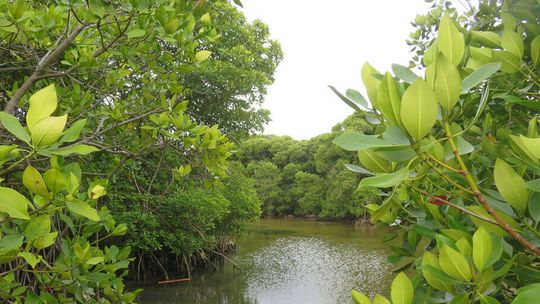
An international study has mentioned that peatlands and mangroves in Southeast Asia play an important role for reducing carbon emissions in the region. The study claims that peatlands and mangroves could mitigate more than 50 % of the region’s land-use carbon emissions.
A mangrove forest in the Maldives.
(Source: Pierre Taillardat)
Queenstown/Singapore – Conserving and restoring Southeast Asia’s carbon-rich peatlands and mangroves could mitigate more than 50 per cent of the region’s land-use carbon emissions, according to a new international study published in Nature Communications. Despite occupying just 5 per cent of the region’s terrestrial land, these ecosystems play an outsized role in emission reduction efforts, making them crucial for meeting climate targets across ASEAN countries.
The research study, conducted by an international team of scientists from NUS, with contributions from Nanyang Technological University, Singapore (NTU Singapore) and James Cook University in Australia, highlights the significant climate benefits of conserving and restoring peatlands and mangroves. Together, these ecosystems store more than 90 per cent of their carbon in soils rather than vegetation, making them among the most efficient natural carbon sinks globally.
However, when disrupted or destroyed through activities such as land-use changes, these ecosystems release significant amounts of carbon into the atmosphere, posing a major challenge to achieving emission reduction targets. Additionally, peatland degradation during dry periods, such as those associated with El Niño events, not only results in massive carbon emissions but also contributes to regional haze events, affecting air quality in countries including Singapore.
Associate Professor Massimo Lupascu, Principal Investigator and the paper’s senior author, explained, “If we conserved and restored the carbon-dense peatlands and mangroves in Southeast Asia, we could mitigate approximately 770 mega tonnes of CO2 equivalent (MtCO2e) annually, or nearly double Malaysia’s national greenhouse gas emissions in 2023.”
“Our research underscores the immense climate benefits of protecting these ecosystems, making them a pragmatic and effective natural climate solution for ASEAN countries,” said Assoc Prof Lupascu, who is from the Department of Geography at the NUS Faculty of Arts and Social Sciences.
Professor David Taylor, a co-author of the paper and Head of the NUS Department of Geography, said that “including both peatlands and mangroves in the new Nationally Determined Contributions (NDCs 3.0) that countries signed up to the Paris Agreement must update and re-commit to every five years can certainly contribute to increasing the ambition of countries across the region through the setting of higher emissions reduction targets, although this would involve substantial investment in effective conservation and restoration.”
Unique ecosystems with global implications
Southeast Asia is home to some of the world’s largest areas of tropical peatlands and mangroves. These ecosystems share water-saturated, oxygen-limited soils that slow the decomposition of organic matter, enabling them to act as natural carbon sinks when undisturbed.
However, this soil-stored carbon is “irrecoverable”, meaning it cannot easily be replaced once lost to human activities, such as agriculture or urban development. Assistant Professor Pierre Taillardat, a co-author of the paper and principal investigator at the Wetland Carbon Lab at the Asian School of the Environment, NTU Singapore, emphasized the transformative potential of wetland conservation and how it can also yield economic benefits through schemes like carbon credits.
“Wetland soils may have little agronomic value, as it is generally not well-suited for traditional farming or crop cultivation, but they are unmatched in their ability to store and preserve carbon,” added Asst Prof Taillardat.
“If carbon were valued like other critical commodities, such as being traded on the carbon credits market, it could unlock vast opportunities for conservation and restoration projects. This will enable local communities to lead carbon management efforts with a win-win scenario where livelihoods and sustainable ecosystems thrive together.”
Updated Emissions Estimates and Pathways for Change
The study also provides up-to-date estimates of emissions from disturbed peatlands and mangroves across Southeast Asia from 2001 to 2022, broken down by land-use type and country.
Date: 08.12.2025
Naturally, we always handle your personal data responsibly. Any personal data we receive from you is processed in accordance with applicable data protection legislation. For detailed information please see our privacy policy.
Consent to the use of data for promotional purposes
I hereby consent to Vogel Communications Group GmbH & Co. KG, Max-Planck-Str. 7-9, 97082 Würzburg including any affiliated companies according to §§ 15 et seq. AktG (hereafter: Vogel Communications Group) using my e-mail address to send editorial newsletters. A list of all affiliated companies can be found here
Newsletter content may include all products and services of any companies mentioned above, including for example specialist journals and books, events and fairs as well as event-related products and services, print and digital media offers and services such as additional (editorial) newsletters, raffles, lead campaigns, market research both online and offline, specialist webportals and e-learning offers. In case my personal telephone number has also been collected, it may be used for offers of aforementioned products, for services of the companies mentioned above, and market research purposes.
Additionally, my consent also includes the processing of my email address and telephone number for data matching for marketing purposes with select advertising partners such as LinkedIn, Google, and Meta. For this, Vogel Communications Group may transmit said data in hashed form to the advertising partners who then use said data to determine whether I am also a member of the mentioned advertising partner portals. Vogel Communications Group uses this feature for the purposes of re-targeting (up-selling, cross-selling, and customer loyalty), generating so-called look-alike audiences for acquisition of new customers, and as basis for exclusion for on-going advertising campaigns. Further information can be found in section “data matching for marketing purposes”.
In case I access protected data on Internet portals of Vogel Communications Group including any affiliated companies according to §§ 15 et seq. AktG, I need to provide further data in order to register for the access to such content. In return for this free access to editorial content, my data may be used in accordance with this consent for the purposes stated here. This does not apply to data matching for marketing purposes.
Right of revocation
I understand that I can revoke my consent at will. My revocation does not change the lawfulness of data processing that was conducted based on my consent leading up to my revocation. One option to declare my revocation is to use the contact form found at https://contact.vogel.de. In case I no longer wish to receive certain newsletters, I have subscribed to, I can also click on the unsubscribe link included at the end of a newsletter. Further information regarding my right of revocation and the implementation of it as well as the consequences of my revocation can be found in the data protection declaration, section editorial newsletter.
By doing so, it offers policymakers critical data to identify hotspots for intervention and prioritize conservation efforts.
In their paper, the researchers call for ASEAN governments to integrate peatland and mangrove conservation into national climate strategies. Given their high carbon storage capacity and the ability to mitigate land-use emissions, peatlands and mangroves represent a cost-effective and impactful approach to achieving net-zero targets.
By conserving and restoring these ecosystems, Southeast Asian nations can reduce emissions, bolster climate resilience, and support local communities that depend on wetlands for their livelihoods.
Dr Sigit Sasmito, from Tropwater, James Cook University in Brisbane, Australia, who is the study’s first author and led the work when he was a Research Fellow in the NUS Department of Geography, remarked, “By investing in the conservation of peatlands and mangroves, Southeast Asia can lead the world in deploying cost-effective, nature-based solutions that deliver enduring climate and biodiversity benefits. These ecosystems pack a climate mitigation punch far beyond their size, offering one of the most scalable and impactful natural solutions to combat the planet's climate crisis.”
The open-access paper, titled “Half of land use carbon emissions in Southeast Asia can be mitigated through peat swamp forest and mangrove conservation and restoration”, is available online at Nature Communications.




:quality(80)/p7i.vogel.de/wcms/45/87/458714daead8bb6b83d5305ff764e8c1/0130386255v1.jpeg "Examples of drawings from each category, with the scores they received from humans, independent AI and the human-guided AI. (Source: Advanced Science)")
:quality(80)/p7i.vogel.de/wcms/66/7c/667c242f45cc06eb5bee090c7723ba0b/0130384415v2.jpeg "Inspired by arm-wrestling, the NUS team built a self-training platform (left) where two rings of muscle tissues continuously and autonomously pull against each other. Ostrabot (right), made from a single trained ring of muscle and two flexible tails, swims 3 times faster than counterparts with conventionally cultured muscle. (Source: National University of Singapore)")
:quality(80)/p7i.vogel.de/wcms/92/ad/92adbafb37924cea35ea3cf05b7a23e5/0130206318v2.jpeg "The world’s first fully functioning proof-of-concept quantum battery
(Source: Csiro)")
:quality(80)/p7i.vogel.de/wcms/9f/8b/9f8bc2b8491d7a514ca154e9588a07b7/0130205846v1.jpeg "The researchers’ new material, based on mineralised sawdust, is an excellent fire retardant. (Source: Dan Vivas Glaser / from Kürsteiner R et al. Chem Circularity 2026)")
:quality(80)/p7i.vogel.de/wcms/6e/7c/6e7c762e933c938a92431a785df4690f/0130440213v2.jpeg "Biotech Fluidics' valving solutions offer low swept volume and eliminate reagent carryover concerns. (Source: Biotech Fluidics)")
:quality(80)/p7i.vogel.de/wcms/b0/0b/b00b237311ce4ceb03b2ba1136b6b074/0130440144v2.jpeg "Azenta Life Sciences offers a range of low binding consumables that deliver consistent performance from sensitive applications that require low DNA input such as Next Generation Sequencing and Molecular Biology. (Source: Azenta)")
:quality(80)/p7i.vogel.de/wcms/6c/ef/6cef060860810f12200fbd6d56884e9d/0130440127v2.jpeg "The Automated Plate Seal Remover from Azenta Life Sciences is a compact system for removing seals from a wide range of microplates at the single touch of a button, without damaging the plate or seal. (Source: Azenta )")
:quality(80)/p7i.vogel.de/wcms/14/ca/14ca189a5a6a5ac4c434039fc35af36c/0130440109v2.jpeg "Afys3G has launched the Information Marking System Lambda768. (Source: Afys3G)")
:quality(80)/p7i.vogel.de/wcms/5d/bb/5dbb962b09bae1c078a8ff996666bc8e/0130386229v2.jpeg "This image created using Gemini Pro, depicts an activated carbon fiber functionalized with amine groups (–NH2) at adjacent positions. This arrangement improves the energy efficacy of key interactions, enabling the desorption of captured carbon dioxide at lower temperatures. (Source: Gemini / Yasuhiro Yamada/ Chiba University / KI-generiert)")
:quality(80)/p7i.vogel.de/wcms/21/9b/219b000051ab1ea14ab5f92e4fd0f9bb/0130384937v2.jpeg "Deforestation in the Appalachian mountains. (Source: Alex Diaz on Unsplash)")
:quality(80)/p7i.vogel.de/wcms/e9/9c/e99cb19231197af70c489cb4acc2ead0/0130293444v2.jpeg "A new global study, led by researchers at Kaust in Saudi Arabia, shows that forests are most effective for climate regulation when conserved or restored in their natural or native locations. (Source: Kaust )")
:quality(80)/p7i.vogel.de/wcms/af/40/af40b535eb65c287fbd22ed5483d1d0e/0130206243v2.jpeg "The researchers dug soil pits in order to measure the carbon storage in soil
(Source: Johanna Asch)")
:quality(80)/p7i.vogel.de/wcms/c3/11/c3116fd7b394726eee766f62ca041009/0130435223v2.jpeg "Peaches are climacteric fruits, which means they continue to ripen after being picked. The recommended storage temperature is 0°C, otherwise there is a risk of cold damage. (Source: © Esther Hildebrandt - stock.adobe.com)")
:quality(80)/p7i.vogel.de/wcms/2a/07/2a0737995810d504b318f8a0f9ac2c3d/0130386209v1.jpeg "Simple, repeatable eating habits may help people stick to diets, see better results, study says (Source: free licensed)")
:quality(80)/p7i.vogel.de/wcms/6f/ba/6fba92196d0cbb1467334f8a2ecc520a/0130203021v2.jpeg "Low to moderate wine consumption shows lower risk compared with spirits, beer and cider (Source: free licensed)")
:quality(80)/p7i.vogel.de/wcms/a9/37/a9376f1d9a893570023d9aa97c085bc5/0129927485v2.jpeg "Examples of foods high in PUFAs include fatty fish and soybeans, while MUFAs include olive oil and avocadoes. (Source: free licensed)")
:quality(80)/p7i.vogel.de/wcms/40/c0/40c0c09c2bad7b925a069edbbac90621/0130385557v1.jpeg "When a stroke damages brain tissue (red) along an important movement pathway (yellow), the injured side of the brain may show faster aging (red), while parts of the opposite side may appear relatively “younger” (blue) as the brain tries to compensate. This pattern is linked to more severe movement problems and less recovery.
(Bild: Stevens INI)")
:quality(80)/p7i.vogel.de/wcms/32/14/3214c28a03f71ad067c5f27e5bd6772b/0130386218v1.jpeg "Antimicrobial-resistant Salmonella poses severe challenges to global food safety and public health. (Source: free licensed)")
:quality(80)/p7i.vogel.de/wcms/30/2e/302e195d532fc9aced73406b07642b57/0130384900v2.jpeg "Sleeping for 11 minutes more, doing an additional 4.5 minutes of moderate-to-vigorous physical activity, and eating additional quarter of a cup of vegetables were associated with a 10 % reduction in major cardiovascular events. (Source: Pixabay)")
:quality(80)/p7i.vogel.de/wcms/47/41/4741ee3c589369a09ab0e3a26b7143f0/0130384858v2.jpeg "A female, Aedes aegypti mosquito, after taking her blood meal. (Source: Lauren Bishop CDC)")
:quality(80)/images.vogel.de/vogelonline/bdb/1710600/1710675/original.jpg "Discover how to set yourself up for success when performing balance-based density determination of solids such as jewelry and precious metals. (Mettler Toledo)")
:quality(80)/images.vogel.de/vogelonline/bdb/1682500/1682579/original.jpg "The new XPR Analytical balance redesigned to meet the needs of laboratory technicians of working fast and lean. (Mettler Toledo)")
:quality(80)/images.vogel.de/vogelonline/bdb/1677000/1677080/original.jpg "Enhance your weighing accuracy, comfort and productivity with the redesigned XPR Analytical balance. (Mettler Toledo)")
:fill(fff,0)/p7i.vogel.de/companies/69/b7/69b7f63f311d9/logo-bimos-tif--2-.jpeg "logo-bimos-tif--2- (https://www.bimos.com/de-de/)")
:quality(80)/p7i.vogel.de/wcms/80/d8/80d85d34062d70f296be5aef298bbffb/0126122738v2.jpeg "A NUS-led study has confirmed corals to be reliable indicators of relative sea-level changes, making them a powerful tool for climate research. (Source: NUS)")
:quality(80)/p7i.vogel.de/wcms/af/40/af40b535eb65c287fbd22ed5483d1d0e/0130206243v2.jpeg "The researchers dug soil pits in order to measure the carbon storage in soil
(Source: Johanna Asch)")