In ant colonies, a single ant can be the catalyst for a wave of mob activity, launching brief bursts of coordinated movement involving hundreds or even thousands of swarming workers, according to new simulations. The findings help explain the mysterious rhythmic bursts seen in ant colonies for decades and could inspire smarter coordination strategies for autonomous systems like fleets of self-driving taxis.
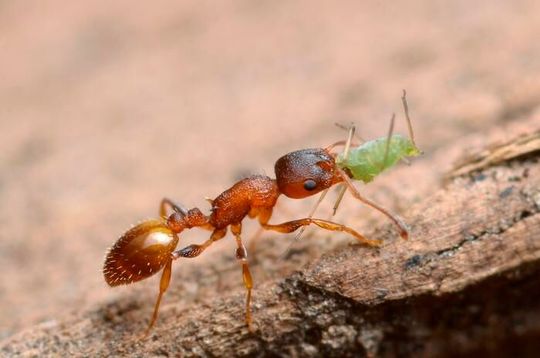
The arboreal ant Temnothorax affinis. Some ant species in this genus swarm in synchronized waves that start with a “first mover” ant.
(Source: Gilles San Martin)
About three decades ago, biologists discovered that acorn ants in the species Leptothorax acervorum, Temnothorax allardycei, T. rugatulus, and T. rudis would periodically move together as one. Masses of insects in the colony suddenly surged into action and then subsided, seemingly at random intervals. Collective spikes of activity aren’t exclusive to ants or other animals; schooling fish, fireflies’ signals, chemical reactions and firing neurons do this, too. But not all complex systems, or even all types of ants, produce short bursts of synchronized motion.
To better understand what launches and shapes patterns of collective movement and rest, researchers built a mathematical model inspired by waves of ant activity. Their findings, published August 5 in the journal PRX Life, show how just one ant in a colony — a “first mover” — activates a group. Moving from ant to ant, motion then ripples through the colony, activating a significant portion of the colony before the wave eventually runs its course.
“In many collective systems, such cascades typically appear only if enough individuals are already active themselves — a quorum of sorts,” said study co-author Simon Garnier, an NJIT professor of biological sciences. “The most surprising result is that a single ant is able to trigger an entire cascade of activity.” This work is part of an NSF grant for which Garnier is the lead principal investigator, exploring activity management and energy use in group systems made of autonomous individuals.
Garnier and two co-authors at New York University’s Tandon School of Engineering — doctoral student Michael Napoli and Maurizio Porfiri, a professor and director of the Center for Urban Science + Progress — created a model that represented each ant as it moved independently through a virtual nest. Every ant could switch between three states: active, inactive, or temporarily unresponsive.
“These switches could occur spontaneously or be triggered by encounters with active nestmates,” Garnier said.
The researchers then varied movements and interactions between ants, to see when individual activity would not affect other ants, and when it would launch coordinated movement within the colony. Using data from prior research of actual ant colonies, the scientists weighed variables such as the density of ants, ant movement speed and sensing distance between nestmates.
According to the simulation, when ant density, speed and distance were just right, one ant’s movement was all that was needed to nudge a large portion of the group into motion.
Synchronized activity bursts among ants reflect a delicate equilibrium, balancing the transmission of a single ant’s actions with the colony’s ability to “deactivate” the cascade, the researchers found. Allowing that deactivation creates a rest period before the next wave of movement, which is a key part of these activity patterns. As social insects, ants rely greatly on high-speed communication between individuals; cycles of movement bursts not only demonstrate how information spreads between nestmates rapidly, but also show the importance of quiet time between calls to action.
Swift mass mobilization may help colonies respond quickly to environmental changes or threats; however, there are potential drawbacks to a colony-wide response. If the ant that triggered the cascade misread the environmental cues at the start, the group could spend a lot of energy for nothing.
“Fortunately, we showed in earlier studies that ants have a regulation mechanism against that,” Garnier explains. “Once too many individuals are active, they tend to inhibit each other and the colony goes back quickly towards a more quiescent state. The end result is that the colony is very reactive without being wasteful.”
The findings could help explain complex dynamics within ant colonies, and may have implications outside the insect world. Engineers could apply lessons from rhythmic ant swarms to autonomous artificial agents that also need to react as a group to cyclical changes in their environment. One such example is fleets of autonomous taxis responding to spikes in customer requests for rides, Garnier says. Looking to ants for inspiration could improve communication, interaction and coordination in autonomous taxis, speeding up their response time “without wasting energy by mobilizing too many agents at once.“
Date: 08.12.2025
Naturally, we always handle your personal data responsibly. Any personal data we receive from you is processed in accordance with applicable data protection legislation. For detailed information please see our privacy policy.
Consent to the use of data for promotional purposes
I hereby consent to Vogel Communications Group GmbH & Co. KG, Max-Planck-Str. 7-9, 97082 Würzburg including any affiliated companies according to §§ 15 et seq. AktG (hereafter: Vogel Communications Group) using my e-mail address to send editorial newsletters. A list of all affiliated companies can be found here
Newsletter content may include all products and services of any companies mentioned above, including for example specialist journals and books, events and fairs as well as event-related products and services, print and digital media offers and services such as additional (editorial) newsletters, raffles, lead campaigns, market research both online and offline, specialist webportals and e-learning offers. In case my personal telephone number has also been collected, it may be used for offers of aforementioned products, for services of the companies mentioned above, and market research purposes.
Additionally, my consent also includes the processing of my email address and telephone number for data matching for marketing purposes with select advertising partners such as LinkedIn, Google, and Meta. For this, Vogel Communications Group may transmit said data in hashed form to the advertising partners who then use said data to determine whether I am also a member of the mentioned advertising partner portals. Vogel Communications Group uses this feature for the purposes of re-targeting (up-selling, cross-selling, and customer loyalty), generating so-called look-alike audiences for acquisition of new customers, and as basis for exclusion for on-going advertising campaigns. Further information can be found in section “data matching for marketing purposes”.
In case I access protected data on Internet portals of Vogel Communications Group including any affiliated companies according to §§ 15 et seq. AktG, I need to provide further data in order to register for the access to such content. In return for this free access to editorial content, my data may be used in accordance with this consent for the purposes stated here. This does not apply to data matching for marketing purposes.
Right of revocation
I understand that I can revoke my consent at will. My revocation does not change the lawfulness of data processing that was conducted based on my consent leading up to my revocation. One option to declare my revocation is to use the contact form found at https://contact.vogel.de. In case I no longer wish to receive certain newsletters, I have subscribed to, I can also click on the unsubscribe link included at the end of a newsletter. Further information regarding my right of revocation and the implementation of it as well as the consequences of my revocation can be found in the data protection declaration, section editorial newsletter.
Original Article: Nest-Level Phase Transition Drives Synchronized Activity Bursts in Ant Colonies; PRX Life; DOI:10.1103/ghnl-p5c1




:quality(80)/p7i.vogel.de/wcms/62/32/62327aaae1415beeed47db6201e79661/0133375912v2.jpeg "A cotton trailer outfitted with benches and a sunshade offers farmworkers a reprieve from the sun as they take a break from picking cantaloupe melons in Firebaugh, Calif.
(Source: Joe Proudman/ Regents of the University of California)")
:quality(80)/p7i.vogel.de/wcms/e6/c8/e6c8bd554776ee1ad2f1f0723fb243a7/0133369387v1.jpeg "Roman road (Source: Queen Mary University of London)")
:quality(80)/p7i.vogel.de/wcms/51/68/51687ac4cc19f2757c138498b877de57/0133167039v2.jpeg "CMFs are foams that consist of hollow spheres – made of materials such as stainless steel, nickel, or other metals and alloys – embedded in a metallic matrix. The resulting material is both lightweight and remarkably strong at absorbing compressive forces. (Source: Jie Sun/ NC State University)")
:quality(80)/p7i.vogel.de/wcms/cd/c0/cdc09efd1e5b3b8f83224e7729d66c10/0133105276v2.jpeg "From the data presented in this report, the authors show how TF3-MALS-RI is uniquely able to separate large polyacrylate molecules and provide precise molecular weight and Rg values. (Source: Postnova Analytics)")
:quality(80)/p7i.vogel.de/wcms/a8/6e/a86e9b1f1561a67038b6d8a9fe629117/0133465534v2.jpeg "Clean, calibrate, and store pH electrodes properly to ensure accurate, reliable measurements every time. (Source: METTLER TOLEDO)")
:quality(80)/p7i.vogel.de/wcms/86/01/86014d3d2a28cefc852f65c8d68317e4/0133104231v2.jpeg "Single-handed tube reading using a Handheld 2. (Source: Azenta Life Sciences)")
:quality(80)/p7i.vogel.de/wcms/0b/0f/0b0f8ed042dfc91f32582e10d54c2c7e/0133087444v2.jpeg "Offering advanced automation to increase your throughput, the Intellixcap provides secure sealing – eliminating the need for manual intervention, while preserving vital sample integrity. (Source: Azenta Life Sciences)")
:quality(80)/p7i.vogel.de/wcms/13/d3/13d35105f74a1c2e22b9c7a270e8e9b3/0132611155v2.jpeg "Circulating cell free DNA. (Source: Amsbio)")
:quality(80)/p7i.vogel.de/wcms/6f/ea/6feaf3edd34eb4a9f1df201dc2e6448d/0133548706v2.jpeg "The researchers studied people’s perceptions, beliefs and knowledge about climate change in two coastal regions, one low-lying island and the other a mainland coast. (Source: P Afna)")
:quality(80)/p7i.vogel.de/wcms/8d/5c/8d5c6c7f897f91d6784825eee20b5584/0133321225v1.jpeg "Empa researcher Christoph Hüglin collects samples of particles that are washed out of the air by rain and snow or settle due to gravity. (Source: Empa)")
:quality(80)/p7i.vogel.de/wcms/a1/af/a1afbc7c8a067bbe94749ec680b4bafd/0133163762v2.jpeg "The study found in murkier water, fish took longer to move towards the food than those in clear water, but individuals in larger groups responded more quickly overall. (Source: Christos Ioannou)")
:quality(80)/p7i.vogel.de/wcms/32/80/3280aa3d44708962943c96fe2d466744/0133088560v2.jpeg "A bumble bee in flight at the University of Bristol Botanic Garden. (Source: Phil Savoie)")
:quality(80)/p7i.vogel.de/wcms/95/3e/953e490f1819f6638bc08fe3d4d43e87/0133566684v1.jpeg "The soy protein isolate the researchers fed to the mice. (Source: KyotoU / Tomoko T. Asai)")
:quality(80)/p7i.vogel.de/wcms/ba/38/ba38179dbcd20fbc3887b2709193d0a8/0133566669v2.jpeg "Consumers in a Cornell study showed no consistent bias against the colour of hybrid red wines, with several ranking among the most visually appealing. (Source: free licensed)")
:quality(80)/p7i.vogel.de/wcms/ac/d1/acd1a8888f6e78206f11f2b4eb33926f/0133566582v1.jpeg "A claim on the front of a box of food products is a hint, not a verdict. The nutrition label on the back – added sugars, sodium, saturated fat, all of it together – still tells the fuller story. (Source: free licensed)")
:quality(80)/p7i.vogel.de/wcms/84/10/8410a026021778497197d21ef6987940/0133532147v2.jpeg "Fig. 1: Behind every sweet, tangy, or refreshing fruit lies a unique pH balance that shapes its flavor, freshness, and quality. (Source: METTLER TOLEDO)")
:quality(80)/p7i.vogel.de/wcms/f3/32/f332f826e9c6b84c66c63c6a79fd9e68/0133566559v2.jpeg "An analysis of 1.4 million adults in England found that 59% of participants with high blood pressure had not been diagnosed and were not taking blood pressure-lowering medication. (Source: free licensed)")
:quality(80)/p7i.vogel.de/wcms/5b/68/5b68667dfbf7bae351f864f0590cc985/0133566532v2.jpeg "Blood pressure normally falls during sleep. A modelling study suggests that a delay in the kidneys’ salt-processing rhythm could disrupt this overnight dip, a mechanism that still needs experimental and clinical testing. (Source: free licensed)")
:quality(80)/p7i.vogel.de/wcms/a9/11/a911e9abe761c9bcf5221cd218e14e80/0133560426v2.jpeg "With direct ties to the trade show, the Medica Labmed Forum bridges the gap between current scientific developments and practical healthcare issues. (Source: Constanze Tillmann/Messe Düsseldorf)")
:quality(80)/p7i.vogel.de/wcms/b2/3c/b23c5aedafa5afc1788f81e6f3b9f4fd/0133548748v2.jpeg "A team led by Prof. Dr. Bahtiyar Yilmaz from the Department for Visceral Surgery and Medicine at Inselspital, Bern University Hospital, and the DBMR at the University of Bern has now investigated what happens in the gut after a fecal microbiota transplant. (Source: Unsplash)")
:quality(80)/images.vogel.de/vogelonline/bdb/1710600/1710675/original.jpg "Discover how to set yourself up for success when performing balance-based density determination of solids such as jewelry and precious metals. (Mettler Toledo)")
:quality(80)/images.vogel.de/vogelonline/bdb/1682500/1682579/original.jpg "The new XPR Analytical balance redesigned to meet the needs of laboratory technicians of working fast and lean. (Mettler Toledo)")
:quality(80)/images.vogel.de/vogelonline/bdb/1677000/1677080/original.jpg "Enhance your weighing accuracy, comfort and productivity with the redesigned XPR Analytical balance. (Mettler Toledo)")
:fill(fff,0)/images.vogel.de/vogelonline/companyimg/107800/107832/65.jpg "logoDueperthal.jpg ()")
:fill(fff,0)/images.vogel.de/vogelonline/companyimg/131900/131910/65.jpg "Xylem_tag_rgb.jpg ()")
:fill(fff,0)/p7i.vogel.de/companies/69/b7/69b7f63f311d9/logo-bimos-tif--2-.jpeg "logo-bimos-tif--2- (https://www.bimos.com/de-de/)")
:quality(80)/p7i.vogel.de/wcms/cd/60/cd60bcc03db7c695dab35b521b8a7b06/0123355178v1.jpeg "Locust outbreak in East Africa (Source: Einat Couzin-Fuchs, Inga Petelski, Yannick Günzel, Felix B. Oberhauser)")
:quality(80)/p7i.vogel.de/wcms/0d/9b/0d9bcd7e41846276db862456d619edd2/0129351002v2.jpeg "A Caltech-led team has developed a way of making bubble bots with simple protein shells that can be modified by enzymes or magnetic nanoparticles for efficient drug delivery. One version the researchers has made is \"smart\" enough to direct itself to direct itself to a tumor target. (Source: Gao Lab/ Caltech)")
:quality(80)/p7i.vogel.de/wcms/e2/6c/e26c7f32645b41925e1fa68d4c50b1aa/0127643977v2.jpeg "A micro-CT scan of an ant colony. (Source: University of Bristol)")