BiodiversityInternational Team Discovers More than 50 New Deep-Sea Species
Source:
Barcelona Supercomputing Center
4 min Reading Time
A team of international researchers, led by Ariadna Mechó of the Barcelona Supercomputing Center, has uncovered up to 60 new marine species. This landmark discovery during a 40-day expedition reveals the rich biodiversity of this underexplored region, stretching from Chile to Rapa Nui.
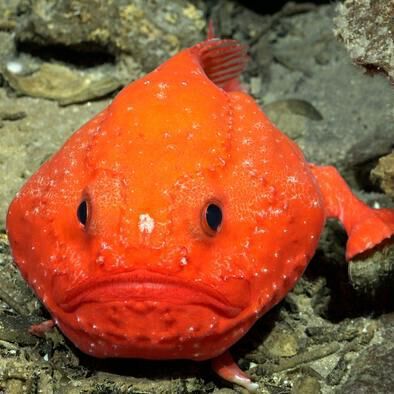
A Chaunax documented on the southwestern flank of Rapa NuiA Chaunax (genus of bony fish in the sea toad family) documented during Dive 664, a transect is located on the southwestern flank of Rapa Nui. The dive began at ~600 m depth and traveled upslope to ~200-300 m. The island is located near the western extent of the Salas y Gómez Ridge of underwater mountains.
(Source: ROV SuBastian / Schmidt Ocean Institute)
An international group of scientists, co-led by researcher Ariadna Mechó of the Barcelona Supercomputing Center — Centro Nacional de Supercomputación (BSC-CNS), observed 160 species on seamounts off the coast of Chile that had not yet been known to live in the region and suspect that at least 50 of these species are new to science. The recent Schmidt Ocean Institute expedition to the underwater mountains of the Salas y Gómez Ridge, a remote and underexplored area that stretches from offshore Chile to Rapa Nui, resulted in identifying deep-sea corals, glass sponges, sea urchins, squids, fishes, molluscs, crabs, sea stars, squat lobsters, and other species likely never-before observed by scientists.
Mechó, a researcher in the Climate Variability and Change group at the BSC’s Earth Sciences Department, presented the results of the 40-day scientific cruise ‘Unexplored Seamounts of the Salas y Gómez Ridge’ and the current negotiations to create a blue corridor in the area at the “Ocean Decade MPA Forum: Progress, obstacles and solutions”, an off-site event organised in the framework of the UN Ocean Decade Conference held in Barcelona from 10-12 April 2024.
Gallery
“The main results of this campaign are that we have found between 50 and 60 potentially new species at first sight, a number that is likely to increase as we have many samples to work on in the laboratory. We also found one of the deepest mesophotic corals in the world, extending the distribution of this Polynesian fauna by several hundred kilometres. And at depth, we have found fields of sponges and corals, habitats that are considered vulnerable and in need of protection”, said Mechó.
The expedition took place from 24 February to 4 April with an international team of 25 scientists from 14 organisations in five countries (Chile, United States, Italy, Spain, Netherlands), including the first Rapa Nui marine biologist, Emilia Ra'a Palma Tuki, a recent graduate of the Universidad Católica del Norte in Chile. The Rapa Nui Sea Council, or Koro Nui o te Vaikava, supported the expedition, providing the main permit to work in the area, and collaborated by providing a Koro Nui observer and a local sailing expert to bring to the expedition their perspectives as members of the Rapa Nui community.
The information collected during this research expedition will provide the scientific basis to inform the management of existing marine protected areas and potentially expand them, especially around the island of Rapa Nui.
Funded by the Schmidt Ocean Institute, the cruise is devoted to studying the ecosystems of one of the most unexplored areas of the world, the submarine mountains and oceanic islands of the Salas y Gómez Ridge, which is a 2,900-kilometre-long underwater mountain chain comprising more than 200 seamounts from offshore Chile to Rapa Nui, otherwise known as Easter Island (or Isla de Pascua).
This ridge hosts one of the most unique and biodiverse seascapes on Earth, with an extremely high rate of endemism, critical habitats for benthic organisms, essential migration corridors for highly mobile species, and the presence of over 80 threatened or endangered species.
In addition, the Salas y Gómez Ridge possesses a rich cultural and maritime heritage with profound connections to Indigenous islander and mainland communities and other nations. This remote, underexplored region likely harbours pristine and unexploited habitats with abundant biodiversity that require international cooperation to protect them before they are lost.
Modelling the Ocean with Supercomputing
The role of BSC and supercomputing in the campaign is to provide climate modelling data through different scenarios to establish the distribution of key species in the area. This will help us understand how these species will be impacted by future changes, depending on each possible scenario.
“But first, we need to better understand the biodiversity and connectivity of the region to know which keystone species are found there and on which mountains exactly, as well as potential faunal breaks (where communities change or stop connecting with each other). Basically, it is a unique exploration in places where practically everything is unexplored”, said Mechó.
The aim is to provide the critical information to support the designation of the Salas y Gomez Ridge as an ecologically and biologically significant marine area (Ebsa) by the Convention on Biological Diversity and an ecological and socioeconomic ‘priority area’ for international protection, by the High Seas Treaty (2023).
Date: 08.12.2025
Naturally, we always handle your personal data responsibly. Any personal data we receive from you is processed in accordance with applicable data protection legislation. For detailed information please see our privacy policy.
Consent to the use of data for promotional purposes
I hereby consent to Vogel Communications Group GmbH & Co. KG, Max-Planck-Str. 7-9, 97082 Würzburg including any affiliated companies according to §§ 15 et seq. AktG (hereafter: Vogel Communications Group) using my e-mail address to send editorial newsletters. A list of all affiliated companies can be found here
Newsletter content may include all products and services of any companies mentioned above, including for example specialist journals and books, events and fairs as well as event-related products and services, print and digital media offers and services such as additional (editorial) newsletters, raffles, lead campaigns, market research both online and offline, specialist webportals and e-learning offers. In case my personal telephone number has also been collected, it may be used for offers of aforementioned products, for services of the companies mentioned above, and market research purposes.
Additionally, my consent also includes the processing of my email address and telephone number for data matching for marketing purposes with select advertising partners such as LinkedIn, Google, and Meta. For this, Vogel Communications Group may transmit said data in hashed form to the advertising partners who then use said data to determine whether I am also a member of the mentioned advertising partner portals. Vogel Communications Group uses this feature for the purposes of re-targeting (up-selling, cross-selling, and customer loyalty), generating so-called look-alike audiences for acquisition of new customers, and as basis for exclusion for on-going advertising campaigns. Further information can be found in section “data matching for marketing purposes”.
In case I access protected data on Internet portals of Vogel Communications Group including any affiliated companies according to §§ 15 et seq. AktG, I need to provide further data in order to register for the access to such content. In return for this free access to editorial content, my data may be used in accordance with this consent for the purposes stated here. This does not apply to data matching for marketing purposes.
Right of revocation
I understand that I can revoke my consent at will. My revocation does not change the lawfulness of data processing that was conducted based on my consent leading up to my revocation. One option to declare my revocation is to use the contact form found at https://contact.vogel.de. In case I no longer wish to receive certain newsletters, I have subscribed to, I can also click on the unsubscribe link included at the end of a newsletter. Further information regarding my right of revocation and the implementation of it as well as the consequences of my revocation can be found in the data protection declaration, section editorial newsletter.
This cruise was strongly connected with an earlier campaign deployed between January and February 2024 and focused on studying the junction between the Salas y Gomez and the Nazca Ridge, and the Desventuradas Islands. During the 2 cruises, more than 100 new species have been discovered on the Salas y Gomez and the Nazca Ridge (SyGR), as well as coral and sponge gardens. That will emphasise the need for a blue corridor along the Salas y Gómez and Nazca Ridges, creating one of the first and larger high-seas marine protected areas in the world.




:quality(80)/p7i.vogel.de/wcms/fd/73/fd73fcb3ceda89d1419de1083fcab7b4/0130081520v2.jpeg "The fingers at the heart of this technology were inspired by the fin-ray effect — a design principle derived from the natural structure of fish fins. (Source: University of Texas at Austin )")
:quality(80)/p7i.vogel.de/wcms/fe/64/fe649767c802d53ac63ee2c2a40b7e0d/0130060830v2.jpeg "Sample tube with light-active substance (Source: Elvira Eberhardt / Ulm University)")
:quality(80)/p7i.vogel.de/wcms/db/e2/dbe2ae4e02f702b30153a882ef705089/0129978032v1.jpeg "Each of the isolated indium atoms (in gold color) can catalyse the synthesis of methanol (top right). (Source: Constance Ko/ ETH Zurich)")
:quality(80)/p7i.vogel.de/wcms/c1/e6/c1e6ac26eb18993236c100e7f01a78f2/0129937639v1.jpeg "Dogs evolved from highly social ancestors and have been shaped by thousands of years of interacting with humans. (Source: free licensed)")
:quality(80)/p7i.vogel.de/wcms/8f/b9/8fb98a958e4afe679865fbe52a473680/0129940982v2.jpeg "pH measurement in various nanoparticles using the Nine-Focus meter ensures precise stability and performance control. (Source: Mettler Toledo)")
:quality(80)/p7i.vogel.de/wcms/11/74/1174e5d4c8b07a64637dced8c9506b40/0129787561v2.jpeg "The Multicell Plus high-pressure reactor sets a new benchmark for operator safety, all-round accessibility and ease-of-use. (Source: Asynt)")
:quality(80)/p7i.vogel.de/wcms/ef/6e/ef6e96191183411973b77041fb6b1e16/0129785957v2.jpeg "Manufactured from high-quality crystal polystyrene - these new automation-ready plates are available in a choice of ANSI / SLAS standard (96-well and breakable 8-well strip) formats. (Source: Porvair Sciences)")
:quality(80)/p7i.vogel.de/wcms/ad/ca/adcaa20ef5ccaf7e3b325788b1e349c4/0129784872v2.jpeg "The high performance Degasi Flat Film in-line degasser. (Source: Biotech Fluidics)")
:quality(80)/p7i.vogel.de/wcms/2d/45/2d45aba62f5042baa00f7fd4fa629839/0130036533v2.jpeg "The population of Pune, India, is expected to reach 11 million by 2050. (Source: free licensed)")
:quality(80)/p7i.vogel.de/wcms/52/f8/52f8d5521fdab07ed0a865ec0d8919fd/0130009438v2.jpeg "Drylands support around half of global livestock production and sustain the livelihoods of close to a billion people, while also underpinning soil stability and carbon storage. (Source: Kaust )")
:quality(80)/p7i.vogel.de/wcms/fe/49/fe494ada322615b6e6f6ff0f5bb7c5cf/0129926008v2.jpeg "A mandrill eating fruit. (Source: University of Bristol )")
:quality(80)/p7i.vogel.de/wcms/af/4e/af4ea968647ee9cae82b39800c611819/0129865630v2.jpeg "Map of a simulated risk of water stress in 2050 where hydrogen is used in transport and industry. Baseline risk (regardless of hydrogen use) is represented by the background color in each area. Dashed areas show water use exceeding available resources due to hydrogen production. Blue dots show areas where the risk of water stress increases by more than 50 percent in the simulation. (Source: Chalmers University of Technology / Joel Löfving)")
:quality(80)/p7i.vogel.de/wcms/6f/ba/6fba92196d0cbb1467334f8a2ecc520a/0130203021v2.jpeg "Low to moderate wine consumption shows lower risk compared with spirits, beer and cider (Source: free licensed)")
:quality(80)/p7i.vogel.de/wcms/a9/37/a9376f1d9a893570023d9aa97c085bc5/0129927485v2.jpeg "Examples of foods high in PUFAs include fatty fish and soybeans, while MUFAs include olive oil and avocadoes. (Source: free licensed)")
:quality(80)/p7i.vogel.de/wcms/ea/88/ea88ef8810e21cdd9bb852c70f385ba1/0129797385v2.jpeg "A team of NUS food scientists consisting of Assoc Prof Liu Shao Quan (centre), Dr Lu Yuyun (right) and Ms Geng Chenhan (left) pioneered a co-fermentation method that improves both the nutrient and flavor profile of kombu. (Source: NUS)")
:quality(80)/p7i.vogel.de/wcms/84/2c/842c7c1678ceeec7147ea3a36e238e75/0129356324v2.jpeg "Kaust and Nadec have signed a MOU that establishes a framework for long-term cooperation across agricultural research, technology development, and professional training. (Source: Kaust )")
:quality(80)/p7i.vogel.de/wcms/ed/c0/edc0c1a86229b11efd17c5e3f94d14da/0130081211v2.jpeg "A new study finds that virtual visits did not make it easier for psychiatrists, psychologists and therapists to reach significantly more people in areas where access to care has long been limited. (Source: Pixabay)")
:quality(80)/p7i.vogel.de/wcms/9c/52/9c52318bc94be17e6662dfceffa4a0c0/0130060546v2.jpeg "Domestic cat ‘Lanni’ from co-author of the study, Latasha Ludwig, Assistant Clinical Professor at Cornell University, USA. (Source: © Latasha Ludwig)")
:quality(80)/p7i.vogel.de/wcms/4b/f4/4bf4cc9e28e65e11a27dd41da2d1a7f5/0130038185v2.jpeg "The biomarker p-tau217 could help identify women at elevated dementia risk decades before clinical symptoms begin. (Source: free licensed)")
:quality(80)/p7i.vogel.de/wcms/4f/29/4f292f402b157e2ab8c57e9f2a3e3199/0130036120v2.jpeg "The chemistry is powered by an LED lamp that triggers a self-sustaining chain reaction, forging new carbon–carbon bonds under mild conditions without toxic or expensive chemicals. (Source: Nordin Ćatić/ St John’s College, Cambridge)")
:quality(80)/images.vogel.de/vogelonline/bdb/1710600/1710675/original.jpg "Discover how to set yourself up for success when performing balance-based density determination of solids such as jewelry and precious metals. (Mettler Toledo)")
:quality(80)/images.vogel.de/vogelonline/bdb/1682500/1682579/original.jpg "The new XPR Analytical balance redesigned to meet the needs of laboratory technicians of working fast and lean. (Mettler Toledo)")
:quality(80)/images.vogel.de/vogelonline/bdb/1677000/1677080/original.jpg "Enhance your weighing accuracy, comfort and productivity with the redesigned XPR Analytical balance. (Mettler Toledo)")
:quality(80)/p7i.vogel.de/wcms/83/62/8362f3ab717d49958b887398e0b32a00/0117794517.jpeg "An octopus documented during Dive 674, an exploration transect on the southeastern flank of an unexplored and unnamed seamount located within the national jurisdiction of Chile, east of Motu Motiro Hiva, an uninhabited island along the Salas y Gómez Ridge. The dive started at ~800 m depth and traveled upslope to ~270 m. This island is located near the western-central extent of the Salas y Gómez Ridge.(Source: ROV SuBastian / Schmidt Ocean Institute)")
:quality(80)/p7i.vogel.de/wcms/cb/34/cb34a445c04cebd296870785d65bb2c2/0117794519.jpeg "A deep-sea dragon fish, an apex predator with enormous jaws filled with fang-like teeth, seen during Dive 674 along a transect on the southeastern flank of an unexplored and unnamed seamount located within the national jurisdiction of Chilé, east of Motu Motiro Hiva, an uninhabited island along the Salas y Gómez Ridge. The dive started at ~800 m depth and traveled upslope to ~270 m. This island is located near the western-central extent of the Salas y Gómez Ridge.(Source: ROV SuBastian / Schmidt Ocean Institute)")
:quality(80)/p7i.vogel.de/wcms/0d/fa/0dfafbc23886fbe316deedb7c4a1c099/0117794518.jpeg "A Chaunax documented on the southwestern flank of Rapa NuiA Chaunax (genus of bony fish in the sea toad family) documented during Dive 664, a transect is located on the southwestern flank of Rapa Nui. The dive began at ~600 m depth and traveled upslope to ~200-300 m. The island is located near the western extent of the Salas y Gómez Ridge of underwater mountains.(Source: ROV SuBastian / Schmidt Ocean Institute)")
:quality(80)/p7i.vogel.de/wcms/d3/ca/d3ca208f2264e3288610ce2fa6b8b756/0126953134v2.jpeg "Clownfish (Amphiprion bicinctus) shelter among their anemone hosts (Radianthus magnifica) in the Red Sea — a fragile partnership threatened by rising marine temperatures. (Source: Kaust )")
:quality(80)/p7i.vogel.de/wcms/c6/84/c684af6fde3bc61025a7ab458371a274/0127660717v1.jpeg "Nests of the yellowfin notie (Lindbergichthys nudifrons). Each nest would have been guarded by a parent fish, protecting their eggs from predators. This remarkable organization is thought to be a survival strategy.
Some are singular, bottom right, some are in curves, centre top, and others in clusters, top left. All have been cleared of the carpet of phytoplankton detritus that covers surrounding areas – seen starkly in the centre top picture. (Source: Weddell Sea Expedition 2019)")