Properties of plastic materials can be improved by adding fillers. To ensure consistent quality, ashing is used to control the product and the raw materials. Read how ashing can be accelerated with the help of an optimized muffle furnace.
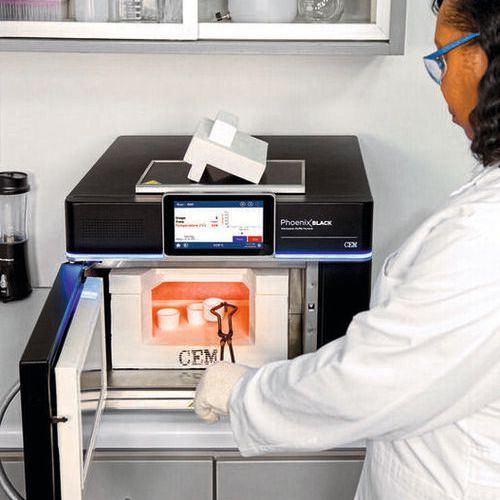
With the Phoenix Black muffle furnace, the content of the fillers can be analyzed faster than with conventional methods.
(Source CEM)
The mechanical and thermal properties of plastics can be improved by adding fibers. It applies in particular to strength, stiffness, hardness, heat resistance, wear resistance, dimensional stability and moisture absorption. Adding fibers directly to the polymer melt in the compounding process is common practice for many manufacturers on a large scale. Many engineering plastics are no longer conceivable without fibers. Short glass fibers are often used, with a fiber length of 300µm in the pellets. Occasionally, long-fiber products are also used, whose fibers can be up to three times longer. Measuring the glass fiber filler content is, therefore, a part of every manufacturing process and every incoming inspection. In addition, carbon fibers, carbon nanotubes, etc. are increasingly being incorporated into the compound. In accordance with certified quality assurance systems in accordance with DIN ISO 9000ff, which are now in place in most production companies, product quality checks should be carried out at short intervals and enable consequences: rapid intervention and adaptation of the production process is necessary.
This requirement is contrasted by an ashing time of several hours in the conventional muffle furnace. In many cases, this is too long to intervene effectively in production on the basis of measurement results or to influence the unloading of goods on delivery. Also, in research and development, e.g. of recycling processes, a fast and flexible test procedure is becoming increasingly important.
Gallery
Here, the Phönix Black muffle furnaces guarantee a significant reduction in time while maintaining the same analytical quality and thus represent alternatives to established conventional techniques. The determination of ash content is regulated by ISO 3451 Parts 1 to 5, which describe dry ashing and sulphate ashing. This specifies a microwave muffle furnace with ashing temperatures of 600±25°C, 750±50°C, 850±50°C and 950±50°C to be regulated. These specifications are met by the Phoenix Black series.
Ashing with muffle furnace technology
Modern production processes are increasingly characterized by the achievement of higher turnover rates and faster production, continuous processes, automation and standardized product quality. This places new demands on monitoring analytics, e.g. with regard to speed, shifting the measurement from the analytical laboratory to the production site, robust equipment (glove compatibility) as well as easy handling by semi-skilled personnel. Depending on the industry and process sequence, the use of a rapid analysis system opens up a range of savings opportunities, e.g. in the plastics-producing and plastics-processing industry or in the recycling industry:
Better and more uniform quality of the yield due to exact measurement of the glass fiber filler content within narrow tolerances
Shortening of the process through shorter waiting times
Protection against rejects through quick checks, and thus an increase in yield
With the Phoenix Black rapid muffle furnace, the glass fiber plastics are analyzed within a few minutes, i.e. the sample is ashed – the glass fiber remains. This relatively simple process is extremely labor- and time-intensive, which is a major problem, especially in production and quality control, and prevents rapid access to ongoing productions. The Phönix Black muffle furnaces from CEM provide a remedy here. The Phönix Black muffle furnace system is used for dry ashing, while the Phönix Black SAS is used for wet ashing. The advantages of this technique are a drastic reduction in time and a ‘clean’ working environment. What used to take hours with the conventional technique is now achieved in minutes with the Phönix technique.
Ashing: How it works
Ashing refers to the thermal decomposition of products containing hydrocarbons, leaving behind the inorganic components (“ash”). Conventional muffle furnaces have long been used for a wide variety of ashing requirements. In this technique, a sample is weighed into a crucible that has previously been dried or annealed. The sample is then placed in a convectively heated muffle furnace, where it usually remains for several hours until its weight is constant. The crucible is then removed from the furnace and placed in a desiccator to cool for a good hour before it can be weighed again.
The fast ashing processes with the Phoenix Black are based on the ‘Microwave muffle furnace technology’. In this process, an optimized air flow is guided around the hot inner furnace part with samples. The hot muffle remains cold on the outside, which protects the user from burns. The air diffusively penetrates through the porous muffle into the interior for rapid ashing or oxidation. There, the plastic samples are quickly ashed with an excess of air. Special quartz fiber crucibles are used as ashing crucibles, in which the sample is then treated at ashing temperatures of up to 1,200°C. The crucibles can be labelled with a high-temperature marking pen. In addition, these crucibles cool down within a few seconds after removal from the oven without absorbing moisture. This eliminates the need to transfer them to the desiccator, which speeds up the reweighing process. An exhaust pipe is connected directly to the unit which thus remains free of deposits. The room air and thus the user are not polluted and the installation does not need to be carried out under a fume hood.
Date: 08.12.2025
Naturally, we always handle your personal data responsibly. Any personal data we receive from you is processed in accordance with applicable data protection legislation. For detailed information please see our privacy policy.
Consent to the use of data for promotional purposes
I hereby consent to Vogel Communications Group GmbH & Co. KG, Max-Planck-Str. 7-9, 97082 Würzburg including any affiliated companies according to §§ 15 et seq. AktG (hereafter: Vogel Communications Group) using my e-mail address to send editorial newsletters. A list of all affiliated companies can be found here
Newsletter content may include all products and services of any companies mentioned above, including for example specialist journals and books, events and fairs as well as event-related products and services, print and digital media offers and services such as additional (editorial) newsletters, raffles, lead campaigns, market research both online and offline, specialist webportals and e-learning offers. In case my personal telephone number has also been collected, it may be used for offers of aforementioned products, for services of the companies mentioned above, and market research purposes.
Additionally, my consent also includes the processing of my email address and telephone number for data matching for marketing purposes with select advertising partners such as LinkedIn, Google, and Meta. For this, Vogel Communications Group may transmit said data in hashed form to the advertising partners who then use said data to determine whether I am also a member of the mentioned advertising partner portals. Vogel Communications Group uses this feature for the purposes of re-targeting (up-selling, cross-selling, and customer loyalty), generating so-called look-alike audiences for acquisition of new customers, and as basis for exclusion for on-going advertising campaigns. Further information can be found in section “data matching for marketing purposes”.
In case I access protected data on Internet portals of Vogel Communications Group including any affiliated companies according to §§ 15 et seq. AktG, I need to provide further data in order to register for the access to such content. In return for this free access to editorial content, my data may be used in accordance with this consent for the purposes stated here. This does not apply to data matching for marketing purposes.
Right of revocation
I understand that I can revoke my consent at will. My revocation does not change the lawfulness of data processing that was conducted based on my consent leading up to my revocation. One option to declare my revocation is to use the contact form found at https://contact.vogel.de. In case I no longer wish to receive certain newsletters, I have subscribed to, I can also click on the unsubscribe link included at the end of a newsletter. Further information regarding my right of revocation and the implementation of it as well as the consequences of my revocation can be found in the data protection declaration, section editorial newsletter.
The speed of the entire ashing process for filler determination is shown as an example in Table 1. In addition to the materials listed, all other plastics, polymers, rubber types, etc. can also be ashed in the Phoenix Black muffle furnace.
In addition to inorganic fillers such as glass fiber or glass beads, organic fillers such as wood flour, carbon fiber, carbon black or carbon nanotubes are also used. Since these organic fillers react with oxygen at a different time than the polymer, the Phoenix Black MIV is operated in an inert gas atmosphere. In this way, the polymer is ashed and the exposed carbon fillers remain intact.
Wet ashing for determination of sulphated ash
In addition to the examples of dry ashing listed so far, there are further regulations for wet ashing for determining the residue on ignition after sulphuric acid treatment of the sample (sulphate ash).
In addition to the already mentioned ISO 3451, which also describes the sulphate ashing of plastics, sulphate ash in accordance with DIN 53568, Part 2 and ISO 247 (Rubber - Determination of ash) is prescribed for testing rubber, elastomers and plastics. In the PVC industry, the chalk content of molded PVC parts is determined as sulphate residue after prior wet ashing. This sulphate ash determination according to the aforementioned regulations is a laborious and lengthy process due to the individual work steps involved, and is also extremely unpleasant for the operator. The sample material is mixed with sulphuric acid in a porcelain or platinum crucible, then pre-incinerated over an open flame and subsequently incinerated in a conventional muffle furnace at approximately 600°C or 950°C (depending on the regulations).
In addition to the time-consuming work steps (duration up to 12 h), the handling of the fuming sulphuric acid is extremely cumbersome and potentially hazardous to health. After the end of the fuming process, time-consuming cleaning work often has to be carried out on the fume cupboard. A Phoenix system is an alternative in terms of speed, occupational safety and operator comfort. The complete incineration process, including pre-incineration, is carried out in the Phönix Black SAS, where a vacuum extraction system from the incineration insert ensures double extraction of the acidic and sometimes toxic combustion products. Here, a quartz pipe leads from the ashing insert with the samples to be processed to a separation and neutralization device consisting of washing bottles and an activated carbon filter. The ashing time is significantly reduced to approximately 60 minutes with simultaneous ashing of up to 15 samples.




:quality(80)/p7i.vogel.de/wcms/92/ad/92adbafb37924cea35ea3cf05b7a23e5/0130206318v2.jpeg "The world’s first fully functioning proof-of-concept quantum battery
(Source: Csiro)")
:quality(80)/p7i.vogel.de/wcms/9f/8b/9f8bc2b8491d7a514ca154e9588a07b7/0130205846v1.jpeg "The researchers’ new material, based on mineralised sawdust, is an excellent fire retardant. (Source: Dan Vivas Glaser / from Kürsteiner R et al. Chem Circularity 2026)")
:quality(80)/p7i.vogel.de/wcms/fd/73/fd73fcb3ceda89d1419de1083fcab7b4/0130081520v2.jpeg "The fingers at the heart of this technology were inspired by the fin-ray effect — a design principle derived from the natural structure of fish fins. (Source: University of Texas at Austin )")
:quality(80)/p7i.vogel.de/wcms/fe/64/fe649767c802d53ac63ee2c2a40b7e0d/0130060830v2.jpeg "Sample tube with light-active substance (Source: Elvira Eberhardt / Ulm University)")
:quality(80)/p7i.vogel.de/wcms/8f/b9/8fb98a958e4afe679865fbe52a473680/0129940982v2.jpeg "pH measurement in various nanoparticles using the Nine-Focus meter ensures precise stability and performance control. (Source: Mettler Toledo)")
:quality(80)/p7i.vogel.de/wcms/11/74/1174e5d4c8b07a64637dced8c9506b40/0129787561v2.jpeg "The Multicell Plus high-pressure reactor sets a new benchmark for operator safety, all-round accessibility and ease-of-use. (Source: Asynt)")
:quality(80)/p7i.vogel.de/wcms/ef/6e/ef6e96191183411973b77041fb6b1e16/0129785957v2.jpeg "Manufactured from high-quality crystal polystyrene - these new automation-ready plates are available in a choice of ANSI / SLAS standard (96-well and breakable 8-well strip) formats. (Source: Porvair Sciences)")
:quality(80)/p7i.vogel.de/wcms/ad/ca/adcaa20ef5ccaf7e3b325788b1e349c4/0129784872v2.jpeg "The high performance Degasi Flat Film in-line degasser. (Source: Biotech Fluidics)")
:quality(80)/p7i.vogel.de/wcms/af/40/af40b535eb65c287fbd22ed5483d1d0e/0130206243v2.jpeg "The researchers dug soil pits in order to measure the carbon storage in soil
(Source: Johanna Asch)")
:quality(80)/p7i.vogel.de/wcms/2d/45/2d45aba62f5042baa00f7fd4fa629839/0130036533v2.jpeg "The population of Pune, India, is expected to reach 11 million by 2050. (Source: free licensed)")
:quality(80)/p7i.vogel.de/wcms/52/f8/52f8d5521fdab07ed0a865ec0d8919fd/0130009438v2.jpeg "Drylands support around half of global livestock production and sustain the livelihoods of close to a billion people, while also underpinning soil stability and carbon storage. (Source: Kaust )")
:quality(80)/p7i.vogel.de/wcms/fe/49/fe494ada322615b6e6f6ff0f5bb7c5cf/0129926008v2.jpeg "A mandrill eating fruit. (Source: University of Bristol )")
:quality(80)/p7i.vogel.de/wcms/6f/ba/6fba92196d0cbb1467334f8a2ecc520a/0130203021v2.jpeg "Low to moderate wine consumption shows lower risk compared with spirits, beer and cider (Source: free licensed)")
:quality(80)/p7i.vogel.de/wcms/a9/37/a9376f1d9a893570023d9aa97c085bc5/0129927485v2.jpeg "Examples of foods high in PUFAs include fatty fish and soybeans, while MUFAs include olive oil and avocadoes. (Source: free licensed)")
:quality(80)/p7i.vogel.de/wcms/ea/88/ea88ef8810e21cdd9bb852c70f385ba1/0129797385v2.jpeg "A team of NUS food scientists consisting of Assoc Prof Liu Shao Quan (centre), Dr Lu Yuyun (right) and Ms Geng Chenhan (left) pioneered a co-fermentation method that improves both the nutrient and flavor profile of kombu. (Source: NUS)")
:quality(80)/p7i.vogel.de/wcms/84/2c/842c7c1678ceeec7147ea3a36e238e75/0129356324v2.jpeg "Kaust and Nadec have signed a MOU that establishes a framework for long-term cooperation across agricultural research, technology development, and professional training. (Source: Kaust )")
:quality(80)/p7i.vogel.de/wcms/e9/73/e9732473361377610267347df55071a1/0130205830v2.jpeg "Sleep EEG signals may reveal whether the brain is aging faster than the body — and help identify elevated dementia risk earlier. (Source: free licensed)")
:quality(80)/p7i.vogel.de/wcms/ed/c0/edc0c1a86229b11efd17c5e3f94d14da/0130081211v2.jpeg "A new study finds that virtual visits did not make it easier for psychiatrists, psychologists and therapists to reach significantly more people in areas where access to care has long been limited. (Source: Pixabay)")
:quality(80)/p7i.vogel.de/wcms/9c/52/9c52318bc94be17e6662dfceffa4a0c0/0130060546v2.jpeg "Domestic cat ‘Lanni’ from co-author of the study, Latasha Ludwig, Assistant Clinical Professor at Cornell University, USA. (Source: © Latasha Ludwig)")
:quality(80)/p7i.vogel.de/wcms/4b/f4/4bf4cc9e28e65e11a27dd41da2d1a7f5/0130038185v2.jpeg "The biomarker p-tau217 could help identify women at elevated dementia risk decades before clinical symptoms begin. (Source: free licensed)")
:quality(80)/images.vogel.de/vogelonline/bdb/1710600/1710675/original.jpg "Discover how to set yourself up for success when performing balance-based density determination of solids such as jewelry and precious metals. (Mettler Toledo)")
:quality(80)/images.vogel.de/vogelonline/bdb/1682500/1682579/original.jpg "The new XPR Analytical balance redesigned to meet the needs of laboratory technicians of working fast and lean. (Mettler Toledo)")
:quality(80)/images.vogel.de/vogelonline/bdb/1677000/1677080/original.jpg "Enhance your weighing accuracy, comfort and productivity with the redesigned XPR Analytical balance. (Mettler Toledo)")
:quality(80)/p7i.vogel.de/wcms/ea/9f/ea9f1df1c757eee2c7c31fcab0f4dd16/0101701873.jpeg "Figure 1: To improve their mechanical and thermal properties, polymers are combined with with glass fibers or other filler materials.(Source: CEM)")
:quality(80)/p7i.vogel.de/wcms/74/a9/74a949db5f1b49de0ebd0fad748cb1bf/0101701876.jpeg "Figure 2: The Phoenix Black muffle furnace allows the amount of filler to be determined faster than with conventional ashing methods.(Source CEM)")
:quality(80)/p7i.vogel.de/wcms/83/6f/836fba2dc4368f3aed6f8bcaee24a438/0126748621v2.jpeg "PCR Biosystems has introduced the Air-Dryable Probe 1-Step Mix which is a versatile all-in-one air-dryable 4x RT-qPCR reagent mix for ultra-sensitive detection of RNA and DNA sequences. (Source: PCR Biosystems)")
:quality(80)/p7i.vogel.de/wcms/81/66/8166d7ee0622b0d062dc92f23d1e0f36/0127659149v1.jpeg "Sabrina Summers, University of Illinois, demonstrates hydrotreating biocrude oil from food waste. (Source: Marianne Stein)")