Climate change doesn’t just threaten how much food we grow — it may also be degrading its nutritional value. New research from Liverpool John Moores University shows that elevated CO₂ and rising temperatures can reduce essential minerals and antioxidants in crops like kale and spinach.
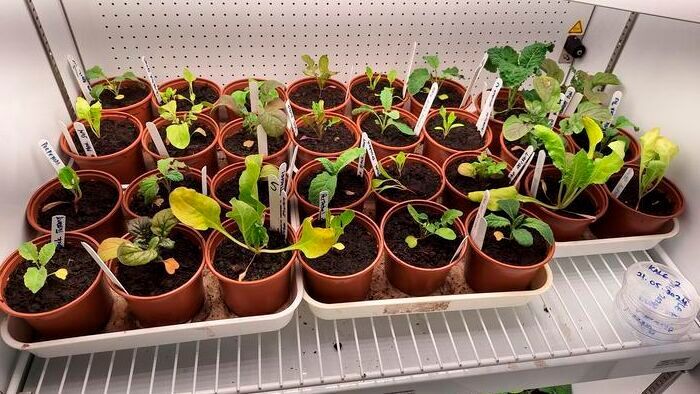
Spinach, rocket and kale plants grown under climate change conditions.
(Source: Jiata Ugwah Ekele)
New preliminary research suggests that a combination of higher atmospheric CO2 and hotter temperatures contribute to a reduction in nutritional quality in food crops, with serious implications for human health and wellbeing.
Most research into the impact of climate change on food production has focused on crop yield, but the size of the harvest means little if the nutritional value is poor. “Our work looks beyond quantity to the quality of what we eat,” says Jiata Ugwah Ekele, a PhD student at Liverpool John Moores University, UK.
The ongoing effects of climate change are posed to have devastating and irreversible consequences for plants across the globe. Ms Ekele’s research is primarily focused on exploring how the nutritional content of food crops may be affected by the interacting effects of rising CO2 levels and increasing temperatures associated with climate change. “These environmental changes can affect everything from photosynthesis and growth rates to the synthesis and storage of nutrients in crops,” says Ms Ekele.
“It’s crucial to understand these impacts because we are what we eat, and plants form the foundation of our food network as the primary producers of the ecosystem,” says Ms Ekele. “By studying these interactions, we can better predict how climate change will shape the nutritional landscape of our food and work toward mitigating those effects.”
Ms Ekele’s research is focused on popular leafy vegetables, including kale, rocket and spinach. For this project, these crops ae grown in environment-controlled growth chambers at Liverpool John Moores University, and the CO2 and temperature levels are changed to simulate the UK’s predicted future climate scenarios. “Photosynthetic markers such as chlorophyll fluorescence and quantum yield are assessed as the crops grow, while yield and biomass are recorded at harvest,” says Ms Ekele.
After the plants have been grown under climate change conditions, their nutritional quality was analysed using high-performance liquid chromatography (HPLC) and X-Ray Fluorescence profiling to measure the concentrations of sugar, protein, phenolics, flavonoids, vitamins and antioxidants.
Preliminary results from this project suggest that elevated levels of atmospheric CO2 can help crops grow faster and bigger, but certainly not healthier. “After some time, the crops showed a reduction in key minerals like calcium and certain antioxidant compounds,” says Ms Ekele.
These changes were only exacerbated by increases in temperature. “The interaction between CO2 and heat stress had complex effects - the crops do not grow as big or fast and the decline in nutritional quality intensifies,” says Ms Ekele.
Rethinking Food Systems for a Warming, Unequal World
A key early finding is that different crops have responded differently to these climate change stressors, with some species reacting more intensely than others. “This diversity in response highlights that we can’t generalise across crops. This complexity has been both fascinating and challenging and reminds us why it's important to study multiple stressors together,” says Ms Ekele.
This nutritional imbalance poses serious health implications for humanity. While higher CO2 levels can increase the concentration of sugars in crops, it can dilute essential proteins, minerals and antioxidants. “This altered balance could contribute to diets that are higher in calories but poorer in nutritional value,” says Ms Ekele. “Increased sugar content in crops, especially fruits and vegetables, could lead to greater risks of obesity and type 2 diabetes - particularly in populations already struggling with non-communicable diseases.”
Crops with poor nutritional content can also lead to deficiencies in vital proteins and vitamins that compromise the human immune system and exacerbate existing health conditions — particularly in low or middle-income countries. “It’s not just about how much food we grow, but also what’s inside that food and how it supports long-term human wellbeing,” says Ms Ekele.
Although this research simulates the UK’s projected climate changes, the implications are global. “Food systems in the Global North are already being challenged by shifting weather patterns, unpredictable growing seasons, and more frequent heatwaves,” says Ms Ekele. “In tropical and subtropical regions, these areas also contend with overlapping stressors such as drought, pests, and soil degradation - and are home to millions who depend directly on agriculture for food and income.”
Date: 08.12.2025
Naturally, we always handle your personal data responsibly. Any personal data we receive from you is processed in accordance with applicable data protection legislation. For detailed information please see our privacy policy.
Consent to the use of data for promotional purposes
I hereby consent to Vogel Communications Group GmbH & Co. KG, Max-Planck-Str. 7-9, 97082 Würzburg including any affiliated companies according to §§ 15 et seq. AktG (hereafter: Vogel Communications Group) using my e-mail address to send editorial newsletters. A list of all affiliated companies can be found here
Newsletter content may include all products and services of any companies mentioned above, including for example specialist journals and books, events and fairs as well as event-related products and services, print and digital media offers and services such as additional (editorial) newsletters, raffles, lead campaigns, market research both online and offline, specialist webportals and e-learning offers. In case my personal telephone number has also been collected, it may be used for offers of aforementioned products, for services of the companies mentioned above, and market research purposes.
Additionally, my consent also includes the processing of my email address and telephone number for data matching for marketing purposes with select advertising partners such as LinkedIn, Google, and Meta. For this, Vogel Communications Group may transmit said data in hashed form to the advertising partners who then use said data to determine whether I am also a member of the mentioned advertising partner portals. Vogel Communications Group uses this feature for the purposes of re-targeting (up-selling, cross-selling, and customer loyalty), generating so-called look-alike audiences for acquisition of new customers, and as basis for exclusion for on-going advertising campaigns. Further information can be found in section “data matching for marketing purposes”.
In case I access protected data on Internet portals of Vogel Communications Group including any affiliated companies according to §§ 15 et seq. AktG, I need to provide further data in order to register for the access to such content. In return for this free access to editorial content, my data may be used in accordance with this consent for the purposes stated here. This does not apply to data matching for marketing purposes.
Right of revocation
I understand that I can revoke my consent at will. My revocation does not change the lawfulness of data processing that was conducted based on my consent leading up to my revocation. One option to declare my revocation is to use the contact form found at https://contact.vogel.de. In case I no longer wish to receive certain newsletters, I have subscribed to, I can also click on the unsubscribe link included at the end of a newsletter. Further information regarding my right of revocation and the implementation of it as well as the consequences of my revocation can be found in the data protection declaration, section editorial newsletter.
Ms Ekele and her team are open to collaborating further on this project with the wider research community, including those from agriculture, nutrition and climate policy. “It’s important to connect plant science with broader issues of human well-being. As the climate continues to change, we must think holistically about the kind of food system we’re building - one that not only produces enough food, but also promotes health, equity, and resilience,” says Ms Ekele. “Food is more than just calories; it’s a foundation for human development and climate adaptation.”




:quality(80)/p7i.vogel.de/wcms/dd/be/ddbe621ac35ec49d9aee43615173f703/0131898392v2.jpeg "The acquisition is consistent with GSK’s strategy of acquiring assets that have validated targets and meaningfully address efficacy and/or tolerability limitations of existing standard-of-care therapies. (Source: Pixabay)")
:quality(80)/p7i.vogel.de/wcms/e2/ae/e2aea4192de2e22dd33d19afee25f312/0131779278v1.jpeg "The artificial photosynthesis system produces formic acid from carbon dioxide and water. The right image shows the group’s unique electrolyzer.
(Source: Osaka Metropolitan University)")
:quality(80)/p7i.vogel.de/wcms/49/03/49033fd7e1cb79cd90776e8d0583b441/0131773380v1.jpeg "Taken from above, this annotated image shows a schoolground in Spain and the motions of teenage participants as indicated by the dots and lines. (Source: Echeverría-Huarte et al.)")
:quality(80)/p7i.vogel.de/wcms/3b/3d/3b3da5e66ded75c51711064456bfcd90/0131640833v1.jpeg "New research from Binghamton University improves the accuracy of generative artificial intelligence to diagnose medical conditions. (Source: free licensed)")
:quality(80)/p7i.vogel.de/wcms/f5/8d/f58d7181bd0660dea9e33b89f15947eb/0131589395v2.jpeg "Equipping all your HPLC systems running standard separation protocols with an automated non-invasive flow monitoring system, such as Flowchrom, is the only true solution. (Source: Testa Analytical)")
:quality(80)/p7i.vogel.de/wcms/63/44/63443a618001fbdc12e18de386a7b548/0131588936v2.jpeg "These compact, chemically inert degassers use trusted Degasi degasser parts, combined in a manner optimized to your specific system requirements. (Source: Biotech Fluidics)")
:quality(80)/p7i.vogel.de/wcms/47/13/4713969ee1fed4c9d6cd932df7c82482/0131588920v2.jpeg "My Genius Pro installed at a leading European transplant center supporting routine infectious disease testing. (Source: Elitech Group)")
:quality(80)/p7i.vogel.de/wcms/45/d9/45d9cf5be3c10b389fd712f319fbfce1/0131588911v2.jpeg "The Nexis GC-2060 supports both routine and ad-hoc analyses through a range of workflow support functions tailored to operational needs – from automating analytical tasks to on-demand operation that analyses exactly what is needed, when it is needed. (Source: Shimadzu)")
:quality(80)/p7i.vogel.de/wcms/9f/d8/9fd8ffb67c1132b4f48dc60e4e194226/0131784166v2.jpeg "Still life featuring protein beads loaded with potassium hydroxide. The porous act as a sponge for CO2. (Source: Mezzenga Lab / ETH Zurich)")
:quality(80)/p7i.vogel.de/wcms/3e/47/3e472068bf13aadf4786e947ae148759/0131779258v2.jpeg "Salts, organic matter and other chemical constituents in natural fresh water and seawater suppress sunlight's ability to degrade plastic. Because sunlight cannot effectively initiate the degradation process, microbes cannot finish the job. That means nature’s cleanup process slows down, allowing plastics to accumulate and persist in waterways around the world. (Source: Ludmilla Aristilde/ Northwestern University)")
:quality(80)/p7i.vogel.de/wcms/bc/bc/bcbcf8be4b6c996f6ff231cb65937953/0131673749v1.jpeg "Sewage overflows occur when untreated sewage enters homes or the environment through broken or clogged pipes, or when the sewage system is overwhelmed. (Source: free licensed)")
:quality(80)/p7i.vogel.de/wcms/a8/3f/a83f5a398b890f44cd03bbc6d561d1ea/0131673786v2.jpeg "Poorly maintained waste disposal rooms can contribute to littering in residential areas.
(Source: free licensed)")
:quality(80)/p7i.vogel.de/wcms/b2/f9/b2f99d68013e2a6ab65e6c86254ec8a9/0131802730v2.jpeg "The UK currently eats 31 % less seafood than is recommended by government guidelines. (Source: University of Bristol)")
:quality(80)/p7i.vogel.de/wcms/1e/ed/1eed2310aac6373fe3d57c8f9d2809d6/0131673857v2.jpeg "“Addressing structural and policy-related barriers to accessing fresh and minimally processed foods remains critical for promoting dietary changes that improve the health and life span for all Americans,” said Dariush Mozaffarian, cardiologist and director of the Food is Medicine Institute at the Friedman School of Nutrition Science and Policy at Tufts University.
(Source: Imani Khayaam for Tufts University)")
:quality(80)/p7i.vogel.de/wcms/48/97/4897129d96e4ab9287933406b153ab51/0131163956v2.jpeg "Eating one egg per day for at least five days a week reduces risk of Alzheimer’s by up to 27%, researchers found. (Source: free licensed)")
:quality(80)/p7i.vogel.de/wcms/f6/a8/f6a8a2ac333baa08d168cc68ac2192c0/0131001826v2.jpeg "University of Oregon researchers find a way to measure the flavor profile of coffee. (Source: free licensed)")
:quality(80)/p7i.vogel.de/wcms/db/28/db28c59875bbfbeae78aac866c08ffa3/0131901880v2.jpeg "Scientists at Northwestern University and Shirley Ryan Abilitylab have developed a first-of-its-kind rehabilitation system that virtually connects therapists and patients through robotic exoskeletons. (Source: Shirley Ryan Abilitylab)")
:quality(80)/p7i.vogel.de/wcms/bb/51/bb51f90e36d72be4dd360c026642b09c/0131843656v2.jpeg "As patients live longer, they are at an increased risk of developing valvular heart disease after successful cancer therapy. (Source: Pixabay)")
:quality(80)/p7i.vogel.de/wcms/a6/11/a611c82a457f79f6ba3dcdcc603ae5fd/0131776472v1.jpeg "Wei Gao and a team at Caltech have developed a bioelectronic material called a stretchable interface for resilient electrochemical sensing (Sires), meeting a key need for the next generation of wearable and implantable sensors. The photographs show Sires-based bioelectronics under stretching (top) and twisting (bottom). Scale bar is 1 cm. (Source: Wei Gao Lab/ Caltech)")
:quality(80)/p7i.vogel.de/wcms/d4/21/d421ea4c124eb14b8ca1c5289d7a087e/0131708182v2.jpeg "Researchers at the University of Turku, Finland, used advanced brain imaging techniques to investigate whether long Covid patients with persistent symptoms show signs of brain inflammation. (Source: University of Turku)")
:quality(80)/images.vogel.de/vogelonline/bdb/1710600/1710675/original.jpg "Discover how to set yourself up for success when performing balance-based density determination of solids such as jewelry and precious metals. (Mettler Toledo)")
:quality(80)/images.vogel.de/vogelonline/bdb/1682500/1682579/original.jpg "The new XPR Analytical balance redesigned to meet the needs of laboratory technicians of working fast and lean. (Mettler Toledo)")
:quality(80)/images.vogel.de/vogelonline/bdb/1677000/1677080/original.jpg "Enhance your weighing accuracy, comfort and productivity with the redesigned XPR Analytical balance. (Mettler Toledo)")
:fill(fff,0)/p7i.vogel.de/companies/69/b7/69b7f63f311d9/logo-bimos-tif--2-.jpeg "logo-bimos-tif--2- (https://www.bimos.com/de-de/)")
:quality(80)/p7i.vogel.de/wcms/b0/37/b0376398d7d37c3c325adbde8d98edb5/0124280860v2.jpeg "Many plant-based protein-rich foods on the market are soy-based. Processing has a big impact on how much of the soybean's original components including potentially beneficial compounds end up in the final product and how healthy the product thereafter is. Spices and heating, for example, also contribute to the type of compounds found in the food we eat. (Source: Ville Koistinen / CC BY 4.0)")
:quality(80)/p7i.vogel.de/wcms/75/db/75db8afe45607bee750df705e22b60e9/0128938816v1.jpeg "A new academic review suggests that bamboo shoots could offer significant health benefits, including improved blood sugar control, gut health and antioxidant activity. (Source: free licensed)")
:quality(80)/p7i.vogel.de/wcms/94/d0/94d0d6d029239f4f349f7b2b589e2967/0125485883v1.jpeg "Vanilla pompona flower with one of its pollinators Eulaema cingulata. (Source: Charlotte Watteyn)")