Modern, targeted laboratory diagnostics enables optimal treatment. At the Labmed Forum, held alongside Medica in Düsseldorf from 16 to 19 November, experts and companies will showcase emerging trends and developments in diagnostic methods.
With direct ties to the trade show, the Medica Labmed Forum bridges the gap between current scientific developments and practical healthcare issues.
(Source: Constanze Tillmann/Messe Düsseldorf)
Medica has its roots in diagnostics. In 1969, it began as “Diagnostic Week.” Laboratory medicine remains an integral part of its DNA. As a cross-disciplinary field of medicine, it provides an important basis for decision-making across numerous specialties and plays a central role in prevention, diagnosis, treatment selection and monitoring. The Medica Labmed Forum at Medica 2026, taking place from 16 to 19 November, highlights both this importance and the field’s rapid development. Led by Prof. Dr. Stefan Holdenrieder of the German Heart Center at the Technical University of Munich, the forum connects the latest scientific advances with practical questions of healthcare delivery—from staff shortages to robotics and artificial intelligence (AI), precision diagnostics and health resilience.
Technology Alone is Not Enough; Integration is Key
The forum is a prime example of Medica’s transformation: what matters is not technology alone, but how it is integrated into existing healthcare structures, supports medical staff, improves decision-making and ultimately benefits patients.
“Laboratory medicine illustrates what we want to achieve with the new Medica: bringing together scientific findings, technological innovations and practical application. What matters is not simply what is technologically possible. We want to show how innovation can be integrated into healthcare processes, support medical staff and ultimately deliver tangible benefits for patients,” says Carmen Berger, who is responsible for Medica and the concurrent supplier platform Compamed at Messe Düsseldorf.
From Large-scale Laboratories to AI-supported Diagnostic Systems
Prof. Dr. Stefan Holdenrieder describes the transformation of laboratory medicine from a specialist perspective: “Laboratory medicine is at a turning point: moving from the central, large-scale laboratory, which operates largely behind the scenes without patient contact, to a connected, increasingly decentralised and AI-supported diagnostic system that accompanies healthy and sick people far more directly than ever before. The Medica Labmed Forum 2026 will show how this transformation is already taking shape in research and practice.”
Short presentations, panel discussions and case studies bring science, industry and practical application closely together. Two sessions are scheduled for each of the four days of the trade fair. Topics range from workforce development and sample logistics to Laboratory 4.0, robotics and AI, as well as precision diagnostics, new career paths and resilient healthcare systems.
Technology Should Ease the Burden on People
The forum opens on 16 November with Prof. Dr. Thomas Streichert of the University of Cologne focusing on strategies to address staff shortages. Approaches under discussion will range from attracting new talent to automating manual processes. The key question is how technology can provide targeted support to specialist staff and free up resources for demanding medical tasks.
In the afternoon, the session “The Sky Is the Limit” explores new approaches to transporting samples. As services become increasingly centralised, samples must travel greater distances. Drones and autonomous robots could help make logistics processes more efficient and reliable in the future, thereby helping to ensure the quality of diagnostic workflows.
Robotics, AI and Laboratory 4.0
The second day of the trade fair is devoted to the laboratory of the future. Prof. Dr. Stefan Holdenrieder will discuss robotics and AI in the context of everyday laboratory work. Automated systems could eventually take over routine tasks, particularly during night and weekend shifts, easing the workload of specialist staff.
AI can also support laboratory workflows, analyse complex sets of findings more quickly and give medical decisions a broader data foundation. At the same time, new developments in genomics and epigenomics show how diagnostics is moving towards earlier and more precise disease detection.
Date: 08.12.2025
Naturally, we always handle your personal data responsibly. Any personal data we receive from you is processed in accordance with applicable data protection legislation. For detailed information please see our privacy policy.
Consent to the use of data for promotional purposes
I hereby consent to Vogel Communications Group GmbH & Co. KG, Max-Planck-Str. 7-9, 97082 Würzburg including any affiliated companies according to §§ 15 et seq. AktG (hereafter: Vogel Communications Group) using my e-mail address to send editorial newsletters. A list of all affiliated companies can be found here
Newsletter content may include all products and services of any companies mentioned above, including for example specialist journals and books, events and fairs as well as event-related products and services, print and digital media offers and services such as additional (editorial) newsletters, raffles, lead campaigns, market research both online and offline, specialist webportals and e-learning offers. In case my personal telephone number has also been collected, it may be used for offers of aforementioned products, for services of the companies mentioned above, and market research purposes.
Additionally, my consent also includes the processing of my email address and telephone number for data matching for marketing purposes with select advertising partners such as LinkedIn, Google, and Meta. For this, Vogel Communications Group may transmit said data in hashed form to the advertising partners who then use said data to determine whether I am also a member of the mentioned advertising partner portals. Vogel Communications Group uses this feature for the purposes of re-targeting (up-selling, cross-selling, and customer loyalty), generating so-called look-alike audiences for acquisition of new customers, and as basis for exclusion for on-going advertising campaigns. Further information can be found in section “data matching for marketing purposes”.
In case I access protected data on Internet portals of Vogel Communications Group including any affiliated companies according to §§ 15 et seq. AktG, I need to provide further data in order to register for the access to such content. In return for this free access to editorial content, my data may be used in accordance with this consent for the purposes stated here. This does not apply to data matching for marketing purposes.
Right of revocation
I understand that I can revoke my consent at will. My revocation does not change the lawfulness of data processing that was conducted based on my consent leading up to my revocation. One option to declare my revocation is to use the contact form found at https://contact.vogel.de. In case I no longer wish to receive certain newsletters, I have subscribed to, I can also click on the unsubscribe link included at the end of a newsletter. Further information regarding my right of revocation and the implementation of it as well as the consequences of my revocation can be found in the data protection declaration, section editorial newsletter.
Prof. Martin Widschwendter of the University of Innsbruck will report on a cancer early-detection programme based on epigenetic changes in cell-free DNA in blood plasma, its implementation in the UK and its planned expansion to Australia.
The afternoon session, “Make Data Relevant,” focuses on Laboratory 4.0. Discussions will explore how decentralised diagnostics, lab-on-a-chip systems, standardised laboratory values and AI could work together in the future—and how diagnostic information can be made available more quickly wherever it is needed to support medical decisions.
Keynote speaker Prof. Dr. Georg Hoffmann sums up this development: “In one or two decades, the laboratory as we know it today will be almost unrecognisable. In many places, centralised laboratory lines, complex sample transport and days-long waits for results will give way to decentralised, AI-supported systems that bring diagnostics to where it is needed—to the patient’s bedside, the doctor’s practice and, often, even the home. Those who invest in Laboratory 4.0 today are already shaping the medicine of the day after tomorrow.”
Better Data for More Individualised Treatment Decisions
On 18 November, the focus turns to precision diagnostics. Prof. Dr. Verena Haselmann of the University Medical Center Hamburg-Eppendorf (UKE) will examine new biomarker technologies and their path from research to treatment decisions.
One key topic will be so-called liquid biopsies. These detect molecular changes by analysing cell-free tumour DNA in blood plasma. Such methods can help identify changes in the course of a disease earlier and tailor cancer treatments more precisely to each patient’s individual circumstances.
In the afternoon, the forum will focus more closely on the next generation of medical professionals. The session “Careers in Laboratory Medicine: Skills – Flexibility – Future” will present career paths in hospitals, research, quality assurance, self-employment and the diagnostics industry. The forum will also address how laboratory medicine can attract enough qualified staff in the future and retain them over the long term.
Health Resilience: Diagnostics Strengthens People and Healthcare Systems
On the final day of the trade fair, the Medica Labmed Forum will deliberately widen its perspective beyond individual diagnoses. Dr. Kai Prager of the German Diagnostics Industry Association (VDGH) in Berlin and DiaSys GmbH, together with Brigitte Pfeiff of Pfeiff Science + Healthcare Communications, will explore health resilience from two perspectives: How can precision medicine and diagnostics help people stay healthy for as long as possible? And how should healthcare systems be organised to remain effective under changing or challenging conditions?
In doing so, the forum connects individual and systemic resilience. Modern diagnostics can detect diseases earlier and enable more precise treatment decisions. At the same time, automation, decentralised diagnostics, digital connectivity and more efficient processes can help make healthcare structures more resilient in the face of staff shortages, crises and other pressures.
Prof. Dr. Johnny Kim, spokesperson for the Cluster4Future curATime innovation network, will use the example of mRNA-based regenerative therapies for cardiovascular diseases to show how research findings, developed further by industry, can ultimately result in treatments for patients.
The closing session will take a critical look at this process: What barriers still prevent new technologies from reaching everyday healthcare? What conditions are needed for their implementation? And what examples already show that innovation can be successfully translated into healthcare practice? These are some of the questions the session will explore.
This brings the discussion full circle to Medica’s strategic development: from scientific findings through technological innovation and integration to tangible benefits for people and healthcare systems.




:quality(80)/p7i.vogel.de/wcms/62/32/62327aaae1415beeed47db6201e79661/0133375912v2.jpeg "A cotton trailer outfitted with benches and a sunshade offers farmworkers a reprieve from the sun as they take a break from picking cantaloupe melons in Firebaugh, Calif.
(Source: Joe Proudman/ Regents of the University of California)")
:quality(80)/p7i.vogel.de/wcms/e6/c8/e6c8bd554776ee1ad2f1f0723fb243a7/0133369387v1.jpeg "Roman road (Source: Queen Mary University of London)")
:quality(80)/p7i.vogel.de/wcms/51/68/51687ac4cc19f2757c138498b877de57/0133167039v2.jpeg "CMFs are foams that consist of hollow spheres – made of materials such as stainless steel, nickel, or other metals and alloys – embedded in a metallic matrix. The resulting material is both lightweight and remarkably strong at absorbing compressive forces. (Source: Jie Sun/ NC State University)")
:quality(80)/p7i.vogel.de/wcms/cd/c0/cdc09efd1e5b3b8f83224e7729d66c10/0133105276v2.jpeg "From the data presented in this report, the authors show how TF3-MALS-RI is uniquely able to separate large polyacrylate molecules and provide precise molecular weight and Rg values. (Source: Postnova Analytics)")
:quality(80)/p7i.vogel.de/wcms/a8/6e/a86e9b1f1561a67038b6d8a9fe629117/0133465534v2.jpeg "Clean, calibrate, and store pH electrodes properly to ensure accurate, reliable measurements every time. (Source: METTLER TOLEDO)")
:quality(80)/p7i.vogel.de/wcms/86/01/86014d3d2a28cefc852f65c8d68317e4/0133104231v2.jpeg "Single-handed tube reading using a Handheld 2. (Source: Azenta Life Sciences)")
:quality(80)/p7i.vogel.de/wcms/0b/0f/0b0f8ed042dfc91f32582e10d54c2c7e/0133087444v2.jpeg "Offering advanced automation to increase your throughput, the Intellixcap provides secure sealing – eliminating the need for manual intervention, while preserving vital sample integrity. (Source: Azenta Life Sciences)")
:quality(80)/p7i.vogel.de/wcms/13/d3/13d35105f74a1c2e22b9c7a270e8e9b3/0132611155v2.jpeg "Circulating cell free DNA. (Source: Amsbio)")
:quality(80)/p7i.vogel.de/wcms/6f/ea/6feaf3edd34eb4a9f1df201dc2e6448d/0133548706v2.jpeg "The researchers studied people’s perceptions, beliefs and knowledge about climate change in two coastal regions, one low-lying island and the other a mainland coast. (Source: P Afna)")
:quality(80)/p7i.vogel.de/wcms/8d/5c/8d5c6c7f897f91d6784825eee20b5584/0133321225v1.jpeg "Empa researcher Christoph Hüglin collects samples of particles that are washed out of the air by rain and snow or settle due to gravity. (Source: Empa)")
:quality(80)/p7i.vogel.de/wcms/a1/af/a1afbc7c8a067bbe94749ec680b4bafd/0133163762v2.jpeg "The study found in murkier water, fish took longer to move towards the food than those in clear water, but individuals in larger groups responded more quickly overall. (Source: Christos Ioannou)")
:quality(80)/p7i.vogel.de/wcms/32/80/3280aa3d44708962943c96fe2d466744/0133088560v2.jpeg "A bumble bee in flight at the University of Bristol Botanic Garden. (Source: Phil Savoie)")
:quality(80)/p7i.vogel.de/wcms/84/10/8410a026021778497197d21ef6987940/0133532147v2.jpeg "Fig. 1: Behind every sweet, tangy, or refreshing fruit lies a unique pH balance that shapes its flavor, freshness, and quality. (Source: METTLER TOLEDO)")
:quality(80)/p7i.vogel.de/wcms/ee/ad/eead38ab1e3c36f262bd889dfc8c5039/0133409909v2.jpeg "Eating a diet rich in wholegrain food is likely to prevent heart disease by reducing body weight, blood pressure and the levels of cholesterol and glucose in the blood. (Source: Unsplash)")
:quality(80)/p7i.vogel.de/wcms/ef/68/ef68375729607984e5bb0c143afdae70/0133375119v2.jpeg "Printed Rice-Lentil 3D structures
(Source: SUTD)")
:quality(80)/p7i.vogel.de/wcms/bf/d0/bfd087349a85956a7aefad57ac1204c7/0133241961v2.jpeg "The Thermo Scientific Suretect Beverage Spoilage Multiplex PCR Assay provides a fast, broad-range molecular solution for detecting key spoilage microorganisms that threaten beverage quality. (Source: © OlegDoroshin - stock.adobe.com)")
:quality(80)/p7i.vogel.de/wcms/a9/11/a911e9abe761c9bcf5221cd218e14e80/0133560426v2.jpeg "With direct ties to the trade show, the Medica Labmed Forum bridges the gap between current scientific developments and practical healthcare issues. (Source: Constanze Tillmann/Messe Düsseldorf)")
:quality(80)/p7i.vogel.de/wcms/b2/3c/b23c5aedafa5afc1788f81e6f3b9f4fd/0133548748v2.jpeg "A team led by Prof. Dr. Bahtiyar Yilmaz from the Department for Visceral Surgery and Medicine at Inselspital, Bern University Hospital, and the DBMR at the University of Bern has now investigated what happens in the gut after a fecal microbiota transplant. (Source: Unsplash)")
:quality(80)/p7i.vogel.de/wcms/d1/bb/d1bb6479bcfc0601c97b579081801328/0133492613v2.jpeg "Vitamin D deficiency was the most common, identified in 12.4 % of children within one year of GLP-1 treatment, the study found. (Source: Unsplash)")
:quality(80)/p7i.vogel.de/wcms/b4/be/b4be197454de6583c081ec202a277000/0133490787v2.jpeg "NUS researchers Viresh Krishnan Sukumar (left), Associate Professor Alfredo Franco-Obregón (centre), and Dr Alex Tai (right) showed that the application of brief, intermittent and low intensity magnetic pulses can reprogram immune cells to eradicate breast cancer. (Source: NUS)")
:quality(80)/images.vogel.de/vogelonline/bdb/1710600/1710675/original.jpg "Discover how to set yourself up for success when performing balance-based density determination of solids such as jewelry and precious metals. (Mettler Toledo)")
:quality(80)/images.vogel.de/vogelonline/bdb/1682500/1682579/original.jpg "The new XPR Analytical balance redesigned to meet the needs of laboratory technicians of working fast and lean. (Mettler Toledo)")
:quality(80)/images.vogel.de/vogelonline/bdb/1677000/1677080/original.jpg "Enhance your weighing accuracy, comfort and productivity with the redesigned XPR Analytical balance. (Mettler Toledo)")
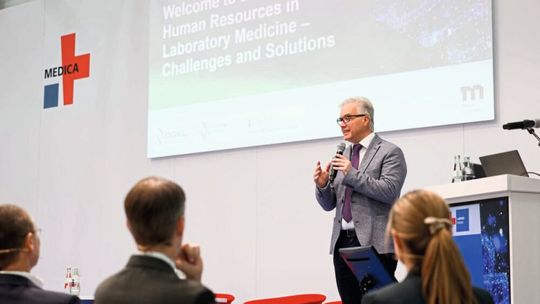
:quality(80)/p7i.vogel.de/wcms/e3/62/e36225590a3db7e12042c5f06bf90894/0127121145v2.jpeg "International expert meeting for trends and innovations in laboratory medicine — the Medica Labmed Forum at Medica. (Source: Constanze Tillmann/ Messe Düsseldorf)")
:quality(80)/p7i.vogel.de/wcms/5b/3f/5b3fc0d5fb08c1f9727125bd926b1481/0132555049v1.jpeg "On 1 and 2 December 2026, the T3 – Transform The Tomorrow conference will explore strategies that help companies future-proof their operations. (Bild: © Vogel Corporate Solutions / AdobeStock 1280236166, Oksana)")