Researchers have developed a new platform called Lytic Selection and Evolution. This system uses a reprogrammed virus that evolves 160,000 times faster than the host, effectively training bacteria to consume a common plastic ingredient. It was found that after five cycles, plastic degradation improved by over 50 %.
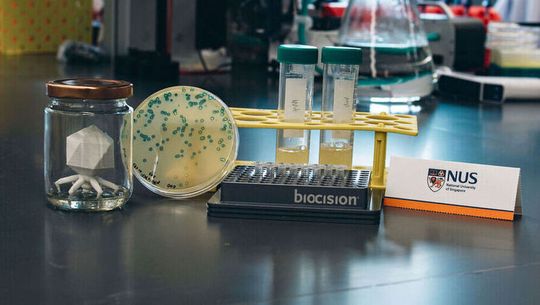
E. coli cultures and other experimental materials used in the study, shown with a 3D-printed model of the engineered phage (extreme left).
(Source: National University of Singapore)
Queenstown/Singapore – Millions of tonnes of plastic waste accumulate in landfills and oceans every year. One promising response is to engineer microbes to break the plastic down into useful chemical building blocks. However, teaching a bacterium to digest plastic efficiently demands fine-tuning not just one gene, but entire clusters of genes working in concert, like upgrading every machine on a factory assembly line rather than swapping out a single part.
A new platform developed by researchers from NUS could make that possible. Called Lytic Selection and Evolution (Lyse), the system harnesses a modified bacteriophage — a virus that infects bacteria — to rapidly create and test many small genetic changes. It can improve long stretches of DNA (up to about 40,000 DNA letters), big enough to include most sets of genes needed for important chemical processes in cells.
A crash course in plastic-eating
To “teach” bacteria to break down new chemicals (such as ingredients in plastic), scientists give them a set of genes – called a gene pathway – that work together like an assembly line. After each round (called an “evolution”), scientists keep the bacteria that perform best (for example, the ones that grow better using the target chemical) and repeat the process. Lyse is designed to speed up this “training” process.
In a proof-of-concept demonstration, Lyse improved a set of five genes that let E. coli bacteria feed on ethylene glycol, a chemical used in making PET plastics. After only five cycles, the best-performing bacteria grew more than 50 per cent better on ethylene glycol. Because Lyse changes only the chosen genes and uses fresh bacteria each round, scientists can move the improved genes into new bacteria easily, a critical step toward deploying plastic degrading microbes at scale.
Researchers led by Assistant Professor Julius Fredens from the Department of Biochemistry and the NUS Synthetic Biology for Clinical and Technological Innovation (Syncti) programme at the NUS Yong Loo Lin School of Medicine, describe the platform in a paper published in Nature Microbiology on 1st May 2026.
“Traditionally, scientists had to choose between slow but highly controlled evolution methods, or super-fast but uncontrollable continuous methods,” said Asst Prof Fredens. “Our goal was to create a best-of-both-worlds system: a tool that rapidly evolves large biological pathways while still letting us hit the pause button to control the process and prevent unwanted genetic errors.”
“Sloppy” by design
Directed evolution is a method scientists use to “speed up” natural selection in the lab. They make random changes (mutations) to a gene, then test and keep the versions that work best, repeating this process many times.
Another method, continuous evolution, such as phage-assisted continuous evolution (Pace), can do these mutation-and-selection cycles very quickly, but they have two main problems: they can only handle small pieces of DNA (about 8,000 DNA letters long), and they can get “cheaters” where the bacteria mutate their own DNA in a way that tricks the test and helps them survive, without actually improving the target gene.
“Lyse sidesteps those two problems by exploiting bacteriophage T7, a virus that infects E. coli bacteria,” explained PhD candidate, Shujian Ong, who conducted much of the research. “T7 replicates rapidly and breaks the bacterial cell open within minutes. We have engineered the virus so that, when it makes new virus particles, it also packs in an extra small ring of DNA called a phagemid which carries the group of genes they want to improve.”
Date: 08.12.2025
Naturally, we always handle your personal data responsibly. Any personal data we receive from you is processed in accordance with applicable data protection legislation. For detailed information please see our privacy policy.
Consent to the use of data for promotional purposes
I hereby consent to Vogel Communications Group GmbH & Co. KG, Max-Planck-Str. 7-9, 97082 Würzburg including any affiliated companies according to §§ 15 et seq. AktG (hereafter: Vogel Communications Group) using my e-mail address to send editorial newsletters. A list of all affiliated companies can be found here
Newsletter content may include all products and services of any companies mentioned above, including for example specialist journals and books, events and fairs as well as event-related products and services, print and digital media offers and services such as additional (editorial) newsletters, raffles, lead campaigns, market research both online and offline, specialist webportals and e-learning offers. In case my personal telephone number has also been collected, it may be used for offers of aforementioned products, for services of the companies mentioned above, and market research purposes.
Additionally, my consent also includes the processing of my email address and telephone number for data matching for marketing purposes with select advertising partners such as LinkedIn, Google, and Meta. For this, Vogel Communications Group may transmit said data in hashed form to the advertising partners who then use said data to determine whether I am also a member of the mentioned advertising partner portals. Vogel Communications Group uses this feature for the purposes of re-targeting (up-selling, cross-selling, and customer loyalty), generating so-called look-alike audiences for acquisition of new customers, and as basis for exclusion for on-going advertising campaigns. Further information can be found in section “data matching for marketing purposes”.
In case I access protected data on Internet portals of Vogel Communications Group including any affiliated companies according to §§ 15 et seq. AktG, I need to provide further data in order to register for the access to such content. In return for this free access to editorial content, my data may be used in accordance with this consent for the purposes stated here. This does not apply to data matching for marketing purposes.
Right of revocation
I understand that I can revoke my consent at will. My revocation does not change the lawfulness of data processing that was conducted based on my consent leading up to my revocation. One option to declare my revocation is to use the contact form found at https://contact.vogel.de. In case I no longer wish to receive certain newsletters, I have subscribed to, I can also click on the unsubscribe link included at the end of a newsletter. Further information regarding my right of revocation and the implementation of it as well as the consequences of my revocation can be found in the data protection declaration, section editorial newsletter.
To make a lot of the new versions of those genes, the phagemid is copied by a specially engineered DNA-copying enzyme (T7 DNA polymerase) that is intentionally error-prone. Think of a normal DNA polymerase as a precise photocopier: this engineered variant is deliberately sloppy, making many “typos” (mutations), — about 160,000 times more than the bacterium’s own DNA copying system.
Paradoxically, the high error rate is what makes the system controllable. Because the polymerase is so “sloppy”, it also messes up the virus’s own DNA. As a result, the phage becomes weaker, losing the ability to spread uncontrollably; it can only destroy the bacteria when added in large numbers.
By adjusting the ratio of phage to bacteria, the researchers toggle between a mutation phase in which the target genes get a lot of new mutations and these mutated genes are packed into new phage particles, and a selection phase, in which mutated genes are put into fresh, normal bacteria and tested for improved function.
From antibiotic resistance to plastic digestion
The NUS team validated the Lyse method in two ways. In an antibiotic-resistance check, the improved trait persisted after the genes were moved into new bacteria, confirming the changes were built into the target gene cluster.
Second, the researchers tried improving a whole “mini-factory” in cells: a five-gene pathway that lets bacteria use ethylene glycol for growth and energy. After five rounds with less glucose each time, the best-performing strain produced 50.9 per cent more biomass using ethylene glycol as its sole food source.
Sequencing showed Lyse changed both regulatory regions (switches that control how much a gene is turned on or off) and protein-coding genes, and each helpful mutation was confirmed by adding it back one at a time into a fresh host.
“Without Lyse, a bacterium’s instinct is to mutate its own entire genome to find ways to eat more plastic, but it struggles to find optimal solutions that way,” added Asst Prof Fredens. “Lyse improves the target gene cluster tremendously without accumulating unwanted mutations in the rest of the bacterium’s DNA. Because all the improvements are strictly contained within our specific gene cluster, we can easily transfer this highly optimized pathway into entirely different bacteria.”
Engineering new-to-nature biology
The platform’s capacity to handle gene clusters of up to 40 kilobases in length — five times the limit of the most commonly used phage-based evolution method — opens the door to applications that were previously impractical. These include optimizing biosynthetic pathways for pharmaceuticals, engineering microbes that break down environmental pollutants and evolving entirely synthetic metabolic routes for carbon capture. The workflow requires only standard laboratory equipment and the mixing of phage lysates with cell cultures, making the technology accessible to laboratories without specialist phage biology expertise.
A patent has been filed for the Lyse technology. Looking ahead, the team plans to apply Lyse to systems that are entirely synthetic and new to nature.
“A key target is engineering synthetic CO2-fixing metabolic pathways, taking computationally designed routes that have never existed in the real world and optimizing them so they actually function efficiently inside living cells,” said Asst Prof Fredens. “With Lyse, we can take AI-designed enzymes and metabolic pathways and rapidly optimize them to work in practice. That is where massive potential lies.”




:quality(80)/p7i.vogel.de/wcms/62/32/62327aaae1415beeed47db6201e79661/0133375912v2.jpeg "A cotton trailer outfitted with benches and a sunshade offers farmworkers a reprieve from the sun as they take a break from picking cantaloupe melons in Firebaugh, Calif.
(Source: Joe Proudman/ Regents of the University of California)")
:quality(80)/p7i.vogel.de/wcms/e6/c8/e6c8bd554776ee1ad2f1f0723fb243a7/0133369387v1.jpeg "Roman road (Source: Queen Mary University of London)")
:quality(80)/p7i.vogel.de/wcms/51/68/51687ac4cc19f2757c138498b877de57/0133167039v2.jpeg "CMFs are foams that consist of hollow spheres – made of materials such as stainless steel, nickel, or other metals and alloys – embedded in a metallic matrix. The resulting material is both lightweight and remarkably strong at absorbing compressive forces. (Source: Jie Sun/ NC State University)")
:quality(80)/p7i.vogel.de/wcms/cd/c0/cdc09efd1e5b3b8f83224e7729d66c10/0133105276v2.jpeg "From the data presented in this report, the authors show how TF3-MALS-RI is uniquely able to separate large polyacrylate molecules and provide precise molecular weight and Rg values. (Source: Postnova Analytics)")
:quality(80)/p7i.vogel.de/wcms/86/01/86014d3d2a28cefc852f65c8d68317e4/0133104231v2.jpeg "Single-handed tube reading using a Handheld 2. (Source: Azenta Life Sciences)")
:quality(80)/p7i.vogel.de/wcms/0b/0f/0b0f8ed042dfc91f32582e10d54c2c7e/0133087444v2.jpeg "Offering advanced automation to increase your throughput, the Intellixcap provides secure sealing – eliminating the need for manual intervention, while preserving vital sample integrity. (Source: Azenta Life Sciences)")
:quality(80)/p7i.vogel.de/wcms/13/d3/13d35105f74a1c2e22b9c7a270e8e9b3/0132611155v2.jpeg "Circulating cell free DNA. (Source: Amsbio)")
:quality(80)/p7i.vogel.de/wcms/bc/ed/bced6850297a04dbea471a66cb6bb6fe/0132611405v2.jpeg "The latest addition to the range is a peristaltic tubing stop adapter that eliminates the need for fixed stoppers and allows custom cut lengths of peristaltic tubing to be installed on any pump head size. (Source: Biotech Fluidics )")
:quality(80)/p7i.vogel.de/wcms/8d/5c/8d5c6c7f897f91d6784825eee20b5584/0133321225v1.jpeg "Empa researcher Christoph Hüglin collects samples of particles that are washed out of the air by rain and snow or settle due to gravity. (Source: Empa)")
:quality(80)/p7i.vogel.de/wcms/a1/af/a1afbc7c8a067bbe94749ec680b4bafd/0133163762v2.jpeg "The study found in murkier water, fish took longer to move towards the food than those in clear water, but individuals in larger groups responded more quickly overall. (Source: Christos Ioannou)")
:quality(80)/p7i.vogel.de/wcms/32/80/3280aa3d44708962943c96fe2d466744/0133088560v2.jpeg "A bumble bee in flight at the University of Bristol Botanic Garden. (Source: Phil Savoie)")
:quality(80)/p7i.vogel.de/wcms/7b/e5/7be5c735140cbe28f3af0ec3d88274b9/0133045403v2.jpeg "After being buried in the ground for two months and broken down by soil organisms, a new pair of cotton underwear (left) shows clear signs of decomposition (right). (Source: Nicolas Zonvi)")
:quality(80)/p7i.vogel.de/wcms/ee/ad/eead38ab1e3c36f262bd889dfc8c5039/0133409909v2.jpeg "Eating a diet rich in wholegrain food is likely to prevent heart disease by reducing body weight, blood pressure and the levels of cholesterol and glucose in the blood. (Source: Unsplash)")
:quality(80)/p7i.vogel.de/wcms/ef/68/ef68375729607984e5bb0c143afdae70/0133375119v2.jpeg "Printed Rice-Lentil 3D structures
(Source: SUTD)")
:quality(80)/p7i.vogel.de/wcms/bf/d0/bfd087349a85956a7aefad57ac1204c7/0133241961v2.jpeg "The Thermo Scientific Suretect Beverage Spoilage Multiplex PCR Assay provides a fast, broad-range molecular solution for detecting key spoilage microorganisms that threaten beverage quality. (Source: © OlegDoroshin - stock.adobe.com)")
:quality(80)/p7i.vogel.de/wcms/d4/61/d461ce0bd5743897993c6475f69e7ad6/0133067478v2.jpeg "In Harris County, 50 % of households with children reported food insecurity, compared with 33 % of households without children. (Source: Rice University)")
:quality(80)/p7i.vogel.de/wcms/f5/d3/f5d3af7b7479d0573bec5c1fb9f1fd7b/0133409927v2.jpeg "The Match study looked at over 500 cancer survivors with varying types and stages of cancer and found that patients experienced less pain, fatigue, and sleep problems after participating in the interventions. (Source: Unsplash)")
:quality(80)/p7i.vogel.de/wcms/22/49/224964dd6850b62cccdbc4bde2d34693/0133372964v1.jpeg "Brain activity recorded during a video game helped researchers predict whether participants would take or avoid a risk half a second before they acted. (Source: free licensed)")
:quality(80)/p7i.vogel.de/wcms/48/a7/48a761934161543f70fef2403b44d714/0133372328v2.jpeg "The link between pollution and coughing persisted in the data, even when pollution levels were below the WHO’s recommended safe daily exposure limit. (Source: free licensed)")
:quality(80)/images.vogel.de/vogelonline/bdb/1710600/1710675/original.jpg "Discover how to set yourself up for success when performing balance-based density determination of solids such as jewelry and precious metals. (Mettler Toledo)")
:quality(80)/images.vogel.de/vogelonline/bdb/1682500/1682579/original.jpg "The new XPR Analytical balance redesigned to meet the needs of laboratory technicians of working fast and lean. (Mettler Toledo)")
:quality(80)/images.vogel.de/vogelonline/bdb/1677000/1677080/original.jpg "Enhance your weighing accuracy, comfort and productivity with the redesigned XPR Analytical balance. (Mettler Toledo)")
:fill(fff,0)/images.vogel.de/vogelonline/companyimg/107800/107832/65.jpg "logoDueperthal.jpg ()")
:quality(80)/p7i.vogel.de/wcms/32/14/3214c28a03f71ad067c5f27e5bd6772b/0130386218v1.jpeg "Antimicrobial-resistant Salmonella poses severe challenges to global food safety and public health. (Source: free licensed)")
:quality(80)/p7i.vogel.de/wcms/b0/5e/b05e25f4e785776e2e3b97fb7e137f27/0127561491v2.jpeg "Human cells that have been edited with the new retron-based gene editing technology. Orange dots mark successful gene edits. Green dots show a fluorescent protein tag on the surface of mitochondria.
(Source: You-Chiun Chang/ University of Texas at Austin)")