New research in Brain Medicine explores how microplastics from ultra-processed foods may accumulate in the brain — and raises urgent questions about their possible role in depression, dementia, and other mental health disorders.
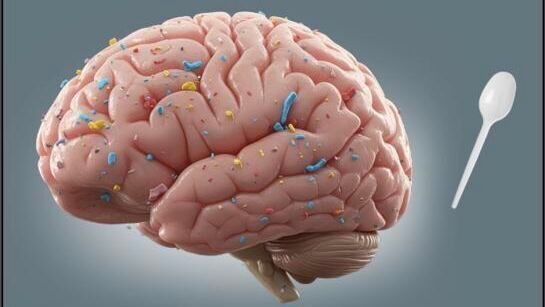
Research has revealed that the human brain contains approximately “a spoon's worth” of microplastics and nanoplastics, with particularly high concentrations (3-5 times greater) in individuals with dementia.
(Source: Genomic Press)
A groundbreaking collection of four papers published in the May issue of Brain Medicine synthesizes mounting evidence that microplastics from ultra-processed foods may be accumulating in human brains and potentially contributing to the rising global rates of depression, dementia, and other mental health disorders. The papers provide the most comprehensive analysis to date of how these tiny plastic particles might be affecting brain health through multiple interconnected biological pathways.
The Plastic Spoon in Your Brain
The striking cover of Brain Medicine's May 2025 issue depicts a human brain stippled with colorful microplastic particles alongside a plastic spoon — a visual that powerfully captures the main finding that human brains contain approximately “a spoonful” of microplastic material. This alarming concept is examined in depth across all four articles in this special collection, including a peer-reviewed commentary previously published online titled “Human microplastic removal: what does the evidence tell us?” that appeared in the May issue alongside three new papers.
The featured peer-reviewed viewpoint article by Dr. Nicholas Fabiano from the University of Ottawa, Dr. Brandon Luu from the University of Toronto, Dr. David Puder from Loma Linda University School of Medicine, and Dr. Wolfgang Marx from Deakin University’s Food & Mood Centre, titled “Microplastics and mental health: The role of ultra-processed foods”, builds upon their earlier commentary on microplastic accumulation in human tissue, “Human microplastic removal: what does the evidence tell us?”. This new viewpoint paper synthesizes emerging evidence to propose a novel hypothesis connecting ultra-processed food consumption, microplastic exposure, and mental health outcomes.
“We’re seeing converging evidence that should concern us all,” explains Dr. Fabiano. “Ultra-processed foods now comprise more than 50 % of energy intake in countries like the United States, and these foods contain significantly higher concentrations of microplastics than whole foods. Recent findings show these particles can cross the blood-brain barrier and accumulate in alarming quantities.”
The Mental Health Connection
The researchers cite substantial evidence linking ultra-processed food consumption with adverse mental health outcomes. A recent umbrella review published in The BMJ found that people who consumed ultra-processed foods had a 22 % higher risk of depression, 48 % higher risk of anxiety, and 41 % higher risk of poor sleep outcomes.
What makes their hypothesis particularly compelling is the novel suggestion that microplastics — tiny plastic particles less than 5 mm in size — may be a missing link in this relationship. The researchers point to disturbing data showing that foods like chicken nuggets contain 30 times more microplastics per gram than chicken breasts, highlighting the impact of industrial processing.
The hypothesis gains further credibility from recent findings published in Nature Medicine that demonstrated alarming microplastic concentrations in the human brain — approximately “a spoon's worth” according to the researchers — with levels three to five times higher in those with documented dementia diagnoses.
Shared Mechanisms of Harm
“This hypothesis is particularly compelling because we see remarkable overlap in biological mechanisms,” notes Dr. Marx. “Ultra-processed foods have been linked to adverse mental health through inflammation, oxidative stress, epigenetics, mitochondrial dysfunction, and disruptions to neurotransmitter systems. Microplastics appear to operate through remarkably similar pathways.”
The viewpoint article raises an intriguing question: Could the microplastic content of ultra-processed foods be partially responsible for their observed negative mental health effects? To study this relationship more systematically, the authors propose the development of a Dietary Microplastic Index (DMI) to quantify exposure through food consumption.
Possible Removal Pathways
Complementing the viewpoint article is a peer-reviewed Brevia research paper titled “Therapeutic apheresis: A promising method to remove microplastics?” by Dr. Stefan Bornstein and colleagues. This paper, also published in the May issue, examines preliminary evidence that extracorporeal therapeutic apheresis — a technique that filters blood outside the body — may have the potential to remove microplastic particles from human circulation.
Date: 08.12.2025
Naturally, we always handle your personal data responsibly. Any personal data we receive from you is processed in accordance with applicable data protection legislation. For detailed information please see our privacy policy.
Consent to the use of data for promotional purposes
I hereby consent to Vogel Communications Group GmbH & Co. KG, Max-Planck-Str. 7-9, 97082 Würzburg including any affiliated companies according to §§ 15 et seq. AktG (hereafter: Vogel Communications Group) using my e-mail address to send editorial newsletters. A list of all affiliated companies can be found here
Newsletter content may include all products and services of any companies mentioned above, including for example specialist journals and books, events and fairs as well as event-related products and services, print and digital media offers and services such as additional (editorial) newsletters, raffles, lead campaigns, market research both online and offline, specialist webportals and e-learning offers. In case my personal telephone number has also been collected, it may be used for offers of aforementioned products, for services of the companies mentioned above, and market research purposes.
Additionally, my consent also includes the processing of my email address and telephone number for data matching for marketing purposes with select advertising partners such as LinkedIn, Google, and Meta. For this, Vogel Communications Group may transmit said data in hashed form to the advertising partners who then use said data to determine whether I am also a member of the mentioned advertising partner portals. Vogel Communications Group uses this feature for the purposes of re-targeting (up-selling, cross-selling, and customer loyalty), generating so-called look-alike audiences for acquisition of new customers, and as basis for exclusion for on-going advertising campaigns. Further information can be found in section “data matching for marketing purposes”.
In case I access protected data on Internet portals of Vogel Communications Group including any affiliated companies according to §§ 15 et seq. AktG, I need to provide further data in order to register for the access to such content. In return for this free access to editorial content, my data may be used in accordance with this consent for the purposes stated here. This does not apply to data matching for marketing purposes.
Right of revocation
I understand that I can revoke my consent at will. My revocation does not change the lawfulness of data processing that was conducted based on my consent leading up to my revocation. One option to declare my revocation is to use the contact form found at https://contact.vogel.de. In case I no longer wish to receive certain newsletters, I have subscribed to, I can also click on the unsubscribe link included at the end of a newsletter. Further information regarding my right of revocation and the implementation of it as well as the consequences of my revocation can be found in the data protection declaration, section editorial newsletter.
“While we need to reduce our exposure to microplastics through better food choices and packaging alternatives, we also need research into how to remove these particles from the human body,” notes Dr. Bornstein. “Our early findings suggest that apheresis might offer one possible pathway for microplastic removal, though much more research is needed.”
“What emerges from this work is not a warning. It is a reckoning,” writes Dr. Wong. “The boundary between internal and external has failed. If microplastics cross the blood-brain barrier, what else do we think remains sacred?”
The authors of all four papers emphasize that while more primary research is needed, their analyses add another dimension to the growing case for reducing ultra-processed food consumption and developing better methods to detect and potentially remove microplastics from the human body.
“As the levels of ultra-processed foods, microplastics, and adverse mental health outcomes simultaneously rise, it is imperative that we further investigate this potential association,” concludes Dr. Fabiano. “After all, you are what you eat.”
Original Article: Una cuchara de plástico en tu cerebro: The calamity of a plastic spoon in your brain; Brain Medicine; DOI:10.61373/bm025g.0062




:quality(80)/p7i.vogel.de/wcms/6b/9a/6b9a2f9d820c458d6518f7d3c0cc990e/0131057985v2.jpeg "The collaboration marks a major step forward in how Dupont scales digital lab workflows, expands access to high-quality experimental data and turns insights into faster, more efficient innovation across its R&D organization. (Source: Dupont )")
:quality(80)/p7i.vogel.de/wcms/ed/07/ed0756a2495cf3591db2f3c23bedd39c/0131055520v2.jpeg "E. coli cultures and other experimental materials used in the study, shown with a 3D-printed model of the engineered phage (extreme left). (Source: National University of Singapore )")
:quality(80)/p7i.vogel.de/wcms/f1/87/f187c86e791dfcf8ecccf615a6a3d054/0131055400v2.jpeg "The new center brings together advanced bioproduction capabilities and hands-on collaboration to help customers accelerate process development and bring transformative therapies to patients faster. (Source: Thermo Fisher Scientific)")
:quality(80)/p7i.vogel.de/wcms/cb/39/cb3902f5777a11e07655ba29d00a0394/0131003637v1.jpeg "Lighting along riverbanks or streams at night disrupts the exchange of energy and nutrients between bodies of water and their adjacent riparian habitats. This can have far-reaching ecological consequences. (Source: RPTU)")
:quality(80)/p7i.vogel.de/wcms/52/2e/522e60883334ab2d806e6038a11e9204/0131030069v3.jpeg "“With Cellcelector, your team moves from single cell → validated clone → production ready line through one tightly integrated, automation driven workflow.” – Dr. Darius Wilson, Head of Product Management, Cell Selection & Retrieval, Sartorius Lab Product & Services (Source: Sartorius)")
:quality(80)/p7i.vogel.de/wcms/06/0e/060e08234d208d1faca16ad0cf582ff3/0131026470v2.jpeg "For enzymatic shearing from fixed cells or tissue – both these detergent-based buffers are ideal for effective fragmentation of nuclear material. (Source: © Kateryna_Kon - stock.adobe.com)")
:quality(80)/p7i.vogel.de/wcms/21/6a/216a1b69d48ac4ef7fe694d4c7791531/0131025888v2.jpeg "Biotech Fluidics has announced the Degasi Integration HFIP – a high-performance online system designed to efficiently degas even the toughest solvents. (Source: Biotech Fluidics )")
:quality(80)/p7i.vogel.de/wcms/4a/8d/4a8d7b8aa03d413a2bbcf34fdf463306/0131025869v2.jpeg "Suitable for reaction temperatures up to 200°C, the Drysyn Vortex is the perfect process development tool to efficiently, and safely, drive three stirrer shafts with one overhead stirrer. (Source: Drysyn Vortex)")
:quality(80)/p7i.vogel.de/wcms/2b/5e/2b5e4798cb0d86b0f29ba4de833c1412/0131003303v1.jpeg "33-month-old acacias in Manaus: ADEs result from the decomposition of organic matter and the use of fire by pre-Columbian populations and continue to be created by present-day peoples
(Source: Tsai Siu Mui/ Cena-USP)")
:quality(80)/p7i.vogel.de/wcms/54/50/5450b302b2cfe1f29c6f3d5c300123ce/0131004604v2.jpeg "Dr. Iván Hernández-Almeida, Science Officer, Past Global Changes, University of Bern
(Source: © Courtesy of Iván Hernández-Almeida)")
:quality(80)/p7i.vogel.de/wcms/f1/71/f1711b934d493949c55d6e9b9ddcffe9/0131003077v1.jpeg "Plastics – rich in carbon and hydrogen – can be converted into a clean energy source, using sunlight. (Source: Adelaide University)")
:quality(80)/p7i.vogel.de/wcms/60/54/6054287023c79b93d166c8b7802f9ad4/0130972957v2.jpeg "Scientists have discovered extensive, ancient and modern deep-sea coral reefs within the Galápagos Marine Reserve – the first of their kind ever to be documented inside the marine protected area since it was established in 1998. (Source: WHOI/NSF)")
:quality(80)/p7i.vogel.de/wcms/f6/a8/f6a8a2ac333baa08d168cc68ac2192c0/0131001826v2.jpeg "University of Oregon researchers find a way to measure the flavor profile of coffee. (Source: free licensed)")
:quality(80)/p7i.vogel.de/wcms/34/ff/34ff3de563d63ac821f789f8ca397070/0130971132v2.jpeg "Mixed nuts on a wooden platter. (Source: Piviso from Pixabay)")
:quality(80)/p7i.vogel.de/wcms/e7/08/e708baaa36f8929e985dfe5baea8bc68/0130734917v2.jpeg "A simple cafeteria menu change can make a measurable difference: replacing one meat-based lunch with a vegetarian option increased vegetarian meal choices by 41 percent in six English workplace canteens, while also reducing calories and greenhouse-gas emissions without hurting sales. (Source: free licensed)")
:quality(80)/p7i.vogel.de/wcms/ea/5a/ea5a5ed15b2c98730c7111bb56b1a7aa/0130612537v1.jpeg "A healthful plant-based diet prioritizes whole grains, fruits, vegetables, vegetable oils, nuts, legumes, tea and coffee. (Source: free licensed)")
:quality(80)/p7i.vogel.de/wcms/33/50/3350efd72f2c620af7c2133ce55c901f/0131086519v2.jpeg "A new Northwestern study examined all 130,267 babies born in Georgia in 2017 and tracked whether their fathers died at any point during the following five years, through 2022. (Source: Unsplash )")
:quality(80)/p7i.vogel.de/wcms/ca/fa/cafafb635ff66815b96824c2f099968a/0131058329v2.jpeg "Clinical trial participant Matthew Husar lived for roughly two years after starting the trial. (Source: Madeline Husar)")
:quality(80)/p7i.vogel.de/wcms/56/d7/56d73ff8d8ffc3ce50e3ff2188b7aada/0131004724v2.jpeg "Among Black players, major cardiac conditions occurred most commonly in those of West African origin (1.6 %), followed by Caribbean origin (0.7 %). (Source: Pixabay)")
:quality(80)/p7i.vogel.de/wcms/87/d5/87d5890059d61e8107148c2039ff9bd8/0131004713v2.jpeg "Using radio waves from a portable device, a reader, the movements of the tags could be recorded and displayed as graphs on a monitor. (Source: Chalmers University of Technology | Mia Halleröd Palmgren)")
:quality(80)/images.vogel.de/vogelonline/bdb/1710600/1710675/original.jpg "Discover how to set yourself up for success when performing balance-based density determination of solids such as jewelry and precious metals. (Mettler Toledo)")
:quality(80)/images.vogel.de/vogelonline/bdb/1682500/1682579/original.jpg "The new XPR Analytical balance redesigned to meet the needs of laboratory technicians of working fast and lean. (Mettler Toledo)")
:quality(80)/images.vogel.de/vogelonline/bdb/1677000/1677080/original.jpg "Enhance your weighing accuracy, comfort and productivity with the redesigned XPR Analytical balance. (Mettler Toledo)")
:fill(fff,0)/p7i.vogel.de/companies/69/b7/69b7f63f311d9/logo-bimos-tif--2-.jpeg "logo-bimos-tif--2- (https://www.bimos.com/de-de/)")
:quality(80)/p7i.vogel.de/wcms/2e/55/2e55c9d23d33f4408d901b55e9e15094/0130918768v1.jpeg "Researchers at the University of Plymouth are investigating whether micro- and nanoplastics that accumulate in the liver could contribute to inflammation, fibrosis and other processes associated with rising rates of liver disease. (Source: free licensed)")
:quality(80)/p7i.vogel.de/wcms/cf/f7/cff7b26a6dd79473dddf47809da425c9/0128811465v1.jpeg "Heavy metals, microplastics, and antibiotic resistance genes increasingly co-occur in greenhouse soils, creating a combined contamination risk that challenges sustainable food production in high-intensity facility agriculture. (Source: free licensed)")