3D-printed and packed with a "toolbox" for wound healing: a novel gel patch is supposed to help close chronic wounds faster. The special feature: The patch can be "switched on" and controlled specifically by light, making personalised treatment possible.
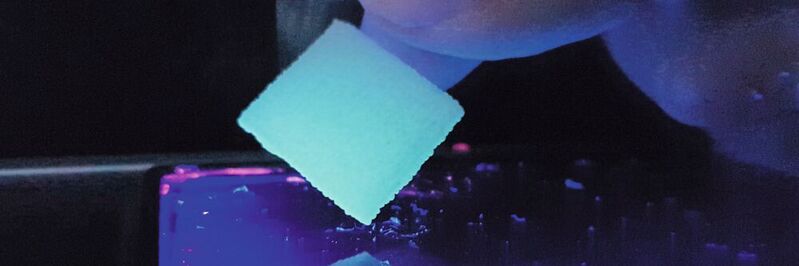
The patch can be custom made in a 3D printer and is activated by green light.
(Source: Leonard Siebert)
Kiel/Germany – Circulatory disorders, diabetes or lying in the same position for extended periods can all lead to chronic wounds that do not heal. There are hardly any effective treatment options. A materials science research team from Kiel University (CAU), together with colleagues from the University Medical Center Schleswig-Holstein (UKSH), Harvard Medical School, USA, and Dankook University in South Korea, has developed a wound patch with enhanced healing functions which can be individually adapted for each patient. The 3D-printed patch has antibacterial properties, supplies the wound with oxygen and moisture, and supports the formation of new tissue. The properties are activated and controlled by irradiation. The scientists from materials science and medicine recently presented their concept in a scientific journal.
Smart plaster could accelerate the healing of chronic wounds
The basis of the newly developed patch is a medical hydrogel. Due to its high water content of 90 percent and comparatively large spacing on the microscale, the patch can provide optimal care for chronic dry wounds. However, the most important component is antibacterial zinc oxide microparticles, which react to light and were developed by the materials science researchers in Kiel. Together with a team from the Brigham and Women’s Hospital of Harvard Medical School, Boston, they found a way to apply special proteins to the microparticles. These proteins are activated with cell-friendly green light, and thereby stimulate the formation of new blood vessels. The improved blood circulation gives rise to new tissue, which enables the wound to close.
Gallery
By controlling the effects of the patch with light, we can adapt the course and dosage of the treatment to the individual needs of patients
Rainer Adelung, Professor of Functional Nanomaterials at the Institute for Materials Science at Kiel University and spokesperson for the Research Training Group "Materials for Brain".
Materials science refers to this as a ‘smart’ material, that independently reacts to external stimuli and can be controlled by them.
Print out, stick on, light up
Similarly functioning hydrogel patches already exist, which can also be activated in a targeted manner – but their therapeutic effects are triggered through heat or electrical signals. "However, these concepts have the disadvantage that the wound also warms up and the hydrogels begin to disintegrate," explained Adelung.
The research team hopes that in the long term, clinics can produce its multifunctional, controllable patches themselves using a 3D printer, and activate the patches directly on patients with very bright, green LEDs. "The shape of the patch as well as the concentration of the zinc oxide particles and the type of protein can be individually adjusted by 3D printing," said first author Dr. Leonard Siebert, who just completed his PhD on innovative 3D-printing methods at Kiel University. During a research stay of several months at the renowned Harvard Medical School in Boston, the materials scientist researched in the working group of Professor Su Ryon Shin, who produces medical hydrogels using special biological 3D printers. "Our particles have a tetrapodal shape, i.e. they consist of several ‘arms’. This means that many of our important proteins can be applied to them, but they do not fit through conventional print nozzles," said Siebert to describe one of the challenges of their approach. In Boston, he finally developed a method to print the zinc oxide particles from his Kiel working group together with the hydrogels.
Potential for personalised medicine
In addition, the Kiel materials scientists worked closely with Professor Helmut Fickenscher, a specialist in infection medicine at the CAU and the University Medical Center Schleswig-Holstein (UKSH). He and his team tested the antibacterial properties of the patch: they put it on a bacterial biofilm for 72 hours and discovered that the bacteria do not proliferate within a radius of several millimetres around the patch. "For this test, we used two typical wound germs with two entirely different structures: Staphylococcus aureus and Pseudomonas aeruginosa. The patch demonstrated a therapeutic effect for both fundamental types, which suggests a universal effect,” summarised Dr Gregor Maschkowitz, medical microbiologist at the UKSH. Further in vivo tests were conducted at the NBM Global Research Center for Regenerative Medicine at Dankook University, South Korea. The initial results there also indicate good tolerability of the patch and improved wound healing.
This patch is an exciting concept for personalised medicine, to treat people using customised treatments as precisely, effectively and gently as possible. It is a tangible example of the promising potential of collaboration between medicine and materials science, which will become increasingly important in the future
Professor Helmut Fickenscher, Infectious diseases physician at Kiel University and Schleswig-Holstein University Hospital
Now that the initial tests have shown that their concept works well in principle, the researchers want to improve the control using light even further, so that patients can be offered even more effective personalised wound treatment in future.
Original Publication: Leonard Siebert, Eder Luna-Cerón, Luis Enrique García-Rivera, Junsung Oh, JunHwee Jang, Diego A. Rosas-Gómez, Mitzi D. Pérez-Gómez, Gregor Maschkowitz, Helmut Fickenscher, Daniela Oceguera-Cuevas, Carmen G. Holguín-León, Batzaya Byambaa, Mohammad A. Hussain, Eduardo Enciso-Martínez, Minsung Cho, Yuhan Lee, Nebras Sobahi, Anwarul Hasan, Dennis P. Orgill, Yogendra Kumar Mishra, Rainer Adelung, Eunjung Lee, Su Ryon Shin: Light-Controlled Growth Factors Release on Tetrapodal ZnO-Incorporated 3D-Printed Hydrogels for Developing Smart Wound Scaffold, Adv. Funct. Mater., Volume 31, Issue 22, May 26, 2021, 2007555, https://doi.org/10.1002/adfm.202007555
Date: 08.12.2025
Naturally, we always handle your personal data responsibly. Any personal data we receive from you is processed in accordance with applicable data protection legislation. For detailed information please see our privacy policy.
Consent to the use of data for promotional purposes
I hereby consent to Vogel Communications Group GmbH & Co. KG, Max-Planck-Str. 7-9, 97082 Würzburg including any affiliated companies according to §§ 15 et seq. AktG (hereafter: Vogel Communications Group) using my e-mail address to send editorial newsletters. A list of all affiliated companies can be found here
Newsletter content may include all products and services of any companies mentioned above, including for example specialist journals and books, events and fairs as well as event-related products and services, print and digital media offers and services such as additional (editorial) newsletters, raffles, lead campaigns, market research both online and offline, specialist webportals and e-learning offers. In case my personal telephone number has also been collected, it may be used for offers of aforementioned products, for services of the companies mentioned above, and market research purposes.
Additionally, my consent also includes the processing of my email address and telephone number for data matching for marketing purposes with select advertising partners such as LinkedIn, Google, and Meta. For this, Vogel Communications Group may transmit said data in hashed form to the advertising partners who then use said data to determine whether I am also a member of the mentioned advertising partner portals. Vogel Communications Group uses this feature for the purposes of re-targeting (up-selling, cross-selling, and customer loyalty), generating so-called look-alike audiences for acquisition of new customers, and as basis for exclusion for on-going advertising campaigns. Further information can be found in section “data matching for marketing purposes”.
In case I access protected data on Internet portals of Vogel Communications Group including any affiliated companies according to §§ 15 et seq. AktG, I need to provide further data in order to register for the access to such content. In return for this free access to editorial content, my data may be used in accordance with this consent for the purposes stated here. This does not apply to data matching for marketing purposes.
Right of revocation
I understand that I can revoke my consent at will. My revocation does not change the lawfulness of data processing that was conducted based on my consent leading up to my revocation. One option to declare my revocation is to use the contact form found at https://contact.vogel.de. In case I no longer wish to receive certain newsletters, I have subscribed to, I can also click on the unsubscribe link included at the end of a newsletter. Further information regarding my right of revocation and the implementation of it as well as the consequences of my revocation can be found in the data protection declaration, section editorial newsletter.
* J. Siekmann, Christian-Albrechts-Universität zu Kiel, 24118 Kiel/Germany




:quality(80)/p7i.vogel.de/wcms/fd/73/fd73fcb3ceda89d1419de1083fcab7b4/0130081520v2.jpeg "The fingers at the heart of this technology were inspired by the fin-ray effect — a design principle derived from the natural structure of fish fins. (Source: University of Texas at Austin )")
:quality(80)/p7i.vogel.de/wcms/fe/64/fe649767c802d53ac63ee2c2a40b7e0d/0130060830v2.jpeg "Sample tube with light-active substance (Source: Elvira Eberhardt / Ulm University)")
:quality(80)/p7i.vogel.de/wcms/db/e2/dbe2ae4e02f702b30153a882ef705089/0129978032v1.jpeg "Each of the isolated indium atoms (in gold color) can catalyse the synthesis of methanol (top right). (Source: Constance Ko/ ETH Zurich)")
:quality(80)/p7i.vogel.de/wcms/c1/e6/c1e6ac26eb18993236c100e7f01a78f2/0129937639v1.jpeg "Dogs evolved from highly social ancestors and have been shaped by thousands of years of interacting with humans. (Source: free licensed)")
:quality(80)/p7i.vogel.de/wcms/8f/b9/8fb98a958e4afe679865fbe52a473680/0129940982v2.jpeg "pH measurement in various nanoparticles using the Nine-Focus meter ensures precise stability and performance control. (Source: Mettler Toledo)")
:quality(80)/p7i.vogel.de/wcms/11/74/1174e5d4c8b07a64637dced8c9506b40/0129787561v2.jpeg "The Multicell Plus high-pressure reactor sets a new benchmark for operator safety, all-round accessibility and ease-of-use. (Source: Asynt)")
:quality(80)/p7i.vogel.de/wcms/ef/6e/ef6e96191183411973b77041fb6b1e16/0129785957v2.jpeg "Manufactured from high-quality crystal polystyrene - these new automation-ready plates are available in a choice of ANSI / SLAS standard (96-well and breakable 8-well strip) formats. (Source: Porvair Sciences)")
:quality(80)/p7i.vogel.de/wcms/ad/ca/adcaa20ef5ccaf7e3b325788b1e349c4/0129784872v2.jpeg "The high performance Degasi Flat Film in-line degasser. (Source: Biotech Fluidics)")
:quality(80)/p7i.vogel.de/wcms/2d/45/2d45aba62f5042baa00f7fd4fa629839/0130036533v2.jpeg "The population of Pune, India, is expected to reach 11 million by 2050. (Source: free licensed)")
:quality(80)/p7i.vogel.de/wcms/52/f8/52f8d5521fdab07ed0a865ec0d8919fd/0130009438v2.jpeg "Drylands support around half of global livestock production and sustain the livelihoods of close to a billion people, while also underpinning soil stability and carbon storage. (Source: Kaust )")
:quality(80)/p7i.vogel.de/wcms/fe/49/fe494ada322615b6e6f6ff0f5bb7c5cf/0129926008v2.jpeg "A mandrill eating fruit. (Source: University of Bristol )")
:quality(80)/p7i.vogel.de/wcms/af/4e/af4ea968647ee9cae82b39800c611819/0129865630v2.jpeg "Map of a simulated risk of water stress in 2050 where hydrogen is used in transport and industry. Baseline risk (regardless of hydrogen use) is represented by the background color in each area. Dashed areas show water use exceeding available resources due to hydrogen production. Blue dots show areas where the risk of water stress increases by more than 50 percent in the simulation. (Source: Chalmers University of Technology / Joel Löfving)")
:quality(80)/p7i.vogel.de/wcms/6f/ba/6fba92196d0cbb1467334f8a2ecc520a/0130203021v2.jpeg "Low to moderate wine consumption shows lower risk compared with spirits, beer and cider (Source: free licensed)")
:quality(80)/p7i.vogel.de/wcms/a9/37/a9376f1d9a893570023d9aa97c085bc5/0129927485v2.jpeg "Examples of foods high in PUFAs include fatty fish and soybeans, while MUFAs include olive oil and avocadoes. (Source: free licensed)")
:quality(80)/p7i.vogel.de/wcms/ea/88/ea88ef8810e21cdd9bb852c70f385ba1/0129797385v2.jpeg "A team of NUS food scientists consisting of Assoc Prof Liu Shao Quan (centre), Dr Lu Yuyun (right) and Ms Geng Chenhan (left) pioneered a co-fermentation method that improves both the nutrient and flavor profile of kombu. (Source: NUS)")
:quality(80)/p7i.vogel.de/wcms/84/2c/842c7c1678ceeec7147ea3a36e238e75/0129356324v2.jpeg "Kaust and Nadec have signed a MOU that establishes a framework for long-term cooperation across agricultural research, technology development, and professional training. (Source: Kaust )")
:quality(80)/p7i.vogel.de/wcms/ed/c0/edc0c1a86229b11efd17c5e3f94d14da/0130081211v2.jpeg "A new study finds that virtual visits did not make it easier for psychiatrists, psychologists and therapists to reach significantly more people in areas where access to care has long been limited. (Source: Pixabay)")
:quality(80)/p7i.vogel.de/wcms/9c/52/9c52318bc94be17e6662dfceffa4a0c0/0130060546v2.jpeg "Domestic cat ‘Lanni’ from co-author of the study, Latasha Ludwig, Assistant Clinical Professor at Cornell University, USA. (Source: © Latasha Ludwig)")
:quality(80)/p7i.vogel.de/wcms/4b/f4/4bf4cc9e28e65e11a27dd41da2d1a7f5/0130038185v2.jpeg "The biomarker p-tau217 could help identify women at elevated dementia risk decades before clinical symptoms begin. (Source: free licensed)")
:quality(80)/p7i.vogel.de/wcms/4f/29/4f292f402b157e2ab8c57e9f2a3e3199/0130036120v2.jpeg "The chemistry is powered by an LED lamp that triggers a self-sustaining chain reaction, forging new carbon–carbon bonds under mild conditions without toxic or expensive chemicals. (Source: Nordin Ćatić/ St John’s College, Cambridge)")
:quality(80)/images.vogel.de/vogelonline/bdb/1710600/1710675/original.jpg "Discover how to set yourself up for success when performing balance-based density determination of solids such as jewelry and precious metals. (Mettler Toledo)")
:quality(80)/images.vogel.de/vogelonline/bdb/1682500/1682579/original.jpg "The new XPR Analytical balance redesigned to meet the needs of laboratory technicians of working fast and lean. (Mettler Toledo)")
:quality(80)/images.vogel.de/vogelonline/bdb/1677000/1677080/original.jpg "Enhance your weighing accuracy, comfort and productivity with the redesigned XPR Analytical balance. (Mettler Toledo)")
:quality(80)/p7i.vogel.de/wcms/23/45/23456383e91823cac2d13cb5a7ff2f08/98907132.jpeg "In tests, the hydrogel patch demonstrated its antibacterial efficacy against two typical wound germs: with Pseudomonas aeruginosa (right), significantly fewer bacteria have colonised the area directly around the patch after 72 hours (dotted circle). With Staphylococcus aureus (left), the bacteria have even disappeared completely from the area directly around the patch (dark grey circle).(Source: Gregor Maschkowitz)")
:quality(80)/p7i.vogel.de/wcms/e1/6f/e16fad7b4d476d9cc34054fa99d9502e/98907135.jpeg "The healing effect of the patch can be influenced by light irradiation and thus optimally adapted to the course of therapy of the individual patient. The antibacterial zinc oxide tetrapods that react to light are integrated into the patch during 3D printing. (Source: Leonard Siebert)")
:quality(80)/p7i.vogel.de/wcms/7c/62/7c6248fd173656b269aa62c06d6a0c61/0123895457v2.jpeg "The microneedles were fabricated from poly lactic-co-glycolic acid (PLGA), an FDA-approved class of biodegradable polymers that are biocompatible and can be used in the sustained delivery of drugs and other molecules. The sponge-like PLGA microneedles, made using the moulds shown above, can help to alleviate inflammatory skin disorders. (Source: NUS)")
:quality(80)/p7i.vogel.de/wcms/8c/e7/8ce757ac249c48bb19b336a8f2e370ad/0124173587v2.jpeg "The 3D bioprinted gingival tissue graft (on the transparent slide) is created using a specialized bio-ink that supports healthy cell growth while preserving structural integrity for personalized dental treatments. (Source: NUS)")