By combining both 3D bioprinting and AI, researchers have been able to address key challenges in dental procedures more effectively such as repairing gum defects caused by periodontal disease or complications from dental implants.
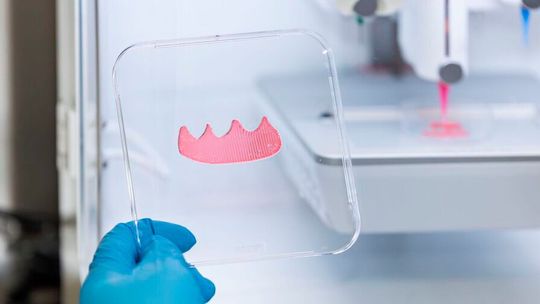
The 3D bioprinted gingival tissue graft (on the transparent slide) is created using a specialized bio-ink that supports healthy cell growth while preserving structural integrity for personalized dental treatments.
(Source: NUS)
Queenstown/Singapore – A team of researchers from the National University of Singapore (NUS) has developed a method to fabricate personalized gingival (gum) tissue grafts using an innovative combination of 3D bioprinting and artificial intelligence (AI).
Led by Assistant Professor Gopu Sriram from NUS Faculty of Dentistry, the team’s approach presents a more customizable and less invasive alternative to traditional grafting methods, which often involve harvesting tissue from the patient’s mouth — a process that can be both uncomfortable and constrained by the availability of suitable tissue.
The 3D bioprinting and AI-enabled technique has the potential to address key challenges in dental procedures more effectively, such as repairing gum defects caused by periodontal disease or complications from dental implants. For instance, by enabling the precise fabrication of tissue constructs tailored to individual patients, the method can significantly improve treatment outcomes, reduce patient discomfort, and minimize the risk of complications, such as infections, during recovery.
The team’s research was published in the journal Advanced Healthcare Materials on 17 December 2024, and was supported by grants from National Additive Manufacturing Innovation Cluster (Namic) and National University Health System (NUHS).
Turbocharging the bioprinting process with AI
Gum tissue grafts are essential in dental care, particularly for addressing mucogingival defects such as gum recession, and complications arising from periodontal disease or dental implants. Typically, these grafts are harvested from the patient’s mouth. Though effective, these procedures come with significant drawbacks: patient discomfort, limited tissue availability, and a higher risk of postoperative complications.
To overcome these challenges, the researchers turned to 3D bioprinting, a technique that fabricates custom-made tissue grafts tailored to the specific dimensions of each patient’s defect. They developed a specialized bio-ink which supports the growth of healthy cells, while also ensuring the material can be printed accurately and holds its shape and structure.
However, the viability of 3D bioprinting is only as good as the parameters applied during the process. Factors such as extrusion pressure, print speed, nozzle dimensions, bio-ink viscosity and printhead temperature all play a crucial role in determining the final properties and performance of the printed component. Tuning these parameters has traditionally been done through tedious, manual trial-and-error experiments that are extremely time- and resource-consuming.
“To speed up the 3D bioprinting process, we integrated AI into our workflow to address this critical bottleneck,” said Professor Dean Ho, Head of the Department of Biomedical Engineering in the College of Design and Engineering at NUS, and co-corresponding author of the research paper. “This approach greatly streamlines the process by reducing the number of experiments needed to optimize the bioprinting parameters — from potentially thousands to just 25 combinations,” added Prof Ho, who is also Director of the Institute for Digital Medicine (Wisdm) at NUS Yong Loo Lin School of Medicine, and N.1 Institute for Health (N.1) at NUS.
This tremendous efficiency boost afforded by the team’s AI-driven workflow saves time and resources while ensuring the creation of tissue constructs with precise dimensions and structural integrity.
“Our study is among the first to specifically integrate 3D bioprinting and AI technologies for the biofabrication of customized oral soft tissue constructs,” said Asst Prof Sriram, who is also the Thrust Co-Lead of Dental and Craniofacial 3DP Applications at NUS Centre for Additive Manufacturing (AM.NUS). “3D bioprinting is by far more challenging than conventional 3D printing because it involves living cells, which introduce a host of complexities to the printing process.”
The bioprinted gum tissue grafts exhibited strong biomimetic properties, maintaining over 90 % cell viability immediately after printing and throughout an 18-day culture period. The grafts also retained their shape and structural integrity, while histological analyses confirmed the presence of key proteins and a multi-layered structure closely resembling natural gum tissue.
Date: 08.12.2025
Naturally, we always handle your personal data responsibly. Any personal data we receive from you is processed in accordance with applicable data protection legislation. For detailed information please see our privacy policy.
Consent to the use of data for promotional purposes
I hereby consent to Vogel Communications Group GmbH & Co. KG, Max-Planck-Str. 7-9, 97082 Würzburg including any affiliated companies according to §§ 15 et seq. AktG (hereafter: Vogel Communications Group) using my e-mail address to send editorial newsletters. A list of all affiliated companies can be found here
Newsletter content may include all products and services of any companies mentioned above, including for example specialist journals and books, events and fairs as well as event-related products and services, print and digital media offers and services such as additional (editorial) newsletters, raffles, lead campaigns, market research both online and offline, specialist webportals and e-learning offers. In case my personal telephone number has also been collected, it may be used for offers of aforementioned products, for services of the companies mentioned above, and market research purposes.
Additionally, my consent also includes the processing of my email address and telephone number for data matching for marketing purposes with select advertising partners such as LinkedIn, Google, and Meta. For this, Vogel Communications Group may transmit said data in hashed form to the advertising partners who then use said data to determine whether I am also a member of the mentioned advertising partner portals. Vogel Communications Group uses this feature for the purposes of re-targeting (up-selling, cross-selling, and customer loyalty), generating so-called look-alike audiences for acquisition of new customers, and as basis for exclusion for on-going advertising campaigns. Further information can be found in section “data matching for marketing purposes”.
In case I access protected data on Internet portals of Vogel Communications Group including any affiliated companies according to §§ 15 et seq. AktG, I need to provide further data in order to register for the access to such content. In return for this free access to editorial content, my data may be used in accordance with this consent for the purposes stated here. This does not apply to data matching for marketing purposes.
Right of revocation
I understand that I can revoke my consent at will. My revocation does not change the lawfulness of data processing that was conducted based on my consent leading up to my revocation. One option to declare my revocation is to use the contact form found at https://contact.vogel.de. In case I no longer wish to receive certain newsletters, I have subscribed to, I can also click on the unsubscribe link included at the end of a newsletter. Further information regarding my right of revocation and the implementation of it as well as the consequences of my revocation can be found in the data protection declaration, section editorial newsletter.
The future of dental care
In dentistry, the ability to produce personalized gum tissue grafts with improved efficiency, structural integrity, and biomimetic properties could address longstanding clinical challenges associated with periodontal diseases and dental implants. “This research demonstrates how AI and 3D bioprinting can converge to solve complex medical problems through precision medicine,” added Asst Prof Sriram. “By optimizing tissue grafts for individual patients, we can reduce the invasiveness of dental procedures while ensuring better healing and recovery.”
Excitingly, the potential implications of this research extend beyond dentistry. “3D bioprinting allows us to create tissue grafts that precisely match the dimensions of a patient’s wounds, potentially reducing or eliminating the need to harvest tissue from the patient’s body,” said Asst Prof Sriram.
“This level of customization minimizes graft distortion and tension during wound closure, reducing the risk of complications, surgery time and discomfort to the patients,” said Dr Jacob Chew, a periodontist, co-investigator of the study, and Academic Fellow at NUS Faculty of Dentistry.
Furthermore, the scarless healing characteristics of oral tissue provide a unique advantage, as insights from this study could inform the fabrication of similar grafts for other barrier tissues, such as skin, potentially aiding in the scarless healing of skin wounds.
Future research will focus on translating these findings from bench to bedside. The team plans to conduct in vivo studies to assess the integration and stability of the grafts in oral environments. They also aim to explore the integration of blood vessels into the grafts through multi-material bioprinting to create more complex and functional constructs. With these developments, the researchers hope to advance the field of regenerative dentistry while paving the way for broader applications in tissue engineering.




:quality(80)/p7i.vogel.de/wcms/fd/73/fd73fcb3ceda89d1419de1083fcab7b4/0130081520v2.jpeg "The fingers at the heart of this technology were inspired by the fin-ray effect — a design principle derived from the natural structure of fish fins. (Source: University of Texas at Austin )")
:quality(80)/p7i.vogel.de/wcms/fe/64/fe649767c802d53ac63ee2c2a40b7e0d/0130060830v2.jpeg "Sample tube with light-active substance (Source: Elvira Eberhardt / Ulm University)")
:quality(80)/p7i.vogel.de/wcms/db/e2/dbe2ae4e02f702b30153a882ef705089/0129978032v1.jpeg "Each of the isolated indium atoms (in gold color) can catalyse the synthesis of methanol (top right). (Source: Constance Ko/ ETH Zurich)")
:quality(80)/p7i.vogel.de/wcms/c1/e6/c1e6ac26eb18993236c100e7f01a78f2/0129937639v1.jpeg "Dogs evolved from highly social ancestors and have been shaped by thousands of years of interacting with humans. (Source: free licensed)")
:quality(80)/p7i.vogel.de/wcms/8f/b9/8fb98a958e4afe679865fbe52a473680/0129940982v2.jpeg "pH measurement in various nanoparticles using the Nine-Focus meter ensures precise stability and performance control. (Source: Mettler Toledo)")
:quality(80)/p7i.vogel.de/wcms/11/74/1174e5d4c8b07a64637dced8c9506b40/0129787561v2.jpeg "The Multicell Plus high-pressure reactor sets a new benchmark for operator safety, all-round accessibility and ease-of-use. (Source: Asynt)")
:quality(80)/p7i.vogel.de/wcms/ef/6e/ef6e96191183411973b77041fb6b1e16/0129785957v2.jpeg "Manufactured from high-quality crystal polystyrene - these new automation-ready plates are available in a choice of ANSI / SLAS standard (96-well and breakable 8-well strip) formats. (Source: Porvair Sciences)")
:quality(80)/p7i.vogel.de/wcms/ad/ca/adcaa20ef5ccaf7e3b325788b1e349c4/0129784872v2.jpeg "The high performance Degasi Flat Film in-line degasser. (Source: Biotech Fluidics)")
:quality(80)/p7i.vogel.de/wcms/2d/45/2d45aba62f5042baa00f7fd4fa629839/0130036533v2.jpeg "The population of Pune, India, is expected to reach 11 million by 2050. (Source: free licensed)")
:quality(80)/p7i.vogel.de/wcms/52/f8/52f8d5521fdab07ed0a865ec0d8919fd/0130009438v2.jpeg "Drylands support around half of global livestock production and sustain the livelihoods of close to a billion people, while also underpinning soil stability and carbon storage. (Source: Kaust )")
:quality(80)/p7i.vogel.de/wcms/fe/49/fe494ada322615b6e6f6ff0f5bb7c5cf/0129926008v2.jpeg "A mandrill eating fruit. (Source: University of Bristol )")
:quality(80)/p7i.vogel.de/wcms/af/4e/af4ea968647ee9cae82b39800c611819/0129865630v2.jpeg "Map of a simulated risk of water stress in 2050 where hydrogen is used in transport and industry. Baseline risk (regardless of hydrogen use) is represented by the background color in each area. Dashed areas show water use exceeding available resources due to hydrogen production. Blue dots show areas where the risk of water stress increases by more than 50 percent in the simulation. (Source: Chalmers University of Technology / Joel Löfving)")
:quality(80)/p7i.vogel.de/wcms/6f/ba/6fba92196d0cbb1467334f8a2ecc520a/0130203021v2.jpeg "Low to moderate wine consumption shows lower risk compared with spirits, beer and cider (Source: free licensed)")
:quality(80)/p7i.vogel.de/wcms/a9/37/a9376f1d9a893570023d9aa97c085bc5/0129927485v2.jpeg "Examples of foods high in PUFAs include fatty fish and soybeans, while MUFAs include olive oil and avocadoes. (Source: free licensed)")
:quality(80)/p7i.vogel.de/wcms/ea/88/ea88ef8810e21cdd9bb852c70f385ba1/0129797385v2.jpeg "A team of NUS food scientists consisting of Assoc Prof Liu Shao Quan (centre), Dr Lu Yuyun (right) and Ms Geng Chenhan (left) pioneered a co-fermentation method that improves both the nutrient and flavor profile of kombu. (Source: NUS)")
:quality(80)/p7i.vogel.de/wcms/84/2c/842c7c1678ceeec7147ea3a36e238e75/0129356324v2.jpeg "Kaust and Nadec have signed a MOU that establishes a framework for long-term cooperation across agricultural research, technology development, and professional training. (Source: Kaust )")
:quality(80)/p7i.vogel.de/wcms/ed/c0/edc0c1a86229b11efd17c5e3f94d14da/0130081211v2.jpeg "A new study finds that virtual visits did not make it easier for psychiatrists, psychologists and therapists to reach significantly more people in areas where access to care has long been limited. (Source: Pixabay)")
:quality(80)/p7i.vogel.de/wcms/9c/52/9c52318bc94be17e6662dfceffa4a0c0/0130060546v2.jpeg "Domestic cat ‘Lanni’ from co-author of the study, Latasha Ludwig, Assistant Clinical Professor at Cornell University, USA. (Source: © Latasha Ludwig)")
:quality(80)/p7i.vogel.de/wcms/4b/f4/4bf4cc9e28e65e11a27dd41da2d1a7f5/0130038185v2.jpeg "The biomarker p-tau217 could help identify women at elevated dementia risk decades before clinical symptoms begin. (Source: free licensed)")
:quality(80)/p7i.vogel.de/wcms/4f/29/4f292f402b157e2ab8c57e9f2a3e3199/0130036120v2.jpeg "The chemistry is powered by an LED lamp that triggers a self-sustaining chain reaction, forging new carbon–carbon bonds under mild conditions without toxic or expensive chemicals. (Source: Nordin Ćatić/ St John’s College, Cambridge)")
:quality(80)/images.vogel.de/vogelonline/bdb/1710600/1710675/original.jpg "Discover how to set yourself up for success when performing balance-based density determination of solids such as jewelry and precious metals. (Mettler Toledo)")
:quality(80)/images.vogel.de/vogelonline/bdb/1682500/1682579/original.jpg "The new XPR Analytical balance redesigned to meet the needs of laboratory technicians of working fast and lean. (Mettler Toledo)")
:quality(80)/images.vogel.de/vogelonline/bdb/1677000/1677080/original.jpg "Enhance your weighing accuracy, comfort and productivity with the redesigned XPR Analytical balance. (Mettler Toledo)")
:quality(80)/p7i.vogel.de/wcms/7c/62/7c6248fd173656b269aa62c06d6a0c61/0123895457v2.jpeg "The microneedles were fabricated from poly lactic-co-glycolic acid (PLGA), an FDA-approved class of biodegradable polymers that are biocompatible and can be used in the sustained delivery of drugs and other molecules. The sponge-like PLGA microneedles, made using the moulds shown above, can help to alleviate inflammatory skin disorders. (Source: NUS)")
:quality(80)/p7i.vogel.de/wcms/15/d1/15d1ab97d1834050b8d828a4c0f9dabf/0124014294v2.jpeg "Tiny pacemaker on a fingertip, between a sesame seed and single grain of rice for scale. (Source: John A. Rogers/Northwestern University)")