Researchers have developed millimetre-scale robotic tools powered by magnetic fields that could enable keyhole brain surgery. Demonstrated in lab models, the tools show promising precision and control. offering a glimpse into the future of minimally invasive neurosurgery.
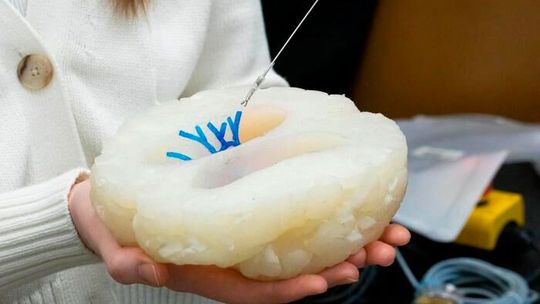
This miniature device, shown next to a model brain, is known as the twisted string actuated forceps. It can grip and pull tissue, and is controlled entirely by external magnetic fields.
(Source: University of Toronto Engineering / Tyler Irving)
A University of Toronto Engineering team has collaborated with researchers in the Wilfred and Joyce Posluns Centre for Image Guided Innovation and Therapeutic Intervention at The Hospital for Sick Children (Sick Kids) to create a set of tiny robotic tools that could enable ‘keyhole surgery’ in the brain. In a paper published in Science Robotics, the team demonstrated the ability of these tools — only about 3 millimetres in diameter — to grip, pull and cut tissue. Their extremely small size is made possible by the fact that they are powered not by motors but by external magnetic fields.
“In the past couple of decades, there has been this huge explosion of robotic tools that enable minimally invasive surgery, which can improve recovery times and outcomes for patients,” says Professor Eric Diller. “We can now replicate the wrist and hand movements of a surgeon on a centimetre scale, and these tools are widely used in surgeries that take place in the torso. But when it comes to neurosurgery, we are working with an even more restrictive space.”
Gallery
Current robotic surgical tools are typically driven by cables connected to electric motors, in much the same way that human fingers are manipulated by tendons in the hand that are connected to muscles in the wrist.
But Diller says that at smaller length scales, the cable-based approach starts to break down. “The smaller you get, the harder you have to pull on the cables,” he says. “And at a certain point, you start to get problems with friction that lead to less reliable operation.” Diller and his collaborators have been working for several years on an alternative approach. Instead of cables and pulleys, their robotic tools contain magnetically active materials that respond to external electromagnetic fields controlled by the surgical team.
The system consists of two parts. The first is the tiny tools themselves: a gripper, a scalpel and a set of forceps. The second part is what the team calls a coil table, which is a surgical table with several electromagnetic coils embedded inside.In this design, the patient would be positioned with their head on top of the embedded coils, and the robotic tools would be inserted into the brain by means of a small incision.
By altering the amount of electricity flowing into the coils, the team can manipulate the magnetic fields, causing the tools to grip, pull or cut tissue as desired. To test the tools, Diller and his team partnered with physicians and researchers at Sick Kids, including Doctors James Drake and Thomas Looi. Together, they designed and built a phantom brain — a life-sized model made of silicone rubber that simulates the geometry of a real brain. The team then used small pieces of tofu and bits of raspberries to simulate the mechanical properties of the brain tissue they would need to work with.
“The tofu is best for simulating cuts with the scalpel, because it has a consistency very similar to that of the corpus collosum, which is the part of the brain we were targeting,” says Changyan He, a former postdoctoral fellow co-supervised by both Drake and Diller, now an assistant professor at the University of Newcastle in New South Wales, Australia. “The raspberries were used for the gripping tasks, to see if we could remove them in the way that a surgeon would remove diseased tissue.” The performance of these magnetically-actuated tools was compared with that of standard tools handled by trained physicians.
In the paper, the team reports that the cuts made with the magnetic scalpel were consistent and narrow, with an average width of 0.3 to 0.4 millimetres. That was even more precise than those from the traditional hand tools, which ranged from 0.6 to 2.1 millimetres. As for the grippers, they were able to successfully pick up the target 76 % of the time.
The team also tested the operation of the tools in animal models, where they found that they performed similarly well. “I think we were all a bit surprised at just how well they performed,” says he. “Our previous work was in very controlled environments, so we thought it might take a year or more of experimentation to get them to the point where they were comparable to human-operated tools.” Despite the team’s success so far, Diller cautions that it may still be a long time before these tools see the inside of an operating room.
Date: 08.12.2025
Naturally, we always handle your personal data responsibly. Any personal data we receive from you is processed in accordance with applicable data protection legislation. For detailed information please see our privacy policy.
Consent to the use of data for promotional purposes
I hereby consent to Vogel Communications Group GmbH & Co. KG, Max-Planck-Str. 7-9, 97082 Würzburg including any affiliated companies according to §§ 15 et seq. AktG (hereafter: Vogel Communications Group) using my e-mail address to send editorial newsletters. A list of all affiliated companies can be found here
Newsletter content may include all products and services of any companies mentioned above, including for example specialist journals and books, events and fairs as well as event-related products and services, print and digital media offers and services such as additional (editorial) newsletters, raffles, lead campaigns, market research both online and offline, specialist webportals and e-learning offers. In case my personal telephone number has also been collected, it may be used for offers of aforementioned products, for services of the companies mentioned above, and market research purposes.
Additionally, my consent also includes the processing of my email address and telephone number for data matching for marketing purposes with select advertising partners such as LinkedIn, Google, and Meta. For this, Vogel Communications Group may transmit said data in hashed form to the advertising partners who then use said data to determine whether I am also a member of the mentioned advertising partner portals. Vogel Communications Group uses this feature for the purposes of re-targeting (up-selling, cross-selling, and customer loyalty), generating so-called look-alike audiences for acquisition of new customers, and as basis for exclusion for on-going advertising campaigns. Further information can be found in section “data matching for marketing purposes”.
In case I access protected data on Internet portals of Vogel Communications Group including any affiliated companies according to §§ 15 et seq. AktG, I need to provide further data in order to register for the access to such content. In return for this free access to editorial content, my data may be used in accordance with this consent for the purposes stated here. This does not apply to data matching for marketing purposes.
Right of revocation
I understand that I can revoke my consent at will. My revocation does not change the lawfulness of data processing that was conducted based on my consent leading up to my revocation. One option to declare my revocation is to use the contact form found at https://contact.vogel.de. In case I no longer wish to receive certain newsletters, I have subscribed to, I can also click on the unsubscribe link included at the end of a newsletter. Further information regarding my right of revocation and the implementation of it as well as the consequences of my revocation can be found in the data protection declaration, section editorial newsletter.
“The technology development timeline for medical devices — especially surgical robots — can be years to decades,” he says. “There’s a lot we still need to figure out. We want to make sure we can fit our field generation system comfortably into the operating room, and make it compatible with imaging systems like fluoroscopy, which makes use of X-rays.”
Still, the team is excited about the potential of the technology. “This really is a wild idea,” says Diller. “It’s a radically different approach to how to how to make and drive these kinds of tools, but it’s also one that can lead to capabilities that are far beyond what we can do today.”
Original Article: Magnetically actuated dexterous tools for minimally invasive operation inside the brain; Science Robotics; DOI:10.1126/scirobotics.adk42




:quality(80)/p7i.vogel.de/wcms/92/ad/92adbafb37924cea35ea3cf05b7a23e5/0130206318v2.jpeg "The world’s first fully functioning proof-of-concept quantum battery
(Source: Csiro)")
:quality(80)/p7i.vogel.de/wcms/9f/8b/9f8bc2b8491d7a514ca154e9588a07b7/0130205846v1.jpeg "The researchers’ new material, based on mineralised sawdust, is an excellent fire retardant. (Source: Dan Vivas Glaser / from Kürsteiner R et al. Chem Circularity 2026)")
:quality(80)/p7i.vogel.de/wcms/fd/73/fd73fcb3ceda89d1419de1083fcab7b4/0130081520v2.jpeg "The fingers at the heart of this technology were inspired by the fin-ray effect — a design principle derived from the natural structure of fish fins. (Source: University of Texas at Austin )")
:quality(80)/p7i.vogel.de/wcms/fe/64/fe649767c802d53ac63ee2c2a40b7e0d/0130060830v2.jpeg "Sample tube with light-active substance (Source: Elvira Eberhardt / Ulm University)")
:quality(80)/p7i.vogel.de/wcms/8f/b9/8fb98a958e4afe679865fbe52a473680/0129940982v2.jpeg "pH measurement in various nanoparticles using the Nine-Focus meter ensures precise stability and performance control. (Source: Mettler Toledo)")
:quality(80)/p7i.vogel.de/wcms/11/74/1174e5d4c8b07a64637dced8c9506b40/0129787561v2.jpeg "The Multicell Plus high-pressure reactor sets a new benchmark for operator safety, all-round accessibility and ease-of-use. (Source: Asynt)")
:quality(80)/p7i.vogel.de/wcms/ef/6e/ef6e96191183411973b77041fb6b1e16/0129785957v2.jpeg "Manufactured from high-quality crystal polystyrene - these new automation-ready plates are available in a choice of ANSI / SLAS standard (96-well and breakable 8-well strip) formats. (Source: Porvair Sciences)")
:quality(80)/p7i.vogel.de/wcms/ad/ca/adcaa20ef5ccaf7e3b325788b1e349c4/0129784872v2.jpeg "The high performance Degasi Flat Film in-line degasser. (Source: Biotech Fluidics)")
:quality(80)/p7i.vogel.de/wcms/af/40/af40b535eb65c287fbd22ed5483d1d0e/0130206243v2.jpeg "The researchers dug soil pits in order to measure the carbon storage in soil
(Source: Johanna Asch)")
:quality(80)/p7i.vogel.de/wcms/2d/45/2d45aba62f5042baa00f7fd4fa629839/0130036533v2.jpeg "The population of Pune, India, is expected to reach 11 million by 2050. (Source: free licensed)")
:quality(80)/p7i.vogel.de/wcms/52/f8/52f8d5521fdab07ed0a865ec0d8919fd/0130009438v2.jpeg "Drylands support around half of global livestock production and sustain the livelihoods of close to a billion people, while also underpinning soil stability and carbon storage. (Source: Kaust )")
:quality(80)/p7i.vogel.de/wcms/fe/49/fe494ada322615b6e6f6ff0f5bb7c5cf/0129926008v2.jpeg "A mandrill eating fruit. (Source: University of Bristol )")
:quality(80)/p7i.vogel.de/wcms/6f/ba/6fba92196d0cbb1467334f8a2ecc520a/0130203021v2.jpeg "Low to moderate wine consumption shows lower risk compared with spirits, beer and cider (Source: free licensed)")
:quality(80)/p7i.vogel.de/wcms/a9/37/a9376f1d9a893570023d9aa97c085bc5/0129927485v2.jpeg "Examples of foods high in PUFAs include fatty fish and soybeans, while MUFAs include olive oil and avocadoes. (Source: free licensed)")
:quality(80)/p7i.vogel.de/wcms/ea/88/ea88ef8810e21cdd9bb852c70f385ba1/0129797385v2.jpeg "A team of NUS food scientists consisting of Assoc Prof Liu Shao Quan (centre), Dr Lu Yuyun (right) and Ms Geng Chenhan (left) pioneered a co-fermentation method that improves both the nutrient and flavor profile of kombu. (Source: NUS)")
:quality(80)/p7i.vogel.de/wcms/84/2c/842c7c1678ceeec7147ea3a36e238e75/0129356324v2.jpeg "Kaust and Nadec have signed a MOU that establishes a framework for long-term cooperation across agricultural research, technology development, and professional training. (Source: Kaust )")
:quality(80)/p7i.vogel.de/wcms/e9/73/e9732473361377610267347df55071a1/0130205830v2.jpeg "Sleep EEG signals may reveal whether the brain is aging faster than the body — and help identify elevated dementia risk earlier. (Source: free licensed)")
:quality(80)/p7i.vogel.de/wcms/ed/c0/edc0c1a86229b11efd17c5e3f94d14da/0130081211v2.jpeg "A new study finds that virtual visits did not make it easier for psychiatrists, psychologists and therapists to reach significantly more people in areas where access to care has long been limited. (Source: Pixabay)")
:quality(80)/p7i.vogel.de/wcms/9c/52/9c52318bc94be17e6662dfceffa4a0c0/0130060546v2.jpeg "Domestic cat ‘Lanni’ from co-author of the study, Latasha Ludwig, Assistant Clinical Professor at Cornell University, USA. (Source: © Latasha Ludwig)")
:quality(80)/p7i.vogel.de/wcms/4b/f4/4bf4cc9e28e65e11a27dd41da2d1a7f5/0130038185v2.jpeg "The biomarker p-tau217 could help identify women at elevated dementia risk decades before clinical symptoms begin. (Source: free licensed)")
:quality(80)/images.vogel.de/vogelonline/bdb/1710600/1710675/original.jpg "Discover how to set yourself up for success when performing balance-based density determination of solids such as jewelry and precious metals. (Mettler Toledo)")
:quality(80)/images.vogel.de/vogelonline/bdb/1682500/1682579/original.jpg "The new XPR Analytical balance redesigned to meet the needs of laboratory technicians of working fast and lean. (Mettler Toledo)")
:quality(80)/images.vogel.de/vogelonline/bdb/1677000/1677080/original.jpg "Enhance your weighing accuracy, comfort and productivity with the redesigned XPR Analytical balance. (Mettler Toledo)")
:quality(80)/p7i.vogel.de/wcms/c5/c8/c5c827f118e8bdfd39c01c251e8b93a0/0123895465v1.jpeg "Extreme close-up of the magnetically controlled gripping and pulling tool known as the twisted string actuated forceps, which measures about 3.2 mm in diameter. (Source: University of Toronto Engineering / Tyler Irving)")
:quality(80)/p7i.vogel.de/wcms/0a/bc/0abc7da99250eca369f3e14e0087fa2a/0123895467v1.jpeg "University of Toronto Engineering researchers Erik Fredin, Anastasia Aubeeluck, Haley Mayer and Professor Eric Diller are some of the members of the team that designed a new set of tiny robotic tools for minimally invasive brain surgery.(Source: University of Toronto Engineering / Tyler Irving)")
:quality(80)/p7i.vogel.de/wcms/3f/04/3f0459aa2b7e5c84b36ba906812cbfce/0123895466v1.jpeg "This miniature device, shown next to a model brain, is known as the twisted string actuated forceps. It can grip and pull tissue, and is controlled entirely by external magnetic fields. (Source: University of Toronto Engineering / Tyler Irving)")
:quality(80)/p7i.vogel.de/wcms/48/08/4808d9d236bc4a5ed87ae073e898c798/0118748317v2.jpeg "A model image of the targeted deep brain zone, the striatum, a key player in reward and reinforcement mechanisms. (Source: EPFL)")
:quality(80)/p7i.vogel.de/wcms/15/d1/15d1ab97d1834050b8d828a4c0f9dabf/0124014294v2.jpeg "Tiny pacemaker on a fingertip, between a sesame seed and single grain of rice for scale. (Source: John A. Rogers/Northwestern University)")
:quality(80)/p7i.vogel.de/wcms/e4/a4/e4a4c0052425933c3e3dff66a6084554/0123895785v2.jpeg "With full freedom of motion, new device can generate a variety of sensations, including pulling, stretching, sliding, vibrations, pressure and twisting. (Source: John A. Rogers/ Northwestern University)")