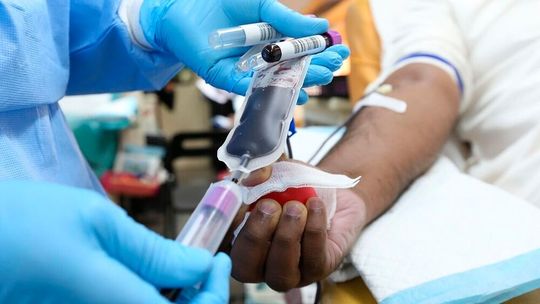
A large-scale study from the University of Colorado Anschutz Medical Campus reveals that caffeine consumption before blood donation may impair red blood cell quality and reduce transfusion effectiveness. The findings highlight the role of genetics and open the door to more personalized donor guidelines.
A new study from the University of Colorado Anschutz Medical Campus shows that caffeine consumption before blood donation may reduce the effectiveness of transfusions.
A new study from the University of Colorado Anschutz Medical Campus has found that caffeine, the world’s most consumed psychoactive substances, may impair the quality of donated blood and reduce the effectiveness of transfusions — especially in recipients whose red blood cell (RBC) metabolism is influenced by a common genetic variant.
“We’ve long understood caffeine’s effects on the brain and central nervous system, but this is the first large-scale study to demonstrate its impact on RBC biology,” said Angelo D’Alessandro, PhD, professor of biochemistry at the University of Colorado School of Medicine and study senior author. “These findings suggest that something as common as your morning cup of coffee could have important implications for the quality of stored blood and how well it works when transfused into patients.”
Published today in Haematologica by researchers involved in the REDS RBC-Omics study, which analyzed samples from over 13,000 blood donors, the study reveals that higher levels of caffeine in the blood are linked to RBCs that are more prone to damage during storage and less effective after transfusion. In a clinical setting, transfusions of RBCs with relatively high levels of caffeine resulted in lower increases in patients’ hemoglobin levels and greater signs of RBC breakdown (hemolysis).
These negative effects were especially pronounced in transfusion recipients and blood donors carrying common variants in the ADORA2b gene, which regulates how RBCs function under low-oxygen conditions. The findings open the door to a new, more individualized approach to blood transfusion that takes into account not just blood type, but lifestyle factors and genetic traits that influence red blood cell quality.
“The translational implications of our findings are significant,” said D’Alessandro.“First, donor caffeine consumption, a common dietary exposure for up to 75% of Americans, emerges as a modifiable behavioral factor potentially influencing RBC storage quality and transfusion outcomes.
“Given caffeine's short biological half-life, transient dietary modifications around the time of blood donation might mitigate its negative impact, aligning with blood donation guidelines in several European countries where donors are advised to limit caffeine intake prior to donation. Conversely, in other regions, such as the United States or Italy, caffeine consumption before blood donation is not actively discouraged and may even be implicitly encouraged due to its known beneficial acute effects on blood pressure, potentially expediting the donation process and reducing vasovagal reactions.
“Indeed, moderate caffeine intake can transiently increase donor blood pressure and vascular tone, facilitating venous access and blood withdrawal efficiency. However, this advantage must be balanced against caffeine’s mild diuretic properties, which may predispose donors to dehydration — an established risk-factor for adverse donation-related events and poorer blood flow during collection.”
This study may also help explain the well-documented performance-enhancing effects of caffeine in exercise and sports. Caffeine increases oxidative stress in red blood cells by two distinct mechanisms: it blocks activation of the ADORA2B receptor and inhibits glucose-6-phosphate dehydrogenase (G6PD), a rate-limiting enzyme in the antioxidant pentose phosphate pathway. Both actions can elevate oxidative stress, which —paradoxically — may promote physiological adaptation. Exercise itself triggers the production of reactive oxygen species, and a controlled increase in oxidative stress is thought to drive beneficial training responses.
“Interestingly, we recently discovered that mice with G6PD deficiency showed improved exercise tolerance,” said Travis Nemkov, PhD, co-author and associate professor of biochemistry. “These findings illustrate how insights from transfusion medicine can inform our understanding of exercise physiology and broader aspects of human health.”
Original Article: Caffeine impairs red blood cell storage quality by dual inhibition of ADORA2b signaling and G6PD activity; Haematologica; DOI:10.3324/haematol.2025.288332
Date: 08.12.2025
Naturally, we always handle your personal data responsibly. Any personal data we receive from you is processed in accordance with applicable data protection legislation. For detailed information please see our privacy policy.
Consent to the use of data for promotional purposes
I hereby consent to Vogel Communications Group GmbH & Co. KG, Max-Planck-Str. 7-9, 97082 Würzburg including any affiliated companies according to §§ 15 et seq. AktG (hereafter: Vogel Communications Group) using my e-mail address to send editorial newsletters. A list of all affiliated companies can be found here
Newsletter content may include all products and services of any companies mentioned above, including for example specialist journals and books, events and fairs as well as event-related products and services, print and digital media offers and services such as additional (editorial) newsletters, raffles, lead campaigns, market research both online and offline, specialist webportals and e-learning offers. In case my personal telephone number has also been collected, it may be used for offers of aforementioned products, for services of the companies mentioned above, and market research purposes.
Additionally, my consent also includes the processing of my email address and telephone number for data matching for marketing purposes with select advertising partners such as LinkedIn, Google, and Meta. For this, Vogel Communications Group may transmit said data in hashed form to the advertising partners who then use said data to determine whether I am also a member of the mentioned advertising partner portals. Vogel Communications Group uses this feature for the purposes of re-targeting (up-selling, cross-selling, and customer loyalty), generating so-called look-alike audiences for acquisition of new customers, and as basis for exclusion for on-going advertising campaigns. Further information can be found in section “data matching for marketing purposes”.
In case I access protected data on Internet portals of Vogel Communications Group including any affiliated companies according to §§ 15 et seq. AktG, I need to provide further data in order to register for the access to such content. In return for this free access to editorial content, my data may be used in accordance with this consent for the purposes stated here. This does not apply to data matching for marketing purposes.
Right of revocation
I understand that I can revoke my consent at will. My revocation does not change the lawfulness of data processing that was conducted based on my consent leading up to my revocation. One option to declare my revocation is to use the contact form found at https://contact.vogel.de. In case I no longer wish to receive certain newsletters, I have subscribed to, I can also click on the unsubscribe link included at the end of a newsletter. Further information regarding my right of revocation and the implementation of it as well as the consequences of my revocation can be found in the data protection declaration, section editorial newsletter.




:quality(80)/p7i.vogel.de/wcms/65/88/658810e8f70ddd88a4dc014f211630a6/0132611511v2.jpeg "In regulated cleanrooms, control is important, but being able to demonstrate control is equally important. (Source: Vaisala)")
:quality(80)/p7i.vogel.de/wcms/87/99/87991d857ac02b67176f4c88015a4d57/0132611186v2.jpeg "Supercritical fluid extraction is an area of growing interest and CO2 is the most common supercritical fluid used in SFE procedures as a replacement for traditional hexane use. (Source: Scimed)")
:quality(80)/p7i.vogel.de/wcms/7a/1c/7a1cac56bca0dde5268e4ede1c762741/0132539982v2.jpeg "The flexible material can be customized to act like different kinds of tissue. (Source: University of Texas at Austin)")
:quality(80)/p7i.vogel.de/wcms/ed/ff/edff58efa9930f672f2e50a63e65562f/0132477775v1.jpeg "Contemporary languages and endangerment status. Made with a Natural Earth base map using data from Glottolog 5.3 and information adapted from Glottoscope. (Source: Claire Bowern)")
:quality(80)/p7i.vogel.de/wcms/13/d3/13d35105f74a1c2e22b9c7a270e8e9b3/0132611155v2.jpeg "Circulating cell free DNA. (Source: Amsbio)")
:quality(80)/p7i.vogel.de/wcms/bc/ed/bced6850297a04dbea471a66cb6bb6fe/0132611405v2.jpeg "The latest addition to the range is a peristaltic tubing stop adapter that eliminates the need for fixed stoppers and allows custom cut lengths of peristaltic tubing to be installed on any pump head size. (Source: Biotech Fluidics )")
:quality(80)/p7i.vogel.de/wcms/c2/34/c234a6626d4f6360382ca7f1f440bebb/0132611196v2.jpeg "Testa Analytical's Trinity – a powerful new triple detector for Gel Permeation Chromatography / Size Exclusion Chromatography. (Source: Testa Analytical)")
:quality(80)/p7i.vogel.de/wcms/5b/3f/5b3fc0d5fb08c1f9727125bd926b1481/0132555049v1.jpeg "On 1 and 2 December 2026, the T3 – Transform The Tomorrow conference will explore strategies that help companies future-proof their operations. (Bild: © Vogel Corporate Solutions / AdobeStock 1280236166, Oksana)")
:quality(80)/p7i.vogel.de/wcms/06/1a/061a5d3a4e85383454d9450761a67de7/0132611653v2.jpeg "Shihong Lin, associate professor of civil and environmental engineering at Rice. (Source: Alex Becker/ Rice University)")
:quality(80)/p7i.vogel.de/wcms/c4/f5/c4f55f42fdf878aec3f850e5569b84ce/0132594173v2.jpeg "The latest research sheds some light on an issue that deserves more attention, that of climate-related suicide. (Source: Unsplash)")
:quality(80)/p7i.vogel.de/wcms/22/b8/22b8fa1a4146bc06c4c15d63992ebb88/0132589504v2.jpeg "Hepa filters are known to improve air quality and clean the air of microbes in laboratory settings, but this is the largest ‘real-world’ study to date to test if they reduce infections in care homes. (Source: Unsplash)")
:quality(80)/p7i.vogel.de/wcms/31/c1/31c1b666641702292624a4e8ca799a09/0132480890v1.jpeg "Decades of PFAS-laced sewage sludge, once spread on farms as fertilizer, have left millions of acres of American cropland contaminated with “forever chemicals”. (Source: frei lizenziert)")
:quality(80)/p7i.vogel.de/wcms/28/b6/28b6114fc9915c5dadee94d5c89bd129/0132593216v2.jpeg "Eating foods that contain common preservative food additives may increase the risks of high blood pressure and cardiovascular disease. (Source: Unsplash)")
:quality(80)/p7i.vogel.de/wcms/01/bc/01bcb16a3381a1d46533861eedbbae71/0132371290v1.jpeg "Adding spice may help people eat less by slowing them down. (Source: free licensed)")
:quality(80)/p7i.vogel.de/wcms/b3/16/b316ac585e067d024da89a5156c950a9/0132370983v1.jpeg "Laboratory tests suggest that some low-calorie sweeteners can alter the growth of gut bacteria, with particularly strong effects observed when isosteviol was combined with the antidepressant duloxetine. (Source: free licensed)")
:quality(80)/p7i.vogel.de/wcms/22/50/2250f9358ba65ad3c4de05ff5ea9f74e/0132117868v1.jpeg "Japanese researchers have developed a naturally bred yeast that produces nine times more ornithine while retaining normal brewing performance, opening a route to craft beer with added fermentation value. (Source: free licensed)")
:quality(80)/p7i.vogel.de/wcms/bb/f9/bbf9cc2b059213fd10c280304a51b143/0132611525v2.jpeg "Nanoact colored cellulose nanobeads were developed by Asahi Kasei by utilizing its core technology of cellulose processing. (Source: Asahi Kasei)")
:quality(80)/p7i.vogel.de/wcms/fc/90/fc9085d5ad403446c67cd4d586f4a0d6/0132611789v2.jpeg "Metastatic BAP1-deficient melanoma is the most common intraocular malignancy in adults, but it remains rare and extremely difficult to treat once it spreads. (Source: Turun yliopisto/University of Turku)")
:quality(80)/p7i.vogel.de/wcms/32/97/32977422ebe164ada6f807d16e410900/0132611708v2.jpeg "Ground sloths, which could reach the size of small elephants, originated in South America and spread into North America via the Panamanian land bridge. (Source: Natural History Museum of Los Angeles County)")
:quality(80)/p7i.vogel.de/wcms/96/6f/966f8a0a2b0c36f08622a4c5c3abb54f/0132611669v1.jpeg "A larkspur specimen in bloom at Beal Botanical Garden. Known for their toxicity, injurious plants such as larkspur and wolfsbane have been leveraged by humans for millennia for their medicinal potential. (Source: Finn Gomez/ Paul Henderson)")
:quality(80)/images.vogel.de/vogelonline/bdb/1710600/1710675/original.jpg "Discover how to set yourself up for success when performing balance-based density determination of solids such as jewelry and precious metals. (Mettler Toledo)")
:quality(80)/images.vogel.de/vogelonline/bdb/1682500/1682579/original.jpg "The new XPR Analytical balance redesigned to meet the needs of laboratory technicians of working fast and lean. (Mettler Toledo)")
:quality(80)/images.vogel.de/vogelonline/bdb/1677000/1677080/original.jpg "Enhance your weighing accuracy, comfort and productivity with the redesigned XPR Analytical balance. (Mettler Toledo)")
:fill(fff,0)/p7i.vogel.de/companies/69/b7/69b7f63f311d9/logo-bimos-tif--2-.jpeg "logo-bimos-tif--2- (https://www.bimos.com/de-de/)")
:quality(80)/p7i.vogel.de/wcms/33/b7/33b71955d001dd7b7f18db12db33c851/0126190920v2.jpeg "Coffee for a good mood — in a new study, regular caffeine consumers confirm its mood-lifting effect. (Source: free licensed)")
:quality(80)/p7i.vogel.de/wcms/1d/6e/1d6e818b1d9d344d6e210ba10c872ae7/0129957745v2.jpeg "The findings could help explain why people exposed to long-term traffic noise have higher rates of high blood pressure and heart disease. (Source: Pixabay)")
:quality(80)/p7i.vogel.de/wcms/b3/16/b316ac585e067d024da89a5156c950a9/0132370983v1.jpeg "Laboratory tests suggest that some low-calorie sweeteners can alter the growth of gut bacteria, with particularly strong effects observed when isosteviol was combined with the antidepressant duloxetine. (Source: free licensed)")