Vision ResearchBetter Focus Makes Augmented Reality Tasks Faster
Source:
Shibaura Institute of Technology
3 min Reading Time
Adjusting display focus to match virtual-object depth could make augmented reality interactions faster. Tests with a varifocal prototype improved 3D pointing performance without significantly changing error rates, although the benefits varied between users.
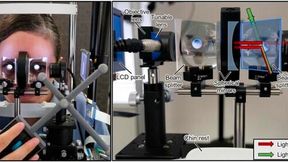
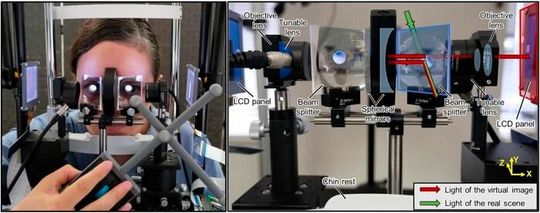
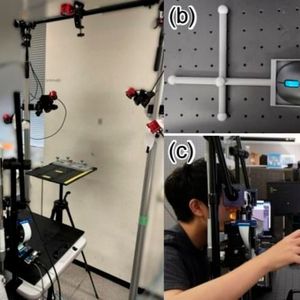
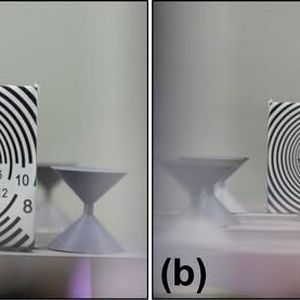
Researchers developed a custom varifocal AR display that combines real-scene light with virtual images reflected by a spherical mirror and beamsplitter. The system adjusts the focal plane to match virtual-object depth and was used to investigate 3D pointing performance under varifocal and fixed-focal viewing.
(Source: Xiaodan Hu/ SIT)
Most virtual reality (VR) and augmented reality (AR) displays present virtual objects at a fixed focal distance, creating a mismatch between where the eyes converge and where they focus. Researchers tested a varifocal display that adjusts focus to match virtual-object depth. In a 3D pointing task, it significantly improved average movement speed and information throughput without significantly affecting error rates. However, benefits varied among users, highlighting the potential for more personalized AR display designs.
Augmented reality (AR) overlays digital objects on the real world, while virtual reality (VR) immerses users in computer-generated environments. In both technologies, interaction with virtual objects at different depths can be challenging when displays do not reproduce how human eyes focus. Looking at different distances requires the eyes to converge on an object and adjust focus together. Most AR and VR headsets show images at a fixed focal distance, even when virtual objects appear at different depths. This mismatch, called the vergence-accommodation conflict (VAC), may affect comfort and interaction.
Gallery
Addressing this challenge, a collaborative international research project was led by Assistant Professor Xiaodan Hu from the Shibaura Institute of Technology, Japan, alongside a global team of experts from Japan, China, and Canada. The team members include Dr. Monica Perusquía-Hernández and Dr. Kiyoshi Kiyokawa from the Nara Institute of Science and Technology, Japan; Dr. Yan Zhang from Shanghai Jiaotong University, China; Dr. Mayra Donaji Barrera Machuca from the University of Calgary, Canada; Dr. Anil Ufuk Batmaz from Concordia University, Canada; and Dr. Wolfgang Stuerzlinger from Simon Fraser University, Canada. The collaboration brought together expertise in hardware development and user studies from the Asian team and interaction experiment design from the Canadian team. Their findings were published online on August 28, 2026, in the journal Virtual Reality.
The team tested whether a varifocal display, which adjusts focus to match an object’s depth, could improve 3D pointing. With a stereoscopic AR prototype, participants used a tracked wand to select virtual targets of different sizes and distances. Researchers compared fixed-focal and varifocal viewing during lateral movements and movements in depth. They measured movement time, error rate, and throughput, a measure of task efficiency. The first study involved 24 participants, followed by a second study with 12 additional participants to verify the hardware’s performance.
In the first study, varifocal viewing significantly reduced movement time and increased throughput. Error rates did not significantly change, indicating that faster performance did not come at the cost of accuracy. Benefits appeared greater for depth movements, although the difference by direction was only borderline significant for throughput.
“Our results show that adjusting focal distance can improve how people interact with virtual objects, beyond its effects on visual perception,” says Dr. Hu. “But users do not all benefit equally, making individual differences an important question for future research.” Varifocal displays could help AR and VR headsets provide more natural focusing cues when people interact with objects at different distances. However, this study did not test long-term eye health or establish that the technology prevents eyestrain. Participants’ ratings showed no clear preference between display modes, and discomfort was mild.
Overall, the findings indicate that reducing VAC with varifocal technology can improve 3D pointing performance, while highlighting the need to understand why responses vary. Differences in binocular vision or depth perception may contribute, but these factors were not measured. The prototype also had a limited field-of-view and did not use eye tracking to adjust focus, limiting its resemblance to everyday AR use. “Future studies can examine which user characteristics predict greater benefits and how displays might adapt to individual needs,” says Dr. Hu. This work offers a basis for evaluating personalized AR systems.
Date: 08.12.2025
Naturally, we always handle your personal data responsibly. Any personal data we receive from you is processed in accordance with applicable data protection legislation. For detailed information please see our privacy policy.
Consent to the use of data for promotional purposes
I hereby consent to Vogel Communications Group GmbH & Co. KG, Max-Planck-Str. 7-9, 97082 Würzburg including any affiliated companies according to §§ 15 et seq. AktG (hereafter: Vogel Communications Group) using my e-mail address to send editorial newsletters. A list of all affiliated companies can be found here
Newsletter content may include all products and services of any companies mentioned above, including for example specialist journals and books, events and fairs as well as event-related products and services, print and digital media offers and services such as additional (editorial) newsletters, raffles, lead campaigns, market research both online and offline, specialist webportals and e-learning offers. In case my personal telephone number has also been collected, it may be used for offers of aforementioned products, for services of the companies mentioned above, and market research purposes.
Additionally, my consent also includes the processing of my email address and telephone number for data matching for marketing purposes with select advertising partners such as LinkedIn, Google, and Meta. For this, Vogel Communications Group may transmit said data in hashed form to the advertising partners who then use said data to determine whether I am also a member of the mentioned advertising partner portals. Vogel Communications Group uses this feature for the purposes of re-targeting (up-selling, cross-selling, and customer loyalty), generating so-called look-alike audiences for acquisition of new customers, and as basis for exclusion for on-going advertising campaigns. Further information can be found in section “data matching for marketing purposes”.
In case I access protected data on Internet portals of Vogel Communications Group including any affiliated companies according to §§ 15 et seq. AktG, I need to provide further data in order to register for the access to such content. In return for this free access to editorial content, my data may be used in accordance with this consent for the purposes stated here. This does not apply to data matching for marketing purposes.
Right of revocation
I understand that I can revoke my consent at will. My revocation does not change the lawfulness of data processing that was conducted based on my consent leading up to my revocation. One option to declare my revocation is to use the contact form found at https://contact.vogel.de. In case I no longer wish to receive certain newsletters, I have subscribed to, I can also click on the unsubscribe link included at the end of a newsletter. Further information regarding my right of revocation and the implementation of it as well as the consequences of my revocation can be found in the data protection declaration, section editorial newsletter.
Original Article: Varifocal displays reduce the impact of the vergence-accommodation conflict on 3D pointing performance in augmented reality systems; Virtual Reality; DOI:10.1007/s10055-026-01473-5