Plants form symbiotic relationships with microbes in the soil to promote their growth. However, researchers from the University of California, Riverside, have discovered that competition between different strains of these bacteria can negatively affect their benefit to the host plant.
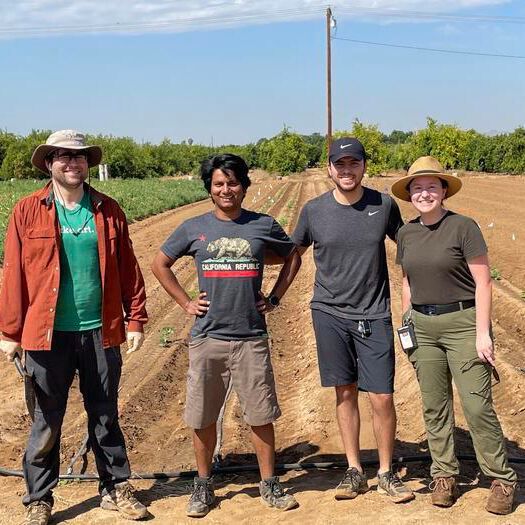
Co-authors Arafat Rahman (second from left) and Max Manci (right) are seen here in the field along with colleagues.
(Source: Sachs lab, UC Riverside)
Plants form alliances with microbes in the soil in which they grow. Legumes, for example, benefit from a symbiotic relationship with microbes that inhabit nodules in their roots and “fix” nitrogen in the atmosphere to make it available to promote the legumes’ growth. But are microbes always beneficial to plants? Or does competition between strains for plant access degrade the service the bacteria ultimately provide?
A team led by scientists at the University of California, Riverside, set up experiments to answer these questions and better understand the competition process. The researchers used a native California plant with nodules, Acmispon strigosus, and a set of eight compatible nitrogen-fixing bacterial strains. They infected some plants with each of the eight strains to directly measure their ability to infect the plants and provide benefits. They then infected other plants with pairs of bacterial strains to assess the competitive ability of each strain and the effect on plant performance.
The researchers found that competition between strains of beneficial bacteria in the soil degrades the service that the bacteria provide to their hosts. “More specifically, we found interstrain competition that occurs in the soil before the bacteria infect the plant causes fewer of the bacteria to colonize the plant, resulting in the plant gaining smaller benefits in the end,” said Joel Sachs, a professor of evolution, ecology, and organismal biology, who led the research team. “To understand symbiosis, we often use sterile conditions where one strain of bacteria is ‘inoculated’ or introduced into an otherwise sterile host. Our experiments show that making that system slightly more complex — simply by using two bacterial strains at a time — fundamentally shifts the balance of benefits that the hosts receive, reshaping our understanding of how symbiosis works.”
Sachs explained that a core challenge in agriculture is leveraging the services that microbes can provide to crops by promoting growth in a sustainable way, without the environmental costs of chemical fertilizers. His lab studies rhizobia — bacteria that promote plant growth. Rhizobial competition is a longstanding problem for sustainable agriculture. Rhizobia form root nodules on legumes, within which the bacteria fix nitrogen for the plant in exchange for carbon from photosynthesis. Growers have long sought to leverage rhizobia to sustainably fertilize staple legume crops such as soybean, peanuts, peas, and green beans.
“One might think using rhizobia as inoculants should allow growers to minimize the use of chemical nitrogen, which is environmentally damaging,” said Sachs, who chairs the Department of Evolution, Ecology, and Organismal Biology. “But such rhizobial inoculation is rarely successful. When growers inoculate their crops with high-quality rhizobia — strains that fix a lot of nitrogen — these ‘elite’ strains get outcompeted by indigenous rhizobia that are already in the soil and provide little or no benefit to hosts.”
In their experiments, Sachs and his colleagues used bacterial strains whose genomes they had already sequenced. They also characterized the strains, which ranged from highly beneficial to ineffective at nitrogen fixation, to know exactly how beneficial they were to the target plant species. The researchers sequenced the contents of more than 1,100 nodules, each of which was from a plant that was inoculated with one of 28 different strain combinations.
Next, the researchers developed mathematical models to predict how much benefit co-inoculated plants would gain based on expectations from plants that were “clonally infected” (infected with one strain). This allowed the researchers to calculate the growth deficit that was specifically caused by interstrain competition.
“Our models showed that co-inoculated plants got much lower benefits from symbiosis than what could be expected from the clonal infections,” said Arafat Rahman, a former graduate student in Sachs’ lab and the first author of the research paper. “While beneficial bacteria work well in the lab, they get out-competed in the natural environment. Ultimately, we want to find a strain of bacteria — or a set of them — that gives maximum benefit to the host plant and is competitive against bacterial strains that are already in the soil.”
Date: 08.12.2025
Naturally, we always handle your personal data responsibly. Any personal data we receive from you is processed in accordance with applicable data protection legislation. For detailed information please see our privacy policy.
Consent to the use of data for promotional purposes
I hereby consent to Vogel Communications Group GmbH & Co. KG, Max-Planck-Str. 7-9, 97082 Würzburg including any affiliated companies according to §§ 15 et seq. AktG (hereafter: Vogel Communications Group) using my e-mail address to send editorial newsletters. A list of all affiliated companies can be found here
Newsletter content may include all products and services of any companies mentioned above, including for example specialist journals and books, events and fairs as well as event-related products and services, print and digital media offers and services such as additional (editorial) newsletters, raffles, lead campaigns, market research both online and offline, specialist webportals and e-learning offers. In case my personal telephone number has also been collected, it may be used for offers of aforementioned products, for services of the companies mentioned above, and market research purposes.
Additionally, my consent also includes the processing of my email address and telephone number for data matching for marketing purposes with select advertising partners such as LinkedIn, Google, and Meta. For this, Vogel Communications Group may transmit said data in hashed form to the advertising partners who then use said data to determine whether I am also a member of the mentioned advertising partner portals. Vogel Communications Group uses this feature for the purposes of re-targeting (up-selling, cross-selling, and customer loyalty), generating so-called look-alike audiences for acquisition of new customers, and as basis for exclusion for on-going advertising campaigns. Further information can be found in section “data matching for marketing purposes”.
In case I access protected data on Internet portals of Vogel Communications Group including any affiliated companies according to §§ 15 et seq. AktG, I need to provide further data in order to register for the access to such content. In return for this free access to editorial content, my data may be used in accordance with this consent for the purposes stated here. This does not apply to data matching for marketing purposes.
Right of revocation
I understand that I can revoke my consent at will. My revocation does not change the lawfulness of data processing that was conducted based on my consent leading up to my revocation. One option to declare my revocation is to use the contact form found at https://contact.vogel.de. In case I no longer wish to receive certain newsletters, I have subscribed to, I can also click on the unsubscribe link included at the end of a newsletter. Further information regarding my right of revocation and the implementation of it as well as the consequences of my revocation can be found in the data protection declaration, section editorial newsletter.
Sachs explained that to discover and develop a bacterial strain that is highly beneficial to plants, scientists need to conduct experiments under very clean conditions. “Ultimately, we want to use beneficial bacteria in agriculture,” he said. “To identify these bacteria, we would, typically, add one bacterial strain to a plant in the lab and show that the plant grows much better with the strain than without. In the field, however, that plant is covered in microbes, complicating the story. In our experiments, we advanced from using one strain to a pair of strains to see what impact that has on plant growth. Interestingly, with just two strains, many of our predictions fell apart.”
Rahman stressed that while experiments are needed to ascertain how beneficial a bacterial strain is, experiments that test how competitive the strain is against a panel of other bacterial strains are also needed. “Both steps are crucial,” he said. “Our work found some of the best strains can be highly beneficial to plant growth but as soon as you pair them with any other strain, that benefit is greatly reduced. Further, it is important to know at which stage the interstrain competition takes place: before the bacteria interact with the plant or after? Our work suggests it’s the former and provides a useful guide to designing future experiments aimed at discovering strains that are better for delivery in crops.”
Sachs said that in a lot of current experimental designs the focus is on the benefit to plants. “It’s important, however, to keep in mind that bacteria are shaped by natural selection,” he said. “Some of them may be highly competitive in entering the nodule to infect the plant but not be very beneficial to the plant and that could be a trait that wins out in nature. If we are to leverage microbial communities for the services they can provide to plants and animals, we need to understand interstrain dynamics in these communities.”
According to Sachs and Rahman, sustainable growth practices need to be a critical aspect of new agriculture to feed a growing population on a limited resource base. “This will require moving past polluting methods such as adding huge amounts of chemical nitrogen to soil,” Sachs said. “Understanding how to efficiently deliver beneficial microbes to a target host is a central challenge in medicine, agriculture, and livestock science. By revealing that interstrain dynamics can reduce the benefits of symbiosis, our work has opened new avenues of research to improve sustainable agricultural practices.”
References: Competitive interference among rhizobia reduces benefits to hosts; Current Biology; DOI:10.1016/j.cub.2023.06.081




:quality(80)/p7i.vogel.de/wcms/66/7c/667c242f45cc06eb5bee090c7723ba0b/0130384415v2.jpeg "Inspired by arm-wrestling, the NUS team built a self-training platform (left) where two rings of muscle tissues continuously and autonomously pull against each other. Ostrabot (right), made from a single trained ring of muscle and two flexible tails, swims 3 times faster than counterparts with conventionally cultured muscle. (Source: National University of Singapore)")
:quality(80)/p7i.vogel.de/wcms/92/ad/92adbafb37924cea35ea3cf05b7a23e5/0130206318v2.jpeg "The world’s first fully functioning proof-of-concept quantum battery
(Source: Csiro)")
:quality(80)/p7i.vogel.de/wcms/9f/8b/9f8bc2b8491d7a514ca154e9588a07b7/0130205846v1.jpeg "The researchers’ new material, based on mineralised sawdust, is an excellent fire retardant. (Source: Dan Vivas Glaser / from Kürsteiner R et al. Chem Circularity 2026)")
:quality(80)/p7i.vogel.de/wcms/fd/73/fd73fcb3ceda89d1419de1083fcab7b4/0130081520v2.jpeg "The fingers at the heart of this technology were inspired by the fin-ray effect — a design principle derived from the natural structure of fish fins. (Source: University of Texas at Austin )")
:quality(80)/p7i.vogel.de/wcms/8f/b9/8fb98a958e4afe679865fbe52a473680/0129940982v2.jpeg "pH measurement in various nanoparticles using the Nine-Focus meter ensures precise stability and performance control. (Source: Mettler Toledo)")
:quality(80)/p7i.vogel.de/wcms/11/74/1174e5d4c8b07a64637dced8c9506b40/0129787561v2.jpeg "The Multicell Plus high-pressure reactor sets a new benchmark for operator safety, all-round accessibility and ease-of-use. (Source: Asynt)")
:quality(80)/p7i.vogel.de/wcms/ef/6e/ef6e96191183411973b77041fb6b1e16/0129785957v2.jpeg "Manufactured from high-quality crystal polystyrene - these new automation-ready plates are available in a choice of ANSI / SLAS standard (96-well and breakable 8-well strip) formats. (Source: Porvair Sciences)")
:quality(80)/p7i.vogel.de/wcms/ad/ca/adcaa20ef5ccaf7e3b325788b1e349c4/0129784872v2.jpeg "The high performance Degasi Flat Film in-line degasser. (Source: Biotech Fluidics)")
:quality(80)/p7i.vogel.de/wcms/21/9b/219b000051ab1ea14ab5f92e4fd0f9bb/0130384937v2.jpeg "Deforestation in the Appalachian mountains. (Source: Alex Diaz on Unsplash)")
:quality(80)/p7i.vogel.de/wcms/e9/9c/e99cb19231197af70c489cb4acc2ead0/0130293444v2.jpeg "A new global study, led by researchers at Kaust in Saudi Arabia, shows that forests are most effective for climate regulation when conserved or restored in their natural or native locations. (Source: Kaust )")
:quality(80)/p7i.vogel.de/wcms/af/40/af40b535eb65c287fbd22ed5483d1d0e/0130206243v2.jpeg "The researchers dug soil pits in order to measure the carbon storage in soil
(Source: Johanna Asch)")
:quality(80)/p7i.vogel.de/wcms/2d/45/2d45aba62f5042baa00f7fd4fa629839/0130036533v2.jpeg "The population of Pune, India, is expected to reach 11 million by 2050. (Source: free licensed)")
:quality(80)/p7i.vogel.de/wcms/6f/ba/6fba92196d0cbb1467334f8a2ecc520a/0130203021v2.jpeg "Low to moderate wine consumption shows lower risk compared with spirits, beer and cider (Source: free licensed)")
:quality(80)/p7i.vogel.de/wcms/a9/37/a9376f1d9a893570023d9aa97c085bc5/0129927485v2.jpeg "Examples of foods high in PUFAs include fatty fish and soybeans, while MUFAs include olive oil and avocadoes. (Source: free licensed)")
:quality(80)/p7i.vogel.de/wcms/ea/88/ea88ef8810e21cdd9bb852c70f385ba1/0129797385v2.jpeg "A team of NUS food scientists consisting of Assoc Prof Liu Shao Quan (centre), Dr Lu Yuyun (right) and Ms Geng Chenhan (left) pioneered a co-fermentation method that improves both the nutrient and flavor profile of kombu. (Source: NUS)")
:quality(80)/p7i.vogel.de/wcms/84/2c/842c7c1678ceeec7147ea3a36e238e75/0129356324v2.jpeg "Kaust and Nadec have signed a MOU that establishes a framework for long-term cooperation across agricultural research, technology development, and professional training. (Source: Kaust )")
:quality(80)/p7i.vogel.de/wcms/30/2e/302e195d532fc9aced73406b07642b57/0130384900v2.jpeg "Sleeping for 11 minutes more, doing an additional 4.5 minutes of moderate-to-vigorous physical activity, and eating additional quarter of a cup of vegetables were associated with a 10 % reduction in major cardiovascular events. (Source: Pixabay)")
:quality(80)/p7i.vogel.de/wcms/47/41/4741ee3c589369a09ab0e3a26b7143f0/0130384858v2.jpeg "A female, Aedes aegypti mosquito, after taking her blood meal. (Source: Lauren Bishop CDC)")
:quality(80)/p7i.vogel.de/wcms/66/a6/66a64c9dd7dbe84d2d7ea95a5e691bb1/0130361609v2.jpeg "Dr. Priya Freaney speaking to a patient at Bluhm Cardiovascular Institute at Northwestern Memorial Hospital in Chicago. (Source: Northwestern Medicine)")
:quality(80)/p7i.vogel.de/wcms/6e/d4/6ed479ad990b9ddc0f2eeadccccf62c7/0130359257v2.jpeg "Routine early measurement of neurofilament light chain could help improve prediction of cognitive impairment after out-of-hospital cardiac arrest, according to a study presented recently at ESC Acute Cardiovascular Care 2026. (Source: Pixabay)")
:quality(80)/images.vogel.de/vogelonline/bdb/1710600/1710675/original.jpg "Discover how to set yourself up for success when performing balance-based density determination of solids such as jewelry and precious metals. (Mettler Toledo)")
:quality(80)/images.vogel.de/vogelonline/bdb/1682500/1682579/original.jpg "The new XPR Analytical balance redesigned to meet the needs of laboratory technicians of working fast and lean. (Mettler Toledo)")
:quality(80)/images.vogel.de/vogelonline/bdb/1677000/1677080/original.jpg "Enhance your weighing accuracy, comfort and productivity with the redesigned XPR Analytical balance. (Mettler Toledo)")
:fill(fff,0)/p7i.vogel.de/companies/5f/3f/5f3f63ceedc78/knf-logo.jpg "KNF_Logo.jpg (www.knf.com)")
:quality(80)/p7i.vogel.de/wcms/78/ee/78eecdb82a8fdcf5b0ffe85d2ea48941/0111749381.jpeg "UC San Diego and Stanford scientists studied maize (corn) plant roots and their metabolites—molecules involved in the plant’s energy production — under different settings, including a control condition (left) and treated with aconitate (center) and succinate (right). (Source: UC San Diego)")
:quality(80)/p7i.vogel.de/wcms/1a/7b/1a7b16e533bb31951724ccb8682f9125/0111291160.jpeg "Amazonian dark earth (ADE) soil profile. Note that there is a black and a yellow layer. ADE corresponds only to the black layer. (Source: Luís Felipe Guandalin Zagatto)")
:quality(80)/p7i.vogel.de/wcms/85/42/85423f3382c25d1ae0ac5645e969cd36/0128898289v2.jpeg "Dr Arya Gopinath Madathil Pulikkal (left) and Asst Prof Andy Tay (right) in front of a small greenhouse containing Choy Sum plants. (Source: NUS)")
:quality(80)/p7i.vogel.de/wcms/19/9a/199a9c04befed796fc4c7f917028f8ab/0127145423v1.jpeg "Harnessing biochar for nitrate removal from contaminated soil and water environments: Economic implications, practical feasibility, and future perspectives.
(Source: Rakesh Kumar, Atiqur Rahman, Jasmeet Lamba, Sushil Adhikari & Henry Allen Torbert)")