Genetic AdaptationWhy we Love Carbs: Key Gene Helped Early Humans Digest Starchy Foods
Source:
University at Buffalo
4 min Reading Time
A new study reveals that the AMY1 gene, which helps digest starch, began duplicating over 800,000 years ago. This early genetic change allowed humans to better adapt to starchy diets, shaping how we process foods like bread and pasta today.
A study co-led by the University at Buffalo uses genetics to understand our ability to begin metabolizing starchy foods like bread and pasta in the mouth.
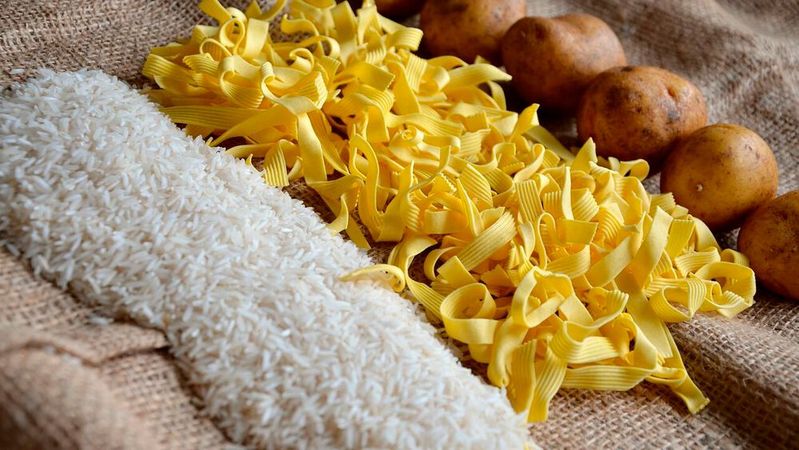
If you’ve ever struggled to reduce your carb intake, ancient DNA might be to blame. It has long been known that humans carry multiple copies of a gene that allows us to begin breaking down complex carbohydrate starch in the mouth, providing the first step in metabolizing starchy foods like bread and pasta. However, it has been notoriously difficult for researchers to determine how and when the number of these genes expanded.
Now, a new study led by the University at Buffalo and the Jackson Laboratory (JAX), reveals how the duplication of this gene — known as the salivary amylase gene (AMY1) — may not only have helped shape human adaptation to starchy foods, but may have occurred as far back as more than 800,000 years ago, long before the advent of farming.
Reported today in the Oct. 17 advanced online issue of Science, the study ultimately showcases how early duplications of this gene set the stage for the wide genetic variation that still exists today, influencing how effectively humans digest starchy foods.
“The idea is that the more amylase genes you have, the more amylase you can produce and the more starch you can digest effectively,” says the study's corresponding author, Omer Gokcumen, PhD, professor in the Department of Biological Sciences, within the UB College of Arts and Sciences.
Amylase, the researchers explain, is an enzyme that not only breaks down starch into glucose, but also gives bread its taste.
Gokcumen and his colleagues, including co-senior author, Charles Lee, professor and Robert Alvine Family Endowed Chair at JAX, used optical genome mapping and long-read sequencing, a methodological breakthrough crucial to mapping the AMY1 gene region in extraordinary detail. Traditional short-read sequencing methods struggle to accurately distinguish between gene copies in this region due to their near-identical sequence. However, long-read sequencing allowed Gokcumen and Lee to overcome this challenge in present-day humans, providing a clearer picture of how AMY1 duplications evolved.
Analyzing the genomes of 68 ancient humans, including a 45,000-year-old sample from Siberia, the research team found that pre-agricultural hunter-gatherers already had an average of four to eight AMY1 copies per diploid cell, suggesting that humans were already walking around Eurasia with a wide variety of high AMY1 copy numbers well before they started domesticating plants and eating excess amounts of starch. The study also found that AMY1 gene duplications occurred in Neanderthals and Denisovans.
“This suggests that the AMY1 gene may have first duplicated more than 800,000 years ago, well before humans split from Neanderthals and much further back than previously thought,” says Kwondo Kim, one of the lead authors on this study from the Lee Lab at JAX.
“The initial duplications in our genomes laid the groundwork for significant variation in the amylase region, allowing humans to adapt to shifting diets as starch consumption rose dramatically with the advent of new technologies and lifestyles,” Gokcumen adds.
The Seeds of Genetic Variation
The initial duplication of AMY1 was like the first ripple in a pond, creating a genetic opportunity that later shaped our species. As humans spread across different environments, the flexibility in the number of AMY1 copies provided an advantage for adapting to new diets, particularly those rich in starch.
“Following the initial duplication, leading to three AMY1 copies in a cell, the amylase locus became unstable and began creating new variations," says Charikleia Karageorgiou, one of the lead authors of the study at UB. “From three AMY1 copies, you can get all the way up to nine copies, or even go back to one copy per haploid cell.”
The research also highlights how agriculture impacted AMY1 variation. While early hunter-gatherers had multiple gene copies, European farmers saw a surge in the average number of AMY1 copies over the past 4,000 years, likely due to their starch-rich diets. Gokcumen’s previous research showed that domesticated animals living alongside humans, such as dogs and pigs, also have higher amylase gene copy numbers compared to animals not reliant on starch-heavy diets.
Date: 08.12.2025
Naturally, we always handle your personal data responsibly. Any personal data we receive from you is processed in accordance with applicable data protection legislation. For detailed information please see our privacy policy.
Consent to the use of data for promotional purposes
I hereby consent to Vogel Communications Group GmbH & Co. KG, Max-Planck-Str. 7-9, 97082 Würzburg including any affiliated companies according to §§ 15 et seq. AktG (hereafter: Vogel Communications Group) using my e-mail address to send editorial newsletters. A list of all affiliated companies can be found here
Newsletter content may include all products and services of any companies mentioned above, including for example specialist journals and books, events and fairs as well as event-related products and services, print and digital media offers and services such as additional (editorial) newsletters, raffles, lead campaigns, market research both online and offline, specialist webportals and e-learning offers. In case my personal telephone number has also been collected, it may be used for offers of aforementioned products, for services of the companies mentioned above, and market research purposes.
Additionally, my consent also includes the processing of my email address and telephone number for data matching for marketing purposes with select advertising partners such as LinkedIn, Google, and Meta. For this, Vogel Communications Group may transmit said data in hashed form to the advertising partners who then use said data to determine whether I am also a member of the mentioned advertising partner portals. Vogel Communications Group uses this feature for the purposes of re-targeting (up-selling, cross-selling, and customer loyalty), generating so-called look-alike audiences for acquisition of new customers, and as basis for exclusion for on-going advertising campaigns. Further information can be found in section “data matching for marketing purposes”.
In case I access protected data on Internet portals of Vogel Communications Group including any affiliated companies according to §§ 15 et seq. AktG, I need to provide further data in order to register for the access to such content. In return for this free access to editorial content, my data may be used in accordance with this consent for the purposes stated here. This does not apply to data matching for marketing purposes.
Right of revocation
I understand that I can revoke my consent at will. My revocation does not change the lawfulness of data processing that was conducted based on my consent leading up to my revocation. One option to declare my revocation is to use the contact form found at https://contact.vogel.de. In case I no longer wish to receive certain newsletters, I have subscribed to, I can also click on the unsubscribe link included at the end of a newsletter. Further information regarding my right of revocation and the implementation of it as well as the consequences of my revocation can be found in the data protection declaration, section editorial newsletter.
“Individuals with higher AMY1 copy numbers were likely digesting starch more efficiently and having more offspring,” Gokcumen says. “Their lineages ultimately fared better over a long evolutionary timeframe than those with lower copy numbers, propagating the number of the AMY1 copies.”
The findings track with a University of California, Berkeley-led study published last month in Nature, which found that humans in Europe expanded their average number of AMY1 copies from four to seven over the last 12,000 years.
“Given the key role of AMY1 copy number variation in human evolution, this genetic variation presents an exciting opportunity to explore its impact on metabolic health and uncover the mechanisms involved in starch digestion and glucose metabolism,” says Feyza Yilmaz, an associate computational scientist at JAX and a lead author of the study. “Future research could reveal its precise effects and timing of selection, providing critical insights into genetics, nutrition, and health.”
Original Article: Reconstruction of the human amylase locus reveals ancient duplications seeding modern-day variation; Science; DOI:10.1126/science.aamTKTK




:quality(80)/p7i.vogel.de/wcms/92/ad/92adbafb37924cea35ea3cf05b7a23e5/0130206318v2.jpeg "The world’s first fully functioning proof-of-concept quantum battery
(Source: Csiro)")
:quality(80)/p7i.vogel.de/wcms/9f/8b/9f8bc2b8491d7a514ca154e9588a07b7/0130205846v1.jpeg "The researchers’ new material, based on mineralised sawdust, is an excellent fire retardant. (Source: Dan Vivas Glaser / from Kürsteiner R et al. Chem Circularity 2026)")
:quality(80)/p7i.vogel.de/wcms/fd/73/fd73fcb3ceda89d1419de1083fcab7b4/0130081520v2.jpeg "The fingers at the heart of this technology were inspired by the fin-ray effect — a design principle derived from the natural structure of fish fins. (Source: University of Texas at Austin )")
:quality(80)/p7i.vogel.de/wcms/fe/64/fe649767c802d53ac63ee2c2a40b7e0d/0130060830v2.jpeg "Sample tube with light-active substance (Source: Elvira Eberhardt / Ulm University)")
:quality(80)/p7i.vogel.de/wcms/8f/b9/8fb98a958e4afe679865fbe52a473680/0129940982v2.jpeg "pH measurement in various nanoparticles using the Nine-Focus meter ensures precise stability and performance control. (Source: Mettler Toledo)")
:quality(80)/p7i.vogel.de/wcms/11/74/1174e5d4c8b07a64637dced8c9506b40/0129787561v2.jpeg "The Multicell Plus high-pressure reactor sets a new benchmark for operator safety, all-round accessibility and ease-of-use. (Source: Asynt)")
:quality(80)/p7i.vogel.de/wcms/ef/6e/ef6e96191183411973b77041fb6b1e16/0129785957v2.jpeg "Manufactured from high-quality crystal polystyrene - these new automation-ready plates are available in a choice of ANSI / SLAS standard (96-well and breakable 8-well strip) formats. (Source: Porvair Sciences)")
:quality(80)/p7i.vogel.de/wcms/ad/ca/adcaa20ef5ccaf7e3b325788b1e349c4/0129784872v2.jpeg "The high performance Degasi Flat Film in-line degasser. (Source: Biotech Fluidics)")
:quality(80)/p7i.vogel.de/wcms/e9/9c/e99cb19231197af70c489cb4acc2ead0/0130293444v2.jpeg "A new global study, led by researchers at Kaust in Saudi Arabia, shows that forests are most effective for climate regulation when conserved or restored in their natural or native locations. (Source: Kaust )")
:quality(80)/p7i.vogel.de/wcms/af/40/af40b535eb65c287fbd22ed5483d1d0e/0130206243v2.jpeg "The researchers dug soil pits in order to measure the carbon storage in soil
(Source: Johanna Asch)")
:quality(80)/p7i.vogel.de/wcms/2d/45/2d45aba62f5042baa00f7fd4fa629839/0130036533v2.jpeg "The population of Pune, India, is expected to reach 11 million by 2050. (Source: free licensed)")
:quality(80)/p7i.vogel.de/wcms/52/f8/52f8d5521fdab07ed0a865ec0d8919fd/0130009438v2.jpeg "Drylands support around half of global livestock production and sustain the livelihoods of close to a billion people, while also underpinning soil stability and carbon storage. (Source: Kaust )")
:quality(80)/p7i.vogel.de/wcms/6f/ba/6fba92196d0cbb1467334f8a2ecc520a/0130203021v2.jpeg "Low to moderate wine consumption shows lower risk compared with spirits, beer and cider (Source: free licensed)")
:quality(80)/p7i.vogel.de/wcms/a9/37/a9376f1d9a893570023d9aa97c085bc5/0129927485v2.jpeg "Examples of foods high in PUFAs include fatty fish and soybeans, while MUFAs include olive oil and avocadoes. (Source: free licensed)")
:quality(80)/p7i.vogel.de/wcms/ea/88/ea88ef8810e21cdd9bb852c70f385ba1/0129797385v2.jpeg "A team of NUS food scientists consisting of Assoc Prof Liu Shao Quan (centre), Dr Lu Yuyun (right) and Ms Geng Chenhan (left) pioneered a co-fermentation method that improves both the nutrient and flavor profile of kombu. (Source: NUS)")
:quality(80)/p7i.vogel.de/wcms/84/2c/842c7c1678ceeec7147ea3a36e238e75/0129356324v2.jpeg "Kaust and Nadec have signed a MOU that establishes a framework for long-term cooperation across agricultural research, technology development, and professional training. (Source: Kaust )")
:quality(80)/p7i.vogel.de/wcms/6e/b9/6eb95805568aa78dc2ed57f829cf33d4/0130300421v2.jpeg "A 10-minute digital program co-developed by a University of Texas psychologist significantly reduced symptoms of depression four weeks after use, according to results from one of the largest randomized controlled trials of single-session mental health interventions. (Source: University of Texas at Austin )")
:quality(80)/p7i.vogel.de/wcms/6f/e9/6fe9d920eca2c0b3bdeb55cbe9f01908/0130299237v2.jpeg "Study authors Jason Miska and Leah Billingham reading out enzymatic activity of microglia in cell cultures. (Source: Northwestern University.)")
:quality(80)/p7i.vogel.de/wcms/c4/54/c454661a9dd459cf7c5b632f79829358/0130284530v2.jpeg "The study shows that AI can be used to assess the build-up of calcium deposits in the arteries of the breast from the standard X-ray mammography scans that are currently used in routine breast cancer screening. (Source: ESC)")
:quality(80)/p7i.vogel.de/wcms/67/9b/679b140c164dbd7c4fe9eda4da91329b/0130281406v3.jpeg "This is the highest resolution molecular structure ever constructed of a key protein complex on the surface of the Andes virus, called the Gn-Gc tetramer, that enables it to infect cells. (Source: University of Texas at Austin)")
:quality(80)/images.vogel.de/vogelonline/bdb/1710600/1710675/original.jpg "Discover how to set yourself up for success when performing balance-based density determination of solids such as jewelry and precious metals. (Mettler Toledo)")
:quality(80)/images.vogel.de/vogelonline/bdb/1682500/1682579/original.jpg "The new XPR Analytical balance redesigned to meet the needs of laboratory technicians of working fast and lean. (Mettler Toledo)")
:quality(80)/images.vogel.de/vogelonline/bdb/1677000/1677080/original.jpg "Enhance your weighing accuracy, comfort and productivity with the redesigned XPR Analytical balance. (Mettler Toledo)")
:quality(80)/p7i.vogel.de/wcms/6f/cd/6fcd456c6031a20b33bb7db5c1e76984/0128355923v2.jpeg "The Matjes River Rockshelter in the Western Cape, South Africa, 540 km east of Cape Town. Eight people who lived here between 10,200 and 3000 years ago contributed DNA to this study. (Source: Nicholas Wiltshire)")
:quality(80)/p7i.vogel.de/wcms/07/29/072957c4059eab05da693e20d17e8cf0/0126506017v1.jpeg "Ancient DNA reveals how key genetic changes helped transform wild horses into rideable partners. (Source: free licensed)")