A US poll reveals a growing trend of young children, ages 5-12, using personal audio devices, raising concerns about noise exposure and hearing health. With half of the parents reporting their kids spend at least an hour daily on these devices, experts at the University of Michigan Health C.S. Mott Children’s Hospital emphasize the risk of hearing loss and other health issues due to prolonged and loud usage.
Young children are more vulnerable to potential harm from noise exposure.
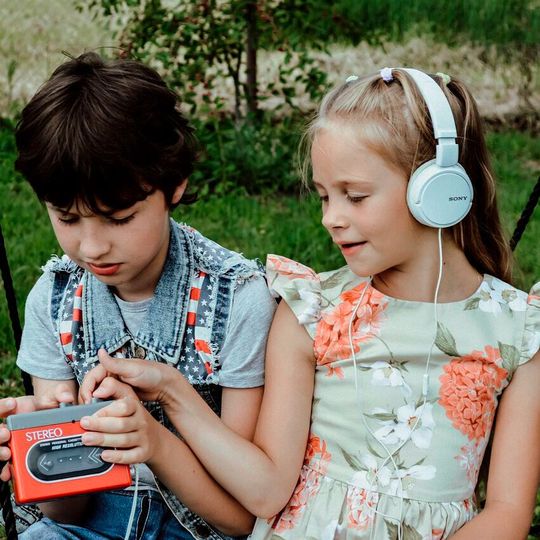
While it’s not surprising to spot teens wearing headphones and earbuds, it’s also becoming a widespread trend among younger children, a national poll suggests. Two in three parents say their child ages 5-12 uses personal audio devices, with half of parents of children ages 5-8 reporting elementary-aged kids use a device.
Among parents whose children use headphones and earbuds, half say kids spend at least an hour a day using them while one in six say a typical day for their child includes at least two hours of use, according to the University of Michigan Health C.S. Mott Children’s Hospital National Poll on Children’s Health.
“Over recent years we’ve mostly been concerned about teens overusing audio devices. But earbuds have become increasingly popular and prevalent among younger kids, exposing them to more intense noise on a regular basis,” said Susan Woolford, M.D., M.P.H., Mott pediatrician and co-director of the Mott poll. “Noise exposure risks to young children have historically involved loud singular events like concerts or fireworks, but parents may underestimate the potential harm from excessive use of listening devices. It may be difficult to know whether their child’s exposure to noise is healthy.”
Children are most likely to use these devices at home, school and in the car, report findings show. About a fourth of parents also say children occasionally use audio devices on airplanes while less than 10 % say kids use them on the bus, outside or in bed.
Half of parents agree that headphones or earbuds help keep their child entertained.
The American Academy of Pediatrics released a statement in 2023 on the need to reduce noise risks to children, with increasing evidence that children and teens may be more exposed through personal listening devices. Prolonged or extreme exposure to high volumes of noise can result in long term health issues, including hearing loss or tinnitus, Woolford says. “Young children are more vulnerable to potential harm from noise exposure because their auditory systems are still developing. Their ear canals are also smaller than adults, intensifying perceived sound levels,” Woolford said. “Tiny hair cells inside the inner ear pick up sound waves to help you hear. When these get damaged or die, hearing loss is irreversible.”
Noise exposure among children can also affect their sleep, academic learning, language, stress levels and even blood pressure, she adds.
More parents of children aged 9-12 years than 5-8 years report their child uses headphones or earbuds and daily use was also more likely to be higher among the older age group, the poll suggests.
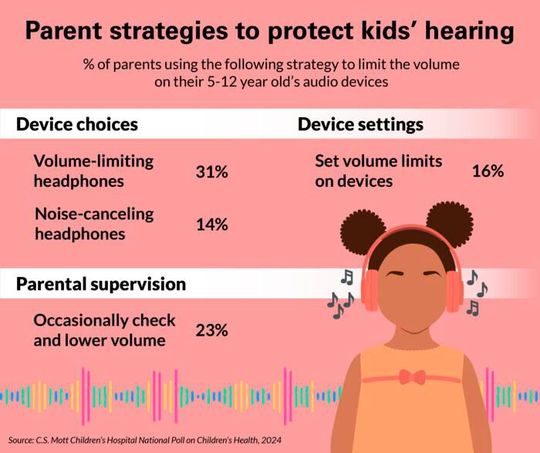
But only half of parents share they’ve tried to limit their child’s audio device usage, citing strategies such as asking the child to take a break, having set hours for use and using a timer.
Parents whose child uses headphones for more than two hours a day are also less likely to set time or volume limits, compared to parents who report less headphone use for their child.
Only half of parents share they’ve tried to limit their child’s audio device usage.
(Source: University of Michigan Health C.S. Mott Children’s Hospital National Poll on Children’s Health)
Woolford offers four tips to reduce risks of noise exposure to children through headphones and earbuds:
Monitor volume levels: Parents can minimize the negative impact of audio device usage by monitoring and adjusting the child’s volume and time on devices, Woolford says. She recommends parents follow the 60/60 rule — children should be limited to no more than 60 minutes of audio devices a day at no more than 60 % of the maximum volume. The sound level on listening devices that are less than 70 dBA (relative loudness of decibels heard) are very unlikely to cause noise-related damage. “A good way to tell if an audio device is too loud is if a child wearing headphones can’t hear you when you’re an arm’s length away,” she said. Parents can also limit their child’s risk by setting specific hours for audio device use or using a timer to keep track.
Use noise cancelling or volume limiting headphones: Parents should consider the risk of noise exposure when purchasing audio devices for their child by checking the information on device packages to identify products that limit the volume. But some products marketed as “kid safe,” Woolford warns, do not limit the volume to 70 decibels. However, children should avoid using noise-cancelling listening devices in situations when perception of sounds is crucial for safety. “Noise-cancelling devices may help prevent children from increasing the volume to levels that are too high,” Woolford said. “But these devices shouldn’t be used when a child is engaged in activities where it’s important to hear their surroundings for their safety, such as walking or bike riding.”
Date: 08.12.2025
Naturally, we always handle your personal data responsibly. Any personal data we receive from you is processed in accordance with applicable data protection legislation. For detailed information please see our privacy policy.
Consent to the use of data for promotional purposes
I hereby consent to Vogel Communications Group GmbH & Co. KG, Max-Planck-Str. 7-9, 97082 Würzburg including any affiliated companies according to §§ 15 et seq. AktG (hereafter: Vogel Communications Group) using my e-mail address to send editorial newsletters. A list of all affiliated companies can be found here
Newsletter content may include all products and services of any companies mentioned above, including for example specialist journals and books, events and fairs as well as event-related products and services, print and digital media offers and services such as additional (editorial) newsletters, raffles, lead campaigns, market research both online and offline, specialist webportals and e-learning offers. In case my personal telephone number has also been collected, it may be used for offers of aforementioned products, for services of the companies mentioned above, and market research purposes.
Additionally, my consent also includes the processing of my email address and telephone number for data matching for marketing purposes with select advertising partners such as LinkedIn, Google, and Meta. For this, Vogel Communications Group may transmit said data in hashed form to the advertising partners who then use said data to determine whether I am also a member of the mentioned advertising partner portals. Vogel Communications Group uses this feature for the purposes of re-targeting (up-selling, cross-selling, and customer loyalty), generating so-called look-alike audiences for acquisition of new customers, and as basis for exclusion for on-going advertising campaigns. Further information can be found in section “data matching for marketing purposes”.
In case I access protected data on Internet portals of Vogel Communications Group including any affiliated companies according to §§ 15 et seq. AktG, I need to provide further data in order to register for the access to such content. In return for this free access to editorial content, my data may be used in accordance with this consent for the purposes stated here. This does not apply to data matching for marketing purposes.
Right of revocation
I understand that I can revoke my consent at will. My revocation does not change the lawfulness of data processing that was conducted based on my consent leading up to my revocation. One option to declare my revocation is to use the contact form found at https://contact.vogel.de. In case I no longer wish to receive certain newsletters, I have subscribed to, I can also click on the unsubscribe link included at the end of a newsletter. Further information regarding my right of revocation and the implementation of it as well as the consequences of my revocation can be found in the data protection declaration, section editorial newsletter.
Ensure kids take breaks from personal listening devices: Parents should help children intentionally have daily “device-free” time, Woolford says. This may involve putting away or locking the child’s audio devices when time limits are up. They may also encourage kids to enjoy things like music on a low volume in their rooms instead of using earbuds to reduce noise intensity. Personal audio devices should also be avoided when children are sleeping or at bedtime, Woolford says.
Be mindful of early signs of hearing loss: If parents feel their child may be at risk of hearing loss due to using audio devices, Woolford recommends checking with a pediatrician, an audiologist, or an ENT (ear, nose and throat) specialist.
“Early signs of hearing loss may include asking for repetition, hearing ringing noises often, speaking loudly to people nearby, delayed speech, or lack of reaction to loud noises,” Woolford said. “Healthcare providers may be of assistance to parents by offering a simple explanation about hearing loss to help the child understand the reasons for limiting their use of audio devices.”




:quality(80)/p7i.vogel.de/wcms/fd/73/fd73fcb3ceda89d1419de1083fcab7b4/0130081520v2.jpeg "The fingers at the heart of this technology were inspired by the fin-ray effect — a design principle derived from the natural structure of fish fins. (Source: University of Texas at Austin )")
:quality(80)/p7i.vogel.de/wcms/fe/64/fe649767c802d53ac63ee2c2a40b7e0d/0130060830v2.jpeg "Sample tube with light-active substance (Source: Elvira Eberhardt / Ulm University)")
:quality(80)/p7i.vogel.de/wcms/db/e2/dbe2ae4e02f702b30153a882ef705089/0129978032v1.jpeg "Each of the isolated indium atoms (in gold color) can catalyse the synthesis of methanol (top right). (Source: Constance Ko/ ETH Zurich)")
:quality(80)/p7i.vogel.de/wcms/c1/e6/c1e6ac26eb18993236c100e7f01a78f2/0129937639v1.jpeg "Dogs evolved from highly social ancestors and have been shaped by thousands of years of interacting with humans. (Source: free licensed)")
:quality(80)/p7i.vogel.de/wcms/8f/b9/8fb98a958e4afe679865fbe52a473680/0129940982v2.jpeg "pH measurement in various nanoparticles using the Nine-Focus meter ensures precise stability and performance control. (Source: Mettler Toledo)")
:quality(80)/p7i.vogel.de/wcms/11/74/1174e5d4c8b07a64637dced8c9506b40/0129787561v2.jpeg "The Multicell Plus high-pressure reactor sets a new benchmark for operator safety, all-round accessibility and ease-of-use. (Source: Asynt)")
:quality(80)/p7i.vogel.de/wcms/ef/6e/ef6e96191183411973b77041fb6b1e16/0129785957v2.jpeg "Manufactured from high-quality crystal polystyrene - these new automation-ready plates are available in a choice of ANSI / SLAS standard (96-well and breakable 8-well strip) formats. (Source: Porvair Sciences)")
:quality(80)/p7i.vogel.de/wcms/ad/ca/adcaa20ef5ccaf7e3b325788b1e349c4/0129784872v2.jpeg "The high performance Degasi Flat Film in-line degasser. (Source: Biotech Fluidics)")
:quality(80)/p7i.vogel.de/wcms/2d/45/2d45aba62f5042baa00f7fd4fa629839/0130036533v2.jpeg "The population of Pune, India, is expected to reach 11 million by 2050. (Source: free licensed)")
:quality(80)/p7i.vogel.de/wcms/52/f8/52f8d5521fdab07ed0a865ec0d8919fd/0130009438v2.jpeg "Drylands support around half of global livestock production and sustain the livelihoods of close to a billion people, while also underpinning soil stability and carbon storage. (Source: Kaust )")
:quality(80)/p7i.vogel.de/wcms/fe/49/fe494ada322615b6e6f6ff0f5bb7c5cf/0129926008v2.jpeg "A mandrill eating fruit. (Source: University of Bristol )")
:quality(80)/p7i.vogel.de/wcms/af/4e/af4ea968647ee9cae82b39800c611819/0129865630v2.jpeg "Map of a simulated risk of water stress in 2050 where hydrogen is used in transport and industry. Baseline risk (regardless of hydrogen use) is represented by the background color in each area. Dashed areas show water use exceeding available resources due to hydrogen production. Blue dots show areas where the risk of water stress increases by more than 50 percent in the simulation. (Source: Chalmers University of Technology / Joel Löfving)")
:quality(80)/p7i.vogel.de/wcms/6f/ba/6fba92196d0cbb1467334f8a2ecc520a/0130203021v2.jpeg "Low to moderate wine consumption shows lower risk compared with spirits, beer and cider (Source: free licensed)")
:quality(80)/p7i.vogel.de/wcms/a9/37/a9376f1d9a893570023d9aa97c085bc5/0129927485v2.jpeg "Examples of foods high in PUFAs include fatty fish and soybeans, while MUFAs include olive oil and avocadoes. (Source: free licensed)")
:quality(80)/p7i.vogel.de/wcms/ea/88/ea88ef8810e21cdd9bb852c70f385ba1/0129797385v2.jpeg "A team of NUS food scientists consisting of Assoc Prof Liu Shao Quan (centre), Dr Lu Yuyun (right) and Ms Geng Chenhan (left) pioneered a co-fermentation method that improves both the nutrient and flavor profile of kombu. (Source: NUS)")
:quality(80)/p7i.vogel.de/wcms/84/2c/842c7c1678ceeec7147ea3a36e238e75/0129356324v2.jpeg "Kaust and Nadec have signed a MOU that establishes a framework for long-term cooperation across agricultural research, technology development, and professional training. (Source: Kaust )")
:quality(80)/p7i.vogel.de/wcms/ed/c0/edc0c1a86229b11efd17c5e3f94d14da/0130081211v2.jpeg "A new study finds that virtual visits did not make it easier for psychiatrists, psychologists and therapists to reach significantly more people in areas where access to care has long been limited. (Source: Pixabay)")
:quality(80)/p7i.vogel.de/wcms/9c/52/9c52318bc94be17e6662dfceffa4a0c0/0130060546v2.jpeg "Domestic cat ‘Lanni’ from co-author of the study, Latasha Ludwig, Assistant Clinical Professor at Cornell University, USA. (Source: © Latasha Ludwig)")
:quality(80)/p7i.vogel.de/wcms/4b/f4/4bf4cc9e28e65e11a27dd41da2d1a7f5/0130038185v2.jpeg "The biomarker p-tau217 could help identify women at elevated dementia risk decades before clinical symptoms begin. (Source: free licensed)")
:quality(80)/p7i.vogel.de/wcms/4f/29/4f292f402b157e2ab8c57e9f2a3e3199/0130036120v2.jpeg "The chemistry is powered by an LED lamp that triggers a self-sustaining chain reaction, forging new carbon–carbon bonds under mild conditions without toxic or expensive chemicals. (Source: Nordin Ćatić/ St John’s College, Cambridge)")
:quality(80)/images.vogel.de/vogelonline/bdb/1710600/1710675/original.jpg "Discover how to set yourself up for success when performing balance-based density determination of solids such as jewelry and precious metals. (Mettler Toledo)")
:quality(80)/images.vogel.de/vogelonline/bdb/1682500/1682579/original.jpg "The new XPR Analytical balance redesigned to meet the needs of laboratory technicians of working fast and lean. (Mettler Toledo)")
:quality(80)/images.vogel.de/vogelonline/bdb/1677000/1677080/original.jpg "Enhance your weighing accuracy, comfort and productivity with the redesigned XPR Analytical balance. (Mettler Toledo)")
:quality(80)/p7i.vogel.de/wcms/9f/67/9f670ddf8d1707ae671dbc30d7059a04/0127153548v2.jpeg "While 83 % of parents believed their child was sleeping the right amount, sleep trackers showed that only 14 % of the children met national sleep guidelines. (Source: Pixabay)")
:quality(80)/p7i.vogel.de/wcms/a0/90/a090f04417769e97307b1adf8999ca2f/0128339201v1.jpeg "The device is designed to support mindfulness in everyday activities, such as washing hands, retrieving a seasoning packet from a paper bag, cleaning a table, and writing on a whiteboard. (Source: Yujie Tao)")