A study has revealed that the way faults are aligned plays an important role in determining where an earthquake will happen. The findings offer new insights into the more traditional notion that it is primarily the type of friction happening at these faults that governs whether earthquakes happen or not.
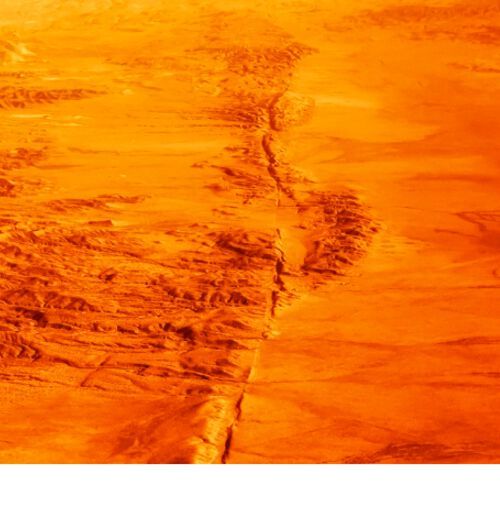
An aerial view of the San Andreas fault.
(Source: Oliver De La Haye/Adobe Stock)
Providence/USA – By taking a close look at the geometrical makeup of rocks where earthquakes originate, researchers at Brown University are adding a new wrinkle to a long-held belief about what causes seismic quakes in the first place.
The work, described in the journal Nature, reveals that the way fault networks are aligned plays a critical role in determining where an earthquake will happen and its strength. The findings challenge the more traditional notion that it is primarily the type of friction happening at these faults that governs whether earthquakes happen or not, and they could improve current understandings of how earthquakes work.
“Our paper paints this very different sort of picture about why earthquakes happen,” said Brown geophysicist Victor Tsai, one of the paper’s lead authors. “And this has very important implications for where to expect earthquakes versus where to not expect earthquakes, as well as for predicting where the most damaging earthquakes will be.”
Fault lines are the visible boundaries on the planet’s surface where the rigid plates that make up the Earth’s lithosphere brush against each another. Tsai says that for decades, geophysicists have explained earthquakes as happening when stress at faults builds up to the point where the faults rapidly slip or break past each other, releasing pent-up pressure in an action known as stick-slip behavior.
Researchers theorized that the rapid slip and intense ground motions that follow are a result of unstable friction that can happen at the faults. In contrast, the thought is that when friction is stable, the plates then slide against each other slowly without an earthquake. This steady and smooth movement is also known as creep.
“People have been trying to measure these frictional properties, like whether the fault zone has unstable friction or stable friction and then, based on laboratory measurements of that, they try to predict if are you going to have an earthquake there or not,” Tsai said. “Our findings suggest that it might be more relevant to look at the geometry of the faults in these fault networks, because it may be the complex geometry of the structures around those boundaries that creates this unstable versus stable behavior.”
The geometry to consider includes complexities in the underlying rock structures such as bends, gaps and stepovers. The study is based on mathematical modeling and studying fault zones in California using data from the U.S. Geological Survey’s Quaternary Fault Database and from the California Geological Survey.
The research team, which also includes Brown graduate student Jaeseok Lee and Brown geophysicist Greg Hirth, offer a more detailed example to illustrate how earthquakes happen. They say to picture the faults that brush up against each other as having serrated teeth like the edge of a saw. When there are fewer teeth or teeth that are not as sharp, the rocks slide past each other more smoothly, allowing for creep. But when the rock structures in these faults are more complex and jagged, these structures catch on to one another and get stuck. When that happens, they build up pressure and eventually as they pull and push harder and harder, they break, jerking away from each other and leading to earthquakes.
The new study builds on previous work looking at why some earthquakes generate more ground motion compared to other earthquakes in different parts of the world, sometimes even those of similar magnitude. The study showed that blocks colliding inside a fault zone as an earthquake happens contributes significantly to the generation of high-frequency vibrations and sparked the notion that maybe geometrical complexity beneath the surface was also playing a role in where and why earthquakes happen.
Analyzing data from faults in California — which include the well-known San Andreas fault — the researchers found that fault zones that have complex geometry underneath, meaning the structures there weren’t as aligned, turned out to have stronger ground motions than less geometrically complex fault zones. This also means some of these zones would have stronger earthquakes, others would have weaker ones, and some would have no earthquakes.
Date: 08.12.2025
Naturally, we always handle your personal data responsibly. Any personal data we receive from you is processed in accordance with applicable data protection legislation. For detailed information please see our privacy policy.
Consent to the use of data for promotional purposes
I hereby consent to Vogel Communications Group GmbH & Co. KG, Max-Planck-Str. 7-9, 97082 Würzburg including any affiliated companies according to §§ 15 et seq. AktG (hereafter: Vogel Communications Group) using my e-mail address to send editorial newsletters. A list of all affiliated companies can be found here
Newsletter content may include all products and services of any companies mentioned above, including for example specialist journals and books, events and fairs as well as event-related products and services, print and digital media offers and services such as additional (editorial) newsletters, raffles, lead campaigns, market research both online and offline, specialist webportals and e-learning offers. In case my personal telephone number has also been collected, it may be used for offers of aforementioned products, for services of the companies mentioned above, and market research purposes.
Additionally, my consent also includes the processing of my email address and telephone number for data matching for marketing purposes with select advertising partners such as LinkedIn, Google, and Meta. For this, Vogel Communications Group may transmit said data in hashed form to the advertising partners who then use said data to determine whether I am also a member of the mentioned advertising partner portals. Vogel Communications Group uses this feature for the purposes of re-targeting (up-selling, cross-selling, and customer loyalty), generating so-called look-alike audiences for acquisition of new customers, and as basis for exclusion for on-going advertising campaigns. Further information can be found in section “data matching for marketing purposes”.
In case I access protected data on Internet portals of Vogel Communications Group including any affiliated companies according to §§ 15 et seq. AktG, I need to provide further data in order to register for the access to such content. In return for this free access to editorial content, my data may be used in accordance with this consent for the purposes stated here. This does not apply to data matching for marketing purposes.
Right of revocation
I understand that I can revoke my consent at will. My revocation does not change the lawfulness of data processing that was conducted based on my consent leading up to my revocation. One option to declare my revocation is to use the contact form found at https://contact.vogel.de. In case I no longer wish to receive certain newsletters, I have subscribed to, I can also click on the unsubscribe link included at the end of a newsletter. Further information regarding my right of revocation and the implementation of it as well as the consequences of my revocation can be found in the data protection declaration, section editorial newsletter.
The researchers determined this based on the average misalignment of the faults they analyzed. This misalignment ratio measures how closely the faults in a certain region are aligned and all going in the same direction versus going in many different directions. The analysis revealed that fault zones where the faults are more misaligned causes stick-slip episodes in the form of earthquakes. Fault zones where the geometry of the faults were more aligned facilitated smooth fault creep with no earthquakes.
“Understanding how faults behave as a system is essential to grasp why and how earthquakes happen,” said Lee, the graduate student who led the work. “Our research indicates that the complexity of fault network geometry is the key factor and establishes meaningful connections between sets of independent observations and integrates them into a novel framework.”
The researchers say more work needs to be done to fully validate the model, but this initial work suggests the idea is promising, especially because the alignment or misalignment of faults is easier to measure than fault frictional properties. If valid, the work can one day be weaved into earthquake prediction models.
That remains far off for now as the researchers begin to outline how to build upon the study.
“The most obvious thing that comes next is trying to go beyond California and see how this model holds up,” Tsai said. “This is potentially a new way of understanding how earthquakes happen.”
The research was supported by the National Science Foundation. Along with Lee, Tsai and Hirth, the team also included Avigyan Chatterjee and Daniel T. Trugman from the University of Nevada Reno.




:quality(80)/p7i.vogel.de/wcms/45/87/458714daead8bb6b83d5305ff764e8c1/0130386255v1.jpeg "Examples of drawings from each category, with the scores they received from humans, independent AI and the human-guided AI. (Source: Advanced Science)")
:quality(80)/p7i.vogel.de/wcms/66/7c/667c242f45cc06eb5bee090c7723ba0b/0130384415v2.jpeg "Inspired by arm-wrestling, the NUS team built a self-training platform (left) where two rings of muscle tissues continuously and autonomously pull against each other. Ostrabot (right), made from a single trained ring of muscle and two flexible tails, swims 3 times faster than counterparts with conventionally cultured muscle. (Source: National University of Singapore)")
:quality(80)/p7i.vogel.de/wcms/92/ad/92adbafb37924cea35ea3cf05b7a23e5/0130206318v2.jpeg "The world’s first fully functioning proof-of-concept quantum battery
(Source: Csiro)")
:quality(80)/p7i.vogel.de/wcms/9f/8b/9f8bc2b8491d7a514ca154e9588a07b7/0130205846v1.jpeg "The researchers’ new material, based on mineralised sawdust, is an excellent fire retardant. (Source: Dan Vivas Glaser / from Kürsteiner R et al. Chem Circularity 2026)")
:quality(80)/p7i.vogel.de/wcms/8f/b9/8fb98a958e4afe679865fbe52a473680/0129940982v2.jpeg "pH measurement in various nanoparticles using the Nine-Focus meter ensures precise stability and performance control. (Source: Mettler Toledo)")
:quality(80)/p7i.vogel.de/wcms/11/74/1174e5d4c8b07a64637dced8c9506b40/0129787561v2.jpeg "The Multicell Plus high-pressure reactor sets a new benchmark for operator safety, all-round accessibility and ease-of-use. (Source: Asynt)")
:quality(80)/p7i.vogel.de/wcms/ef/6e/ef6e96191183411973b77041fb6b1e16/0129785957v2.jpeg "Manufactured from high-quality crystal polystyrene - these new automation-ready plates are available in a choice of ANSI / SLAS standard (96-well and breakable 8-well strip) formats. (Source: Porvair Sciences)")
:quality(80)/p7i.vogel.de/wcms/ad/ca/adcaa20ef5ccaf7e3b325788b1e349c4/0129784872v2.jpeg "The high performance Degasi Flat Film in-line degasser. (Source: Biotech Fluidics)")
:quality(80)/p7i.vogel.de/wcms/5d/bb/5dbb962b09bae1c078a8ff996666bc8e/0130386229v2.jpeg "This image created using Gemini Pro, depicts an activated carbon fiber functionalized with amine groups (–NH2) at adjacent positions. This arrangement improves the energy efficacy of key interactions, enabling the desorption of captured carbon dioxide at lower temperatures. (Source: Gemini / Yasuhiro Yamada/ Chiba University / KI-generiert)")
:quality(80)/p7i.vogel.de/wcms/21/9b/219b000051ab1ea14ab5f92e4fd0f9bb/0130384937v2.jpeg "Deforestation in the Appalachian mountains. (Source: Alex Diaz on Unsplash)")
:quality(80)/p7i.vogel.de/wcms/e9/9c/e99cb19231197af70c489cb4acc2ead0/0130293444v2.jpeg "A new global study, led by researchers at Kaust in Saudi Arabia, shows that forests are most effective for climate regulation when conserved or restored in their natural or native locations. (Source: Kaust )")
:quality(80)/p7i.vogel.de/wcms/af/40/af40b535eb65c287fbd22ed5483d1d0e/0130206243v2.jpeg "The researchers dug soil pits in order to measure the carbon storage in soil
(Source: Johanna Asch)")
:quality(80)/p7i.vogel.de/wcms/2a/07/2a0737995810d504b318f8a0f9ac2c3d/0130386209v1.jpeg "Simple, repeatable eating habits may help people stick to diets, see better results, study says (Source: free licensed)")
:quality(80)/p7i.vogel.de/wcms/6f/ba/6fba92196d0cbb1467334f8a2ecc520a/0130203021v2.jpeg "Low to moderate wine consumption shows lower risk compared with spirits, beer and cider (Source: free licensed)")
:quality(80)/p7i.vogel.de/wcms/a9/37/a9376f1d9a893570023d9aa97c085bc5/0129927485v2.jpeg "Examples of foods high in PUFAs include fatty fish and soybeans, while MUFAs include olive oil and avocadoes. (Source: free licensed)")
:quality(80)/p7i.vogel.de/wcms/ea/88/ea88ef8810e21cdd9bb852c70f385ba1/0129797385v2.jpeg "A team of NUS food scientists consisting of Assoc Prof Liu Shao Quan (centre), Dr Lu Yuyun (right) and Ms Geng Chenhan (left) pioneered a co-fermentation method that improves both the nutrient and flavor profile of kombu. (Source: NUS)")
:quality(80)/p7i.vogel.de/wcms/40/c0/40c0c09c2bad7b925a069edbbac90621/0130385557v1.jpeg "When a stroke damages brain tissue (red) along an important movement pathway (yellow), the injured side of the brain may show faster aging (red), while parts of the opposite side may appear relatively “younger” (blue) as the brain tries to compensate. This pattern is linked to more severe movement problems and less recovery.
(Bild: Stevens INI)")
:quality(80)/p7i.vogel.de/wcms/32/14/3214c28a03f71ad067c5f27e5bd6772b/0130386218v1.jpeg "Antimicrobial-resistant Salmonella poses severe challenges to global food safety and public health. (Source: free licensed)")
:quality(80)/p7i.vogel.de/wcms/30/2e/302e195d532fc9aced73406b07642b57/0130384900v2.jpeg "Sleeping for 11 minutes more, doing an additional 4.5 minutes of moderate-to-vigorous physical activity, and eating additional quarter of a cup of vegetables were associated with a 10 % reduction in major cardiovascular events. (Source: Pixabay)")
:quality(80)/p7i.vogel.de/wcms/47/41/4741ee3c589369a09ab0e3a26b7143f0/0130384858v2.jpeg "A female, Aedes aegypti mosquito, after taking her blood meal. (Source: Lauren Bishop CDC)")
:quality(80)/images.vogel.de/vogelonline/bdb/1710600/1710675/original.jpg "Discover how to set yourself up for success when performing balance-based density determination of solids such as jewelry and precious metals. (Mettler Toledo)")
:quality(80)/images.vogel.de/vogelonline/bdb/1682500/1682579/original.jpg "The new XPR Analytical balance redesigned to meet the needs of laboratory technicians of working fast and lean. (Mettler Toledo)")
:quality(80)/images.vogel.de/vogelonline/bdb/1677000/1677080/original.jpg "Enhance your weighing accuracy, comfort and productivity with the redesigned XPR Analytical balance. (Mettler Toledo)")
:quality(80)/p7i.vogel.de/wcms/32/ae/32ae11ef4154e0a95f766875fd10ad47/0124884486v2.jpeg "An intercrystal formed by overlaying twisted graphene on hexagonal boron nitride. (Source: Andrei Lab/ Rutgers University)")
:quality(80)/p7i.vogel.de/wcms/30/f0/30f048dd590f3a1219cde2731d17a373/0128071235v2.jpeg "The illustration shows a cutaway revealing the interior of early Earth with a hot, melted layer above the boundary between the core and mantle. Scientists think some material from the core leaked into this molten layer and mixed in. Over time, that mixing helped create the uneven structure of Earth’s mantle that we see today. (Source: Yoshinori Miyazaki/ Rutgers University)")