Scientists have revealed in a study that overeating falls into five distinct patterns: Take-out feasting, evening restaurant reveling, evening craving, uncontrolled pleasure eating, and stress-driven evening nibbling.
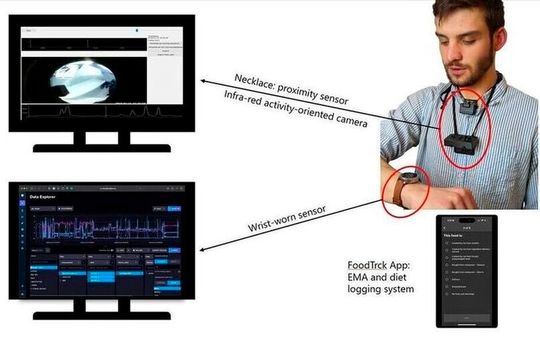
Image showing a person wearing all three sensors from the study (a necklace, wristband and body camera that respects the wearer's privacy) and what kind of information it provides in the study.
(Source: Habits Lab, Northwestern University)
Chicago/USA – What if your smart watch could sense when you're about to raid the fridge, and gently steer you toward a healthier choice instead?
Northwestern University scientists are bringing that vision closer to reality with a groundbreaking lifestyle medicine program that uses three wearable sensors — a necklace, a wristband and a body camera — to capture real-world eating behavior in unprecedented detail and with respect for privacy.
“Overeating is a major contributor to obesity, yet most treatments overlook the unconscious habits that drive it,” said corresponding author Nabil Alshurafa, associate professor of behavioral medicine at Northwestern University Feinberg School of Medicine and of computer engineering at Northwestern’s McCormick School of Engineering.
In a new study, 60 adults with obesity wore the three sensors and used a smartphone app to track meal-related mood and context snapshots (i.e. who they're with, what they're doing) for two weeks. The study yielded thousands of hours of video and sensor data and revealed that overeating is far from one-size-fits-all. Instead, it falls into five distinct patterns:
Take-out feasting: Gorging on delivery and take-out meals
Evening restaurant reveling: Social dinners leading to excess food intake
“These patterns reflect the complex dance between environment, emotion and habit,” Alshurafa said. “What's amazing is now we have a roadmap for personalized interventions.”
The study will be published on Sept. 17 in the journal npj Digital Medicine, part of the Nature Portfolio.
The findings lay the groundwork for a new diagnostic era in which scientists profile individuals into one of the five patterns and deploy tailored interventions. Alshurafa’s team is already working with clinicians to pilot trials of personalized behavior-change programs based on these findings, he said.
“What struck me most was how overeating isn’t just about willpower,” said lead author Farzad Shahabi, a PhD student in Alshurafa’s lab. “Using passive sensing, we were able to uncover hidden consumption patterns in people’s real-world behavior that are emotional, behavioral and contextual. Seeing the patterns emerge from the data felt like turning on a light in a room we've all been stumbling through for decades. Our long-term vision is to move beyond one-size-fits-all solutions and toward a world in which health technology feels less like a prescription and more like a partnership.”
A bodycam with a respect for privacy
During the early days of this research, Alshurafa asked Northwestern’s police department to loan him a police bodycam to see how he might design a camera that captures eating behavior in the real world. He programmed the camera to only record the wearer’s food-related actions to preserve bystander privacy.
Called Habitsense, the bodycam is the first patented Activity-Oriented Camera (AOC) that uses thermal sensing to trigger recording only when food enters the camera’s field of view. Unlike egocentric cameras, which capture a scene from the perspective of the wearer, or broad surveillance, AOCs record activity, not the scene, which reduces privacy concerns while capturing critical data.
A necklace that records eating behaviors
In addition to Habitsense and a wrist-worn activity tracker similar to a Fitbit or Apple Watch, study participants wore a necklace designed by Alshurafa and his team called Necksense. It is the first technology to precisely and passively record multiple eating behaviors, detecting in the real world when people are eating, including how fast they chew, how many bites they take and how many times their hands move to their mouths.
Research driven by personal struggles with weight
Alshurafa’s struggles with his own weight, fluctuating 40 to 50 pounds most of his younger life, sparked his scientific focus on weight management. He struggled with different diets and got caught in a cycle of late-night binge eating while watching TV.
“I tried to turn my personal struggle into a scientific mission that promises to reshape obesity treatment,” Alshurafa said. “By merging computer science, behavioral medicine and a dash of Jane Goodall–style curiosity, we're working to lead the way toward truly personalized, habit-based health care. This study marks only the beginning of a journey toward smarter and more compassionate interventions for millions grappling with overeating.”
Date: 08.12.2025
Naturally, we always handle your personal data responsibly. Any personal data we receive from you is processed in accordance with applicable data protection legislation. For detailed information please see our privacy policy.
Consent to the use of data for promotional purposes
I hereby consent to Vogel Communications Group GmbH & Co. KG, Max-Planck-Str. 7-9, 97082 Würzburg including any affiliated companies according to §§ 15 et seq. AktG (hereafter: Vogel Communications Group) using my e-mail address to send editorial newsletters. A list of all affiliated companies can be found here
Newsletter content may include all products and services of any companies mentioned above, including for example specialist journals and books, events and fairs as well as event-related products and services, print and digital media offers and services such as additional (editorial) newsletters, raffles, lead campaigns, market research both online and offline, specialist webportals and e-learning offers. In case my personal telephone number has also been collected, it may be used for offers of aforementioned products, for services of the companies mentioned above, and market research purposes.
Additionally, my consent also includes the processing of my email address and telephone number for data matching for marketing purposes with select advertising partners such as LinkedIn, Google, and Meta. For this, Vogel Communications Group may transmit said data in hashed form to the advertising partners who then use said data to determine whether I am also a member of the mentioned advertising partner portals. Vogel Communications Group uses this feature for the purposes of re-targeting (up-selling, cross-selling, and customer loyalty), generating so-called look-alike audiences for acquisition of new customers, and as basis for exclusion for on-going advertising campaigns. Further information can be found in section “data matching for marketing purposes”.
In case I access protected data on Internet portals of Vogel Communications Group including any affiliated companies according to §§ 15 et seq. AktG, I need to provide further data in order to register for the access to such content. In return for this free access to editorial content, my data may be used in accordance with this consent for the purposes stated here. This does not apply to data matching for marketing purposes.
Right of revocation
I understand that I can revoke my consent at will. My revocation does not change the lawfulness of data processing that was conducted based on my consent leading up to my revocation. One option to declare my revocation is to use the contact form found at https://contact.vogel.de. In case I no longer wish to receive certain newsletters, I have subscribed to, I can also click on the unsubscribe link included at the end of a newsletter. Further information regarding my right of revocation and the implementation of it as well as the consequences of my revocation can be found in the data protection declaration, section editorial newsletter.
The study is titled “Unveiling overeating patterns within digital longitudinal data on eating behaviors and contexts.” Other Northwestern authors
include Boyang Wei, Chris Romano, Rowan McCloskey, Annie Lin, Mahdi Pedram, Jake Schauer and Tammy Stump. PhD student Glenn Fernandes and senior engineer Tanmeet Butani contributed to the hardware system.
Funding for the study was provided by the National Institutes of Health’s National Institute of Diabetes and Digestive and Kidney Disease (grant 5K25DK113242).




:quality(80)/p7i.vogel.de/wcms/65/88/658810e8f70ddd88a4dc014f211630a6/0132611511v2.jpeg "In regulated cleanrooms, control is important, but being able to demonstrate control is equally important. (Source: Vaisala)")
:quality(80)/p7i.vogel.de/wcms/87/99/87991d857ac02b67176f4c88015a4d57/0132611186v2.jpeg "Supercritical fluid extraction is an area of growing interest and CO2 is the most common supercritical fluid used in SFE procedures as a replacement for traditional hexane use. (Source: Scimed)")
:quality(80)/p7i.vogel.de/wcms/7a/1c/7a1cac56bca0dde5268e4ede1c762741/0132539982v2.jpeg "The flexible material can be customized to act like different kinds of tissue. (Source: University of Texas at Austin)")
:quality(80)/p7i.vogel.de/wcms/ed/ff/edff58efa9930f672f2e50a63e65562f/0132477775v1.jpeg "Contemporary languages and endangerment status. Made with a Natural Earth base map using data from Glottolog 5.3 and information adapted from Glottoscope. (Source: Claire Bowern)")
:quality(80)/p7i.vogel.de/wcms/13/d3/13d35105f74a1c2e22b9c7a270e8e9b3/0132611155v2.jpeg "Circulating cell free DNA. (Source: Amsbio)")
:quality(80)/p7i.vogel.de/wcms/bc/ed/bced6850297a04dbea471a66cb6bb6fe/0132611405v2.jpeg "The latest addition to the range is a peristaltic tubing stop adapter that eliminates the need for fixed stoppers and allows custom cut lengths of peristaltic tubing to be installed on any pump head size. (Source: Biotech Fluidics )")
:quality(80)/p7i.vogel.de/wcms/c2/34/c234a6626d4f6360382ca7f1f440bebb/0132611196v2.jpeg "Testa Analytical's Trinity – a powerful new triple detector for Gel Permeation Chromatography / Size Exclusion Chromatography. (Source: Testa Analytical)")
:quality(80)/p7i.vogel.de/wcms/5b/3f/5b3fc0d5fb08c1f9727125bd926b1481/0132555049v1.jpeg "On 1 and 2 December 2026, the T3 – Transform The Tomorrow conference will explore strategies that help companies future-proof their operations. (Bild: © Vogel Corporate Solutions / AdobeStock 1280236166, Oksana)")
:quality(80)/p7i.vogel.de/wcms/06/1a/061a5d3a4e85383454d9450761a67de7/0132611653v2.jpeg "Shihong Lin, associate professor of civil and environmental engineering at Rice. (Source: Alex Becker/ Rice University)")
:quality(80)/p7i.vogel.de/wcms/c4/f5/c4f55f42fdf878aec3f850e5569b84ce/0132594173v2.jpeg "The latest research sheds some light on an issue that deserves more attention, that of climate-related suicide. (Source: Unsplash)")
:quality(80)/p7i.vogel.de/wcms/22/b8/22b8fa1a4146bc06c4c15d63992ebb88/0132589504v2.jpeg "Hepa filters are known to improve air quality and clean the air of microbes in laboratory settings, but this is the largest ‘real-world’ study to date to test if they reduce infections in care homes. (Source: Unsplash)")
:quality(80)/p7i.vogel.de/wcms/31/c1/31c1b666641702292624a4e8ca799a09/0132480890v1.jpeg "Decades of PFAS-laced sewage sludge, once spread on farms as fertilizer, have left millions of acres of American cropland contaminated with “forever chemicals”. (Source: frei lizenziert)")
:quality(80)/p7i.vogel.de/wcms/28/b6/28b6114fc9915c5dadee94d5c89bd129/0132593216v2.jpeg "Eating foods that contain common preservative food additives may increase the risks of high blood pressure and cardiovascular disease. (Source: Unsplash)")
:quality(80)/p7i.vogel.de/wcms/01/bc/01bcb16a3381a1d46533861eedbbae71/0132371290v1.jpeg "Adding spice may help people eat less by slowing them down. (Source: free licensed)")
:quality(80)/p7i.vogel.de/wcms/b3/16/b316ac585e067d024da89a5156c950a9/0132370983v1.jpeg "Laboratory tests suggest that some low-calorie sweeteners can alter the growth of gut bacteria, with particularly strong effects observed when isosteviol was combined with the antidepressant duloxetine. (Source: free licensed)")
:quality(80)/p7i.vogel.de/wcms/22/50/2250f9358ba65ad3c4de05ff5ea9f74e/0132117868v1.jpeg "Japanese researchers have developed a naturally bred yeast that produces nine times more ornithine while retaining normal brewing performance, opening a route to craft beer with added fermentation value. (Source: free licensed)")
:quality(80)/p7i.vogel.de/wcms/bb/f9/bbf9cc2b059213fd10c280304a51b143/0132611525v2.jpeg "Nanoact colored cellulose nanobeads were developed by Asahi Kasei by utilizing its core technology of cellulose processing. (Source: Asahi Kasei)")
:quality(80)/p7i.vogel.de/wcms/fc/90/fc9085d5ad403446c67cd4d586f4a0d6/0132611789v2.jpeg "Metastatic BAP1-deficient melanoma is the most common intraocular malignancy in adults, but it remains rare and extremely difficult to treat once it spreads. (Source: Turun yliopisto/University of Turku)")
:quality(80)/p7i.vogel.de/wcms/32/97/32977422ebe164ada6f807d16e410900/0132611708v2.jpeg "Ground sloths, which could reach the size of small elephants, originated in South America and spread into North America via the Panamanian land bridge. (Source: Natural History Museum of Los Angeles County)")
:quality(80)/p7i.vogel.de/wcms/96/6f/966f8a0a2b0c36f08622a4c5c3abb54f/0132611669v1.jpeg "A larkspur specimen in bloom at Beal Botanical Garden. Known for their toxicity, injurious plants such as larkspur and wolfsbane have been leveraged by humans for millennia for their medicinal potential. (Source: Finn Gomez/ Paul Henderson)")
:quality(80)/images.vogel.de/vogelonline/bdb/1710600/1710675/original.jpg "Discover how to set yourself up for success when performing balance-based density determination of solids such as jewelry and precious metals. (Mettler Toledo)")
:quality(80)/images.vogel.de/vogelonline/bdb/1682500/1682579/original.jpg "The new XPR Analytical balance redesigned to meet the needs of laboratory technicians of working fast and lean. (Mettler Toledo)")
:quality(80)/images.vogel.de/vogelonline/bdb/1677000/1677080/original.jpg "Enhance your weighing accuracy, comfort and productivity with the redesigned XPR Analytical balance. (Mettler Toledo)")
:quality(80)/p7i.vogel.de/wcms/bc/f3/bcf32d0a9e410836dab7c95a777ad9b4/0131367205v2.jpeg "Wearable polygraph device in the palm of a hand for scale. (Source: John A. Rogers/Northwestern University)")
:quality(80)/p7i.vogel.de/wcms/d5/14/d5144a87f3c04019e3338c738a9c02ed/0126611086v1.jpeg "Detectors are created from cutting and polishing specific sizes from the boules. (Source: Mercouri Kanatzidis/Northwestern University)")