Cyclone researchers have stated that the number and intensity of Atlantic tropical storms will increase in the presence of a warming climate. They have also mentioned that it could potentially lead to the development of stronger hurricanes.
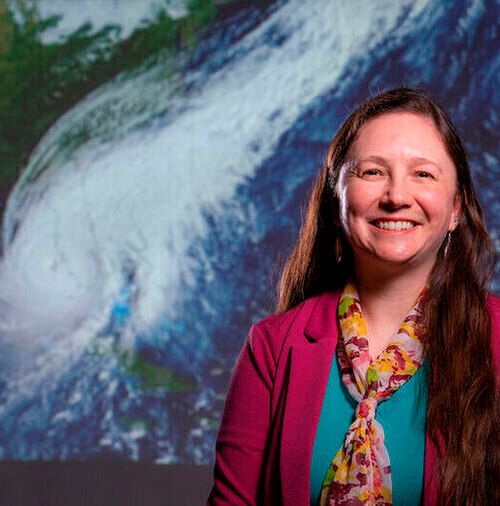
Iowa State's Christina Patricola studies tropical cyclones in Cyclone Country. She and collaborators have recently published studies of the storms and the hurricanes they can produce.
(Source: Christopher Gannon/Iowa State University)
Iowa/USA – A warming climate will increase the number of tropical cyclones and their intensity in the North Atlantic, potentially creating more and stronger hurricanes, according to simulations using a high-resolution, global climate model.
“Unfortunately, it’s not great news for people living in coastal regions,” said Christina Patricola, an Iowa State University assistant professor of geological and atmospheric sciences, an affiliate of the U.S. Department of Energy’s Lawrence Berkeley National Laboratory in California and a study leader. “Atlantic hurricane seasons will become even more active in the future, and hurricanes will be even more intense.”
The research team ran climate simulations using the Department of Energy’s Energy Exascale Earth System Model and found that tropical cyclone frequency could increase 66 % during active North Atlantic hurricane seasons by the end of this century. (Those seasons are typically characterized by La Niña conditions – unusually cool surface water in the eastern tropical Pacific Ocean – and the positive phase of the Atlantic Meridional Mode – warmer surface temperatures in the northern tropical Atlantic Ocean).
The projected numbers of tropical cyclones could increase by 34 % during inactive North Atlantic hurricane seasons. (Inactive seasons generally occur during El Niño conditions with warmer surface temperatures in the eastern tropical Pacific Ocean and the negative phase of the Atlantic Meridional Mode with cooler surface temperatures in the northern tropical Atlantic Ocean.)
In addition, the simulations project an increase in storm intensity during the active and inactive storm seasons.
The scientific journal Geophysical Research Letters recently published the findings. Ana C.T. Sena, an Iowa State postdoctoral research associate, is first author.
“Altogether, the co-occurring increase in (tropical cyclone) number and strength may lead to increased risk to the continental North Atlantic in the future climate,” the researchers wrote.
Patricola added: “Anything that can be done to curb greenhouse gas emissions could be helpful to reduce this risk.”
Cyclone studies in Cyclone Country
Iowa State is home to the cyclones and storm sirens are part of the hype at most athletic contests. Talk of the cyclones is all over campus. But North Atlantic tropical cyclones? What are they?
“Tropical cyclone is a more generic term than hurricane,” Patricola said. “Hurricanes are relatively strong tropical cyclones.”
Exactly, says the National Oceanic and Atmospheric Administration. Tropical cyclone is a general reference to a low-pressure system that forms over tropical waters with thunderstorms near the center of its closed, cyclonic winds. When those rotating winds exceed 39 mph, the system becomes a named tropical storm. At 74-plus mph, it becomes a hurricane in the Atlantic and East Pacific oceans, a typhoon in the northern West Pacific.
Patricola grew up in the Northeast and can still tell stories about 1991’s Hurricane Bob. “That was a big one for us in Massachusetts,” she said. “For me, it was very exciting. It really caught my interest.”
Why are tropical cyclone numbers so consistent?
Patricola and another set of collaborators have just published a second research paper about tropical cyclones. This one is also in Geophysical Research Letters, with Derrick Danso, an Iowa State postdoctoral research associate, as first author. The paper examines a possible explanation for the relatively constant number of tropical cyclones observed globally from year to year.
Could it be that African Easterly Waves, low pressure systems over the Sahel region of North Africa that take moist tropical winds and raise them up into thunderclouds, are a key to that steady production of storms?
Using regional model simulations, the researchers were able to filter out the African Easterly Waves and see what happened. As it turned out, the simulations didn’t change the seasonal number of Atlantic tropical cyclones. But, tropical cyclones were stronger, peak formation of the storms shifted from September to August, and the formation region shifted from the coast of North Africa to the Gulf of Mexico.
So African Easterly Waves many not help researchers predict the number of Atlantic tropical cyclones every year, but they do appear to impact important storm characteristics, including intensity and possibly where they make landfall.
Date: 08.12.2025
Naturally, we always handle your personal data responsibly. Any personal data we receive from you is processed in accordance with applicable data protection legislation. For detailed information please see our privacy policy.
Consent to the use of data for promotional purposes
I hereby consent to Vogel Communications Group GmbH & Co. KG, Max-Planck-Str. 7-9, 97082 Würzburg including any affiliated companies according to §§ 15 et seq. AktG (hereafter: Vogel Communications Group) using my e-mail address to send editorial newsletters. A list of all affiliated companies can be found here
Newsletter content may include all products and services of any companies mentioned above, including for example specialist journals and books, events and fairs as well as event-related products and services, print and digital media offers and services such as additional (editorial) newsletters, raffles, lead campaigns, market research both online and offline, specialist webportals and e-learning offers. In case my personal telephone number has also been collected, it may be used for offers of aforementioned products, for services of the companies mentioned above, and market research purposes.
Additionally, my consent also includes the processing of my email address and telephone number for data matching for marketing purposes with select advertising partners such as LinkedIn, Google, and Meta. For this, Vogel Communications Group may transmit said data in hashed form to the advertising partners who then use said data to determine whether I am also a member of the mentioned advertising partner portals. Vogel Communications Group uses this feature for the purposes of re-targeting (up-selling, cross-selling, and customer loyalty), generating so-called look-alike audiences for acquisition of new customers, and as basis for exclusion for on-going advertising campaigns. Further information can be found in section “data matching for marketing purposes”.
In case I access protected data on Internet portals of Vogel Communications Group including any affiliated companies according to §§ 15 et seq. AktG, I need to provide further data in order to register for the access to such content. In return for this free access to editorial content, my data may be used in accordance with this consent for the purposes stated here. This does not apply to data matching for marketing purposes.
Right of revocation
I understand that I can revoke my consent at will. My revocation does not change the lawfulness of data processing that was conducted based on my consent leading up to my revocation. One option to declare my revocation is to use the contact form found at https://contact.vogel.de. In case I no longer wish to receive certain newsletters, I have subscribed to, I can also click on the unsubscribe link included at the end of a newsletter. Further information regarding my right of revocation and the implementation of it as well as the consequences of my revocation can be found in the data protection declaration, section editorial newsletter.
Both papers call for more study.
“We are,” Patricola said, “chipping away at the problem of predicting the number of tropical cyclones.”




:quality(80)/p7i.vogel.de/wcms/45/87/458714daead8bb6b83d5305ff764e8c1/0130386255v1.jpeg "Examples of drawings from each category, with the scores they received from humans, independent AI and the human-guided AI. (Source: Advanced Science)")
:quality(80)/p7i.vogel.de/wcms/66/7c/667c242f45cc06eb5bee090c7723ba0b/0130384415v2.jpeg "Inspired by arm-wrestling, the NUS team built a self-training platform (left) where two rings of muscle tissues continuously and autonomously pull against each other. Ostrabot (right), made from a single trained ring of muscle and two flexible tails, swims 3 times faster than counterparts with conventionally cultured muscle. (Source: National University of Singapore)")
:quality(80)/p7i.vogel.de/wcms/92/ad/92adbafb37924cea35ea3cf05b7a23e5/0130206318v2.jpeg "The world’s first fully functioning proof-of-concept quantum battery
(Source: Csiro)")
:quality(80)/p7i.vogel.de/wcms/9f/8b/9f8bc2b8491d7a514ca154e9588a07b7/0130205846v1.jpeg "The researchers’ new material, based on mineralised sawdust, is an excellent fire retardant. (Source: Dan Vivas Glaser / from Kürsteiner R et al. Chem Circularity 2026)")
:quality(80)/p7i.vogel.de/wcms/8f/b9/8fb98a958e4afe679865fbe52a473680/0129940982v2.jpeg "pH measurement in various nanoparticles using the Nine-Focus meter ensures precise stability and performance control. (Source: Mettler Toledo)")
:quality(80)/p7i.vogel.de/wcms/11/74/1174e5d4c8b07a64637dced8c9506b40/0129787561v2.jpeg "The Multicell Plus high-pressure reactor sets a new benchmark for operator safety, all-round accessibility and ease-of-use. (Source: Asynt)")
:quality(80)/p7i.vogel.de/wcms/ef/6e/ef6e96191183411973b77041fb6b1e16/0129785957v2.jpeg "Manufactured from high-quality crystal polystyrene - these new automation-ready plates are available in a choice of ANSI / SLAS standard (96-well and breakable 8-well strip) formats. (Source: Porvair Sciences)")
:quality(80)/p7i.vogel.de/wcms/ad/ca/adcaa20ef5ccaf7e3b325788b1e349c4/0129784872v2.jpeg "The high performance Degasi Flat Film in-line degasser. (Source: Biotech Fluidics)")
:quality(80)/p7i.vogel.de/wcms/5d/bb/5dbb962b09bae1c078a8ff996666bc8e/0130386229v2.jpeg "This image created using Gemini Pro, depicts an activated carbon fiber functionalized with amine groups (–NH2) at adjacent positions. This arrangement improves the energy efficacy of key interactions, enabling the desorption of captured carbon dioxide at lower temperatures. (Source: Gemini / Yasuhiro Yamada/ Chiba University / KI-generiert)")
:quality(80)/p7i.vogel.de/wcms/21/9b/219b000051ab1ea14ab5f92e4fd0f9bb/0130384937v2.jpeg "Deforestation in the Appalachian mountains. (Source: Alex Diaz on Unsplash)")
:quality(80)/p7i.vogel.de/wcms/e9/9c/e99cb19231197af70c489cb4acc2ead0/0130293444v2.jpeg "A new global study, led by researchers at Kaust in Saudi Arabia, shows that forests are most effective for climate regulation when conserved or restored in their natural or native locations. (Source: Kaust )")
:quality(80)/p7i.vogel.de/wcms/af/40/af40b535eb65c287fbd22ed5483d1d0e/0130206243v2.jpeg "The researchers dug soil pits in order to measure the carbon storage in soil
(Source: Johanna Asch)")
:quality(80)/p7i.vogel.de/wcms/2a/07/2a0737995810d504b318f8a0f9ac2c3d/0130386209v1.jpeg "Simple, repeatable eating habits may help people stick to diets, see better results, study says (Source: free licensed)")
:quality(80)/p7i.vogel.de/wcms/6f/ba/6fba92196d0cbb1467334f8a2ecc520a/0130203021v2.jpeg "Low to moderate wine consumption shows lower risk compared with spirits, beer and cider (Source: free licensed)")
:quality(80)/p7i.vogel.de/wcms/a9/37/a9376f1d9a893570023d9aa97c085bc5/0129927485v2.jpeg "Examples of foods high in PUFAs include fatty fish and soybeans, while MUFAs include olive oil and avocadoes. (Source: free licensed)")
:quality(80)/p7i.vogel.de/wcms/ea/88/ea88ef8810e21cdd9bb852c70f385ba1/0129797385v2.jpeg "A team of NUS food scientists consisting of Assoc Prof Liu Shao Quan (centre), Dr Lu Yuyun (right) and Ms Geng Chenhan (left) pioneered a co-fermentation method that improves both the nutrient and flavor profile of kombu. (Source: NUS)")
:quality(80)/p7i.vogel.de/wcms/40/c0/40c0c09c2bad7b925a069edbbac90621/0130385557v1.jpeg "When a stroke damages brain tissue (red) along an important movement pathway (yellow), the injured side of the brain may show faster aging (red), while parts of the opposite side may appear relatively “younger” (blue) as the brain tries to compensate. This pattern is linked to more severe movement problems and less recovery.
(Bild: Stevens INI)")
:quality(80)/p7i.vogel.de/wcms/32/14/3214c28a03f71ad067c5f27e5bd6772b/0130386218v1.jpeg "Antimicrobial-resistant Salmonella poses severe challenges to global food safety and public health. (Source: free licensed)")
:quality(80)/p7i.vogel.de/wcms/30/2e/302e195d532fc9aced73406b07642b57/0130384900v2.jpeg "Sleeping for 11 minutes more, doing an additional 4.5 minutes of moderate-to-vigorous physical activity, and eating additional quarter of a cup of vegetables were associated with a 10 % reduction in major cardiovascular events. (Source: Pixabay)")
:quality(80)/p7i.vogel.de/wcms/47/41/4741ee3c589369a09ab0e3a26b7143f0/0130384858v2.jpeg "A female, Aedes aegypti mosquito, after taking her blood meal. (Source: Lauren Bishop CDC)")
:quality(80)/images.vogel.de/vogelonline/bdb/1710600/1710675/original.jpg "Discover how to set yourself up for success when performing balance-based density determination of solids such as jewelry and precious metals. (Mettler Toledo)")
:quality(80)/images.vogel.de/vogelonline/bdb/1682500/1682579/original.jpg "The new XPR Analytical balance redesigned to meet the needs of laboratory technicians of working fast and lean. (Mettler Toledo)")
:quality(80)/images.vogel.de/vogelonline/bdb/1677000/1677080/original.jpg "Enhance your weighing accuracy, comfort and productivity with the redesigned XPR Analytical balance. (Mettler Toledo)")
:fill(fff,0)/p7i.vogel.de/companies/5f/3f/5f3f63ceedc78/knf-logo.jpg "KNF_Logo.jpg (www.knf.com)")
:quality(80)/p7i.vogel.de/wcms/ff/81/ff81e4b5f70a937c0121ae20562d5284/0125840719v2.jpeg "Across warming seas, record-breaking marine heatwaves in 2023 underscored the growing vulnerability of ecosystems and human livelihoods. These events contributed to fishery losses and revealed region-specific drivers, including enhanced shortwave radiation, oceanic advection, and changes in upper-ocean stratification. Together, these mechanisms illustrate the intensifying influence of climate variability on ocean heat extremes. (Source: Zhenzhong Zeng)")
:quality(80)/p7i.vogel.de/wcms/d9/f8/d9f82dbc05c3b73e34f37e9a3a4f9ad1/0126746946v2.jpeg "A supercell thunderstorm over Lake Maggiore, photographed from Locarno Monti. (Source: © Meteoswiss, Luca Panziera)")