Biocrusts play a crucial role in maintaining soil health and ecosystem sustainability, but they are currently under assault. Now, Ferran Garcia-Pichel and his student at Arizona State University propose an innovative approach to restoring healthy biocrusts.
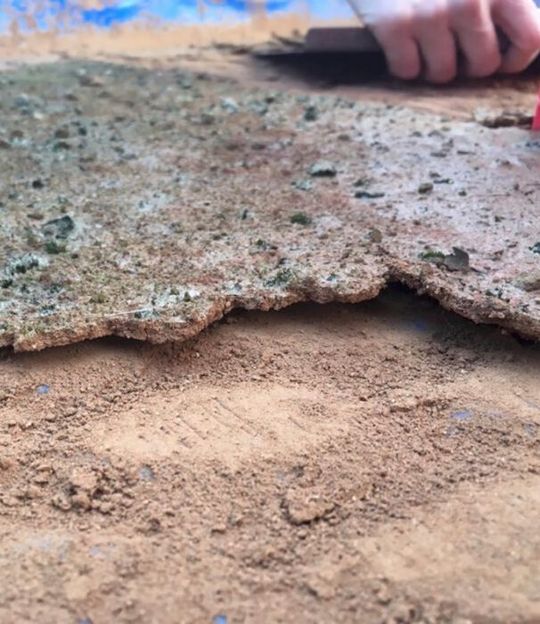
Biocrusts are complex ecosystems researchers have only recently begun to explore. Among their many housekeeping functions, they act to stabilize soil by binding soil particles together, minimizing the loss of topsoil caused by wind and water. They contribute to nutrient cycling by fixing atmospheric nitrogen, a process where nitrogen gas is converted into ammonia, making it available to plants. Cyanobacteria, which are present in biocrusts, are the primary organisms responsible for this process.
(Source: The Biodesign Institute at Arizona State University)
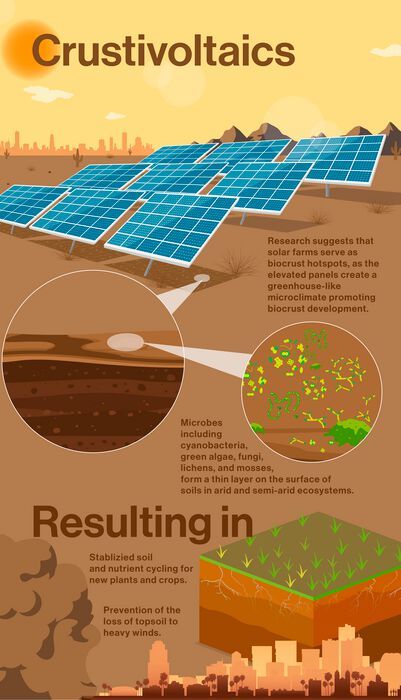
In the arid regions of the American Southwest, an unseen world lies beneath our feet. Biocrusts, or biological soil crusts, are communities of living organisms. These industrious microbes include cyanobacteria, green algae, fungi, lichens, and mosses, forming a thin layer on the surface of soils in arid and semi-arid ecosystems.
But human activities including agriculture, urbanization, and off-road vehicle use can lead to the degradation of biocrusts, which have long-term consequences for these fragile environments. Climate change is also placing stress on biocrusts, which struggle to adapt to sunlight and searing heat in arid landscapes like the Sonoran Desert.
Ferran Garcia-Pichel and his student at Arizona State University want to counteract this by using new and existing solar energy farms as nurseries for generating fresh biocrust. Safely shielded from the sun beneath arrays of solar panels, like beachgoers under an umbrella, the biocrusts are sheltered from excessive heat and can flourish and develop. Ultimately, the newly generated biocrusts can then be used to replenish arid lands where such soils have been damaged or destroyed.
In a proof-of-concept study, ASU researchers adapted a suburban solar farm in the lower Sonoran Desert as an experimental breeding ground for biocrust. During the three-year study, photovoltaic panels promoted biocrust formation, doubling biocrust biomass and tripling biocrust cover compared with open areas with similar soil characteristics.
When biocrusts were harvested, natural recovery was moderate, taking around 6-8 years to fully recuperate without intervention. However, when harvested areas were re-inoculated, the recovery was much faster, with biocrust cover reaching near-original levels within one year.
This technology can be a game changer for arid soil restoration.
Ferran Garcia-Pichel
The researchers emphasize that the use of similar, but larger, solar farms could provide a low-cost, low-impact, and high-capacity method to regenerate biocrusts and expand soil restoration approaches to regional scales. They have dubbed their pioneering approach “crustivoltaics.”
The study estimates that use of the three largest solar farms in Maricopa County, Arizona as biocrust nurseries could empower a small-scale enterprise to rejuvenate all idle agricultural lands within the county, spanning more than 70,000 hectares, in under five years. Among many environmental benefits, this restoration effort has the potential to significantly decrease airborne dust presently impacting the Phoenix Metropolitan region.
“This technology can be a game changer for arid soil restoration,” Garcia-Pichel says. “For the first time reaching regional scales at our fingertips, and we could not be more excited. To boot, crustivoltaics represents a win-win approach for conservation of arid lands and for the energy industry alike.”
Garcia-Pichel is a Regents’ Professor in the School of Life Science and the founding director of the Biodesign Center for Fundamental & Applied Microbiomics. The center amalgamates researchers that study assemblages of microbes (or microbiomes) acting in unison in various settings, from humans to animals and plants, to oceans and deserts. Garcia-Pichel’s lab has specialized in the study and applications of desert soil microbiomes.
The group’s findings appear in the current issue of the journal Nature Sustainability, in a publication co-lead by graduate student Ana “Meches” Heredia-Velásquez, and former graduate student Dr. Ana Giraldo-Silva, now a professor at the Public University of Navarre in Spain. A separate briefing of this contribution appears concurrently in Nature.
In a proof-of-concept study, ASU researchers adapted a suburban solar farm in the lower Sonoran Desert as an experimental breeding ground for biocrust. During the three-year study, photovoltaic panels promoted biocrust formation, doubling biocrust biomass and tripling biocrust cover compared with open areas with similar soil characteristics.
(Source: Shireen Dooling)
Living Matrix
Biocrusts are complex ecosystems researchers have only recently begun to explore. Among their many housekeeping functions, they act to stabilize soil by binding soil particles together, minimizing the loss of topsoil caused by wind and water. They contribute to nutrient cycling by fixing atmospheric nitrogen, a process where nitrogen gas is converted into ammonia, making it available to plants. Cyanobacteria, which are present in biocrusts, are the primary organisms responsible for this process.
Photosynthetic activities within biocrusts play a role in carbon storage by fixing atmospheric carbon dioxide. This process can help mitigate some of the effects of climate change by removing carbon dioxide from the atmosphere. Biocrusts also increase the soil's water-retaining capacity, allowing more water to infiltrate the soil and reducing runoff. This helps to improve water availability for plants and other organisms in arid ecosystems.
Date: 08.12.2025
Naturally, we always handle your personal data responsibly. Any personal data we receive from you is processed in accordance with applicable data protection legislation. For detailed information please see our privacy policy.
Consent to the use of data for promotional purposes
I hereby consent to Vogel Communications Group GmbH & Co. KG, Max-Planck-Str. 7-9, 97082 Würzburg including any affiliated companies according to §§ 15 et seq. AktG (hereafter: Vogel Communications Group) using my e-mail address to send editorial newsletters. A list of all affiliated companies can be found here
Newsletter content may include all products and services of any companies mentioned above, including for example specialist journals and books, events and fairs as well as event-related products and services, print and digital media offers and services such as additional (editorial) newsletters, raffles, lead campaigns, market research both online and offline, specialist webportals and e-learning offers. In case my personal telephone number has also been collected, it may be used for offers of aforementioned products, for services of the companies mentioned above, and market research purposes.
Additionally, my consent also includes the processing of my email address and telephone number for data matching for marketing purposes with select advertising partners such as LinkedIn, Google, and Meta. For this, Vogel Communications Group may transmit said data in hashed form to the advertising partners who then use said data to determine whether I am also a member of the mentioned advertising partner portals. Vogel Communications Group uses this feature for the purposes of re-targeting (up-selling, cross-selling, and customer loyalty), generating so-called look-alike audiences for acquisition of new customers, and as basis for exclusion for on-going advertising campaigns. Further information can be found in section “data matching for marketing purposes”.
In case I access protected data on Internet portals of Vogel Communications Group including any affiliated companies according to §§ 15 et seq. AktG, I need to provide further data in order to register for the access to such content. In return for this free access to editorial content, my data may be used in accordance with this consent for the purposes stated here. This does not apply to data matching for marketing purposes.
Right of revocation
I understand that I can revoke my consent at will. My revocation does not change the lawfulness of data processing that was conducted based on my consent leading up to my revocation. One option to declare my revocation is to use the contact form found at https://contact.vogel.de. In case I no longer wish to receive certain newsletters, I have subscribed to, I can also click on the unsubscribe link included at the end of a newsletter. Further information regarding my right of revocation and the implementation of it as well as the consequences of my revocation can be found in the data protection declaration, section editorial newsletter.
Finally, biocrusts support a diverse community of microorganisms that contribute to overall ecosystem biodiversity and resilience.
Drylands, which make up approximately 41 percent of the Earth's continental area, are experiencing severe degradation due to human activities and climate change. The communities of microorganisms on soil surfaces are vital to protect and fertilize these soils and are essential for dryland sustainability. However, current biocrust restoration methods involve high effort and low capacity, limiting their application to small areas. Existing methods have struggled to replenish more than a few hundred square meters of land.
Solar Solutions
The research suggests that solar farms serve as biocrust hotspots, as the elevated photovoltaic panels create a greenhouse-like microclimate promoting biocrust development. Although crustivoltaics is a slower and weather-dependent method compared to greenhouse-sized biocrust nurseries, it has many advantages. The technique requires fewer resources, minimal management, and no upfront investment. Indeed, the use of crustivoltaics is 10,000 times more cost-effective than current methods, according to the research findings.
The next steps will involve implementing crustivoltaics at regional scales through the cooperation of scientists, collaborative agencies, land users and managers. Use of the technique can provide incentives to solar farm operators, including reduced dust formation on solar panels and increased revenue from carbon credits.
The crustivoltaic approach has the potential to offer a dual-use solution for both solar power generation and biocrust restoration on a large scale, while also providing socioeconomic benefits. This method could play a significant role in the restoration and sustainability of dryland ecosystems.
References: Dual use of solar power plants as biocrust nurseries for large-scale arid soil restoration; Nature Sustainability; DOI:10.1038/s41893-023-01106-8




:quality(80)/p7i.vogel.de/wcms/fd/73/fd73fcb3ceda89d1419de1083fcab7b4/0130081520v2.jpeg "The fingers at the heart of this technology were inspired by the fin-ray effect — a design principle derived from the natural structure of fish fins. (Source: University of Texas at Austin )")
:quality(80)/p7i.vogel.de/wcms/fe/64/fe649767c802d53ac63ee2c2a40b7e0d/0130060830v2.jpeg "Sample tube with light-active substance (Source: Elvira Eberhardt / Ulm University)")
:quality(80)/p7i.vogel.de/wcms/db/e2/dbe2ae4e02f702b30153a882ef705089/0129978032v1.jpeg "Each of the isolated indium atoms (in gold color) can catalyse the synthesis of methanol (top right). (Source: Constance Ko/ ETH Zurich)")
:quality(80)/p7i.vogel.de/wcms/c1/e6/c1e6ac26eb18993236c100e7f01a78f2/0129937639v1.jpeg "Dogs evolved from highly social ancestors and have been shaped by thousands of years of interacting with humans. (Source: free licensed)")
:quality(80)/p7i.vogel.de/wcms/8f/b9/8fb98a958e4afe679865fbe52a473680/0129940982v2.jpeg "pH measurement in various nanoparticles using the Nine-Focus meter ensures precise stability and performance control. (Source: Mettler Toledo)")
:quality(80)/p7i.vogel.de/wcms/11/74/1174e5d4c8b07a64637dced8c9506b40/0129787561v2.jpeg "The Multicell Plus high-pressure reactor sets a new benchmark for operator safety, all-round accessibility and ease-of-use. (Source: Asynt)")
:quality(80)/p7i.vogel.de/wcms/ef/6e/ef6e96191183411973b77041fb6b1e16/0129785957v2.jpeg "Manufactured from high-quality crystal polystyrene - these new automation-ready plates are available in a choice of ANSI / SLAS standard (96-well and breakable 8-well strip) formats. (Source: Porvair Sciences)")
:quality(80)/p7i.vogel.de/wcms/ad/ca/adcaa20ef5ccaf7e3b325788b1e349c4/0129784872v2.jpeg "The high performance Degasi Flat Film in-line degasser. (Source: Biotech Fluidics)")
:quality(80)/p7i.vogel.de/wcms/2d/45/2d45aba62f5042baa00f7fd4fa629839/0130036533v2.jpeg "The population of Pune, India, is expected to reach 11 million by 2050. (Source: free licensed)")
:quality(80)/p7i.vogel.de/wcms/52/f8/52f8d5521fdab07ed0a865ec0d8919fd/0130009438v2.jpeg "Drylands support around half of global livestock production and sustain the livelihoods of close to a billion people, while also underpinning soil stability and carbon storage. (Source: Kaust )")
:quality(80)/p7i.vogel.de/wcms/fe/49/fe494ada322615b6e6f6ff0f5bb7c5cf/0129926008v2.jpeg "A mandrill eating fruit. (Source: University of Bristol )")
:quality(80)/p7i.vogel.de/wcms/af/4e/af4ea968647ee9cae82b39800c611819/0129865630v2.jpeg "Map of a simulated risk of water stress in 2050 where hydrogen is used in transport and industry. Baseline risk (regardless of hydrogen use) is represented by the background color in each area. Dashed areas show water use exceeding available resources due to hydrogen production. Blue dots show areas where the risk of water stress increases by more than 50 percent in the simulation. (Source: Chalmers University of Technology / Joel Löfving)")
:quality(80)/p7i.vogel.de/wcms/6f/ba/6fba92196d0cbb1467334f8a2ecc520a/0130203021v2.jpeg "Low to moderate wine consumption shows lower risk compared with spirits, beer and cider (Source: free licensed)")
:quality(80)/p7i.vogel.de/wcms/a9/37/a9376f1d9a893570023d9aa97c085bc5/0129927485v2.jpeg "Examples of foods high in PUFAs include fatty fish and soybeans, while MUFAs include olive oil and avocadoes. (Source: free licensed)")
:quality(80)/p7i.vogel.de/wcms/ea/88/ea88ef8810e21cdd9bb852c70f385ba1/0129797385v2.jpeg "A team of NUS food scientists consisting of Assoc Prof Liu Shao Quan (centre), Dr Lu Yuyun (right) and Ms Geng Chenhan (left) pioneered a co-fermentation method that improves both the nutrient and flavor profile of kombu. (Source: NUS)")
:quality(80)/p7i.vogel.de/wcms/84/2c/842c7c1678ceeec7147ea3a36e238e75/0129356324v2.jpeg "Kaust and Nadec have signed a MOU that establishes a framework for long-term cooperation across agricultural research, technology development, and professional training. (Source: Kaust )")
:quality(80)/p7i.vogel.de/wcms/ed/c0/edc0c1a86229b11efd17c5e3f94d14da/0130081211v2.jpeg "A new study finds that virtual visits did not make it easier for psychiatrists, psychologists and therapists to reach significantly more people in areas where access to care has long been limited. (Source: Pixabay)")
:quality(80)/p7i.vogel.de/wcms/9c/52/9c52318bc94be17e6662dfceffa4a0c0/0130060546v2.jpeg "Domestic cat ‘Lanni’ from co-author of the study, Latasha Ludwig, Assistant Clinical Professor at Cornell University, USA. (Source: © Latasha Ludwig)")
:quality(80)/p7i.vogel.de/wcms/4b/f4/4bf4cc9e28e65e11a27dd41da2d1a7f5/0130038185v2.jpeg "The biomarker p-tau217 could help identify women at elevated dementia risk decades before clinical symptoms begin. (Source: free licensed)")
:quality(80)/p7i.vogel.de/wcms/4f/29/4f292f402b157e2ab8c57e9f2a3e3199/0130036120v2.jpeg "The chemistry is powered by an LED lamp that triggers a self-sustaining chain reaction, forging new carbon–carbon bonds under mild conditions without toxic or expensive chemicals. (Source: Nordin Ćatić/ St John’s College, Cambridge)")
:quality(80)/images.vogel.de/vogelonline/bdb/1710600/1710675/original.jpg "Discover how to set yourself up for success when performing balance-based density determination of solids such as jewelry and precious metals. (Mettler Toledo)")
:quality(80)/images.vogel.de/vogelonline/bdb/1682500/1682579/original.jpg "The new XPR Analytical balance redesigned to meet the needs of laboratory technicians of working fast and lean. (Mettler Toledo)")
:quality(80)/images.vogel.de/vogelonline/bdb/1677000/1677080/original.jpg "Enhance your weighing accuracy, comfort and productivity with the redesigned XPR Analytical balance. (Mettler Toledo)")
:quality(80)/p7i.vogel.de/wcms/52/f8/52f8d5521fdab07ed0a865ec0d8919fd/0130009438v2.jpeg "Drylands support around half of global livestock production and sustain the livelihoods of close to a billion people, while also underpinning soil stability and carbon storage. (Source: Kaust )")
:quality(80)/p7i.vogel.de/wcms/37/77/37779bf078072a8d5d3533eaa0fe3c48/0127289681v1.jpeg "Biochar-driven rhizoremediation of soil contaminated with organic pollutants: engineered solutions, microbiome enrichment, and bioeconomic benefits for ecosystem restoration. (Source: Nandita Das & Piyush Pandey)")