The first genetic data from Palaeolithic human individuals in the UK — the oldest human DNA obtained from the British Isles so far — indicates the presence of two distinct groups that migrated to Britain at the end of the last ice age, according to new research.
Ancient DNA reveals that recolonisation of Britain consisted of at least two groups with distinct origins and cultures.
(Source: Trustees of the Natural History Museum)
A new study by UCL Institute of Archaeology, the Natural History Museum and the Francis Crick Institute researchers reveals for the first time that the recolonisation of Britain consisted of at least two groups with distinct origins and cultures.
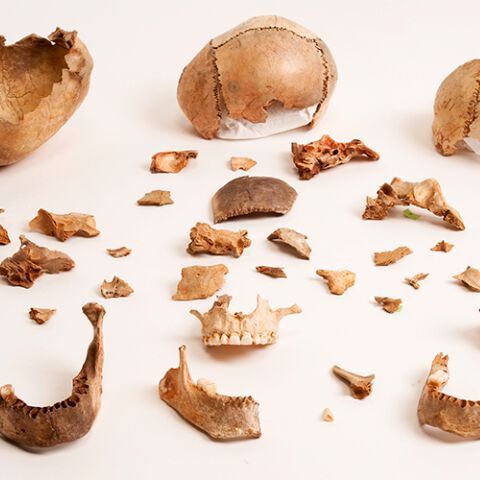
The study team explored DNA evidence from an individual from Gough’s Cave, Somerset, and an individual from Kendrick’s Cave, North Wales, who both lived more than 13,500 years ago. Very few skeletons of this age exist in Britain, with around a dozen found across six sites in total. The study, which involved radiocarbon dating and analysis as well as DNA extraction and sequencing, shows that it is possible to obtain useful genetic information from some of the oldest human skeletal material in the country.
The authors say that these genome sequences now represent the earliest chapter of the genetic history of Britain, but ancient DNA and proteins promise to take us back even further into human history.
The researchers found that the DNA from the individual from Gough’s Cave, who died about 15,000 years ago, indicates that her ancestors were part of an initial migration into northwest Europe around 16,000 years ago. However, the individual from Kendrick’s Cave is from a later period, around 13,500 years ago, with his ancestry from a western hunter-gatherer group. This group’s ancestral origins are thought to be from the near East, migrating to Britain around 14,000 years ago.
Study co-author Dr Mateja Hajdinjak (Francis Crick Institute) said: “Finding the two ancestries so close in time in Britain, only a millennium or so apart, is adding to the emerging picture of Palaeolithic Europe, which is one of a changing and dynamic population.”
The authors note that these migrations occurred after the last ice age when approximately two-thirds of Britain was covered by glaciers. As the climate warmed and the glaciers melted, drastic ecological and environmental changes took place and humans began to move back into northern Europe.
Study co-author Dr Sophy Charlton, who undertook the study whilst at the Natural History Museum, said: “The period we were interested in, from 20-10,000 years ago, is part of the Palaeolithic — the Old Stone Age. This is an important time period for the environment in Britain, as there would have been significant climate warming, increases in the amount of forest, and changes in the type of animals available to hunt.”
As well as genetically, the two groups were found to be culturally distinct, with differences in what they ate and how they buried their dead.
Study co-author Dr Rhiannon Stevens (UCL Institute of Archaeology) said: “Chemical analyses of the bones showed that the individuals from Kendrick’s Cave ate a lot of marine and freshwater foods, including large marine mammals. “Humans at Gough’s Cave, however, showed no evidence of eating marine and freshwater foods, and primarily ate terrestrial herbivores such as red deer, bovids (such as wild cattle called aurochs) and horses.”
The researchers discovered that the mortuary practices of the two groups also differed. Although there were animal bones found at Kendrick’s Cave, these included portable art items, such as a decorated horse jawbone. No animal bones were found that showed evidence of being eaten by humans, and the scientists say that this indicates the cave was used as a burial site by its occupiers.
In contrast, animal and human bones found in Gough’s Cave showed significant human modification, including human skulls modified into ‘skull-cups’, which the researchers believe to be evidence for ritualistic cannibalism. Individuals from this earlier population seem to be the same people who created the Magdalenian stone tools, a culture known also for iconic cave art and bone artefacts.
Date: 08.12.2025
Naturally, we always handle your personal data responsibly. Any personal data we receive from you is processed in accordance with applicable data protection legislation. For detailed information please see our privacy policy.
Consent to the use of data for promotional purposes
I hereby consent to Vogel Communications Group GmbH & Co. KG, Max-Planck-Str. 7-9, 97082 Würzburg including any affiliated companies according to §§ 15 et seq. AktG (hereafter: Vogel Communications Group) using my e-mail address to send editorial newsletters. A list of all affiliated companies can be found here
Newsletter content may include all products and services of any companies mentioned above, including for example specialist journals and books, events and fairs as well as event-related products and services, print and digital media offers and services such as additional (editorial) newsletters, raffles, lead campaigns, market research both online and offline, specialist webportals and e-learning offers. In case my personal telephone number has also been collected, it may be used for offers of aforementioned products, for services of the companies mentioned above, and market research purposes.
Additionally, my consent also includes the processing of my email address and telephone number for data matching for marketing purposes with select advertising partners such as LinkedIn, Google, and Meta. For this, Vogel Communications Group may transmit said data in hashed form to the advertising partners who then use said data to determine whether I am also a member of the mentioned advertising partner portals. Vogel Communications Group uses this feature for the purposes of re-targeting (up-selling, cross-selling, and customer loyalty), generating so-called look-alike audiences for acquisition of new customers, and as basis for exclusion for on-going advertising campaigns. Further information can be found in section “data matching for marketing purposes”.
In case I access protected data on Internet portals of Vogel Communications Group including any affiliated companies according to §§ 15 et seq. AktG, I need to provide further data in order to register for the access to such content. In return for this free access to editorial content, my data may be used in accordance with this consent for the purposes stated here. This does not apply to data matching for marketing purposes.
Right of revocation
I understand that I can revoke my consent at will. My revocation does not change the lawfulness of data processing that was conducted based on my consent leading up to my revocation. One option to declare my revocation is to use the contact form found at https://contact.vogel.de. In case I no longer wish to receive certain newsletters, I have subscribed to, I can also click on the unsubscribe link included at the end of a newsletter. Further information regarding my right of revocation and the implementation of it as well as the consequences of my revocation can be found in the data protection declaration, section editorial newsletter.
Gough’s Cave is also the site where Britain’s famous Cheddar Man was discovered in 1903, dated to 10,564 to 9,915 years BP. In this study, Cheddar Man was found to have a mixture of ancestries, mostly (85 percent) western hunter-gatherer and some (15 percent) of the older type from the initial migration.
Co-author Dr Selina Brace (Natural History Museum) said: “We really wanted to find out more about who these early populations in Britain might have been. “We knew from our previous work, including the study of Cheddar Man, that western hunter-gatherers were in Britain by around 10,500 years BP, but we didn’t know when they first arrived in Britain, and whether this was the only population that was present.”




:quality(80)/p7i.vogel.de/wcms/62/32/62327aaae1415beeed47db6201e79661/0133375912v2.jpeg "A cotton trailer outfitted with benches and a sunshade offers farmworkers a reprieve from the sun as they take a break from picking cantaloupe melons in Firebaugh, Calif.
(Source: Joe Proudman/ Regents of the University of California)")
:quality(80)/p7i.vogel.de/wcms/e6/c8/e6c8bd554776ee1ad2f1f0723fb243a7/0133369387v1.jpeg "Roman road (Source: Queen Mary University of London)")
:quality(80)/p7i.vogel.de/wcms/51/68/51687ac4cc19f2757c138498b877de57/0133167039v2.jpeg "CMFs are foams that consist of hollow spheres – made of materials such as stainless steel, nickel, or other metals and alloys – embedded in a metallic matrix. The resulting material is both lightweight and remarkably strong at absorbing compressive forces. (Source: Jie Sun/ NC State University)")
:quality(80)/p7i.vogel.de/wcms/cd/c0/cdc09efd1e5b3b8f83224e7729d66c10/0133105276v2.jpeg "From the data presented in this report, the authors show how TF3-MALS-RI is uniquely able to separate large polyacrylate molecules and provide precise molecular weight and Rg values. (Source: Postnova Analytics)")
:quality(80)/p7i.vogel.de/wcms/86/01/86014d3d2a28cefc852f65c8d68317e4/0133104231v2.jpeg "Single-handed tube reading using a Handheld 2. (Source: Azenta Life Sciences)")
:quality(80)/p7i.vogel.de/wcms/0b/0f/0b0f8ed042dfc91f32582e10d54c2c7e/0133087444v2.jpeg "Offering advanced automation to increase your throughput, the Intellixcap provides secure sealing – eliminating the need for manual intervention, while preserving vital sample integrity. (Source: Azenta Life Sciences)")
:quality(80)/p7i.vogel.de/wcms/13/d3/13d35105f74a1c2e22b9c7a270e8e9b3/0132611155v2.jpeg "Circulating cell free DNA. (Source: Amsbio)")
:quality(80)/p7i.vogel.de/wcms/bc/ed/bced6850297a04dbea471a66cb6bb6fe/0132611405v2.jpeg "The latest addition to the range is a peristaltic tubing stop adapter that eliminates the need for fixed stoppers and allows custom cut lengths of peristaltic tubing to be installed on any pump head size. (Source: Biotech Fluidics )")
:quality(80)/p7i.vogel.de/wcms/8d/5c/8d5c6c7f897f91d6784825eee20b5584/0133321225v1.jpeg "Empa researcher Christoph Hüglin collects samples of particles that are washed out of the air by rain and snow or settle due to gravity. (Source: Empa)")
:quality(80)/p7i.vogel.de/wcms/a1/af/a1afbc7c8a067bbe94749ec680b4bafd/0133163762v2.jpeg "The study found in murkier water, fish took longer to move towards the food than those in clear water, but individuals in larger groups responded more quickly overall. (Source: Christos Ioannou)")
:quality(80)/p7i.vogel.de/wcms/32/80/3280aa3d44708962943c96fe2d466744/0133088560v2.jpeg "A bumble bee in flight at the University of Bristol Botanic Garden. (Source: Phil Savoie)")
:quality(80)/p7i.vogel.de/wcms/7b/e5/7be5c735140cbe28f3af0ec3d88274b9/0133045403v2.jpeg "After being buried in the ground for two months and broken down by soil organisms, a new pair of cotton underwear (left) shows clear signs of decomposition (right). (Source: Nicolas Zonvi)")
:quality(80)/p7i.vogel.de/wcms/ee/ad/eead38ab1e3c36f262bd889dfc8c5039/0133409909v2.jpeg "Eating a diet rich in wholegrain food is likely to prevent heart disease by reducing body weight, blood pressure and the levels of cholesterol and glucose in the blood. (Source: Unsplash)")
:quality(80)/p7i.vogel.de/wcms/ef/68/ef68375729607984e5bb0c143afdae70/0133375119v2.jpeg "Printed Rice-Lentil 3D structures
(Source: SUTD)")
:quality(80)/p7i.vogel.de/wcms/bf/d0/bfd087349a85956a7aefad57ac1204c7/0133241961v2.jpeg "The Thermo Scientific Suretect Beverage Spoilage Multiplex PCR Assay provides a fast, broad-range molecular solution for detecting key spoilage microorganisms that threaten beverage quality. (Source: © OlegDoroshin - stock.adobe.com)")
:quality(80)/p7i.vogel.de/wcms/d4/61/d461ce0bd5743897993c6475f69e7ad6/0133067478v2.jpeg "In Harris County, 50 % of households with children reported food insecurity, compared with 33 % of households without children. (Source: Rice University)")
:quality(80)/p7i.vogel.de/wcms/f5/d3/f5d3af7b7479d0573bec5c1fb9f1fd7b/0133409927v2.jpeg "The Match study looked at over 500 cancer survivors with varying types and stages of cancer and found that patients experienced less pain, fatigue, and sleep problems after participating in the interventions. (Source: Unsplash)")
:quality(80)/p7i.vogel.de/wcms/22/49/224964dd6850b62cccdbc4bde2d34693/0133372964v1.jpeg "Brain activity recorded during a video game helped researchers predict whether participants would take or avoid a risk half a second before they acted. (Source: free licensed)")
:quality(80)/p7i.vogel.de/wcms/48/a7/48a761934161543f70fef2403b44d714/0133372328v2.jpeg "The link between pollution and coughing persisted in the data, even when pollution levels were below the WHO’s recommended safe daily exposure limit. (Source: free licensed)")
:quality(80)/images.vogel.de/vogelonline/bdb/1710600/1710675/original.jpg "Discover how to set yourself up for success when performing balance-based density determination of solids such as jewelry and precious metals. (Mettler Toledo)")
:quality(80)/images.vogel.de/vogelonline/bdb/1682500/1682579/original.jpg "The new XPR Analytical balance redesigned to meet the needs of laboratory technicians of working fast and lean. (Mettler Toledo)")
:quality(80)/images.vogel.de/vogelonline/bdb/1677000/1677080/original.jpg "Enhance your weighing accuracy, comfort and productivity with the redesigned XPR Analytical balance. (Mettler Toledo)")
:fill(fff,0)/images.vogel.de/vogelonline/companyimg/107800/107832/65.jpg "logoDueperthal.jpg ()")
:fill(fff,0)/p7i.vogel.de/companies/69/b7/69b7f63f311d9/logo-bimos-tif--2-.jpeg "logo-bimos-tif--2- (https://www.bimos.com/de-de/)")
:quality(80)/p7i.vogel.de/wcms/6f/cd/6fcd456c6031a20b33bb7db5c1e76984/0128355923v2.jpeg "The Matjes River Rockshelter in the Western Cape, South Africa, 540 km east of Cape Town. Eight people who lived here between 10,200 and 3000 years ago contributed DNA to this study. (Source: Nicholas Wiltshire)")
:quality(80)/p7i.vogel.de/wcms/ed/ff/edff58efa9930f672f2e50a63e65562f/0132477775v1.jpeg "Contemporary languages and endangerment status. Made with a Natural Earth base map using data from Glottolog 5.3 and information adapted from Glottoscope. (Source: Claire Bowern)")