With an aim to make the UK a world leader in artificial intelligence, the country’s fastest and most powerful supercomputer is now officially online. The supercomputer is claimed to be the second greenest in the world.
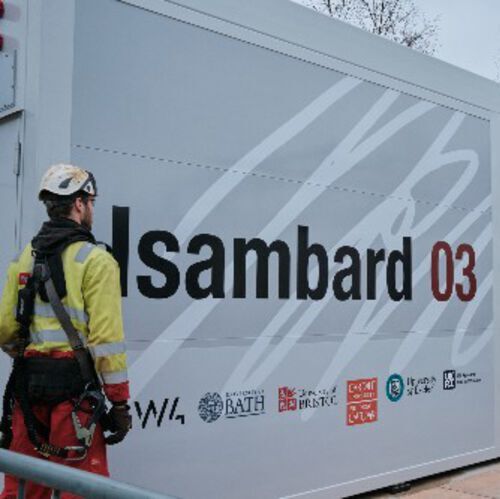
Isambard 3 Modular Data Centre where phase one of Isambard-AI is temporarily housed.
(Source: Christy Nunn)
Bristol/UK – As it goes live, the multimillion Isambard-AI has appeared in the global power rankings for the fastest and is now officially the most sustainable supercomputer in the UK. It is second greenest in the world as it shoots into the top two of the Green500. Scientists will soon be able to use the world-class equipment for research that has not been possible in the UK until now, with organizations such as the UK’s AI Safety Institute expected to be amongst the first to harness its capabilities for AI research from this month.
The new Bristol Isambard-AI facility will be used by a wide range of organizations from across the UK to utilize the power of AI, which is already propelling emerging technologies such as training large language models (LLMs), healthcare and robotics. The supercomputer will also play an essential role in critical areas such as AI safety, accelerating automated drug discovery and climate research.
With the latest technologies, including HPE Slingshot 11 interconnect and direct liquid cooling solutions with highly-integrated, heterogeneous CPU-GPU systems from Nvidia, it is one of the most efficient supercomputers that has ever been built.
Bristol’s Isambard-AI phase one has also appeared at position 128 in the latest edition of the Top500 list of high-performance computing (HPC) systems on Earth, as published at the ISC High Performance 2024 event in Hamburg, Germany.
University of Bristol’s Vice-Chancellor and President Professor Evelyn Welch said: “With Isambard-AI phase one turned on, and primed for action later this month, we welcome this huge step forward towards providing UK researchers with world-class AI and HPC resources, until now accessible by few. “This will equip the UK with the means to drive the next wave of scientific breakthroughs and positions Bristol as a vital cog in global technological discovery that will improve people’s lives.”
Professor Judith Squires, Provost and Deputy Vice Chancellor, who joined a Government delegation to the Isambard-AI site, said: “The speed with which this project is being delivered is testament to the expertise and ambition of our hard-working HPC and AI teams here at the University. “The arrival of Isambard-AI phase one, builds on Bristol’s reputation in AI research and training; home to two Centres for Doctoral Training in AI, as well as two new national AI research hubs, our state-of-the-art capabilities will enable us to push the boundaries of scientific research to make breakthroughs that will benefit everyone."
Professor Simon McIntosh-Smith, Director of the Bristol Centre for Supercomputing at the University of Bristol, explained: “Assuming there are eight billion people on earth, and everyone performed one calculation per second, it would take 2.3 years for all eight billion people, working 24/7, 365-days a year, to do what Isambard-AI phase one could do in one second.
“That’s a pretty astounding performance, even though we can pack it into a relatively small space.
“Isambard-AI phase 1 signifies the start of the Isambard-AI service. When the remaining 5,280 GPUs arrive at the University’s National Composites Centre (NCC) later in the summer, it will increase the performance by a factor of 32.”
Following a 225 million pound investment from the UK Government last autumn, with thanks to HPE modular data center technology; the Isambard-AI phase one with HPE Cray EX2500 supercomputer and 168 Nvidia GH200 Grace Hopper Superchips has been delivered in record time, signalling the speed at which AI is advancing and recognizing the value of having a national AI Research Resource in place.
Minister for AI Viscount Camrose said: “With the launch of the first stage of University of Bristol’s supercomputer Isambard-AI, we're witnessing a groundbreaking moment for UK science, innovation, and technology. This world-class equipment will revolutionize research possibilities here in the UK, with our world-first AI Safety Institute among the organizations who are set to benefit by harnessing one of the most powerful computer systems on the planet to drive forward their vital research.
Date: 08.12.2025
Naturally, we always handle your personal data responsibly. Any personal data we receive from you is processed in accordance with applicable data protection legislation. For detailed information please see our privacy policy.
Consent to the use of data for promotional purposes
I hereby consent to Vogel Communications Group GmbH & Co. KG, Max-Planck-Str. 7-9, 97082 Würzburg including any affiliated companies according to §§ 15 et seq. AktG (hereafter: Vogel Communications Group) using my e-mail address to send editorial newsletters. A list of all affiliated companies can be found here
Newsletter content may include all products and services of any companies mentioned above, including for example specialist journals and books, events and fairs as well as event-related products and services, print and digital media offers and services such as additional (editorial) newsletters, raffles, lead campaigns, market research both online and offline, specialist webportals and e-learning offers. In case my personal telephone number has also been collected, it may be used for offers of aforementioned products, for services of the companies mentioned above, and market research purposes.
Additionally, my consent also includes the processing of my email address and telephone number for data matching for marketing purposes with select advertising partners such as LinkedIn, Google, and Meta. For this, Vogel Communications Group may transmit said data in hashed form to the advertising partners who then use said data to determine whether I am also a member of the mentioned advertising partner portals. Vogel Communications Group uses this feature for the purposes of re-targeting (up-selling, cross-selling, and customer loyalty), generating so-called look-alike audiences for acquisition of new customers, and as basis for exclusion for on-going advertising campaigns. Further information can be found in section “data matching for marketing purposes”.
In case I access protected data on Internet portals of Vogel Communications Group including any affiliated companies according to §§ 15 et seq. AktG, I need to provide further data in order to register for the access to such content. In return for this free access to editorial content, my data may be used in accordance with this consent for the purposes stated here. This does not apply to data matching for marketing purposes.
Right of revocation
I understand that I can revoke my consent at will. My revocation does not change the lawfulness of data processing that was conducted based on my consent leading up to my revocation. One option to declare my revocation is to use the contact form found at https://contact.vogel.de. In case I no longer wish to receive certain newsletters, I have subscribed to, I can also click on the unsubscribe link included at the end of a newsletter. Further information regarding my right of revocation and the implementation of it as well as the consequences of my revocation can be found in the data protection declaration, section editorial newsletter.
“Not only does Isambard-AI rank among the world's fastest supercomputers, but it also sets the standard for eco-conscious computing, leading the charge in efficiency and sustainability. From AI safety to healthcare and climate research, its capabilities are unparalleled, marking the UK out as a global leader in AI and responsible innovation.”
“It is exciting to see Isambard-AI entering the first stage of its journey to deliver Europe's largest AI system for open science and propel the UK as a global leader in AI," said Matt Harris, managing director for UK, Ireland, Middle East and Africa at HPE. "With AI progressing at rapid pace, we are proud to have delivered the system in a record time, with just 3 months between concept design and the system going live. This unique supercomputer is the centrepiece of the UK Government's AI Research Resource and will enable organizations like the AI Safety Institute to train generative AI models at scale with research outcomes expected as soon as May this year."
Further information
Isambard-AI phase one’s performance is around 7.4 PFLOP/s on the Top500 – meaning the 168 GPUs can perform 7.4x10^15 operations per second, while for AI the performance is even more impressive, at 647 PFLOP/s of 8-bit floating point (647x10^15).
The University of Bristol is one of the top universities in the UK for AI research and scientific computing. It already plays host to cutting-edge computing technology, with the Isambard 3 supercomputer due to be installed later this summer to support a broad range of scientific research.
The University is also home to two Centres for Doctoral Training in AI: the UKRI Centre for Doctoral Training in Interactive Artificial Intelligence and The UKRI Centre for Doctoral Training In Practice-Oriented Artificial Intelligence; as well as two new national AI research hubs: The AI for Collective Intelligence Hub and The Mathematical and Computational Foundations of AI - Information theory for distributed AI Hub.
The Isambard-AI project is being led by Bristol experts Professor McIntosh-Smith and Dr Sadaf Alam with their team at the Bristol Centre for Supercomputing (Brics).
The Top500 list, published twice yearly at ISC and SC, provides the most accurate, reliable and historically consistent ranking of general-purpose HPC systems in common use for high-end scientific computing applications.




:quality(80)/p7i.vogel.de/wcms/aa/39/aa398d3e6667bdb43ad57abf38dc394c/0129347450v2.jpeg "An illustration shows a strand of engineered DNA passing through a nanoscale sensor, where its physical structure can be decoded as digital information. DNA nanostructures could one day serve as ultra-dense carriers of digital information and advance the field of data encryption. (Source: Jason Drees/ ASU)")
:quality(80)/p7i.vogel.de/wcms/06/a1/06a11f1d752afb35854aa9e1afb62e98/0129209625v2.jpeg "“Unsinkable\" metal tube made from chemically-etched aluminum floats in distilled water at the lab of University of Rochester professor Chunlei Guo. (Source: J. Adam Fenster / University of Rochester)")
:quality(80)/p7i.vogel.de/wcms/6d/df/6ddf023361ec7f8fbfb6c56521577960/0129056554v2.jpeg "The evolution of carburization (depicted by the spheres) under kinetic control (illustrated by the surface contours). The molecular beams represent gas evolution under synthesis conditions while the fiery sphere highlights the formation of the pure tungsten semi-carbide phase with additional molecular beams at the top to illustrate its catalytic performance. (Source: Sinhara M. H. D. Perera)")
:quality(80)/p7i.vogel.de/wcms/26/3d/263d97f8f2797267ecf2781b56882758/0129056451v1.jpeg "A study by the Complexity Science Hub finds that AI systems are already involved in nearly one-third of newly written software code, with rapid adoption in the United States and Europe and measurable productivity gains mainly for experienced developers. (Source: free licensed)")
:quality(80)/p7i.vogel.de/wcms/21/03/21030cc2541c455da0769decca8d1f82/0129146048v2.jpeg "Vyon porous plastics from Porvair Sciences are the perfect material for filtration applications in the healthcare and medical device market. (Source: Porvair Sciences)")
:quality(80)/p7i.vogel.de/wcms/bd/aa/bdaae5b9d381e2471ab37f479ad43d79/0129143884v2.jpeg "The Solvent Line Monitor from Testa Analytical is a true plug-and-play addition to any HPLC system designed to detect when one or more of its pump solvent reservoirs are empty and automatically shut-off the system. (Source: Testa Analytical)")
:quality(80)/p7i.vogel.de/wcms/8f/66/8f66b8acbb3037ca8e6b320bcad1c817/0129118043v2.jpeg "The Plasmaquant 9200 series is ideal for applications in research, trace analysis and quality control. (Source: Analytik Jena )")
:quality(80)/p7i.vogel.de/wcms/66/82/66825163ab842baded640db1a484e729/0129117548v2.jpeg "Biotech Fluidics has announced the Smartsaver solvent recycling unit which is designed to recover up to 90 % of your mobile phase by redirection of the pure solvent to the solvent reservoir during isocratic HPLC. (Source: Biotech Fluidics )")
:quality(80)/p7i.vogel.de/wcms/c8/ad/c8ada88a48bc380a87b17fb820ca4721/0129504248v2.jpeg "A young star surrounded by a disk of gas and dust. New planets can form from this material. Whether they have the chemical conditions necessary for life depends on the correct oxygen content during core formation. (Source: Nasa-JPL)")
:quality(80)/p7i.vogel.de/wcms/1a/4f/1a4fe7f8b5541716ba908251738beca1/0129349759v2.jpeg "Krict’s Syngas-to-Sustainable Aviation Fuel (SAF) Conversion Facility (Source: Korea Research Institute of Chemical Technology (Krict))")
:quality(80)/p7i.vogel.de/wcms/d4/29/d429a973c6f14ced3d2eb44931669a78/0129348927v1.jpeg "Cage-like ulva biochar confined synthesis of Fe₃O₄/ZnO heterojunction nanoparticles for synergistic adsorption and photocatalytic degradation of PFOA
(Source: Hua Jing et. al.)")
:quality(80)/p7i.vogel.de/wcms/86/90/8690b8154a552da13b37f289349b1db4/0129283446v2.jpeg "Lina Pérez-Ángel holds two sediment samples whose ages are separated by about a million years. (Source: Ellen Jorgensen)")
:quality(80)/p7i.vogel.de/wcms/84/2c/842c7c1678ceeec7147ea3a36e238e75/0129356324v2.jpeg "Kaust and Nadec have signed a MOU that establishes a framework for long-term cooperation across agricultural research, technology development, and professional training. (Source: Kaust )")
:quality(80)/p7i.vogel.de/wcms/d1/3c/d13c2ad34af600dbd360c0bb0990b922/0129045715v2.jpeg "Replacing animal products with plant-based foods helps reduce the risk of heart disease and type 2 diabetes, finds a new review by the Physicians Committee for Responsible Medicine. (Source: Pixabay)")
:quality(80)/p7i.vogel.de/wcms/e1/b3/e1b3e26d03101ba93b76b304da150c9a/0129025388v2.jpeg "The research reanalyzed data from a seminal clinical trial, led by US National Institutes of Health veteran Dr Kevin Hall, which first exposed how eating exclusively UPFs results in excessive calorie consumption and weight gain. (Source: Pixabay)")
:quality(80)/p7i.vogel.de/wcms/75/db/75db8afe45607bee750df705e22b60e9/0128938816v1.jpeg "A new academic review suggests that bamboo shoots could offer significant health benefits, including improved blood sugar control, gut health and antioxidant activity. (Source: free licensed)")
:quality(80)/p7i.vogel.de/wcms/4f/b3/4fb3b146c4aedd40397a148c8322867f/0129504680v1.jpeg "Aerobic exercise, such as running, swimming, and dancing, may be most effective for relieving the symptoms of depression and anxiety. (Source: free licensed)")
:quality(80)/p7i.vogel.de/wcms/18/e6/18e6f3c86e5006f24237775af2a6124b/0129504632v1.jpeg "The Listeria lifecycle after it infects a mammalian host. Counterclockwise from upper left, the bacteria are quickly ingested by an immune system cell called a macrophage, where they end up in an organ called the phagosome for digestion. But they escape the phagosome and enlist a protein called actin to build a needle-like protrusion and push it through the cell wall into a neighboring cell, starting the cycle over again. The Listeria strain used for cancer therapy is unable to co-opt actin and thus cannot infect other cells to cause illness. (Source: American Society for Cell Biology)")
:quality(80)/p7i.vogel.de/wcms/bc/49/bc49ddee3b9194ee0589427d13610f11/0129504608v1.jpeg "The figure depicts associations between genetic variants and 921 different bacterial species in the Swedish cohorts (n = 16,017). Each point represents a genetic variant, and the higher the point, the stronger the association. Genetic regions that have not previously been identified in similar genetic studies are shown in purple. (Source: Tove Fall/ Uppsala University)")
:quality(80)/p7i.vogel.de/wcms/45/47/4547a006853506f31157fb435ce1449f/0129504589v1.jpeg "Elephant trunk whiskers shine (Source: MPI-IS/A. Posada)")
:quality(80)/images.vogel.de/vogelonline/bdb/1710600/1710675/original.jpg "Discover how to set yourself up for success when performing balance-based density determination of solids such as jewelry and precious metals. (Mettler Toledo)")
:quality(80)/images.vogel.de/vogelonline/bdb/1682500/1682579/original.jpg "The new XPR Analytical balance redesigned to meet the needs of laboratory technicians of working fast and lean. (Mettler Toledo)")
:quality(80)/images.vogel.de/vogelonline/bdb/1677000/1677080/original.jpg "Enhance your weighing accuracy, comfort and productivity with the redesigned XPR Analytical balance. (Mettler Toledo)")
:quality(80)/p7i.vogel.de/wcms/11/cc/11cc8f2a016d508485c68f2928ca9f98/0128070800v2.jpeg "Based on the direct liquid-cooled HPE Cray EX system, featuring 2,800 Nvidia GH200 Grace Hopper Superchips, Shaheen III delivers more than three times the processing power of the CPU-based system that ranked among the world’s fastest at the time of its launch in 2023. (Source: Kaust )")
:quality(80)/p7i.vogel.de/wcms/3a/6f/3a6fd10e8169369e6ebf06609476fc08/0128229949v2.jpeg "Merck has collaborated with Lenovo Group and Equinix to successfully launch a state-of-the-art high-performance computer in Munich, Germany. (Source: Merck)")